SUBSCRIBE TO OUR FREE NEWSLETTER
Daily news & progressive opinion—funded by the people, not the corporations—delivered straight to your inbox.
5
#000000
#FFFFFF
To donate by check, phone, or other method, see our More Ways to Give page.
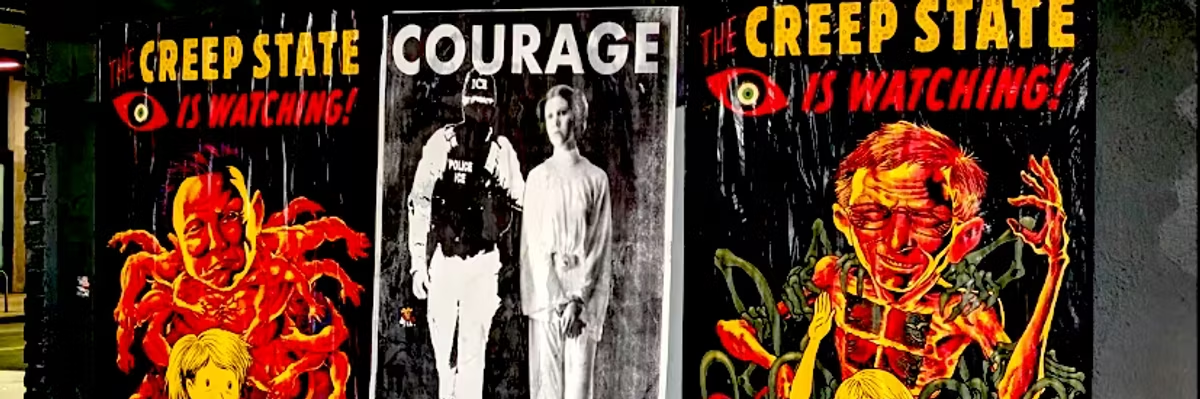
On their way to attend the Met Gala on Monday night, guests might have spotted a different image of Amazon founder Jeff Bezos than the one he tried to project by chairing the annual fundraiser: a poster featuring his bulbous head, looming over them out of the darkness, attached to a muscular spider-shaped body. Above it, a mysterious message: “The Creep State is watching.”
What does it mean?
The Creep State is an anonymous guerilla art and protest project that debuted in Austin, Texas during South by Southwest earlier this year. It is designed to draw people’s attention to the threat posed by Big Tech billionaires and their increasing influence over both the US government and the daily lives of everyone who interacts with their products.
“These individuals are a danger to all of us,” a DC-based organizer said.
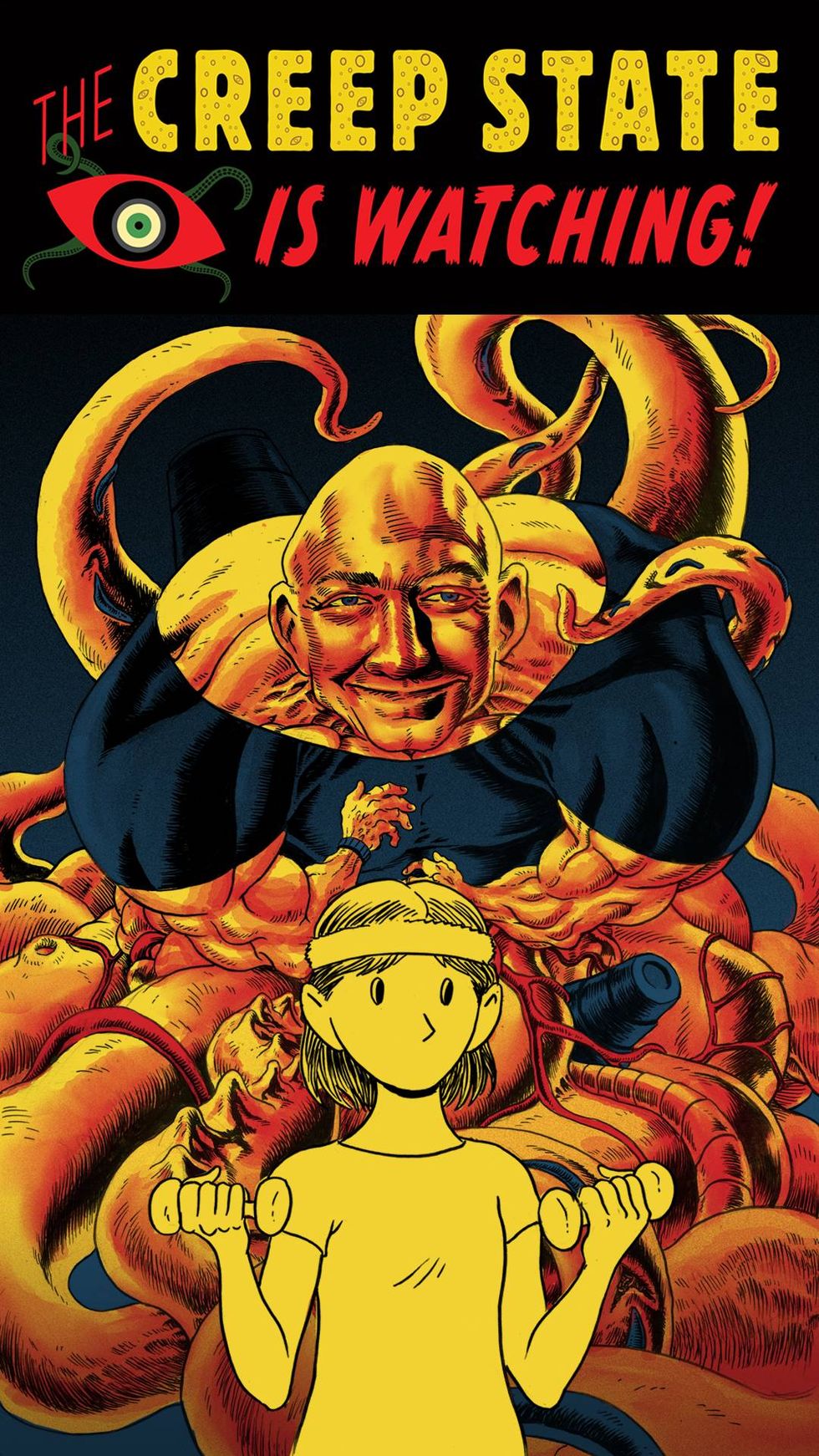 The Creep State image of Jeff Bezos is shown. (Photo via Creep State)
The idea for the Creep State came from the desire to raise awareness about certain Silicon Valley oligarchs and their anti-democratic actions and aspirations. Participants in the project who spoke to Common Dreams asked to remain anonymous in keeping with the guerilla-style tactics of their effort.
“There's what is really a very small group of men who control these algorithms, who control the software, the hardware, and.. they are trying to initially infiltrate our government and eventually replace our government,” a Seattle-based organizer explained. “They've all been pretty clear about, you know, some version of, you know, a company town run by a CEO king.”
The project’s designers wanted to convey that “these specific individuals have very nefarious and creepy goals, and they are personally creeps,"—hence, the “creep state” framing.
“Whatever you do, see, hear, touch, say, feel, believe, dream, the Creep State is watching."
Currently, the project consists of a physical and digital element.
Volunteers wheatpaste posters of seven Silicon Valley kingpins—Jeff Bezos, Elon Musk, Mark Zuckerberg, Sam Altman, Peter Thiel, Bill Gates, and Marc Andreessen, drawn in cartoon style as B-movie monsters—in major US cities. To date, the images have been displayed in Austin, Seattle, DC, Palo Alto, the area around the Met Gala in New York, and Los Angeles, with more to come.
The posters include a QR code that leads to a website, including a video highlighting how these moguls' companies and products are already monitoring people’s daily activities, from surveillance pricing to sleep tracking.
“Whatever you do, see, hear, touch, say, feel, believe, dream, the Creep State is watching," the video declares, before concluding: “We’re fighting back.”
“These people and these companies need to continue to be exposed for all of the harm that they're causing and the real power that they have over our government and those governed,” the DC-based organizer said.
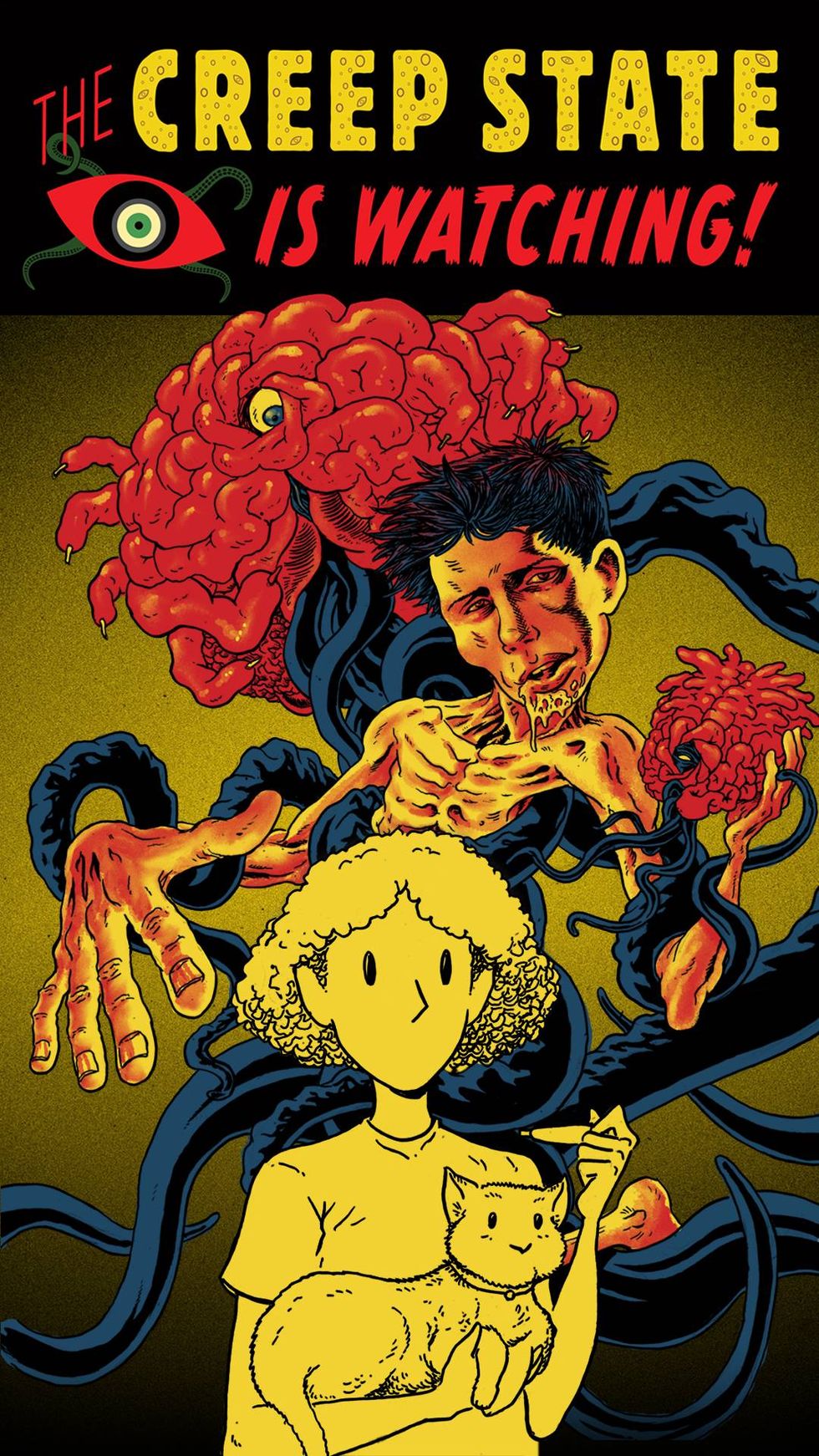 The Creep State image of Sam Altman is shown. (Photo via Creep State)
While there have been many different campaigns and critiques calling out Big Tech and the rise of AI in recent years, the creators of the Creep State took an artistic approach partly to grab people’s attention, to make something that “quite literally visually shocked people out of the normal way that they think about and talk about these guys,” as the Seattle-based organizer put it.
They added that they wanted a viewer’s first response upon seeing the art to be, “Woah!”
So far, it seems to be working.
When the art went up in Seattle ahead of the No Kings protest on March 28, “people walking by stopped and took pictures and were like, ‘Whoa, what is this about? Oh my God, is that Jeff Bezos? Whoa, is that Bill Gates?’” the Seattle organizer said.
A member of the team who put the posters up in DC on April 18 similarly recalled: “We had a young woman come up to us and ask us about the Creep State and said she was glad we were exposing these guys. She said she was from [Prince George's] County in Maryland and was part of the movement to stop data centers there.”
"Fundamentally the question that we face is will we allow one or a few of these corporations to literally remake our society?"
The project’s designers see themselves as operating within a tradition of guerilla art against the powerful from Banksy, Favianna Rodriguez, and Shepard Fairey's OBEY posters to student protests against Slobodan Milošević in Serbia in the 1990s and the FeesMustFall campaign in South Africa in the 2010s. However, the project—which made a point of working with actual human creators, including a screenwriter, comic book artist, and graphic designer—takes on extra resonance in an age in which AI slop clogs up social media feeds and threatens to put creative workers out of a job.
“This is very much a people versus the machines kind of thing,” the Seattle-based organizer said. “Are we going to be a society where human creativity and human inspiration and human thinking are valued, or are we going to be a world where.. we're all plugged into a screen?”
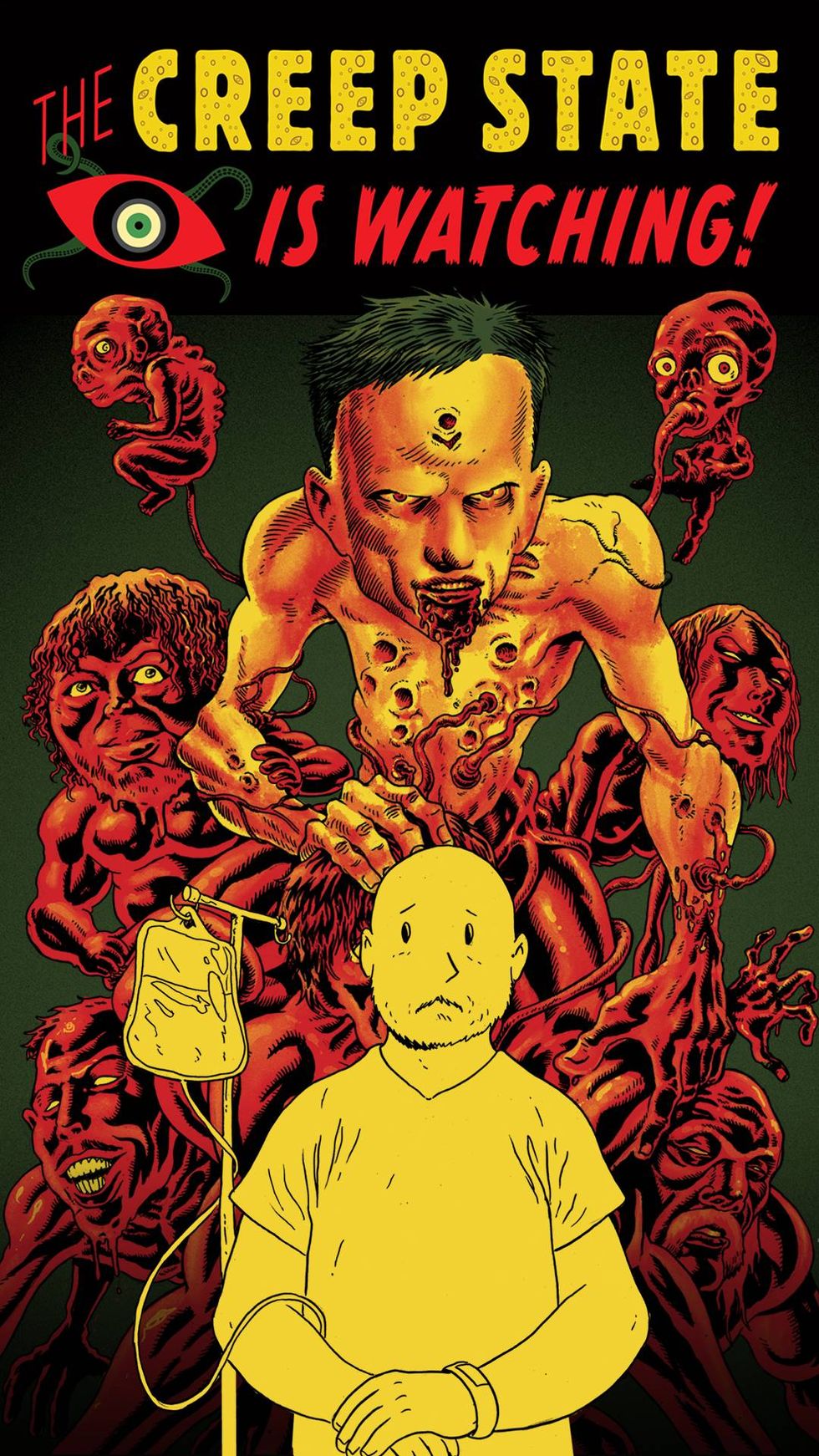 The Creep State image of Peter Thiel is shown. (Photo via Creep State)
As the project uses an artistic approach to hook people who might otherwise ignore its messaging, it also crafts that messaging in an attempt to appeal to people who might not always agree politically.
The name “Creep State” was chosen in part for its similarity to “deep state,” which is often used on the political right to describe hidden actors undemocratically controlling the federal government. Some of the headlines highlighted in the introductory video were also selected to appeal to right-leaning viewers. (“Prayer apps: is AI playing God?” one reads.)
“Our assessment here is that we may have, and we very much do have, some very deep disagreements in a variety of ways with the right wing. But there is a very real grassroots right-wing opposition to the Silicon Valley takeover of our economy and our democracy. And we want to make sure that this is a campaign that different types of folks can see themselves reflected in,” the Seattle-based organizer said.
"Once they're burrowed in, it's going to be very difficult to root them out.”
Indeed, the rise of AI and the hyperscale data centers it relies on seems to have, at least so far, bypassed the usual culture war divides. As communities across the country have mobilized against the data center buildout, “you've got DSA people linking arms with, you know, like ultra-MAGA folks,” the Seattle organizer added.
The numbers reflect this, with around 50% of both Republicans and Democrats now saying they are more concerned than excited about AI and 55% of the politicians opposing data centers, which are often located in red states, being Republicans.
The embrace of AI and its Silicon Valley pushers may be one wedge between President Donald Trump and some of his supporters, as 75% of 2024 Trump voters think that AI should be regulated while the president himself has thrown his weight behind a plan to prohibit states from regulating AI at all.
Indeed, even as the Creep State’s developers reach out to Trump voters, they are clear that the Trump administration itself has escalated the Big Tech takeover of the US government, upping the urgency of their project.
Even before Trump was elected a second time around, Silicon Valley enabled his rise. Bezos sunk The Washington Post’s endorsement of his rival Kamala Harris, while Musk donated more than a quarter billion to back Trump's campaign. His Vice President JD Vance is a protege of Thiel, who has backed Trump since 2016.
Trump has repaid these Big Tech executives handsomely with access, money, and his deregulatory push. The DC-based organizer said they were partly inspired to get involved with the Creep State project after witnessing the havoc wreaked by Musk’s Department of Government Efficiency, which cut funding for essential grants and may lead to the deaths of over 14 million through the shuttering of the US Agency for International Development. At the same time, tech billionaires have increased their profits by contracting with the government, enabling deportations via Immigration and Customs Enforcement and both surveillance and targeting via the Pentagon.
Yet the Seattle-based organizer said that some Trump supporters “are beginning to realize… that these guys don't care about Trump. Trump is a vehicle for them. And, you know, once they're burrowed in, it's going to be very difficult to root them out.”
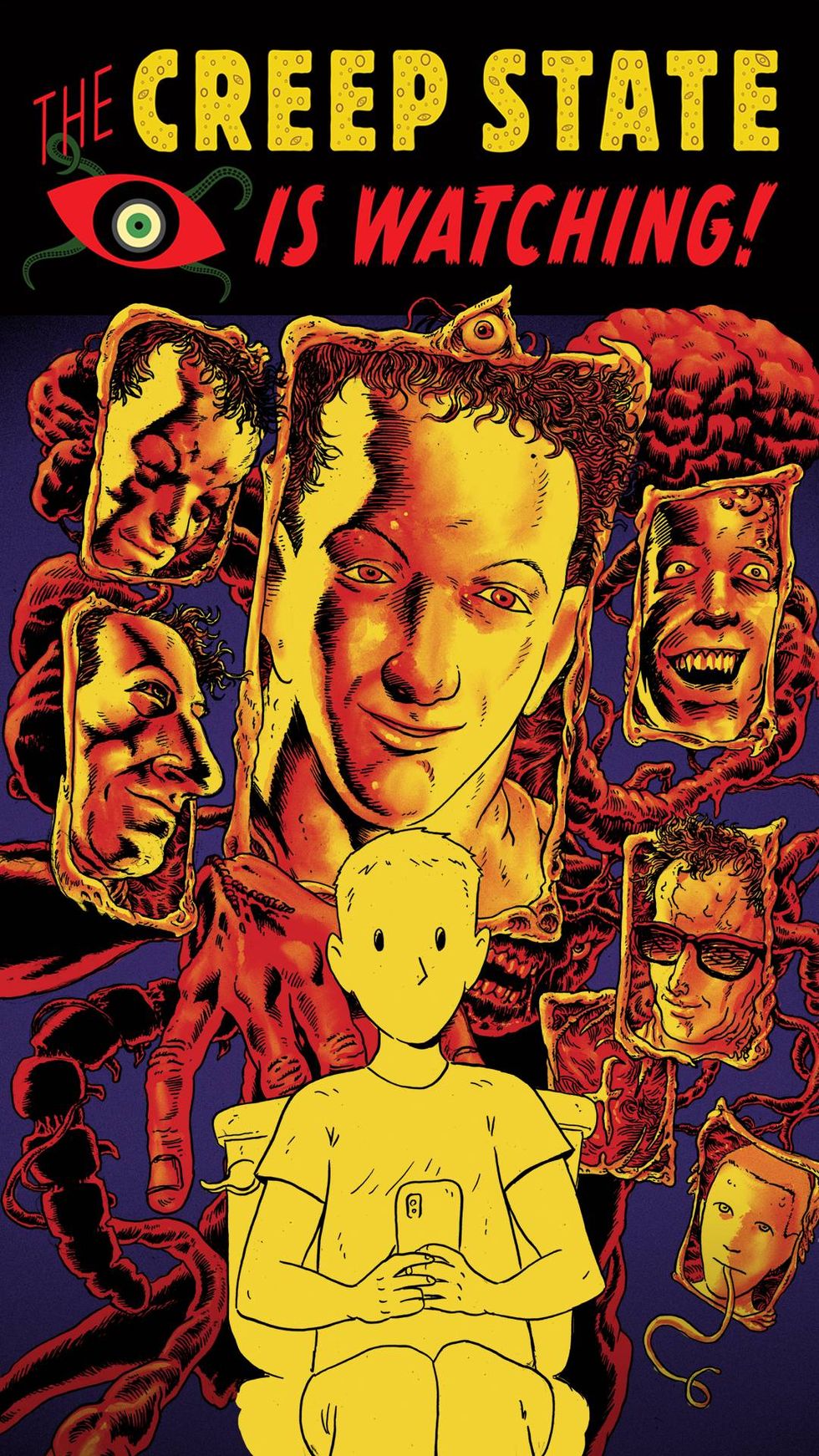 The Creep State image of Mark Zuckerberg is shown. (Photo via Creep State)
Ultimately the goal of the Creep State project is to plug everyone who sees and responds to the art—whatever their politics—into the growing movement to push back against the Big Tech power grab.
“The more we can expose these actors, it can inspire people to… organize against them, demand… oversight and regulations over AI and the influence that these individuals have on their politics,” the DC-based organizer said.
People who scan the QR code can be funneled into future wheatpasting sessions (which are all volunteer efforts) or local fights related to tech policy. One hope the organizers have is that communities across the country who are fighting data center construction or Flock camera expansion could order posters from the site that would have their QR codes adjusted to direct viewers to the local struggle.
“If we can plug people into some of those fights with organizations and for them to get more deeply involved, we'd love to do that,” the DC organizer said.
The Seattle organizer concluded, "Fundamentally the question that we face is will we allow one or a few of these corporations to literally remake our society?"
They continued: "We're all living through this polycrisis. The climate is collapsing, the economy is in tatters, we're at war abroad. There's something new and crazy every day, and it's hard to break through to people. So the hope is that this art specifically, in this way of highlighting both the like political creepiness and the personal creepiness of these guys, can maybe shock some people who otherwise are just trying to get through their day into, 'I need to do something.'"
On their way to attend the Met Gala on Monday night, guests might have spotted a different image of Amazon founder Jeff Bezos than the one he tried to project by chairing the annual fundraiser: a poster featuring his bulbous head, looming over them out of the darkness, attached to a muscular spider-shaped body. Above it, a mysterious message: “The Creep State is watching.”
What does it mean?
The Creep State is an anonymous guerilla art and protest project that debuted in Austin, Texas during South by Southwest earlier this year. It is designed to draw people’s attention to the threat posed by Big Tech billionaires and their increasing influence over both the US government and the daily lives of everyone who interacts with their products.
“These individuals are a danger to all of us,” a DC-based organizer said.
The Creep State image of Jeff Bezos is shown. (Photo via Creep State)
The idea for the Creep State came from the desire to raise awareness about certain Silicon Valley oligarchs and their anti-democratic actions and aspirations. Participants in the project who spoke to Common Dreams asked to remain anonymous in keeping with the guerilla-style tactics of their effort.
“There's what is really a very small group of men who control these algorithms, who control the software, the hardware, and.. they are trying to initially infiltrate our government and eventually replace our government,” a Seattle-based organizer explained. “They've all been pretty clear about, you know, some version of, you know, a company town run by a CEO king.”
The project’s designers wanted to convey that “these specific individuals have very nefarious and creepy goals, and they are personally creeps,"—hence, the “creep state” framing.
“Whatever you do, see, hear, touch, say, feel, believe, dream, the Creep State is watching."
Currently, the project consists of a physical and digital element.
Volunteers wheatpaste posters of seven Silicon Valley kingpins—Jeff Bezos, Elon Musk, Mark Zuckerberg, Sam Altman, Peter Thiel, Bill Gates, and Marc Andreessen, drawn in cartoon style as B-movie monsters—in major US cities. To date, the images have been displayed in Austin, Seattle, DC, Palo Alto, the area around the Met Gala in New York, and Los Angeles, with more to come.
The posters include a QR code that leads to a website, including a video highlighting how these moguls' companies and products are already monitoring people’s daily activities, from surveillance pricing to sleep tracking.
“Whatever you do, see, hear, touch, say, feel, believe, dream, the Creep State is watching," the video declares, before concluding: “We’re fighting back.”
“These people and these companies need to continue to be exposed for all of the harm that they're causing and the real power that they have over our government and those governed,” the DC-based organizer said.
The Creep State image of Sam Altman is shown. (Photo via Creep State)
While there have been many different campaigns and critiques calling out Big Tech and the rise of AI in recent years, the creators of the Creep State took an artistic approach partly to grab people’s attention, to make something that “quite literally visually shocked people out of the normal way that they think about and talk about these guys,” as the Seattle-based organizer put it.
They added that they wanted a viewer’s first response upon seeing the art to be, “Woah!”
So far, it seems to be working.
When the art went up in Seattle ahead of the No Kings protest on March 28, “people walking by stopped and took pictures and were like, ‘Whoa, what is this about? Oh my God, is that Jeff Bezos? Whoa, is that Bill Gates?’” the Seattle organizer said.
A member of the team who put the posters up in DC on April 18 similarly recalled: “We had a young woman come up to us and ask us about the Creep State and said she was glad we were exposing these guys. She said she was from [Prince George's] County in Maryland and was part of the movement to stop data centers there.”
"Fundamentally the question that we face is will we allow one or a few of these corporations to literally remake our society?"
The project’s designers see themselves as operating within a tradition of guerilla art against the powerful from Banksy, Favianna Rodriguez, and Shepard Fairey's OBEY posters to student protests against Slobodan Milošević in Serbia in the 1990s and the FeesMustFall campaign in South Africa in the 2010s. However, the project—which made a point of working with actual human creators, including a screenwriter, comic book artist, and graphic designer—takes on extra resonance in an age in which AI slop clogs up social media feeds and threatens to put creative workers out of a job.
“This is very much a people versus the machines kind of thing,” the Seattle-based organizer said. “Are we going to be a society where human creativity and human inspiration and human thinking are valued, or are we going to be a world where.. we're all plugged into a screen?”
The Creep State image of Peter Thiel is shown. (Photo via Creep State)
As the project uses an artistic approach to hook people who might otherwise ignore its messaging, it also crafts that messaging in an attempt to appeal to people who might not always agree politically.
The name “Creep State” was chosen in part for its similarity to “deep state,” which is often used on the political right to describe hidden actors undemocratically controlling the federal government. Some of the headlines highlighted in the introductory video were also selected to appeal to right-leaning viewers. (“Prayer apps: is AI playing God?” one reads.)
“Our assessment here is that we may have, and we very much do have, some very deep disagreements in a variety of ways with the right wing. But there is a very real grassroots right-wing opposition to the Silicon Valley takeover of our economy and our democracy. And we want to make sure that this is a campaign that different types of folks can see themselves reflected in,” the Seattle-based organizer said.
"Once they're burrowed in, it's going to be very difficult to root them out.”
Indeed, the rise of AI and the hyperscale data centers it relies on seems to have, at least so far, bypassed the usual culture war divides. As communities across the country have mobilized against the data center buildout, “you've got DSA people linking arms with, you know, like ultra-MAGA folks,” the Seattle organizer added.
The numbers reflect this, with around 50% of both Republicans and Democrats now saying they are more concerned than excited about AI and 55% of the politicians opposing data centers, which are often located in red states, being Republicans.
The embrace of AI and its Silicon Valley pushers may be one wedge between President Donald Trump and some of his supporters, as 75% of 2024 Trump voters think that AI should be regulated while the president himself has thrown his weight behind a plan to prohibit states from regulating AI at all.
Indeed, even as the Creep State’s developers reach out to Trump voters, they are clear that the Trump administration itself has escalated the Big Tech takeover of the US government, upping the urgency of their project.
Even before Trump was elected a second time around, Silicon Valley enabled his rise. Bezos sunk The Washington Post’s endorsement of his rival Kamala Harris, while Musk donated more than a quarter billion to back Trump's campaign. His Vice President JD Vance is a protege of Thiel, who has backed Trump since 2016.
Trump has repaid these Big Tech executives handsomely with access, money, and his deregulatory push. The DC-based organizer said they were partly inspired to get involved with the Creep State project after witnessing the havoc wreaked by Musk’s Department of Government Efficiency, which cut funding for essential grants and may lead to the deaths of over 14 million through the shuttering of the US Agency for International Development. At the same time, tech billionaires have increased their profits by contracting with the government, enabling deportations via Immigration and Customs Enforcement and both surveillance and targeting via the Pentagon.
Yet the Seattle-based organizer said that some Trump supporters “are beginning to realize… that these guys don't care about Trump. Trump is a vehicle for them. And, you know, once they're burrowed in, it's going to be very difficult to root them out.”
The Creep State image of Mark Zuckerberg is shown. (Photo via Creep State)
Ultimately the goal of the Creep State project is to plug everyone who sees and responds to the art—whatever their politics—into the growing movement to push back against the Big Tech power grab.
“The more we can expose these actors, it can inspire people to… organize against them, demand… oversight and regulations over AI and the influence that these individuals have on their politics,” the DC-based organizer said.
People who scan the QR code can be funneled into future wheatpasting sessions (which are all volunteer efforts) or local fights related to tech policy. One hope the organizers have is that communities across the country who are fighting data center construction or Flock camera expansion could order posters from the site that would have their QR codes adjusted to direct viewers to the local struggle.
“If we can plug people into some of those fights with organizations and for them to get more deeply involved, we'd love to do that,” the DC organizer said.
The Seattle organizer concluded, "Fundamentally the question that we face is will we allow one or a few of these corporations to literally remake our society?"
They continued: "We're all living through this polycrisis. The climate is collapsing, the economy is in tatters, we're at war abroad. There's something new and crazy every day, and it's hard to break through to people. So the hope is that this art specifically, in this way of highlighting both the like political creepiness and the personal creepiness of these guys, can maybe shock some people who otherwise are just trying to get through their day into, 'I need to do something.'"
On their way to attend the Met Gala on Monday night, guests might have spotted a different image of Amazon founder Jeff Bezos than the one he tried to project by chairing the annual fundraiser: a poster featuring his bulbous head, looming over them out of the darkness, attached to a muscular spider-shaped body. Above it, a mysterious message: “The Creep State is watching.”
What does it mean?
The Creep State is an anonymous guerilla art and protest project that debuted in Austin, Texas during South by Southwest earlier this year. It is designed to draw people’s attention to the threat posed by Big Tech billionaires and their increasing influence over both the US government and the daily lives of everyone who interacts with their products.
“These individuals are a danger to all of us,” a DC-based organizer said.
The Creep State image of Jeff Bezos is shown. (Photo via Creep State)
The idea for the Creep State came from the desire to raise awareness about certain Silicon Valley oligarchs and their anti-democratic actions and aspirations. Participants in the project who spoke to Common Dreams asked to remain anonymous in keeping with the guerilla-style tactics of their effort.
“There's what is really a very small group of men who control these algorithms, who control the software, the hardware, and.. they are trying to initially infiltrate our government and eventually replace our government,” a Seattle-based organizer explained. “They've all been pretty clear about, you know, some version of, you know, a company town run by a CEO king.”
The project’s designers wanted to convey that “these specific individuals have very nefarious and creepy goals, and they are personally creeps,"—hence, the “creep state” framing.
“Whatever you do, see, hear, touch, say, feel, believe, dream, the Creep State is watching."
Currently, the project consists of a physical and digital element.
Volunteers wheatpaste posters of seven Silicon Valley kingpins—Jeff Bezos, Elon Musk, Mark Zuckerberg, Sam Altman, Peter Thiel, Bill Gates, and Marc Andreessen, drawn in cartoon style as B-movie monsters—in major US cities. To date, the images have been displayed in Austin, Seattle, DC, Palo Alto, the area around the Met Gala in New York, and Los Angeles, with more to come.
The posters include a QR code that leads to a website, including a video highlighting how these moguls' companies and products are already monitoring people’s daily activities, from surveillance pricing to sleep tracking.
“Whatever you do, see, hear, touch, say, feel, believe, dream, the Creep State is watching," the video declares, before concluding: “We’re fighting back.”
“These people and these companies need to continue to be exposed for all of the harm that they're causing and the real power that they have over our government and those governed,” the DC-based organizer said.
The Creep State image of Sam Altman is shown. (Photo via Creep State)
While there have been many different campaigns and critiques calling out Big Tech and the rise of AI in recent years, the creators of the Creep State took an artistic approach partly to grab people’s attention, to make something that “quite literally visually shocked people out of the normal way that they think about and talk about these guys,” as the Seattle-based organizer put it.
They added that they wanted a viewer’s first response upon seeing the art to be, “Woah!”
So far, it seems to be working.
When the art went up in Seattle ahead of the No Kings protest on March 28, “people walking by stopped and took pictures and were like, ‘Whoa, what is this about? Oh my God, is that Jeff Bezos? Whoa, is that Bill Gates?’” the Seattle organizer said.
A member of the team who put the posters up in DC on April 18 similarly recalled: “We had a young woman come up to us and ask us about the Creep State and said she was glad we were exposing these guys. She said she was from [Prince George's] County in Maryland and was part of the movement to stop data centers there.”
"Fundamentally the question that we face is will we allow one or a few of these corporations to literally remake our society?"
The project’s designers see themselves as operating within a tradition of guerilla art against the powerful from Banksy, Favianna Rodriguez, and Shepard Fairey's OBEY posters to student protests against Slobodan Milošević in Serbia in the 1990s and the FeesMustFall campaign in South Africa in the 2010s. However, the project—which made a point of working with actual human creators, including a screenwriter, comic book artist, and graphic designer—takes on extra resonance in an age in which AI slop clogs up social media feeds and threatens to put creative workers out of a job.
“This is very much a people versus the machines kind of thing,” the Seattle-based organizer said. “Are we going to be a society where human creativity and human inspiration and human thinking are valued, or are we going to be a world where.. we're all plugged into a screen?”
The Creep State image of Peter Thiel is shown. (Photo via Creep State)
As the project uses an artistic approach to hook people who might otherwise ignore its messaging, it also crafts that messaging in an attempt to appeal to people who might not always agree politically.
The name “Creep State” was chosen in part for its similarity to “deep state,” which is often used on the political right to describe hidden actors undemocratically controlling the federal government. Some of the headlines highlighted in the introductory video were also selected to appeal to right-leaning viewers. (“Prayer apps: is AI playing God?” one reads.)
“Our assessment here is that we may have, and we very much do have, some very deep disagreements in a variety of ways with the right wing. But there is a very real grassroots right-wing opposition to the Silicon Valley takeover of our economy and our democracy. And we want to make sure that this is a campaign that different types of folks can see themselves reflected in,” the Seattle-based organizer said.
"Once they're burrowed in, it's going to be very difficult to root them out.”
Indeed, the rise of AI and the hyperscale data centers it relies on seems to have, at least so far, bypassed the usual culture war divides. As communities across the country have mobilized against the data center buildout, “you've got DSA people linking arms with, you know, like ultra-MAGA folks,” the Seattle organizer added.
The numbers reflect this, with around 50% of both Republicans and Democrats now saying they are more concerned than excited about AI and 55% of the politicians opposing data centers, which are often located in red states, being Republicans.
The embrace of AI and its Silicon Valley pushers may be one wedge between President Donald Trump and some of his supporters, as 75% of 2024 Trump voters think that AI should be regulated while the president himself has thrown his weight behind a plan to prohibit states from regulating AI at all.
Indeed, even as the Creep State’s developers reach out to Trump voters, they are clear that the Trump administration itself has escalated the Big Tech takeover of the US government, upping the urgency of their project.
Even before Trump was elected a second time around, Silicon Valley enabled his rise. Bezos sunk The Washington Post’s endorsement of his rival Kamala Harris, while Musk donated more than a quarter billion to back Trump's campaign. His Vice President JD Vance is a protege of Thiel, who has backed Trump since 2016.
Trump has repaid these Big Tech executives handsomely with access, money, and his deregulatory push. The DC-based organizer said they were partly inspired to get involved with the Creep State project after witnessing the havoc wreaked by Musk’s Department of Government Efficiency, which cut funding for essential grants and may lead to the deaths of over 14 million through the shuttering of the US Agency for International Development. At the same time, tech billionaires have increased their profits by contracting with the government, enabling deportations via Immigration and Customs Enforcement and both surveillance and targeting via the Pentagon.
Yet the Seattle-based organizer said that some Trump supporters “are beginning to realize… that these guys don't care about Trump. Trump is a vehicle for them. And, you know, once they're burrowed in, it's going to be very difficult to root them out.”
The Creep State image of Mark Zuckerberg is shown. (Photo via Creep State)
Ultimately the goal of the Creep State project is to plug everyone who sees and responds to the art—whatever their politics—into the growing movement to push back against the Big Tech power grab.
“The more we can expose these actors, it can inspire people to… organize against them, demand… oversight and regulations over AI and the influence that these individuals have on their politics,” the DC-based organizer said.
People who scan the QR code can be funneled into future wheatpasting sessions (which are all volunteer efforts) or local fights related to tech policy. One hope the organizers have is that communities across the country who are fighting data center construction or Flock camera expansion could order posters from the site that would have their QR codes adjusted to direct viewers to the local struggle.
“If we can plug people into some of those fights with organizations and for them to get more deeply involved, we'd love to do that,” the DC organizer said.
The Seattle organizer concluded, "Fundamentally the question that we face is will we allow one or a few of these corporations to literally remake our society?"
They continued: "We're all living through this polycrisis. The climate is collapsing, the economy is in tatters, we're at war abroad. There's something new and crazy every day, and it's hard to break through to people. So the hope is that this art specifically, in this way of highlighting both the like political creepiness and the personal creepiness of these guys, can maybe shock some people who otherwise are just trying to get through their day into, 'I need to do something.'"