SUBSCRIBE TO OUR FREE NEWSLETTER
Daily news & progressive opinion—funded by the people, not the corporations—delivered straight to your inbox.
5
#000000
#FFFFFF
To donate by check, phone, or other method, see our More Ways to Give page.
Daily news & progressive opinion—funded by the people, not the corporations—delivered straight to your inbox.
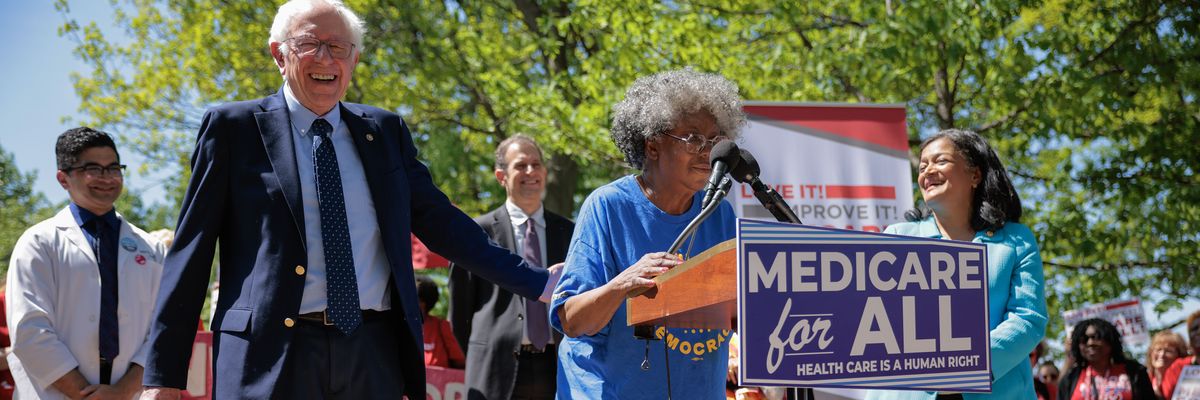
Sen. Bernie Sanders (I-Vt.) shares a laugh with 80-year-old Frankie Clark of North Carolina as she addresses a rally to reintroduce the Medicare for All Act in Upper Senate Park on Capitol Hill on April 29, 2025, in Washington, DC.
“These subsidies have to get bigger and bigger and bigger to keep the ACA affordable,” said US Senate candidate Dr. Abdul El-Sayed. “The fight for healthcare right now can’t end with ACA subsidies. It has to be bigger.”
As the government appears poised to reopen, with Republicans having successfully avoided concessions on their goal of eliminating Affordable Care Act tax credits, President Donald Trump has proposed his own solution to the looming explosion in health insurance costs.
By agreeing to reopen the government without a deal, Democrats have given up their main leverage to force Republicans to extend the credits set to expire at the end of the year. If this happens, over 22 million Americans are expected to see their monthly insurance premiums more than double. As enrollment data for next year shows, Americans are already seeing skyrocketing healthcare costs, not just for ACA recipients but for everyone.
While Republicans successfully strong-armed their opposition into caving by using the shutdown to turn the screws on government workers and food stamp recipients, they still have to weather the political fallout of the coming healthcare apocalypse. A poll released Thursday by KFF found that 74% of Americans—half of whom are self-identified Republicans—want to see the credits extended. Three-quarters also say they'd blame either Trump or Republicans in Congress if they weren't.
On Truth Social Saturday, as a shutdown deal appeared likely, Trump proposed his own idea:
I am recommending to Senate Republicans that the Hundreds of Billions of Dollars currently being sent to money sucking Insurance Companies in order to save the bad Healthcare provided by ObamaCare, BE SENT DIRECTLY TO THE PEOPLE SO THAT THEY CAN PURCHASE THEIR OWN, MUCH BETTER, HEALTHCARE, and have money left over. In other words, take from the BIG, BAD Insurance Companies, give it to the people, and terminate, per Dollar spent, the worst Healthcare anywhere in the World, ObamaCare.
Trump is correct that under the current scheme, Americans don't actually receive money directly. But experts warn that while there’s a visceral populist logic to his proposal, the flaws of replacing those annual subsidies with a one-time payment become obvious with the barest of scrutiny, especially when it is paired with a proposal to fully repeal the ACA.
"You have to read between the lines here to imagine what President Trump is proposing," said Larry Levitt, the executive vice president for health policy at KFF. "It sounds like it could be a plan for health accounts that could be used for insurance that doesn’t cover preexisting conditions, which could create a death spiral in ACA plans that do."
One of the Senate's most prominent proponents of eliminating the ACA and other parts of the social safety net, Sen. Rick Scott (R-Fla.), said he was "writing the bill right now," and clarified that it would indeed involve "HSA-style accounts" for Americans in place of subsidized insurance.
On Sunday, Sen. Adam Schiff (D-Calif.) noted that this was just a reheating of the "same old, tired proposal of repealing the Affordable Care Act, giving people a benefit in the form of a health savings account, but allowing insurance companies once again to cancel policies and refuse to write policies for people who have preexisting health conditions."
HSAs were a key component of the Republicans' failed 2017 plan to "repeal and replace" the ACA, which many critics pointed out would allow insurers to skyrocket the costs of insurance for those dealing with preexisting conditions.
Sen. Chris Murphy (D-Conn.), who sits on the Senate Committee on Health, Education, Labor, and Pensions (HELP), called Trump's new plan "unsurprisingly nonsensical."
"Is he suggesting eliminating health insurance and giving people a few thousand dollars instead?" Murphy asked. "And then when they get a cancer diagnosis, they just go bankrupt?"
But while many Democrats decried yet another effort to dismantle the ACA, some progressives pointed out that health insurance costs, and healthcare costs more generally, have still exploded under Obamacare, which—despite introducing new guardrails—still leaves profit-driven insurance intact and requires all Americans to purchase it.
"Yes, Mr. President: You’re right. We do have 'the worst healthcare' of any major country," replied Sen. Bernie Sanders (I-Vt.), the HELP committee's ranking member, who has long decried the profiteering of insurance companies. "Despite spending twice as much per capita, we are the only major country not to guarantee health care to all as a human right. The solution: Medicare for All."
He was joined by Rep. Ro Khanna (D-Calif.), who ripped Trump's plan on Fox News.
"Healthcare premiums... they are going to spike about 100% in some cases," Khanna said. "Now, if you take the tax credits and you just give them to the American people, who is the president expecting them to buy the plans from? Is he expecting them to get junk insurance?"
"I agree with him that the system is broken," he continued. "And we should be expanding Medicare to have Medicare for All. But in the meantime, we've got to give people help so that their premiums don't spike."
On social media, Khanna pointed to a 2020 analysis by the nonpartisan Congressional Budget Office (CBO), which found that the US would spend about $650 billion less on healthcare per year in 2030 if it adopted Medicare for All because it would drastically reduce the administrative waste and non-healthcare-related spending inherent to private insurance. It would also allow the government to use its massive leverage as America's primary insurer to negotiate dramatic price reductions for drugs and medical services.
Those arguments have also been made by Dr. Abdul El-Sayed, a long-time Medicare for All proponent who is running for the open Senate seat in Michigan in 2026. He explained to a crowd that the fact that Republicans "can muck around with subsidies" in the first place is evidence of a broader healthcare crisis that stems from the preeminence of privatized healthcare.
"The very fact that we're watching as these subsidies have to get bigger and bigger and bigger to keep the ACA affordable, the very fact that we're relying on Medicaid to be expanded, that, to me, is the reason why in a moment like this, it's not enough just to protect what we have," he said.
He continued on social media: "The fight for healthcare right now can’t end with ACA subsidies. It has to be bigger. Too many Americans are suffering over medical debt and spiraling costs. It should be nothing short of Medicare for All."
Dear Common Dreams reader, It’s been nearly 30 years since I co-founded Common Dreams with my late wife, Lina Newhouser. We had the radical notion that journalism should serve the public good, not corporate profits. It was clear to us from the outset what it would take to build such a project. No paid advertisements. No corporate sponsors. No millionaire publisher telling us what to think or do. Many people said we wouldn't last a year, but we proved those doubters wrong. Together with a tremendous team of journalists and dedicated staff, we built an independent media outlet free from the constraints of profits and corporate control. Our mission has always been simple: To inform. To inspire. To ignite change for the common good. Building Common Dreams was not easy. Our survival was never guaranteed. When you take on the most powerful forces—Wall Street greed, fossil fuel industry destruction, Big Tech lobbyists, and uber-rich oligarchs who have spent billions upon billions rigging the economy and democracy in their favor—the only bulwark you have is supporters who believe in your work. But here’s the urgent message from me today. It's never been this bad out there. And it's never been this hard to keep us going. At the very moment Common Dreams is most needed, the threats we face are intensifying. We need your support now more than ever. We don't accept corporate advertising and never will. We don't have a paywall because we don't think people should be blocked from critical news based on their ability to pay. Everything we do is funded by the donations of readers like you. When everyone does the little they can afford, we are strong. But if that support retreats or dries up, so do we. Will you donate now to make sure Common Dreams not only survives but thrives? —Craig Brown, Co-founder |
As the government appears poised to reopen, with Republicans having successfully avoided concessions on their goal of eliminating Affordable Care Act tax credits, President Donald Trump has proposed his own solution to the looming explosion in health insurance costs.
By agreeing to reopen the government without a deal, Democrats have given up their main leverage to force Republicans to extend the credits set to expire at the end of the year. If this happens, over 22 million Americans are expected to see their monthly insurance premiums more than double. As enrollment data for next year shows, Americans are already seeing skyrocketing healthcare costs, not just for ACA recipients but for everyone.
While Republicans successfully strong-armed their opposition into caving by using the shutdown to turn the screws on government workers and food stamp recipients, they still have to weather the political fallout of the coming healthcare apocalypse. A poll released Thursday by KFF found that 74% of Americans—half of whom are self-identified Republicans—want to see the credits extended. Three-quarters also say they'd blame either Trump or Republicans in Congress if they weren't.
On Truth Social Saturday, as a shutdown deal appeared likely, Trump proposed his own idea:
I am recommending to Senate Republicans that the Hundreds of Billions of Dollars currently being sent to money sucking Insurance Companies in order to save the bad Healthcare provided by ObamaCare, BE SENT DIRECTLY TO THE PEOPLE SO THAT THEY CAN PURCHASE THEIR OWN, MUCH BETTER, HEALTHCARE, and have money left over. In other words, take from the BIG, BAD Insurance Companies, give it to the people, and terminate, per Dollar spent, the worst Healthcare anywhere in the World, ObamaCare.
Trump is correct that under the current scheme, Americans don't actually receive money directly. But experts warn that while there’s a visceral populist logic to his proposal, the flaws of replacing those annual subsidies with a one-time payment become obvious with the barest of scrutiny, especially when it is paired with a proposal to fully repeal the ACA.
"You have to read between the lines here to imagine what President Trump is proposing," said Larry Levitt, the executive vice president for health policy at KFF. "It sounds like it could be a plan for health accounts that could be used for insurance that doesn’t cover preexisting conditions, which could create a death spiral in ACA plans that do."
One of the Senate's most prominent proponents of eliminating the ACA and other parts of the social safety net, Sen. Rick Scott (R-Fla.), said he was "writing the bill right now," and clarified that it would indeed involve "HSA-style accounts" for Americans in place of subsidized insurance.
On Sunday, Sen. Adam Schiff (D-Calif.) noted that this was just a reheating of the "same old, tired proposal of repealing the Affordable Care Act, giving people a benefit in the form of a health savings account, but allowing insurance companies once again to cancel policies and refuse to write policies for people who have preexisting health conditions."
HSAs were a key component of the Republicans' failed 2017 plan to "repeal and replace" the ACA, which many critics pointed out would allow insurers to skyrocket the costs of insurance for those dealing with preexisting conditions.
Sen. Chris Murphy (D-Conn.), who sits on the Senate Committee on Health, Education, Labor, and Pensions (HELP), called Trump's new plan "unsurprisingly nonsensical."
"Is he suggesting eliminating health insurance and giving people a few thousand dollars instead?" Murphy asked. "And then when they get a cancer diagnosis, they just go bankrupt?"
But while many Democrats decried yet another effort to dismantle the ACA, some progressives pointed out that health insurance costs, and healthcare costs more generally, have still exploded under Obamacare, which—despite introducing new guardrails—still leaves profit-driven insurance intact and requires all Americans to purchase it.
"Yes, Mr. President: You’re right. We do have 'the worst healthcare' of any major country," replied Sen. Bernie Sanders (I-Vt.), the HELP committee's ranking member, who has long decried the profiteering of insurance companies. "Despite spending twice as much per capita, we are the only major country not to guarantee health care to all as a human right. The solution: Medicare for All."
He was joined by Rep. Ro Khanna (D-Calif.), who ripped Trump's plan on Fox News.
"Healthcare premiums... they are going to spike about 100% in some cases," Khanna said. "Now, if you take the tax credits and you just give them to the American people, who is the president expecting them to buy the plans from? Is he expecting them to get junk insurance?"
"I agree with him that the system is broken," he continued. "And we should be expanding Medicare to have Medicare for All. But in the meantime, we've got to give people help so that their premiums don't spike."
On social media, Khanna pointed to a 2020 analysis by the nonpartisan Congressional Budget Office (CBO), which found that the US would spend about $650 billion less on healthcare per year in 2030 if it adopted Medicare for All because it would drastically reduce the administrative waste and non-healthcare-related spending inherent to private insurance. It would also allow the government to use its massive leverage as America's primary insurer to negotiate dramatic price reductions for drugs and medical services.
Those arguments have also been made by Dr. Abdul El-Sayed, a long-time Medicare for All proponent who is running for the open Senate seat in Michigan in 2026. He explained to a crowd that the fact that Republicans "can muck around with subsidies" in the first place is evidence of a broader healthcare crisis that stems from the preeminence of privatized healthcare.
"The very fact that we're watching as these subsidies have to get bigger and bigger and bigger to keep the ACA affordable, the very fact that we're relying on Medicaid to be expanded, that, to me, is the reason why in a moment like this, it's not enough just to protect what we have," he said.
He continued on social media: "The fight for healthcare right now can’t end with ACA subsidies. It has to be bigger. Too many Americans are suffering over medical debt and spiraling costs. It should be nothing short of Medicare for All."
As the government appears poised to reopen, with Republicans having successfully avoided concessions on their goal of eliminating Affordable Care Act tax credits, President Donald Trump has proposed his own solution to the looming explosion in health insurance costs.
By agreeing to reopen the government without a deal, Democrats have given up their main leverage to force Republicans to extend the credits set to expire at the end of the year. If this happens, over 22 million Americans are expected to see their monthly insurance premiums more than double. As enrollment data for next year shows, Americans are already seeing skyrocketing healthcare costs, not just for ACA recipients but for everyone.
While Republicans successfully strong-armed their opposition into caving by using the shutdown to turn the screws on government workers and food stamp recipients, they still have to weather the political fallout of the coming healthcare apocalypse. A poll released Thursday by KFF found that 74% of Americans—half of whom are self-identified Republicans—want to see the credits extended. Three-quarters also say they'd blame either Trump or Republicans in Congress if they weren't.
On Truth Social Saturday, as a shutdown deal appeared likely, Trump proposed his own idea:
I am recommending to Senate Republicans that the Hundreds of Billions of Dollars currently being sent to money sucking Insurance Companies in order to save the bad Healthcare provided by ObamaCare, BE SENT DIRECTLY TO THE PEOPLE SO THAT THEY CAN PURCHASE THEIR OWN, MUCH BETTER, HEALTHCARE, and have money left over. In other words, take from the BIG, BAD Insurance Companies, give it to the people, and terminate, per Dollar spent, the worst Healthcare anywhere in the World, ObamaCare.
Trump is correct that under the current scheme, Americans don't actually receive money directly. But experts warn that while there’s a visceral populist logic to his proposal, the flaws of replacing those annual subsidies with a one-time payment become obvious with the barest of scrutiny, especially when it is paired with a proposal to fully repeal the ACA.
"You have to read between the lines here to imagine what President Trump is proposing," said Larry Levitt, the executive vice president for health policy at KFF. "It sounds like it could be a plan for health accounts that could be used for insurance that doesn’t cover preexisting conditions, which could create a death spiral in ACA plans that do."
One of the Senate's most prominent proponents of eliminating the ACA and other parts of the social safety net, Sen. Rick Scott (R-Fla.), said he was "writing the bill right now," and clarified that it would indeed involve "HSA-style accounts" for Americans in place of subsidized insurance.
On Sunday, Sen. Adam Schiff (D-Calif.) noted that this was just a reheating of the "same old, tired proposal of repealing the Affordable Care Act, giving people a benefit in the form of a health savings account, but allowing insurance companies once again to cancel policies and refuse to write policies for people who have preexisting health conditions."
HSAs were a key component of the Republicans' failed 2017 plan to "repeal and replace" the ACA, which many critics pointed out would allow insurers to skyrocket the costs of insurance for those dealing with preexisting conditions.
Sen. Chris Murphy (D-Conn.), who sits on the Senate Committee on Health, Education, Labor, and Pensions (HELP), called Trump's new plan "unsurprisingly nonsensical."
"Is he suggesting eliminating health insurance and giving people a few thousand dollars instead?" Murphy asked. "And then when they get a cancer diagnosis, they just go bankrupt?"
But while many Democrats decried yet another effort to dismantle the ACA, some progressives pointed out that health insurance costs, and healthcare costs more generally, have still exploded under Obamacare, which—despite introducing new guardrails—still leaves profit-driven insurance intact and requires all Americans to purchase it.
"Yes, Mr. President: You’re right. We do have 'the worst healthcare' of any major country," replied Sen. Bernie Sanders (I-Vt.), the HELP committee's ranking member, who has long decried the profiteering of insurance companies. "Despite spending twice as much per capita, we are the only major country not to guarantee health care to all as a human right. The solution: Medicare for All."
He was joined by Rep. Ro Khanna (D-Calif.), who ripped Trump's plan on Fox News.
"Healthcare premiums... they are going to spike about 100% in some cases," Khanna said. "Now, if you take the tax credits and you just give them to the American people, who is the president expecting them to buy the plans from? Is he expecting them to get junk insurance?"
"I agree with him that the system is broken," he continued. "And we should be expanding Medicare to have Medicare for All. But in the meantime, we've got to give people help so that their premiums don't spike."
On social media, Khanna pointed to a 2020 analysis by the nonpartisan Congressional Budget Office (CBO), which found that the US would spend about $650 billion less on healthcare per year in 2030 if it adopted Medicare for All because it would drastically reduce the administrative waste and non-healthcare-related spending inherent to private insurance. It would also allow the government to use its massive leverage as America's primary insurer to negotiate dramatic price reductions for drugs and medical services.
Those arguments have also been made by Dr. Abdul El-Sayed, a long-time Medicare for All proponent who is running for the open Senate seat in Michigan in 2026. He explained to a crowd that the fact that Republicans "can muck around with subsidies" in the first place is evidence of a broader healthcare crisis that stems from the preeminence of privatized healthcare.
"The very fact that we're watching as these subsidies have to get bigger and bigger and bigger to keep the ACA affordable, the very fact that we're relying on Medicaid to be expanded, that, to me, is the reason why in a moment like this, it's not enough just to protect what we have," he said.
He continued on social media: "The fight for healthcare right now can’t end with ACA subsidies. It has to be bigger. Too many Americans are suffering over medical debt and spiraling costs. It should be nothing short of Medicare for All."