

SUBSCRIBE TO OUR FREE NEWSLETTER
Daily news & progressive opinion—funded by the people, not the corporations—delivered straight to your inbox.
5
#000000
#FFFFFF
To donate by check, phone, or other method, see our More Ways to Give page.
Daily news & progressive opinion—funded by the people, not the corporations—delivered straight to your inbox.
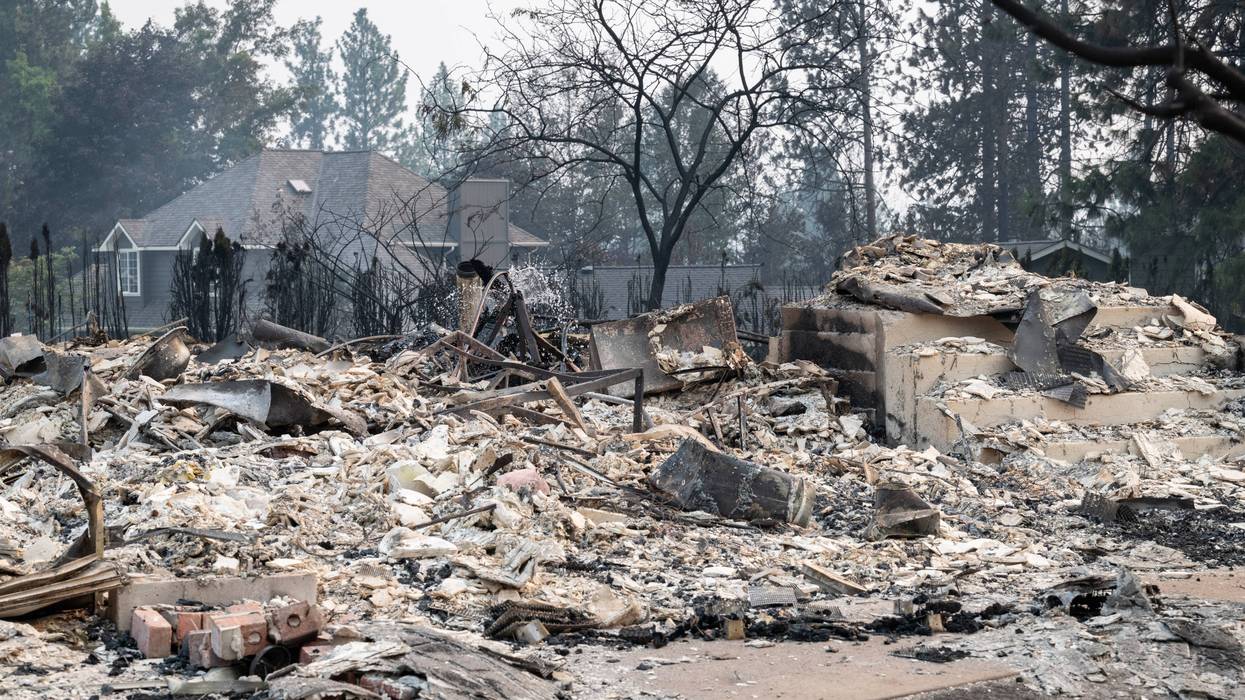
If the infernos raging around the world don’t bring policymakers to their senses and force necessary changes to grapple with the fossil-fueled climate crisis, what will?
Unusually hot, dry conditions across many parts of the world—including in Algeria, Canada, France, Greece, Morocco, Spain, Tunisia, and the Western United States—have set the stage for the catastrophic wildfire season underway now. Just over this weekend, rapidly spreading wildfires have exploded around Spokane, Washington, forcing nearly 65,000 people to evacuate thus far. Unrelenting hot dry weather, supercharged by climate change, is contributing to the dangerous conditions causing these fires.
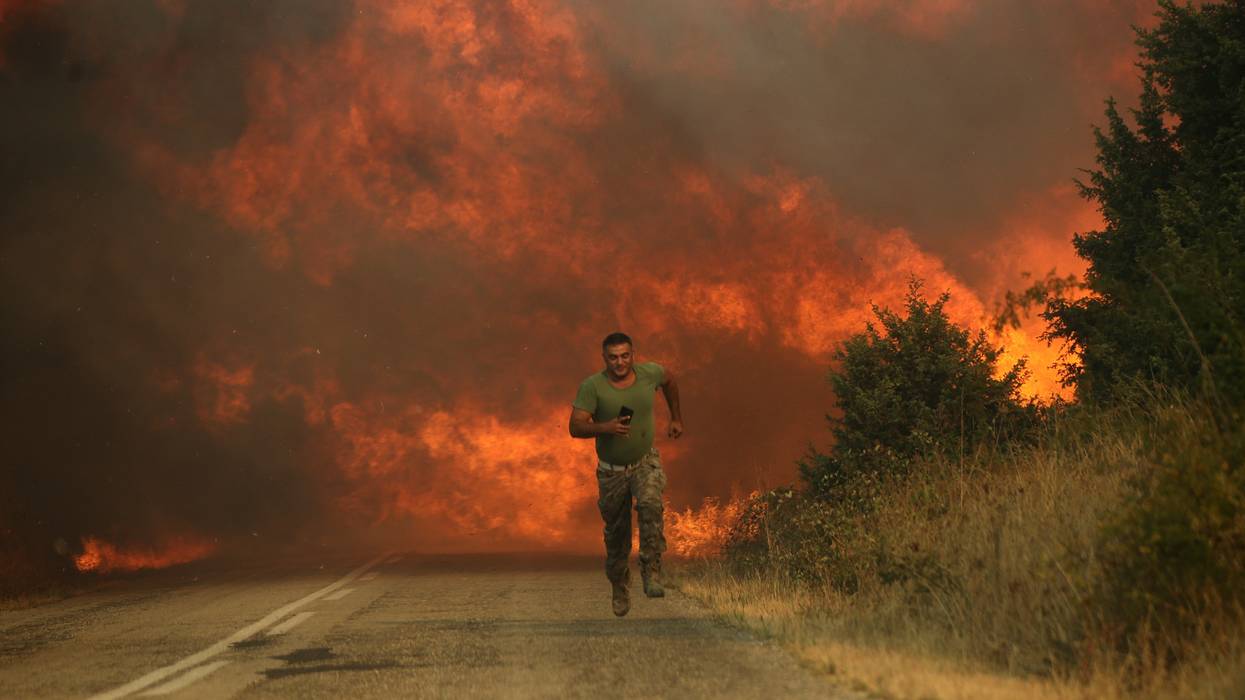
The images of these fires are stunning, their scale terrifying, the human toll enormous already and mounting. And while the proximate causes of the fires, the types of vegetation burning, and nearby settlements differ greatly, the abnormal climatic conditions looming in the background everywhere are unmistakably clear.
Many lives have been lost, and precious communities razed to the ground. Hundreds of thousands of people have had to evacuate from fire zones and millions more have experienced dangerous levels of exposure to wildfire smoke. And, unfortunately, more heat is on the way—a deadly hazard on its own, and one that will also continue to fan the flames of this extraordinarily destructive wildfire season.
If these infernos don’t bring policymakers to their senses and force necessary changes to grapple with the fossil fueled climate crisis, what will?
The 2026 wildfire season got off to an early above-normal start in the US. Thus far this year, nearly 5.3 million acres of land have burned across the country, well above the 10-year average of 3.7 million acres for this time of year. On July 18, the National Preparedness Level was raised to 5, the highest level, a sign of the extreme fire dangers and high level of resources committed to fight fires.
Colorado, Nebraska, and Utah are among the states that have experienced an incredibly challenging wildfire season this year. The Aspen Acres fire, covering nearly 102,000 acres in Colorado, has been burning for over a month now. And recent rains have led to heavy flash flooding in the burned areas, carrying ash and debris across roads and into waterways.
Even as wildfires are raging, fossil fuel companies are raking in record profits, aided by craven politicians all too eager to give them free rein to burn down the planet.
As of last week, Oregon had 31 large fires burning, across 1.6 million acres. They include the Rowe Creek Complex fire currently covering over 320,000 acres, the Big Grass fire with over 337,000 acres, and the Coleman Creek fire covering over 251,000 acres. Despite the state being in such a dire situation, the Trump administration has denied FEMA Fire Management Assistance Grants (FMAGs) for two wildfires: the East Evans Creek Fire and Rowe Creek Fire Complex. State Sens.Jeff Merkley and Ron Wyden have strongly criticized the action and demanded answers from the agency.
Washington had 13 large fires burning over nearly 204,000 acres as of last week, including the Kaiser Canyon fire, which has burned over 128,000 acres.
The latest fuels and fire advisory for the Pacific Northwest notes that low snowpack and drought conditions in the region have led to fuels (i.e. vegetation) drying out much earlier than usual—all of which is ‘producing extreme fire behavior.’ This means intense fires that spread rapidly and are hard to control, putting people and infrastructure in danger.
And the most recent wildfire outlook for August shows continued elevated fire risks in the Northwest, the upper Midwest, as well as Texas, and southern Florida.

Numerous large wildfires (nearly 900) are also burning across Canada. Over 9 million acres (3.76 million hectares) have burned thus far this year as the nation experiences one of its worst seasons (with the province of Ontario experiencing its worst-ever season).
France and Spain are also in the throes of their worst wildfire seasons on record, with little letup in sight as yet another intense heatwave rolls through Europe, the fastest-warming continent globally. Approximately 300,000 people have been displaced by the fires thus far, which are now approaching major cities. Firefighters have lost their lives. Homes and livelihoods are going up in smoke. New research from World Weather Attribution shows that climate change is increasing the likelihood of the kind of hot, dry conditions preceding the extreme fire weather that led to the wildfires in France and Spain.
Northern Africa, which has received far less attention, is also seeing major wildfires which have caused deaths, prompted evacuations, and are putting a big strain on local firefighting resources in Algeria, Tunisia, and Morocco.
And earlier this year, Southern Hemisphere countries, including Australia, Chile, and Argentina, experienced intense wildfires during their summer season.
While year-to-date carbon emissions from biomass burning in wildfires were at record lows in the first half of the year, that could change rapidly depending on how the next couple of months of peak fire season in the Northern Hemisphere go (especially boreal fires).
Repeatedly this year, smoke from wildfire\s in Canada and the Western US has blanketed areas up to hundreds of miles to the east and south, reaching as far south as Florida last week. At times, over 100 million people were under alerts for pollution from wildfire smoke. Numerous cities—including Chicago, Detroit, Toronto and Milwaukee—experienced hazardous levels of particulate matter pollution, which can cause heart and lung ailments, worsen or trigger asthma, cause cancer, and even lead to death.
It’s almost unbearable to think that we knew the scientific facts decades ago and policymakers could have taken action to limit the harms so evident around us today.
Research shows that the contribution of wildfires to PM2.5 pollution has been steadily growing in the US. One recent research article on the health impacts of wildfire smoke, driven by climate change, estimates that cumulative excess deaths caused by PM2.5 pollution could be as high as 1.9 million between 2026 and 2055.
Firefighters who spend extended periods of time exposed to hazardous smoke, often with little to no protection, face some of the most acute health risks. A 2025 investigative series by Hannah Dreier of The New York Times showed the harrowing toll this is taking on young firefighters who are getting sick and dying from the toxic substances they’re exposed to. The Forest Service and the Department of Interior have finally been forced to respond and start providing N95 respirator masks to frontline firefighters in 2026.
Even as wildfires are raging, fossil fuel companies are raking in record profits, aided by craven politicians all too eager to give them free rein to burn down the planet. Fossil fuel companies and their political allies are now pushing for legislation to grant them immunity from legal and financial accountability for the climate damages they have caused. Join us in fighting back: Tell Congress: No Immunity for Big Oil!
And the Trump administration’s cuts to the US Forest Service staffing and budget, closure of research stations, and chaotic reorganization plans for federal firefighting efforts are also hampering efforts to address wildfire threats. News stories indicate that DOGE’s destructive actions also delayed grants for forest thinning and fuels management efforts in Minnesota, in an area that has now experienced major fires.
Whether it’s catastrophic wildfires or unrelenting heatwaves, this year has brought home the realities of climate change in ways that are hard to comprehend. Tens of thousands of people have died from extreme heat this year alone, with the highest toll in Europe and Asia. We’ve seen searing images of people fleeing for their lives, and firefighters bravely risking theirs, in the face of towering wildfires. Otherworldly, murky yellow skies and smoke-refracted sunsets signaling dangerous air quality have become all too common.
It’s almost unbearable to think that we knew the scientific facts decades ago and policymakers could have taken action to limit the harms so evident around us today. We can’t let greedy fossil fuel companies and spineless politicians decide our future. We owe it to people reeling from climate-fueled disasters today, and to the generations to come that will live in the shadow of our choices, to do what it takes to chart a different, safer path ahead.

As the consequences build, the pressure on decent politicians to act will grow.
The climate fight moves in stages. A decade ago, we got to the pledge stage. First, governments signed the Paris accords, and then, under pressure from Greta Thunberg’s movement, banks and corporations did the same. Leaders don’t mind making pledges; the hard part is always a few years away, and the pledge itself takes off some of the pressure.
Then other stuff intervened: Covid-19, the invasion of Ukraine, AI, the high prices that those things caused, the fascists that were elected on the back of those high prices. So politicians and corporations began to abandon their climate pledges, in favor of other priorities.
But what do you know, now something else is happening: a global outbreak of extremely high temperatures, and with them all the disasters we’ve come to expect. The question is, will that provide pressure enough to get climate action back on course? We’re going to find out over the next year, and I think we’re going to find out first on the other side of the Atlantic
This spring and summer have been horrific in Europe and the UK. A wavering jet stream—the product of a melting Arctic—has brought heat dome after heat dome to the continent, producing bouts of extraordinarily high temperature. Records have been smashed left and right, and now that heat is producing vast fires, centered in Spain and France, but spreading far afield to the UK, Belgium, and elsewhere.
Why would you recommend a Mediterranean climate at the precise moment that the countries that ring the Med are on fire?
I want to start the account by saying: These are not the worst heatwaves underway in the world. It’s hit 127°F in Iran, even as the bombs are falling; India has seen another brutal spring and summer, and as Hannah Ellis-Petersen and Aakash Hassan write from Andhra Pradesh, the toll on very poor people is unbearable. They describe Mahalaxmi, paid by a government scheme to join with other women in digging a new reservoir by hand:
By 11:00 am, the first shift of their day was over. The women headed home, exchanging few words due to their exhaustion. Mahalaxmi did not speak when she got home, but went straight to the bedroom where she collapsed in apparent sleep.
Unable to rouse her hours later, her husband, Palli Shyam Sundha Rao, rushed to find a doctor. Examining her lifeless body, the doctor concluded Mahalaxmi had died from heatstroke.
“It was such a shock to all of us,” said Purilla. “She always seemed so strong. If the heat can take her like this, then it could take any of us.”
So let that serve as a baseline. Scary as what’s happening in Europe and the US is, we retain some wealth to buffer our lives and our communities. That’s not true elsewhere. Still, it’s been wildly hard in Europe. As Mark Landler and Chico Harlan reported on Thursday:
Ravenous fires. Searing heatwaves. Freakish storms. The summer of 2026 has already shattered meteorological records in several European countries. On a continent that has weathered centuries of upheaval—ruinous wars, deadly pandemics—it is the weather itself that now has Europe feeling close to a breaking point.
It has displaced more than 300,000 people in France and Spain, where the largest fires in those countries’ modern history have led to their largest peacetime evacuations, with villages destroyed and hundreds of thousands of acres incinerated. It has left millions more desperate for relief from temperatures that routinely soar above 40°C, or 104°F.
And there is absolutely no doubt how connected all this is to global warming—that is, to our longstanding habit of burning coal and gas and oil. Raymond Zhong, writing in the Times, says new research makes that clear:
For central Spain, the scientists found that the intense heat and dryness in July had roughly a 17% probability of occurring in a given year in the present-day climate. In the preindustrial world, however, the likelihood of such conditions would have been one-twentieth as high, the researchers estimated.
In fact, we can say with increasing specificity what happened, and it’s very similar to things we’ve seen elsewhere, and that I described a few weeks ago in an interview with University of California climate scientist Daniel Swain. What we’re seeing is what he calls “weather whiplash,” when the extreme rains that climate change produces cause a massive growth of vegetation in the spring, only to see these new high temperatures produce “flash droughts” that turn those green grasses and shrubs into tinder, waiting for lightning to strike. The folks at Yale Environment 360 quoted:
Francesca Di Giuseppe, fire forecast coordinator at the European Centre for Medium-Range Weather Forecasts, who said the “rebound” from a wet winter to a dry summer was a key factor. After an exceptionally rainy winter spurred the growth of vegetation, an unusual summer drought turned that new growth to tinder.
The results have been brutal. I won’t bother cataloguing deaths and dollars—if we’re “lucky,” the former will be measured in the many tens of thousands, and the latter in the hundreds of billions—but I do want to give some small sense of what life is like. Madeline Schwartz, editor of the international journal the Dial, writes from Paris that:
This summer has unleashed a special kind of hell on France: not just several heatwaves with temperatures reaching as high as 112°F, but drought and forest fires, some right next to Paris. On my street, the leaves have already turned brown; a once lush lawn now looks like burned straw. Across the country, farmers are reporting that crops have withered in the blistering conditions.
The British paper The Express reports that signs in grocery stores warn produce buyers about high prices and unavailable items:
“Produce such as carrots, onions, and potatoes will likely be hit the hardest due to dry soil shrinking crop sizes, while leeks, cabbage and cauliflower could also become harder to find.”
Salad crops such as lettuce may also face a price hike, as they could be replaced by pricier imports due to the heavy irrigation required.
Cupboard essentials such as bread, pasta, and cereal could be affected too, as wheat and barley crops come under heat stress.
Pippa Neill describes the stress on farmers:
“The vines are dying. The grass is yellow and now we can smell the smoke,” Uyen Do, an organic farmer in the Dordogne region of France says, almost in tears. “It’s already very difficult to survive economically and now with climate change it’s becoming a struggle that I’m not sure we’re capable of going through.”
But British farmer Brian King says drought is just one part of the problem. During the recent heatwaves, which saw several days where temperatures exceeded 30°C, “the environment was so hostile that the plants are so stressed they want to die because they just can’t take it”.
Drought has pushed the Rhine River to its lowest recorded levels, stranding the barges that normally carry coal and gas. As Eamon Farhat reports:
The cost to ship diesel from Rotterdam to Karlsruhe—further inland from the closely watched Kaub chokepoint—has climbed to the highest since Bloomberg began compiling the data in 2009.
“With every centimeter it’s getting more difficult,” said Florian Krekel at Germany’s WSV, which manages the country’s waterways. “There’s no rain in sight.”
As river levels fall, Hungary and France are having to shut some nuclear power plants because they can no longer safely cool them; oh, and a sunken Nazi warship has reappeared along the dwindling Danube in Serbia, so that’s nice. The Royal Horticultural Society, meanwhile, may have to move its hydrangea garden to the north of England
But it’s the fires that have really left their mark on this European summer. As Margherita Stancati, Noemie Bisserbe, and Ed Ballard wrote in The Wall Street Journal last week, the continent has never seen anything on this scale before:
In Spain, the fires have destroyed more than 370,000 acres so far this year. Isabel Díaz Ayuso, the leader of Madrid’s local government, earlier this week described the Madrid wildfires as perhaps “the worst natural catastrophe in Spain’s history.”
The intensity of the fires has created large, fire-fueled thunderstorms, known as pyrocumulonimbus clouds, for the first time in France’s recent history. The clouds, which have been observed during wildfires in Canada and Australia, are created by intense heat that lifts hot smoky air and causes the water vapor to condense into ash. The clouds can generate lightning, further spreading the fires.
The US is so vast that sometimes we barely notice things happening in the other corner: There are big wildfires burning in Oregon right now, for instance, (and the chance for many more over the course of a windy weekend). But we forget how compact European countries are. France is among the largest of its nations, but the Tour de France had to be shortened on its final day in order to free up policemen to go help with firefighting in other regions of the country. So there’s no escaping the smoke, or its political meaning. And that’s what we need to talk about.
All this comes after a period of what American politicians have called “climate-hushing,” when even non-MAGA leaders have been backing away from the steps needed to speed up the energy transition. That’s been true in other places too. Bill McGuire, a climate researcher at University College London, wrote that:
Such is the astonishing scale of the wildfires burning at the gates of Bordeaux and Madrid, that if they had happened 20—even 10—years back, they may well have shocked the world into taking action on the climate crisis. But like the proverbial frog in a pot of slowly heating water, we have become inured; not only to the ever more devastating impacts of climate breakdown, but increasingly to the actions needed to bring global heating to heel.
Even as more than 35,000 wildfires rage across the surface of our world, and as we continue to rewind our planet’s climate so it resembles hotter episodes from its distant past, governments and trading blocs are very deliberately turning away from climate action.
The latest evidence that we are not only doing too little but actually doing less as time goes by is provided by the climate action media platform, We Don’t Have Time. It reported last week that the 12 months to July this year saw the reversal across the world of 45 climate policies. The retreat on climate action is global, but Europe—previously seen as a leader in emissions reductions—is in the vanguard, weakening measures across the board, including in the areas of carbon pricing, methane emissions, and the phasing out of petrol and diesel vehicles.
There are even some who are seizing on the new disasters to urge… less action. In a truly remarkable essay for Britain’s conservative Telegraph, pundit Allister Heath used the fires to say that the “war against global warming has been lost” and hence it was time to
accept this sobering reality, cut our losses, cease tilting at (and building) windmills, ditch the despicable con that is net zero, and learn to cope with, and even enjoy, a warmer, drier, more volatile Mediterranean climate.
This is monumentally stupid on several different levels, and Alan Rusbridger, former editor of The Guardian now proprietor the the British magazine the Prospect outlines a number of them in a (highly enjoyable) takedown. But mainly: Why would you recommend a Mediterranean climate at the precise moment that the countries that ring the Med are on fire? And of course it’s not as if you get to choose even the current, fiery Mediterranean climate. If you abandon “net zero,” or the other attempts to rapidly build out solar panels and windmills, you’ll get an ever hotter version.
That hasn’t stopped Britain’s Conservatives from purging party members who want to continue the energy transition, and there are at least some signs that England’s new prime minister, Labour’s Andy Burnham, is tilting in somewhat the same direction. The Murdoch tabloids have been mounting a crusade to open up new oil wells in the North Sea, and Burnham said this week that the country needed to be “pragmatic” in the face of rising energy costs, never mind that the global price of energy won’t budge one pence with whatever new supply can be found in the dwindling deposits off the UK coast.
But my guess is that Burnham may well decide to stand up to Murdoch et al. and turn his back on more drilling, simply because the heat and the smoke have made the case for climate action so wildly clear. As Fiona Harvey and a team at The Guardian reported yesterday, a rebellion is brewing because many Labour parliamentarians
are increasingly worried about how support for expanded drilling will play with an electorate alarmed by the worst drought since 1976, soaring temperatures, wildfires, and climate-related food inflation and potential supply shortages.
They worry about losing more voters to the Greens: Zack Polanski’s party has stressed its opposition to further new licences for the North Sea, including the Jackdaw gasfield in the North Sea and the Rosebank oilfield, west of Shetland. A decision to go ahead with the projects could trigger a new surge in defectors from Labour.
Rachael Maskell, the Labour MP for York Central, urged ministers to “keep carbon in the ground”, and watch the recent national emergency climate briefing. She added: “We’re seeing ice caps melting, seas warming up, hotter and hotter summers. This summer has been a warning that we have to go towards a sustainable future fast.”
Clive Lewis, the Labour MP for Norwich South, said there was “no legitimate reason” to press ahead with Jackdaw because it would make only a negligible difference to energy prices while sending the wrong signal internationally as Europe experienced record heat.
Lewis said approving the field would show Burnham was “not looking at the evidence” and that Labour risked adding “the stain of the climate crisis” to the party’s record, alongside Gaza.
Indeed, Britain’s brand new Foreign Minister Ed Miliband, who had been its energy and climate minister until last week, has already issued a joint communique with his Spanish counterpart calling for deeper climate action:
At a time when Europe is facing record heatwaves and terrible wildfires as a consequence of the climate crisis, the two Ministers agreed that this summer’s wildfires demonstrated that climate change was now a national security emergency facing Europe and threatening our way of life.
Both parties agreed that tackling the climate crisis was an urgent policy priority for all countries—to tackle the cost of living, protect health and well-being, and to ensure European economic and energy security. The two Ministers noted that climate action was essential to protect not just current generations, but our children and grandchildren too.
The two Ministers underscored the priority they attach to combating climate change within their foreign policy and agreed on the need to co-lead the green transition, convinced that decarbonisation, energy security, environmental protection, and resilience are inseparable from our security and the prosperity and competitiveness of our economies.
I think that this is a good sign—and I think it’s a dry run for what the whole world is going to go through over the next 12 months. The signs keep mounting that the El Niño building in the Pacific is going to be massive in scale. As United Nations Secretary General Antonio Guterres said last Friday:
This is only a warm-up act. El Niño is strengthening, adding fuel to a planet already on fire.
As the consequences build, the pressure on decent politicians to act will grow. Obviously the Trump administration, and its fascist friends elsewhere, will continue to coddle the fossil fuel industry—but it will be harder and harder for others to turn aside renewed climate fears. I’d be willing to bet that climate will be a key issue in the Democratic primaries (and campaigning for those will be well underway by this time next year).
In fact, there’s already an effort underway—the veteran campaigner Margie Alt is helping lead a Climate Action Campaign this summer to get the issue back on the political… front burner.
Actions began on Thursday and will take a variety of forms. In Michigan, participants will demonstrate against the Republican representative Bill Huizenga who voted for Trump’s so-called big beautiful bill, which boosted planet-heating fossil fuels.
In Arizona, young activists will meet with the Democratic representative Adelita Shirley Grijalva, a climate champion, and encourage her to continue talking about global warming. In other districts, organizers have circulated petitions calling on the House Democratic leader, Hakeem Jeffries, and Senate Democratic leader, Chuck Schumer, to prioritize climate issues or plan to call on their representatives to connect the climate crisis to recent heatwaves.
I have no doubt it will annoy some Democrats—and no one is saying the issue should dominate the midterms, which must be fought on the value of democracy and the cost of living. But every politician worth her salt should at every opportunity at least mention the anti-renewables jihad that the Trump administration has launched—the number of Americans who support shutting down 90% finished wind farms is tiny, and the rest of us are truly annoyed.
And in many ways this generation of politicians is the luckiest yet, because they have a tool to call on that make those pledges relatively easy to fulfill. With ever-cheaper power from the sun, wind, and batteries, this ultimate cycle of the climate fight will look different than the ones before. We’re going to get a last chance to get this crisis at least a little right. We dare not lose it.

Everyone needs to consider spending at least some time every year doing what they can to improve the climate or soon events like this week’s convergence of bad global warming outcomes will become both commonplace and unstoppable.
Many older environmentalists, myself included, have been trying to warn our fellow human beings about the danger of global warming since the 1980s.
Back then, there were fewer signs that what the vast majority of climate scientists were already saying about the then-looming crisis would come true.
Over the years, we’d be more likely than people around us to worry about summers getting hotter than they had been in our childhood. Or storms getting more intense. Or getting less rain where there used to be more and more rain where there used to be less. And so on. But the real dangers were still in the future, and many people have trouble processing dangers that are not in the present, we understood.
And we did what we could for 40 years.
We have a Republican administration, working more directly for the fossil fuel industry and other related destructive and antiquated industries than any other to date, that seems determined to do as much damage to the planet as it possibly can while in power.
And it wasn’t enough.
And now global warming is definitely here. And it’s gotten so bad so fast that this week many of us on the East Coast were treated to two major manifestations of the climate crisis that is upon us like a wolf burying its fangs in our collective neck: Another of the increasingly frequent “heat domes” that translate to increasingly horrendous heatwaves plus terrible smoke from wildfires in Ontario.
And the smoke was so bad that it actually mitigated the heatwave. Something so messed up that few of us who aren’t, say, trained geophysicists have ever conceived that such a thing could happen outside of a major volcanic eruption in our hemisphere… like the big one in Iceland in 2010.
So where do we go from here? Well, things aren’t looking good.
We have a Republican administration, working more directly for the fossil fuel industry and other related destructive and antiquated industries than any other to date, that seems determined to do as much damage to the planet as it possibly can while in power. We have a Democratic Party that is better on global warming, but not that much better, hoping to retake the federal government. We have other political forces more committed to bringing the “drill baby drill, burn baby burn” crowds to heel—like the Green Party and Democratic Socialists of America. But they remain very small relative to the population (outside of DSA’s impressive base in New York City thus far) and hemmed in on every side by the major parties. And most of the largest environmental organizations have simply run out of steam.
Major advances in several areas of science and technology are likely sufficient to allow humanity to at least blunt the worst effects of global warming. And some countries are funding such research and working to meet self-imposed climate targets. But most are not, least of all the United States. Which “is the second-highest climate polluting country, responsible for around 12% of global emissions,” according to Yale Climate Connections. The highest being China, a nation that is also doing much more to remediate global warming than the US. Nor is the best science useful if it’s not deployed. Even as the pollution responsible for warming continues to get worse year by year.
Do I know some magic path out of this morass? No. But I will tell you this: Everyone needs to consider spending at least some time every year doing what they can to improve the climate or soon events like this week’s convergence of bad global warming outcomes will become both commonplace and unstoppable.
Just like all of us environmentalists have been saying all along. In the public interest. Not for personal gain. Unlike what the climate scofflaws profiting from the destruction of human civilization have all-too-successfully propagandized far too many Americans into believing.
Mull that over while you wait for the smoke to clear and heat to subside… until the next “smokewave” and the next heatwave.
And the next and the next and the next and the next…
The original version of this article ran on July 17, 2026 at BINJ.News.

The time has come for us to rise up against this deceptive and powerful industry, to finally kick them out of spaces with influence. It is high time for us to stop being manipulated by fossil fuel companies that are only out to make a profit and harm us.
Temperatures have soared globally this summer. And far from simply being uncomfortable, it’s killing people.
This past July 4 was one of the hottest in US history. While Americans gathered to celebrate the country’s 250th birthday, dozens died from extreme heat—and the toll may still rise. In Europe, which has seen its own devastating heatwave, some 3,700 people have died. And the heat has become so extreme in Pakistan that people’s teeth are literally dissolving in their mouths.
This is only the beginning of extreme heat this summer—and if we don’t stop the climate crisis, for the rest of time. Scientists are warning that this marks “uncharted territory” in rising temperatures.
The good news? We know the solution. To build a better world, with cheaper and cleaner energy, we have to phase out fossil fuels and transition to green energy. This process is easier and cheaper than ever. Some 90% of renewable energy is now cheaper than fossil fuels, and renewables don’t heat our planet the way that fossil fuels do.
As temperatures rise, we are now in a battle of people vs. fossil fuels.
The bad news? Fossil fuel companies, and the politicians who support them, are trying to block this transition. Companies like Exxon have known for over 50 years that fossil fuels cause climate change —and that rising temperatures would cost lives. But they’ve tried to bury this information, stall the transition, and deceive the public that fossil fuels aren’t responsible.
I’ve seen this play out firsthand.
When I was 17, I spent a sunny week in Dubai at the 28th United Nations annual climate conference (COP28). I was so excited to attend the conference. I met other activists passionate about renewable energy and taking down the fossil fuel industry. I even attended lobbying meetings with the lead US negotiators, Trigg Talley and Sue Biniaz.
Everything in Dubai felt larger than life—from the Burj Khalifa to the massive dome in the middle of the conference center. But over the week, the conference began to feel more and more dystopian. The fossil fuel industry had sent 2,456 lobbyists to that COP—and despite the loud cries of activists and scientists, their voices drowned ours out.
At the end of the conference, we had a small win—fossil fuels were mentioned in a COP text for the first time ever. But the language was so weak that the statement felt almost meaningless. The text did nothing to change the trajectory of the climate crisis.
The fossil fuel industry has propagated lies about climate change for years. They’ve tried to convince us that climate change is our fault instead of theirs, with campaigns around “carbon footprints”—a concept created by BP—and recycling, which was popularized by the plastics industry but has never managed to efficiently recycle plastics themselves.
They have also spent hundreds of millions of dollars on influencing climate decision-making spaces—from United Nations conferences to Washington, DC. Big Oil spent $445 million during the 2024 elections—and in return has gotten $40 billion in fossil fuel subsidies from the Trump administration.
The time has come for us to rise up against this deceptive and powerful industry, to finally kick them out of spaces with influence. It is high time for us to stop being manipulated by fossil fuel companies that are only out to make a profit and harm us.
As temperatures rise, we are now in a battle of people vs. fossil fuels. We must win—it’s a matter of life and death.
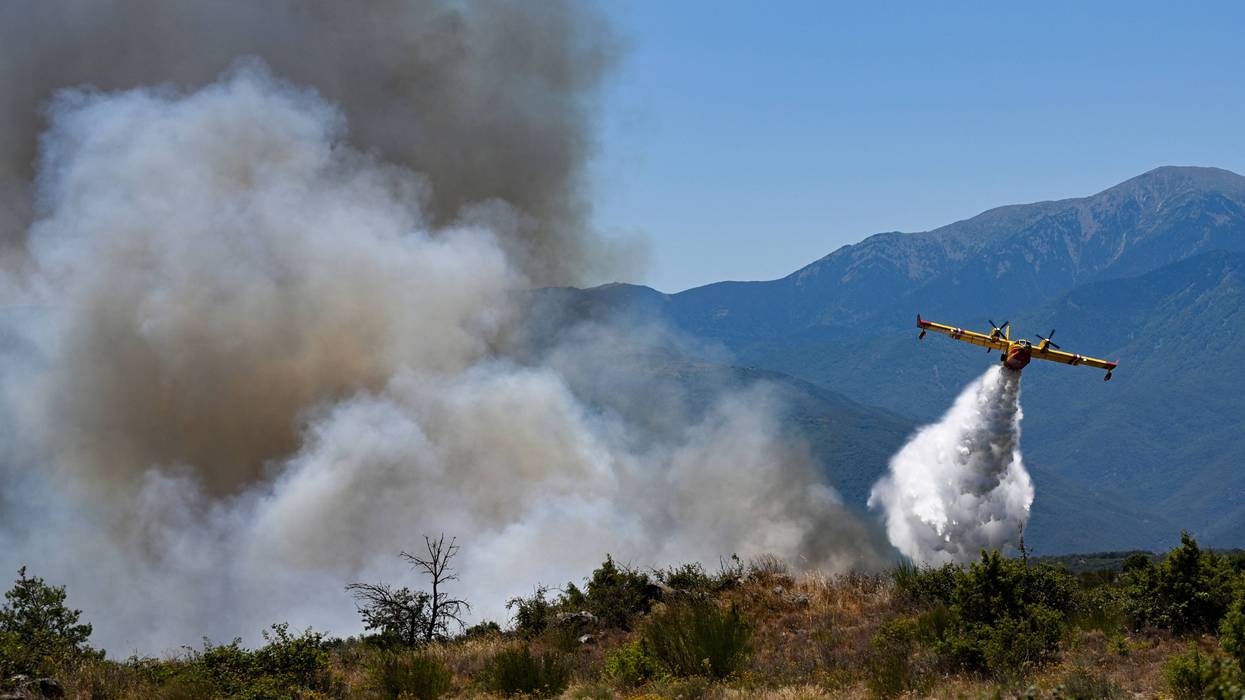
Blazes mobilized hundreds of firefighters over the weekend and scorched a total of 42,000 acres in Spain, France, and Portugal alone—an area two times the size of Manhattan.
On the heels of a deadly European heatwave, fierce fires erupted in Greece, Spain, Portugal, and France over the weekend, raising fears for a summer of extremes as the effects of the climate emergency become ever more apparent.
The blazes mobilized hundreds of firefighters and scorched a total of 42,000 acres as of Sunday in Spain, France, and Portugal alone—an area two times the size of Manhattan.
" Climate change is here, we are living the consequences and it is only the start of July," French fire service Colonel Eric Belgioino told the public, as Agence France-Presse reported.
Multiplication des #wildfire🔥(feux de forêt) ce dimanche en France.
Quatre foyers, dont trois hors de contrôle, sont désormais visibles simultanément depuis les satellites. À eux seuls, ils ont déjà parcouru l'équivalent d'environ 3.500 terrains de football. @zoom_earth pic.twitter.com/qpdrct7AmA
— Guillaume Jauseau (@GJauseau) July 5, 2026
One of the fires raging in the South of France forced organizers of the Tour de France to close the third stage of the race to the public on Monday, as Reuters reported.
The fire has consumed 6.18 square miles in Southern France and put two people in critical condition.
"An exceptional fire calls for exceptional measures for the tour," race director Christian Prudhomme said, according to Reuters.
As of Sunday, seven departments in France faced "very high risk” for fires, as temperatures were expected to reach highs of 100-104°F across the south, as Anadolu Agency reported.
🇪🇸 🔥 Firefighters tackle wildfires menacing Spanish tourist hotspot
Wildfires in Catalonia have burned over 2000 hectares of forest, prompting regional authorities to ask residents of 10 municipalities to stay at home, including in popular tourist hotspots such as the Platja… pic.twitter.com/Dal7mlAJlu
— AFP News Agency (@AFP) July 5, 2026
Across the border in Spain, a fire in Costa Brava burned through over 5,400 acres in a 48-hour period, according to AFP. The flames led to shelter-in-place or evacuation orders for nearly 50,000 people.
The Catalunya fire service said on Sunday that firefighters "worked tirelessly throughout the night to consolidate the perimeter of the La Bisbal d'Empordà forest fire, which is now stabilized."
A large wildfire near Vouzela in central Portugal spread overnight across three municipalities, burning over 2,400 hectares, injuring six people and forcing village evacuations, with nearly 1,000 firefighters and eight aircraft deployed to tackle the blaze https://t.co/GzfxgDSGiq pic.twitter.com/v5KgKj9IPt
— Reuters (@Reuters) July 3, 2026
Another blaze ignited in Portugal's central Vouzela area on Thursday.
It burned through 30,000 acres and required the work of 1,200 firefighters before it was partially contained as of Sunday.
🇬🇷🔥 Not only are Europeans dealing with deadly heat, there is also a fire threat.
Check out this video from an overnight fire in the Oreokastro area of northern Greece.
So far, 2 factories have been destroyed, and evacuations have been ordered near Thessaloniki.
Writer:…
— Mario Nawfal (@MarioNawfal) July 5, 2026
In Greece, two fires erupted on Saturday and Sunday.
The first, in the Oraiokastro suburb of the country's second-largest city of Thessaloniki, compelled evacuations and shelter-in-place orders when it overtook a recycling plant and released dangerous smoke into the air, The Associated Press reported.
“The smoke contains volatile organic compounds that irritate the eyes and throat, as well as carcinogenic substances such as benzene, dioxins, and furans,” Dimosthenis Sarigiannis, professor of environmental engineering at the Aristotle University of Thessaloniki, told ekathimerini.com.
The inferno also damaged multiple homes and businesses, Oraiokastro Mayor Pandelis Tsakiris told the country's state broadcaster.
The second blaze ignited on Sunday west of Athens, according to AP, and 210 firefighters worked hard to control it before the sun set and firefighting planes would be grounded.
The European fires follow a heatwave that scientists said would have been "virtually impossible" without climate change caused by the burning of fossil fuels, and spark concerns that the continent could see a devastating summer for fires.
French Interior Minister Laurent Nunez noted that the fire season had started one month early, according to AFP.
As fire Colonel Belgioino said: "The season is going to be long for the soldiers fighting fires. You have to help us."

"How we confront the climate crisis will determine a lot about the next 250 years of American history, including if we make it that long," one climate advocate said. "The revolution we need today is the clean energy revolution."
The US reliance on and promotion of fossil fuels is interfering with its ability to celebrate its 250th birthday, as several July 4 events were canceled due to a dangerous, record-breaking heatwave in the Central and Eastern US that scientists say would have been "virtually impossible" without the climate emergency.
As millions of people sweltered under heat alerts, extreme heat and humidity led to the cancellation of both Washington, DC and Philadelphia's Independence Day parades. Nearly 30 other events in states including Alabama, Delaware, New Jersey, New York, Pennsylvania, Maryland, and Virginia were modified, postponed, or canceled, according to USA Today.
I'm just saying, it seems like a signwww.cbsnews.com/philadelphia...
[image or embed]
— Bill McKibben (@billmckibben.bsky.social) July 3, 2026 at 1:12 PM
"The US having to cancel major 4th of July celebrations because of extreme heat is almost too spot on as a metaphor for the country’s failure to combat global warming," Fossil Free Media director Jamie Henn told Common Dreams. "How we confront the climate crisis will determine a lot about the next 250 years of American history, including if we make it that long. The revolution we need today is the clean energy revolution so we can finally declare our independence from fossil fuels."
Happy Independence Day!🇺🇸🎆
A prolonged, dangerous heat wave will persist through the Independence Day weekend across the Ohio Valley, Midwest, and Mid-Atlantic. Numerous temperature records are expected. 🥵
Clusters of severe thunderstorms will move across parts of the… pic.twitter.com/hz4vSz40Z4
— National Weather Service (@NWS) July 4, 2026
Temperature records were tied or broken in 22 locations on Thursday and 17 on Friday, according to CNN, with DC breaking a 120-year record on both days with temperatures above 102°F.
The heat forced the temporary closure Friday afternoon of the Great American State Fair on the National Mall, and seven attendees required "advanced life support," probably due to heat exposure, according to CNN.
Matt Rein, the Democratic National Committee's influencer and creative partnerships director, reported from the state fair on Saturday that local emergency workers said guests were "dropping like flies" due to the heat.
This is the scene here at one of the cordoned off medical area inside a main tent.
They keep having to make more space as more people are brought in.
There is no AC. https://t.co/eVVpqwHiMJ pic.twitter.com/Rmyg4YW1r2
— Matt Rein (@MatthewARein) July 4, 2026
Meanwhile, one group who tried to draw attention to the climate emergency at a July 4 event was evicted for its efforts by the US Coast Guard, as the Times Union reported. The nonprofit Hudson River Sloop Clearwater had attempted to join Saturday's Sail4th 250 parade of tall ships to New York Harbor when its sailboat was removed by the guard. The Coast Guard later said it was due to banners the boat was displaying reading, "Save the Clean Water Act” and “Indigenous rights, racial justice, climate solutions,” despite the fact that the group had the event organizer's permission to participate.
A sailboat, the Hudson River Sloop Clearwater, was removed from the Sail4th 250 Parade of Ships for displaying banners about climate justice and clean water.
Source: ig/jackiemarieburton, ig/sloopclearwater pic.twitter.com/kJoS4RLgAQ
— Dr. Lucky Tran (@luckytran) July 4, 2026
The heat dome that has settled over the Central and Eastern US over the July 4 weekend is so dangerous in part because it includes high humidity along with high heat, with heat indexes of 105-115°F expected in some places. This corresponds with a Wet Bulb Global Temperature (WBGT)—a measurement that accounts for heat, humidity, and air flow—of 28-30°C, at which point it is dangerous for even healthy people to be physically active outdoors. According to World Weather Attribution, the current heatwave broke regional records for WBGT.
"It is still a relatively rare event even in today’s climate, that has warmed by 1.4°C due to the burning of fossil fuels. In a 1.4°C cooler climate, WBGTs as high as those forecast in early July 2026 would have been so extreme as to be virtually impossible," the group wrote on Friday.
Friederike Otto, a professor of climate science at Imperial College London, told CNN, “When a historic 4th of July celebration is disrupted, and World Cup matches are played in conditions that are unsafe for players and fans, it shouldn’t take another scientific study to wake people up."
Otto continued, "Climate change is here, it’s already impacting the things we enjoy in our everyday lives, and it will continue to get worse the longer we drag out the inevitable transition to net zero emissions.”
Climate scientist and communicator Katharine Hayhoe encouraged people to use this opportunity to talk about the climate emergency to their friends and family:
Heatwaves aren't new. But I'm a climate scientist, and I can tell you heatwaves like this are virtually impossible without fossil fuel pollution. Not only that, but when extreme weather hits, research shows that connecting it to climate change helps people understand why it matters. And you know who the most trusted people to do that are? Not scientists. You! Yes, people we know are the most effective messengers to have these conversations. So if you're worried about what's happening and how extreme heat puts us at risk—talk about it!
While the US is the world's leading historical emitter of greenhouse gas emissions, and its military is the No. 1 institutional climate polluter, the Trump administration in particular has taken steps to accelerate the climate emergency by increasing oil, gas, and coal production while hindering the development of renewable energy.
"Trump’s promotion of coal burning and cancellation of wind turbines make him the Benedict Arnold of America’s current struggle, not its George Washington."
Just two days before the nation's birthday, Energy Secretary and fracking CEO Chris Wright bragged on social media that the Trump administration would end subsidies for new wind and solar on July 4.
Climate scientist Rebekah Jones shot back: "During a record heatwave, no less. Fossil fuel industries have received $549 BILLION in direct subsidies, and $7 TRILLION in tax benefits. They average $30 billion per year in upfront taxpayer money. All of renewable energy recieved $400 million per year from 1994-2009."
Tennessee state Sen. Heidi Campbell (D-20) also called out the move: "Talk about 'slugs for salt’—it's 119 degree heat index in the Eastern US this week—these guys are all in on the rapture."
In a July 4 post, scholar Juan Cole argued that President Donald Trump's climate policies were tantamount to treason.
"Since 2018, some 13,000 Americans have died from heat," he said. "Trump’s promotion of coal burning and cancellation of wind turbines make him the Benedict Arnold of America’s current struggle, not its George Washington."
Cole pointed out that the current heatwave was part of a pattern of hotter summers in the nation's capital due to the climate emergency, noting that the last decade was its hottest on record.
He continued:
The bad news is that this is only the beginning. Summers in the capital are going to be more dangerous every decade unless we halt dangerous carbon emissions.
The average summer temperature in DC could be 97°F in the 2080s if we go on farting out CO2 at our current rate. Humidity will also increase, as the Atlantic heats up and puts more water vapor in the atmosphere. The ability of the atmosphere to hold water vapor increases 7% with every 1°C increase in temperature.
That combined with more frequent storms and sea-level rise opens up the possiblity that DC "will be unlivable in the summers within the lifetime of my younger readers," he wrote.
"Trump is helping climate change accomplish what British military might could not, putting in question the future of America in places like Washington, DC and Baltimore, at least in the summers," Cole said.

One journalist called it "the kind of thing somebody can genuinely be prosecuted for if someone dies, which is not uncommon if you slap it together like this."
In what some described as a "fitting metaphor" for the state of the US, a large panel fell from the stage at President Donald Trump's 250th anniversary extravaganza, nearly crushing a group of young dancers during a rehearsal.
A video of the falling piece of wood was posted to social media Thursday by the independent journalist Aaron Parnas, who wrote, "The stage is falling apart at the rehearsal for Freedom 250's July 4th celebration."
The giant panel interrupted a patriotic dance number, making a loud crash and sending bits of dust and debris flying just feet behind the troupe of what appeared to be about two dozen performers on the event's Salute to America stage, where many of the festival's biggest acts are taking place.
“We’re grateful to report that everyone is safe,” a Freedom 250 representative said. “We take the safety of our performers, crew, volunteers, and guests extremely seriously.”
He added that "additional safeguards and senior technical oversight are now in place as preparations continue.”
HuffPost deputy editor Philip Lewis said it was "literally a miracle no one was hurt."
From a scourge of algae in the reflecting pool, to the rash of headline acts bailing from their performances, to the persistent low attendance, and empty booths, the festivities—commandeered by the Trump-aligned Freedom 250 operation—have been seemingly marred by one indignity after another.
Power outages have led the supply of ice cream to become liquefied by the heat, and a faulty generator has led the giant Ferris wheel to run only intermittently.
A model of the president's planned "Arc de Trump" has been mocked as "a sad, peeling mess" by Margaret Hartmann of New York Magazine, who noted the creasing vinyl, cracking wood, and caulk oozing out the sides. The mid-festival addition of a series of improvised columns did little to stop it from being referred to as a "Temu arch."
Other buildings were haphazardly overlaid with vinyl covers designed to look like three-dimensional pieces of classical architecture.
An interim report published Thursday by Democrats on the House Natural Resources Committee emphasized the festival's dual role—in addition to being a monument to Trump's ego—as yet another opportunity for his donors and allies to profit.
Through the newly created Freedom 250 group, the report alleges, Trump has used the event to sell sponsorship packages promising VIP access, speaking roles, private receptions, and photo opportunities with the president.
It also points to federal contracts for Trump-connected event vendors, official merchandise sales through a Trump campaign vendor, and event-registration data routed through a firm founded by former Trump digital strategist Brad Parscale.
The company in charge of the State Fair's production is Event Strategies, Inc.—a firm run by a group of longtime Trump aides. According to the San Francisco Chronicle, it has received taxpayer funds through the National Park Foundation, though it remains unclear how much the company has made.
It's also unclear what, if any, oversights may have led to the dangerous stage mishap. However, the use of an opaque private charity to fund the festival appears to have enabled corner-cutting elsewhere.
According to the Democratic report, the UFC arena on the White House South Lawn “bypassed layers of [National Park Service]-mandated environmental review,” allowing the commercial fighting organization headed by Trump pal Dana White to save time and money, which led to a lawsuit last month seeking to stop the event.
Journalist Ryan Grim said that if there have indeed been safety rules flouted, the falling panel is "the kind of thing somebody can genuinely be prosecuted for if someone dies, which is not uncommon if you slap it together like this."
Many found the short video deeply resonant—a microcosm of the unprecedented elite enrichment that has taken place during the second Trump administration, subsidized by bone-deep cuts to social safety net programs that have made life more precarious for millions of people, including many children.
Political commentator J Aubrey said that it was "hard to imagine a more fitting metaphor for our rapidly decaying society."
There is, unnervingly, still plenty of time for a deadly incident to occur at the fair.
The president's Independence Day celebration is slated to culminate in the launching of 850,000 firework shells from near the reflecting pool and several other sites along the Potomac River.
The National Park Service has projected the display would cause “very unhealthy” conditions around central DC, including particulate pollution that can harm those with asthma, according to documents uncovered by The Washington Post.
Soaring temperatures have also put Washington under severe drought, turning the surrounding area into a potential tinderbox. DC Water has said it was coordinating with federal officials in the case that a forest fire breaks out.
"It only takes one small spark landing in dry vegetation under the right conditions to start a fast-moving wildfire," April Newman, a public information officer at Cal Fire, told Axios.
Trump himself, who recently turned 80 years old and is rumored to be in poor health, is also not immune to the dangers.
The president declared that on Independence Day, "when it's going to be approximately 107 degrees out... I'm going to make a really long speech."
That speech, scheduled for 9:45 pm ET, will take place on the Salute to America stage.
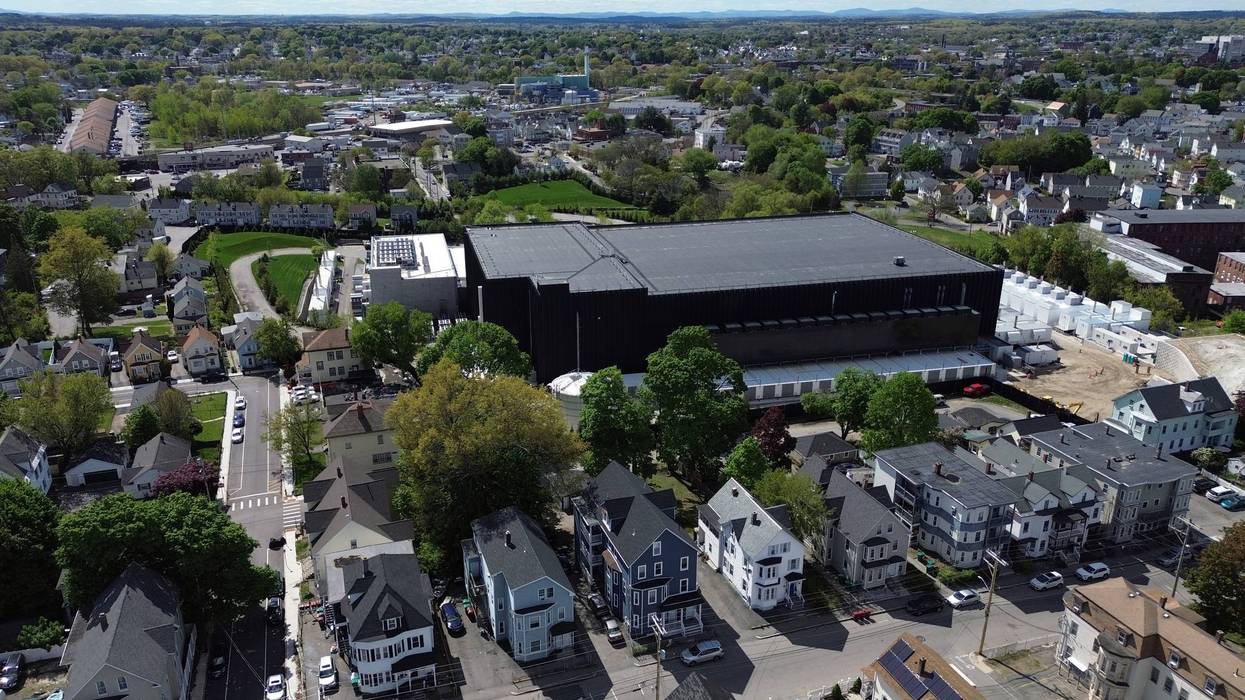
As power grids become strained amid the latest US heatwave, residents of communities with data centers are being asked to make sacrifices in the form of cost, comfort, and potentially safety.
The rise of global temperatures has made oppressive summer heatwaves an annual occurrence, and for many Americans, air conditioning is no longer optional.
But as scorching temperatures bear down on the US once again this week, affecting more than 250 million people across the country, some are suddenly being forced to share the precious cool air with data centers that have popped up in their towns to power the breakneck build-out of artificial intelligence technology.
To keep their massive arrays of computer servers cool, these complexes require large amounts of energy even in normal times. But during a heatwave, the demand becomes even greater.
As power grids become strained, residents of communities with data centers are being asked to make sacrifices in the form of cost, comfort, and potentially safety.
In Henrico County, Virginia, which has 37 data centers, thousands of county employees received an email last week from County Manager John Vithoulkas warning them that beginning on July 1, the rate paid by "government and school facilities will increase dramatically—by 25%, increasing costs by an estimated $5 million next fiscal year."
"To mitigate the impact of higher electric costs, I am asking that we, collectively, make slight adjustments to conserve electricity across our individual workspaces,” he said in the email, which was obtained by 404 Media. “Turn off your lights when leaving your workspace, including when you leave for the day,” he continued. “Turn off your computers/laptops at the end of each workday. If your workspace has windows, adjust the blinds to manage heat from sunlight.”
He also informed them of the high cost of running "space heaters," which Frank Landymore of Futurism.com suggested was a thinly veiled way of telling residents to turn down the AC, since nobody would be using space heaters in 100-degree heat.
It was a signifier of what's happened across the entire mid-Atlantic grid, whose largest operator, PJM Interconnection, is experiencing record energy demand.
According to Reuters, the grid that supplies power to 67 million people has seen a roughly 1,000% increase in capacity prices since 2024 as a result of the AI boom, which is already being passed onto consumers in the form of higher bills.
To reduce the risk of outages caused by an overburdened grid, the US Department of Energy granted PJM the authority to require data centers to operate backup diesel generators.
Under the emergency order, Politico reported, data centers are allowed to produce enough diesel emissions that the Environmental Protection Agency (EPA) would categorize it as a "possible human carcinogen."
The result has been what Shaolei Ren, a professor at the University of California, Riverside, told The Associated Press could be “a disaster for the local air quality" in communities with data centers.
In Lowell, Massachusetts, where a Markley Group data center sits in the working-class Sacred Heart neighborhood, residents told the AP that they were staying inside to avoid smelling the diesel fumes being belched up near their homes.
Public backlash led the Lowell City Council to vote unanimously for a moratorium on data center building in February. But many residents feel the damage has already been done, with the Markley center gobbling up their town's electric and water resources.
One resident told The Harvard Crimson in May that since the center came to town, his winter electric bill has shot up from $40 to $177.
As temperatures spiked this week, more than 200 protesters flooded a local zoning meeting to voice their anger about the noise, pollution, and surveillance equipment bearing down on their homes. One 14-year-old girl was dragged out of the meeting by police officers.
"I'm not hurting anyone," she shouted as cops escorted her through the exit. "We just don't want data centers!"
Within roughly three years, data centers have come to consume about 4.5% of all electricity in the US, a number that is expected to keep ballooning in the coming years.
Even before the data center boom began, scientists had long warned that the climate crisis caused by human carbon emissions would make US heatwaves more frequent, longer, and more intense.
Heatwaves in major US cities are already three times as common as they were in the 1960s, according to an EPA report from 2024, and the average heatwave season is now 46 days longer.
The number of heat-related deaths in the US more than doubled from 1,069 in 1999 to 2,325 in 2023, according to a JAMA Network study analyzing mortality data from the Centers for Disease Control and Prevention.
With more than 1,500 data center projects currently underway across the US, a vicious cycle appears poised to accelerate.
The rapid buildout of data centers has already culminated in massive emission spikes. Amazon, which once pledged to reach net-zero emissions by 2040, saw its carbon output increase by 16% in 2025 in large part due to its multi-billion dollar data center buildout.
According to a report out Wednesday from the Environmental Integrity Project, at least 74 natural gas-fired power plants are being planned to power the industry's expansion, which are expected to release 662 million tons of greenhouse gas—equivalent to the entire nation of Australia—per year.
Many of the plants are being built in low-income areas that already have poorer health outcomes and could produce nearly 160,000 tons of health-damaging pollutants that can cause lung damage, asthma, and heart attacks.
“In their wholehearted embrace of dirty and outdated gas power, data center developers are announcing to the public that they don’t care about us," said Alex Bomstein, the executive director at Clean Air Council. "We deserve better than decades of toxic pollution, parched streambeds, and climate chaos.”
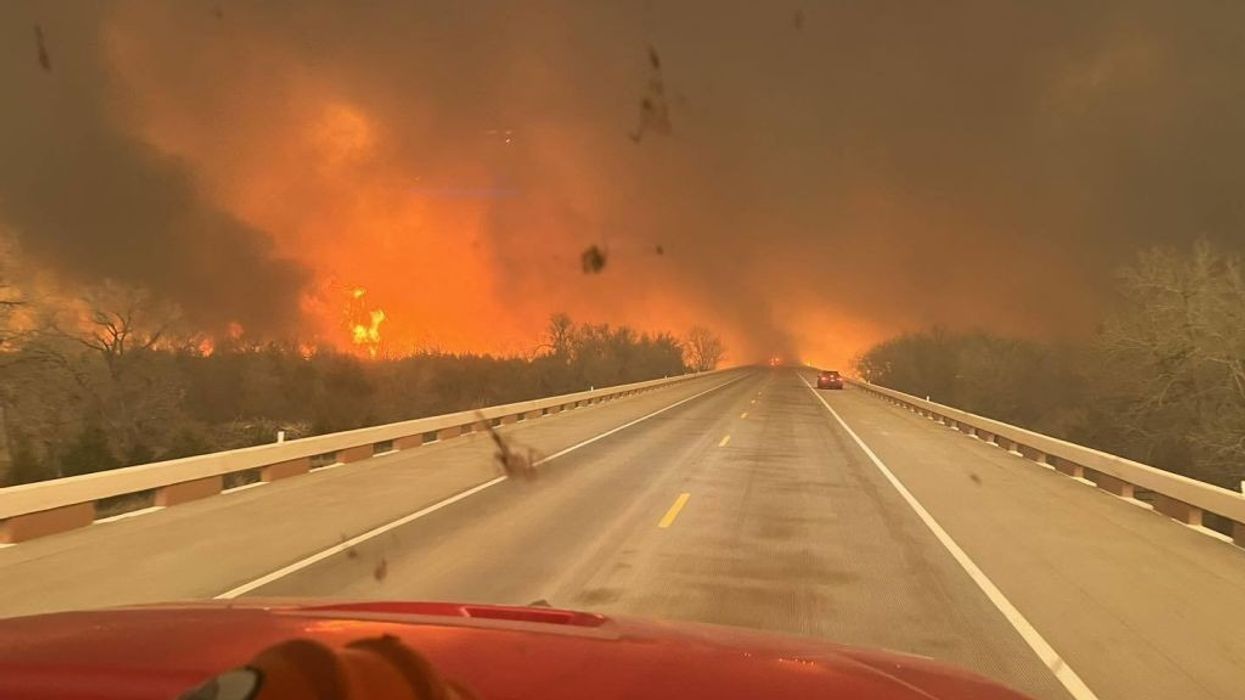
"As remarkable as this might appear, it is not really surprising as the continuous warming of the climate system inevitably leads to new temperature extremes," said the head of the E.U. climate service.
Last month was the warmest February on record, the European Union’s climate service said Wednesday, marking the ninth consecutive month of unprecedented heat as the climate crisis continues to drive up global temperatures.
Climate scientists say the climate crisis, without a doubt, is to blame for increased temperatures.
Not only was it warm above sea level—global ocean temperatures also reached a record high last month. That's not just for February but for any month on record.
"Ocean warming has prompted concerns about the mass bleaching of coral reefs. It also raises global sea levels and can help to fuel higher intensity hurricanes," the BBC reports. "Unusually warm waters may also have been a factor in another exceptional month for Antarctic sea ice. The three lowest minimum extents in the satellite era have now occurred in the last three years."
The #C3S's monthly climate bulletin is out now:
📈 February 2024 was globally the warmest on record;
📈 Global Sea Surface Temperatures hit record highs.
▶️https://t.co/XEmBnArhh6 pic.twitter.com/uUubVY9c05
— Copernicus ECMWF (@CopernicusECMWF) March 7, 2024
Arctic sea ice is also disappearing, and the Arctic could be virtually ice-free during the summer within a decade.
"February joins the long streak of records of the last few months," said Carlo Buentempo, director of the Copernicus Climate Change Service. "As remarkable as this might appear, it is not really surprising as the continuous warming of the climate system inevitably leads to new temperature extremes."
“The climate responds to the actual concentrations of greenhouse gases in the atmosphere so, unless we manage to stabilize those, we will inevitably face new global temperature records and their consequences,” Buentempo added.
The last year has been over 1.5°C above pre-industrial averages—1.56°C, to be exact—but that won't signify a breach of the goals set in the Paris Agreement unless temperatures remain elevated for the next few years.
"A year ago, the fact that the global temperature for a particular month would reach 1.5°C above the pre-industrial level would have been considered exceptional," Julien Nicolas, a senior scientist at Copernicus, told The New York Times.
The world will have to get off of fossil fuels in order to halt runaway warming, and this year could help determine the future of the climate, considering one of the people running to lead the nation appears destined to unleash billions of tons of additional planet-warming emissions should he return to office.
"Breaking heat records has become the norm in 2023," said one scientist. "Global warming continues because we have not stopped burning fossil fuels. It is that simple."
Climate scientists across the world have been alarmed over the past three months by fast-spreading wildfires, prolonged and deadly heatwaves, and numerous shattered heat records across the northern hemisphere both in the oceans and on land—and data released Tuesday confirmed that the past three months have been the hottest summer on record, driven by humans' continued emission of heat-trapping gases and compounded by El Niño.
The Copernicus Climate Change Service (C3S), the European Union's climate agency, found that the global average temperature during June, July, and August reached 16.77°C (62.18°F), which was 0.66°C or 1.18°F above the 1991-2020 average.
The previous temperature record was set in 2019 and was 0.29°C (0.5°F) lower than this year's high.
Last month was the hottest August on record "by a large margin," said the World Meteorological Organization, with the average temperature 1.5°C higher than the preindustrial average.
United Nations Secretary-General António Guterres said Wednesday the world is experiencing the consequences of "our fossil fuel addiction," which "scientists have long warned" would be unleashed if humans continue extracting oil and gas instead of rapidly shifting to renewable energy sources.
"Our planet has just endured a season of simmering—the hottest summer on record. Climate breakdown has begun," said Guterres.
"In the southern hemisphere Antarctic sea ice extent was literally off the charts, and the global sea surface temperature was once again at a new record. It is worth noting that this is happening BEFORE we see the full warming impact of the El Niño event."
C3S released the data as the Eastern United States experienced a "dangerous heatwave," with cities including New York and Washington, D.C. announcing heat advisories.
As the World Weather Attribution (WWA) said earlier this summer, the extreme heat felt across North America and Europe in July—the hottest month ever on record, followed by August—would have been "virtually impossible" without planetary heating and the climate crisis.
Scientists at the WWA also found that the hot, dry conditions that allowed wildfires to spread rapidly in Eastern Canada were made twice as likely by the climate emergency, and independent scientists at Climate Central determined that the current heat forecast in the United Kingdom—with temperatures over 33°C or 91°F expected in London on Saturday—was made five times more likely.
Friederike Otto, a senior lecturer on climate change and the environment at Imperial College London, told The Guardian that "breaking heat records has become the norm in 2023."
" Global warming continues because we have not stopped burning fossil fuels," said Otto. "It is that simple."
Scientists last observed a powerful El Niño warming event, which is marked by very high temperatures in the Pacific Ocean near the equator, in 2016, which currently holds the record for the hottest January-August period, followed by this year.
El Niño is still developing this year, and experts have warned that next summer could see even more intense heatwaves and wildfires as the effects of the warming phenomenon are typically observed the year after it develops.
"The northern hemisphere just had a summer of extremes—with repeated heatwaves fueling devastating wildfires, harming health, disrupting daily lives, and wreaking a lasting toll on the environment," said Petteri Taalas, secretary-general of the WMO. "In the southern hemisphere Antarctic sea ice extent was literally off the charts, and the global sea surface temperature was once again at a new record. It is worth noting that this is happening BEFORE we see the full warming impact of the El Niño event."
Mark Maslin, professor of earth system science at University College London, told The Guardian that the news from C3S "is a wake-up call to international leaders that we must rapidly reduce carbon emissions now."
"Let us hope this message hits home at COP28... this December and action actually happens," Maslin said.
Advocates have raised alarm about the appointment of Sultan Ahmed Al Jaber, CEO of the United Arab Emirates' Abu Dhabi National Oil Company, to lead the United Nations Climate Change Conference, also known as COP28, later this year.
"Surging temperatures demand a surge in action," said Guterres. "Leaders must turn up the heat now for climate solutions. We can still avoid the worst of climate chaos—and we don't have a moment to lose."