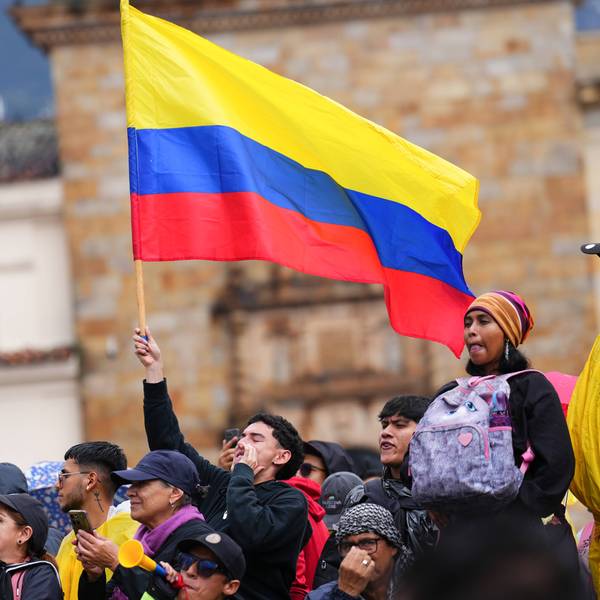
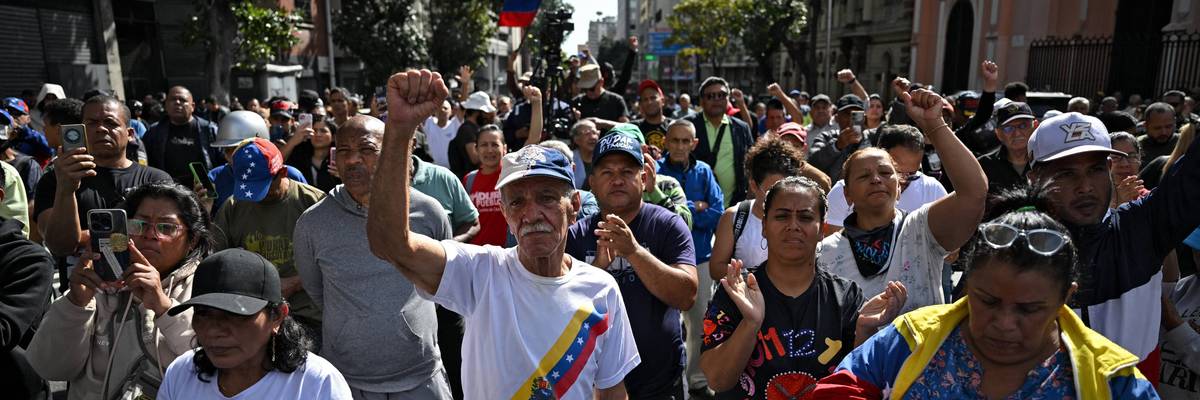
Supporters of Venezuela's President Nicolas Maduro gather in the streets of Caracas on January 3, 2026, after US forces captured him.
Venezuela Under Siege: Defending the Bolivarian Revolution Against US Imperialism
What some may regard as unjustifiable compromises by the Venezuelan government pale in comparison with our obligations as international solidarity activists: defending Venezuela and Cuba against the policies of imperialism.
In response to recent developments in Venezuela under imperialist siege, international solidarity activists should adopt a stance that does not inadvertently reinforce Washington’s drive for domination. Our central responsibility is not to adjudicate every tactical decision made under siege conditions, but to oppose the imperialist aggression that creates those conditions.
The overwhelming structure of US hybrid warfare against Venezuela remains intact, continuing to suffocate the country’s economic recovery and undermine its sovereignty. Washington continues to exert decisive pressure over the country’s principal source of national revenue, the oil sector. It uses sanctions, financial coercion, and domination of global banking systems, as it has against other targeted states such as Iraq and Syria.
At the same time, the threat of direct military escalation remains ever present, a danger underscored by continuing military deployments, aggressive rhetoric, and repeated threats.
What some may regard as unjustifiable compromises by the Venezuelan government pale in comparison with our obligations as international solidarity activists: defending Venezuela and Cuba against the policies of imperialism. The US continues to intensify blockades, sanctions, destabilization efforts, and military threats against these revolutionary processes while simultaneously waging disinformation campaigns against the Chavista leadership and the Cuban Revolution.
The role of internationalists is to oppose imperialism at home, not to instruct Venezuelans on how to defend their revolution.
Both Fidel Castro and Hugo Chávez identified US imperialism as the principal enemy of humanity. Our primary political focus should therefore remain opposition to imperialist domination, rather than allowing secondary disagreements to obscure the central contradiction.
The Responsibilities of Internationalists
First and foremost, the main blow must be directed against US imperialism. Any discussion of shortcomings, compromises, or concessions should be understood within the context of relentless external aggression, destabilization efforts, and military threats.
That is why internationals vigorously campaign both for the safe return to Venezuela of President Nicolás Maduro and First Lady Cilia Flores and for the immediate and unconditional lifting of all sanctions.
The political choices made by the Venezuelan leadership must ultimately be resolved within Venezuela itself. The role of internationalists is to oppose imperialism at home, not to instruct Venezuelans on how to defend their revolution.
Support for Venezuela against US imperialism does not require agreement with every decision taken under conditions of coercion. Understanding political decisions made under such circumstances is to situate them within the realities imposed by imperialist military power. This includes the extradition of Alex Saab.
A longstanding objective of US policy has been to fracture the unity of the Chavista leadership, military, and popular base. Despite immense pressure, that unity has largely held. Attempts to counterpose solidarity with the popular base against solidarity with the leadership, however well intentioned, objectively strengthen imperialist aims.
The Conditions Facing Venezuela
We do not know the full extent of the pressures exerted on the Venezuelan government, nor the range of alternatives realistically available under present conditions. The Venezuelan leadership operates under severe geopolitical constraints. The US openly threatens Libya- or Iran-style retaliation. Another major military escalation remains entirely possible.
Unlike in earlier periods, Venezuela today lacks strong regional allies, while in the context of the ongoing Gaza genocide, so-called “international law” offers little meaningful restraint on US power.
In conclusion, under conditions of economic warfare, military threat, diplomatic isolation, and perpetual destabilization efforts, Venezuela’s contradictions cannot be analyzed abstractly or outside the realities of imperialist power.
Given the vast military asymmetry between the two countries, the consequences of direct military confrontation would be catastrophic for Venezuela, potentially including the destruction of vital infrastructure and long-term devastation of the oil industry upon which the country depends.
If the US succeeds in placing the extreme right-wing opposition in power, the likely result would be devastating political repression directed against Chavismo and the popular sectors.
Strategic Realities and Political Continuity
While continuing to rely upon the Chavista base, the government also recognizes the necessity of building a broader patriotic bloc capable of resisting imperialist pressure more effectively.
Even amid forced compromises, the central achievements of the Bolivarian process remain significant: preservation of the revolutionary leadership, survival against destabilization efforts, and avoidance of a full-scale invasion.
Years of sanctions and economic warfare severely degraded Venezuela’s oil infrastructure. Restoring productive capacity, reestablishing trade, and attracting investment have therefore become vital imperatives.
The political transitions from Chávez to Maduro to Delcy Rodríguez largely reflect changes in the international geopolitical landscape. Yet there has remained substantial political continuity within Chavismo, evident in continued solidarity with Cuba, the vitality of the communal system, and the endurance of the revolutionary mass movement.
In conclusion, under conditions of economic warfare, military threat, diplomatic isolation, and perpetual destabilization efforts, Venezuela’s contradictions cannot be analyzed abstractly or outside the realities of imperialist power. The primary task of solidarity movements within the imperial centers remains what it has always been: opposing the aggression of our own ruling classes.
We are at a crossroads
This country and this world are at a monumental crossroads. In a few short weeks, US voters will have an opportunity to beat back the forces of fascism and confront the billionaires who are rigging the economy, our media system, and our democracy, making it increasingly impossible for ordinary people to get by. We’re not just talking about the election. We’re talking about what must be done once these fascist elements are vanquished from power. We need a bolder set of solutions than what either major party has so far been willing to offer and a working-class movement ready to fight like hell for it. Trump didn't emerge from nowhere. The conditions that fueled MAGA authoritarianism were created by decades of radical neoliberal economic policies and a corrupt political system dominated by corporate interests. They slashed taxes on the super-rich, promising that the benefits would trickle down. They said giveaways to the corporate titans would make life more affordable for the rest of us. It was all bullshit. And when a bitter, betrayed populace searches for someone to blame, right-wing demagogues have little trouble finding scapegoats. People know when they're being lied to, but you won't hear any of this from the corporate media. Only independent journalism—powered and funded by people who believe in building a better world—can deliver truly trustworthy daily news. Our Fall Campaign is underway, and we need your help. To power our newsroom through the rest of the year, we need to raise $125,000 by midnight on October 31. So if you share our vision, please contribute whatever you can to sustain our work. |
In response to recent developments in Venezuela under imperialist siege, international solidarity activists should adopt a stance that does not inadvertently reinforce Washington’s drive for domination. Our central responsibility is not to adjudicate every tactical decision made under siege conditions, but to oppose the imperialist aggression that creates those conditions.
The overwhelming structure of US hybrid warfare against Venezuela remains intact, continuing to suffocate the country’s economic recovery and undermine its sovereignty. Washington continues to exert decisive pressure over the country’s principal source of national revenue, the oil sector. It uses sanctions, financial coercion, and domination of global banking systems, as it has against other targeted states such as Iraq and Syria.
At the same time, the threat of direct military escalation remains ever present, a danger underscored by continuing military deployments, aggressive rhetoric, and repeated threats.
What some may regard as unjustifiable compromises by the Venezuelan government pale in comparison with our obligations as international solidarity activists: defending Venezuela and Cuba against the policies of imperialism. The US continues to intensify blockades, sanctions, destabilization efforts, and military threats against these revolutionary processes while simultaneously waging disinformation campaigns against the Chavista leadership and the Cuban Revolution.
The role of internationalists is to oppose imperialism at home, not to instruct Venezuelans on how to defend their revolution.
Both Fidel Castro and Hugo Chávez identified US imperialism as the principal enemy of humanity. Our primary political focus should therefore remain opposition to imperialist domination, rather than allowing secondary disagreements to obscure the central contradiction.
The Responsibilities of Internationalists
First and foremost, the main blow must be directed against US imperialism. Any discussion of shortcomings, compromises, or concessions should be understood within the context of relentless external aggression, destabilization efforts, and military threats.
That is why internationals vigorously campaign both for the safe return to Venezuela of President Nicolás Maduro and First Lady Cilia Flores and for the immediate and unconditional lifting of all sanctions.
The political choices made by the Venezuelan leadership must ultimately be resolved within Venezuela itself. The role of internationalists is to oppose imperialism at home, not to instruct Venezuelans on how to defend their revolution.
Support for Venezuela against US imperialism does not require agreement with every decision taken under conditions of coercion. Understanding political decisions made under such circumstances is to situate them within the realities imposed by imperialist military power. This includes the extradition of Alex Saab.
A longstanding objective of US policy has been to fracture the unity of the Chavista leadership, military, and popular base. Despite immense pressure, that unity has largely held. Attempts to counterpose solidarity with the popular base against solidarity with the leadership, however well intentioned, objectively strengthen imperialist aims.
The Conditions Facing Venezuela
We do not know the full extent of the pressures exerted on the Venezuelan government, nor the range of alternatives realistically available under present conditions. The Venezuelan leadership operates under severe geopolitical constraints. The US openly threatens Libya- or Iran-style retaliation. Another major military escalation remains entirely possible.
Unlike in earlier periods, Venezuela today lacks strong regional allies, while in the context of the ongoing Gaza genocide, so-called “international law” offers little meaningful restraint on US power.
In conclusion, under conditions of economic warfare, military threat, diplomatic isolation, and perpetual destabilization efforts, Venezuela’s contradictions cannot be analyzed abstractly or outside the realities of imperialist power.
Given the vast military asymmetry between the two countries, the consequences of direct military confrontation would be catastrophic for Venezuela, potentially including the destruction of vital infrastructure and long-term devastation of the oil industry upon which the country depends.
If the US succeeds in placing the extreme right-wing opposition in power, the likely result would be devastating political repression directed against Chavismo and the popular sectors.
Strategic Realities and Political Continuity
While continuing to rely upon the Chavista base, the government also recognizes the necessity of building a broader patriotic bloc capable of resisting imperialist pressure more effectively.
Even amid forced compromises, the central achievements of the Bolivarian process remain significant: preservation of the revolutionary leadership, survival against destabilization efforts, and avoidance of a full-scale invasion.
Years of sanctions and economic warfare severely degraded Venezuela’s oil infrastructure. Restoring productive capacity, reestablishing trade, and attracting investment have therefore become vital imperatives.
The political transitions from Chávez to Maduro to Delcy Rodríguez largely reflect changes in the international geopolitical landscape. Yet there has remained substantial political continuity within Chavismo, evident in continued solidarity with Cuba, the vitality of the communal system, and the endurance of the revolutionary mass movement.
In conclusion, under conditions of economic warfare, military threat, diplomatic isolation, and perpetual destabilization efforts, Venezuela’s contradictions cannot be analyzed abstractly or outside the realities of imperialist power. The primary task of solidarity movements within the imperial centers remains what it has always been: opposing the aggression of our own ruling classes.
- Why Venezuela Is the Vietnam of Our Time ›
- More Countries Condemn Trump's 'Imperialist' Saber-Rattling Against Venezuela ›
- Trump's Attack on Venezuela Is Not Your Average American Imperialism ›
- Bernie Sanders: US Attack on Venezuela Is Rank Imperialism ›
- Venezuela and the Return of Empire ›
- Venezuela Elections: A Key Victory for Anti Imperialist Movement in Latin America ›
In response to recent developments in Venezuela under imperialist siege, international solidarity activists should adopt a stance that does not inadvertently reinforce Washington’s drive for domination. Our central responsibility is not to adjudicate every tactical decision made under siege conditions, but to oppose the imperialist aggression that creates those conditions.
The overwhelming structure of US hybrid warfare against Venezuela remains intact, continuing to suffocate the country’s economic recovery and undermine its sovereignty. Washington continues to exert decisive pressure over the country’s principal source of national revenue, the oil sector. It uses sanctions, financial coercion, and domination of global banking systems, as it has against other targeted states such as Iraq and Syria.
At the same time, the threat of direct military escalation remains ever present, a danger underscored by continuing military deployments, aggressive rhetoric, and repeated threats.
What some may regard as unjustifiable compromises by the Venezuelan government pale in comparison with our obligations as international solidarity activists: defending Venezuela and Cuba against the policies of imperialism. The US continues to intensify blockades, sanctions, destabilization efforts, and military threats against these revolutionary processes while simultaneously waging disinformation campaigns against the Chavista leadership and the Cuban Revolution.
The role of internationalists is to oppose imperialism at home, not to instruct Venezuelans on how to defend their revolution.
Both Fidel Castro and Hugo Chávez identified US imperialism as the principal enemy of humanity. Our primary political focus should therefore remain opposition to imperialist domination, rather than allowing secondary disagreements to obscure the central contradiction.
The Responsibilities of Internationalists
First and foremost, the main blow must be directed against US imperialism. Any discussion of shortcomings, compromises, or concessions should be understood within the context of relentless external aggression, destabilization efforts, and military threats.
That is why internationals vigorously campaign both for the safe return to Venezuela of President Nicolás Maduro and First Lady Cilia Flores and for the immediate and unconditional lifting of all sanctions.
The political choices made by the Venezuelan leadership must ultimately be resolved within Venezuela itself. The role of internationalists is to oppose imperialism at home, not to instruct Venezuelans on how to defend their revolution.
Support for Venezuela against US imperialism does not require agreement with every decision taken under conditions of coercion. Understanding political decisions made under such circumstances is to situate them within the realities imposed by imperialist military power. This includes the extradition of Alex Saab.
A longstanding objective of US policy has been to fracture the unity of the Chavista leadership, military, and popular base. Despite immense pressure, that unity has largely held. Attempts to counterpose solidarity with the popular base against solidarity with the leadership, however well intentioned, objectively strengthen imperialist aims.
The Conditions Facing Venezuela
We do not know the full extent of the pressures exerted on the Venezuelan government, nor the range of alternatives realistically available under present conditions. The Venezuelan leadership operates under severe geopolitical constraints. The US openly threatens Libya- or Iran-style retaliation. Another major military escalation remains entirely possible.
Unlike in earlier periods, Venezuela today lacks strong regional allies, while in the context of the ongoing Gaza genocide, so-called “international law” offers little meaningful restraint on US power.
In conclusion, under conditions of economic warfare, military threat, diplomatic isolation, and perpetual destabilization efforts, Venezuela’s contradictions cannot be analyzed abstractly or outside the realities of imperialist power.
Given the vast military asymmetry between the two countries, the consequences of direct military confrontation would be catastrophic for Venezuela, potentially including the destruction of vital infrastructure and long-term devastation of the oil industry upon which the country depends.
If the US succeeds in placing the extreme right-wing opposition in power, the likely result would be devastating political repression directed against Chavismo and the popular sectors.
Strategic Realities and Political Continuity
While continuing to rely upon the Chavista base, the government also recognizes the necessity of building a broader patriotic bloc capable of resisting imperialist pressure more effectively.
Even amid forced compromises, the central achievements of the Bolivarian process remain significant: preservation of the revolutionary leadership, survival against destabilization efforts, and avoidance of a full-scale invasion.
Years of sanctions and economic warfare severely degraded Venezuela’s oil infrastructure. Restoring productive capacity, reestablishing trade, and attracting investment have therefore become vital imperatives.
The political transitions from Chávez to Maduro to Delcy Rodríguez largely reflect changes in the international geopolitical landscape. Yet there has remained substantial political continuity within Chavismo, evident in continued solidarity with Cuba, the vitality of the communal system, and the endurance of the revolutionary mass movement.
In conclusion, under conditions of economic warfare, military threat, diplomatic isolation, and perpetual destabilization efforts, Venezuela’s contradictions cannot be analyzed abstractly or outside the realities of imperialist power. The primary task of solidarity movements within the imperial centers remains what it has always been: opposing the aggression of our own ruling classes.
- Why Venezuela Is the Vietnam of Our Time ›
- More Countries Condemn Trump's 'Imperialist' Saber-Rattling Against Venezuela ›
- Trump's Attack on Venezuela Is Not Your Average American Imperialism ›
- Bernie Sanders: US Attack on Venezuela Is Rank Imperialism ›
- Venezuela and the Return of Empire ›
- Venezuela Elections: A Key Victory for Anti Imperialist Movement in Latin America ›