SUBSCRIBE TO OUR FREE NEWSLETTER
Daily news & progressive opinion—funded by the people, not the corporations—delivered straight to your inbox.
5
#000000
#FFFFFF
To donate by check, phone, or other method, see our More Ways to Give page.
Daily news & progressive opinion—funded by the people, not the corporations—delivered straight to your inbox.
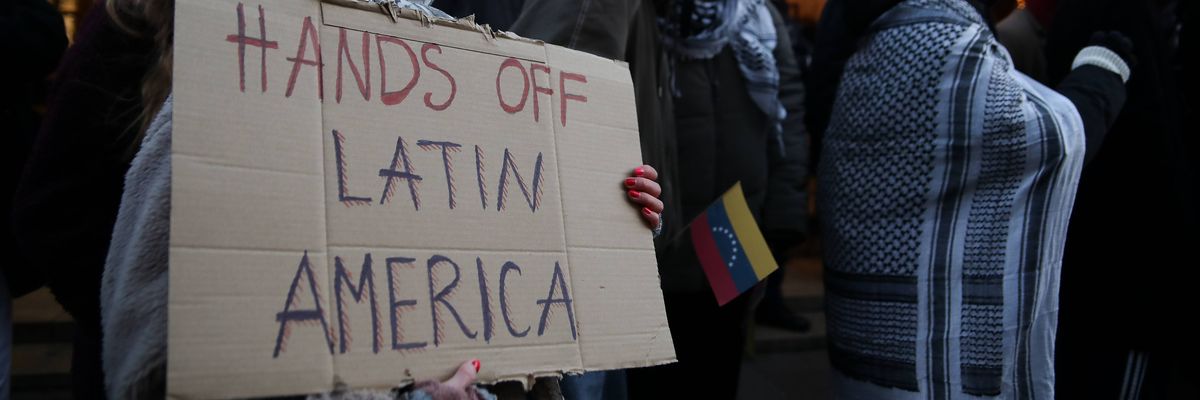
Participants in a solidarity protest with Venezuela gather in front of the US Consulate in Krakow, Poland, on January 4, 2026.
Anyone who cares about democracy in the US or in Venezuela ought to be very concerned about what is happening now.
Right now, MAGA ideologues are apparently cheering Trump’s decision to attack Venezuela, kidnap the Maduros, and declare that the US will now “run” the country and its oil refineries. Because MAGA ideologues always cheer Trump. But also because they understand something that too many other smart people do not seem to fully understand—that this is a triumph for the MAGA ideology, whatever its ultimate outcome, something that no one can predict.
Some on the liberal center are clearly confused. They opine: “How can this be what Trump meant when he said ‘America First?’ How can that idea mean attacking another country? He will obviously outrage his base over this.”
And some on the left are equally confused. They ask: “how can anyone really think there is anything particularly disturbing or dangerous about what Trump is doing, given the fact that he is simply doing what a long line of presidents have done, especially in the Western hemisphere, since the late 19th century? What’s new?”
Both of these responses are deeply confused, because each in a different way fails to take the full measure of Trumpism.
Anyone who considers the current attack on Venezuela as in tension with MAGA has not been paying attention to MAGA.
The centrist liberal confusion rests on a failure to understand that for Trumpism, “America First” cannot be understood apart from “Making America Great Again,” and neither can be understood apart from the distinctive features of Trumpist authoritarianism: contempt for the very idea of law, cynicism about the susceptibility of most Americans to the basest of appeals, and unbounded faith in literal bullshit. None of the rhetoric of Trumpism out to be taken too literally, and all of it is fairly easily transmogrified into its opposite as it suits The Leader. Did anyone serious really take seriously Trump’s bullshit about being “the peace president?”
“America First” has always meant America first. Not “The United States” first. America. Obviously, this is partly a matter of sheer semantics. “America First” is a better slogan, that trips more easily off the tongue. But it’s not only that. And for two reasons.
“The United States” is the name of a specific, federally-organized and yet singular nation-state, designated as such by a Constitution, whose Preamble twice names the nation-state as “the United States of America.” [Note: the language of even the Declaration of Independence is different, and can be read as referring to the thirteen colonies as now united, as independent states, in collectively declaring independence.] This “United States” denotes and constitutes something very particular, and it is linked to a very specific set of Constitutional Articles, a great many subsequent Amendments, and an entire body of law and precedent. For Trump, and his current administration, and for all of those Republicans—almost every single one—who support Trump, all of this constitutional stuff deserves nothing but disdain.
And “America First” has always been about America, where the reference was not to one enormously important nation-state on the continent of North America—the US–but to America, understood as one enormous landmass, connected by an isthmus that was only broken by the construction of the Panama Canal, begun in 1904 after the US acquired the territory after the aptly named “Spanish-American War.” That war pit Spain against the United States of America, but also, especially for US ideologues, against all of America which, thankfully, the US government chose to “liberate.” “America” thus understood means North America, Central America, and South America, as superintended by the benevolent US.
Ever since the Monroe Doctrine, the US has asserted a special hegemony over the Americas and most of the Caribbean.
Trump’s “America First” never meant “we don’t care about what is outside of our borders.” It has always meant “we real authentic Americans–as opposed to the liberals and Marxists and woke lovers of ‘illegals’ and ‘cross dressers’—will decide who deserves to be inside and who outside. And we believe that the great danger confronting us comes from the south, and those brown people who are invading us because they are rapists and killers and drug dealers and sex traffickers.”
Trumpism has always been about ruling the hemisphere, building walls, strengthening borders, and by all means necessary controlling the dangerous populations to the south. A special love for Bolsonaro and Kast and Milei. A special hatred for Maduro but also Chavismo more generally. A special hatred for Cuba no doubt intensified by the “statesmanship” of “Little Marco” Rubio. And above all, an absolute determination to keep those “invaders” at bay.
Trump’s recent national security policy is all about such regional domination, as has been widely observed by commentators, whether they are MAGA enthusiasts who love to imagine a world divided up between the US, Russia, and China, and liberals and progressives who rightly recoil at the thought.
In addition, what could do more to “Make America Great Again” then to cosplay Teddy Roosevelt’s “Rough Riders” by attacking Caracas and seizing Maduro, thereby demonstrating to the world that Pete Hegseth is a man’s man, and his Pentagon is a War Department, and his military is all about the “warrior ethos” of killing and breaking things?
Anyone who considers the current attack on Venezuela as in tension with MAGA has not been paying attention to MAGA. It is true, as some have noted, that this US intervention might turn out to involve the loss of much US blood and treasure, in which case many in Trump’s base might turn on him. But if that happens, it will not be because they were ideologically opposed to US military attacks or even occupations. It will be because they are ideologically opposed to protracted and costly wars. But the MAGA base does not oppose the deployment of massive brutality, either inside or outside the country’s borders, in the name of “American Greatness.”
Leftists who mock those who are confused or incredulous about how Trump could do this are right to insist that Trump’s attack on Venezuela is the latest of many such imperial interventions. But they are wrong to regard Trump’s attack as simply that, and to recycle conventional platitudes about US imperialism that can be found in old Chomsky essays or Howard Zinn book chapters. For in a different way, they too refuse to reckon with the distinct importance, and danger, of Trump’s “America First,” which is not a continuation of US imperial globalism justified by a kind of Wilsonian idealism about “defending democracy,” but a blunt repudiation of globalism, all forms of idealism, Wilsonian and otherwise, and democracy itself.
In global terms, this means utter contempt for human rights anywhere and everywhere, and cynical deference to the power politics of domination and conquest. It has long been well understood that US rhetoric about democracy and human rights has often masked violence and exploitation. But not everywhere and all at once. Further, even in the face of manifest and immoral US hypocrisy—you think the Central European anti-communist dissidents were unaware of US support for Somoza and Pinochet and the Shah of Iran?—democracy activists all over the world have drawn on the rhetoric of human rights and democracy, often sought refuge in the US, and accepted the support of their efforts that was offered by USAID and National Endowment for Democracy and the State Department. When Nelson Mandela was invited to the White House by President George H.W. Bush, he did not declare “down with American imperialism.” He went. Can you imagine anything like this happening with Trump?
US hypocrisy about “making the world safe for democracy” was bad, and sometimes very bad.
Trump’s geopolitical brutalism is worse. Much worse. I seriously doubt that Lula is now thinking “Trump, Biden, Obama, Bush, meh, it’s all the same.” Because he is an experienced and a serious politician of a country that knows the difference between dictatorship and precarious and flawed constitutional democracy, and not an armchair critic of the US holding forth from Berkeley or Ann Arbor.
But it is really in “domestic” US politics that the “what’s new?” rhetoric most comes up short.
Instead of an argument, I would pose these very direct questions, in no particular order of moral or political priority:
Do you not see that this most recent Trump/Hegseth attack on Venezuela is exactly what they both forecast when they spoke at the end of September to assembled generals and admirals at Quantico, and that this forecast was linked to the explicit suggestion that similar things might well be in store for US cities? Remember that? Has any US President and Secretary of Defense ever performed like this before?
Have you not noticed that the months-long US militarism and violence—murder– in the Caribbean has been targeting Venezuela at the same time that Trump and Kristi Noem and Stephen Miller and Tom Homan are targeting Venezuelans and imagined Venezuelans for detention and deportation in the US? And did you notice that Trump today indicated that soon all the Venezuelans in the US will be “liberated” via return to their country, whether they want to or not, whether they have lived here for two years or two decades? There is no daylight between Trump’s brutal ICE deportation policies, and the current attack on Venezuela. None.
Have you noticed that the Trump/Hegseth/Rubio demonization of Venezuela has been consistently articulated as a rabid anticommunism, and that Red-baiting has been a central element not simply of Trump’s campaign rhetoric, but of his current project of attacking the autonomy of US universities and suppressing “anti-American” teaching and learning and speaking and protesting?
Have you noticed that there are interesting coincidences between this attack on Venezuela, and recent judicial pushbacks on Trump’s National Guard deployments? The courts seem to be indicating that such deployments might require either substantial evidence that the US is actually at war or an invocation of the Insurrection Act. Do you think it is possible that a sustained conflict in Venezuela, combined perhaps with protest against such a war, might strengthen Trump’s hand with regard to such questions?
In short, anyone who cares about democracy in the US or in Venezuela ought to be very concerned about what is happening now.
Yes, the US has engaged in scores of reactionary and often very violent interventions in Latin and Central America and the Caribbean—and elsewhere. We should not forget them, nor should we ignore the ways that they are precursors to what is going on now.
But this is different. Because there has never been a US president so hostile to constitutional democracy and the very idea of human dignity and the autonomy of civil society as Trump, and there has never been an administration—linked to a fully cowed Republican majority in Congress—that has behaved so contemptuously in both global and domestic politics.
If you think that this is nothing more than what others have done, then you think that there is no difference between Trump and Biden or Obama, and that there is no difference between Mike Johnson and Hakeem Jeffries, and little difference between possible Democratic Congressional victories in 2026—this year—and continued Republican control of the national government.
And if you believe that, then . . . you really ought to be listening more carefully to what Zohran Mamdani and Alexandria Ocasio Cortez and Ilhan Omar and Bernie Sanders and Jamie Raskin are saying. For none of them are saying that, and with good reason—because they are serious about mobilizing and then exercising power.
We have no idea how this Venezuela debacle will unfold or what its ultimate political consequences will be.
But it would be a huge mistake to be surprised by Trump’s aggression against Venezuela, or to consider it somehow at odds with what he has always stood for. And it would be an equally huge mistake to regard it as “American imperial business as usual.” For nothing about Trump is “business as usual.”
Trump is old and lacking in vigor and he has faced obstacles to his efforts and he is a lame duck (though do you really think “Trump 2028” is a joke?). He has also succeeded in using his authority to poison the public culture and to attack the judiciary, the press, public education, and public health. He has three more years remaining on his term of office, and he possesses virtually absolute control over the Executive branch of the government and especially of the repressive apparatuses of the national state. Trump and his cronies are dead serious about MAGA ideology. And MAGA ideology is dangerous and even deadly, whether in Caracas or in Chicago.
This is not normal.
And it is very, very dangerous.
Dear Common Dreams reader, It’s been nearly 30 years since I co-founded Common Dreams with my late wife, Lina Newhouser. We had the radical notion that journalism should serve the public good, not corporate profits. It was clear to us from the outset what it would take to build such a project. No paid advertisements. No corporate sponsors. No millionaire publisher telling us what to think or do. Many people said we wouldn't last a year, but we proved those doubters wrong. Together with a tremendous team of journalists and dedicated staff, we built an independent media outlet free from the constraints of profits and corporate control. Our mission has always been simple: To inform. To inspire. To ignite change for the common good. Building Common Dreams was not easy. Our survival was never guaranteed. When you take on the most powerful forces—Wall Street greed, fossil fuel industry destruction, Big Tech lobbyists, and uber-rich oligarchs who have spent billions upon billions rigging the economy and democracy in their favor—the only bulwark you have is supporters who believe in your work. But here’s the urgent message from me today. It's never been this bad out there. And it's never been this hard to keep us going. At the very moment Common Dreams is most needed, the threats we face are intensifying. We need your support now more than ever. We don't accept corporate advertising and never will. We don't have a paywall because we don't think people should be blocked from critical news based on their ability to pay. Everything we do is funded by the donations of readers like you. When everyone does the little they can afford, we are strong. But if that support retreats or dries up, so do we. Will you donate now to make sure Common Dreams not only survives but thrives? —Craig Brown, Co-founder |
Right now, MAGA ideologues are apparently cheering Trump’s decision to attack Venezuela, kidnap the Maduros, and declare that the US will now “run” the country and its oil refineries. Because MAGA ideologues always cheer Trump. But also because they understand something that too many other smart people do not seem to fully understand—that this is a triumph for the MAGA ideology, whatever its ultimate outcome, something that no one can predict.
Some on the liberal center are clearly confused. They opine: “How can this be what Trump meant when he said ‘America First?’ How can that idea mean attacking another country? He will obviously outrage his base over this.”
And some on the left are equally confused. They ask: “how can anyone really think there is anything particularly disturbing or dangerous about what Trump is doing, given the fact that he is simply doing what a long line of presidents have done, especially in the Western hemisphere, since the late 19th century? What’s new?”
Both of these responses are deeply confused, because each in a different way fails to take the full measure of Trumpism.
Anyone who considers the current attack on Venezuela as in tension with MAGA has not been paying attention to MAGA.
The centrist liberal confusion rests on a failure to understand that for Trumpism, “America First” cannot be understood apart from “Making America Great Again,” and neither can be understood apart from the distinctive features of Trumpist authoritarianism: contempt for the very idea of law, cynicism about the susceptibility of most Americans to the basest of appeals, and unbounded faith in literal bullshit. None of the rhetoric of Trumpism out to be taken too literally, and all of it is fairly easily transmogrified into its opposite as it suits The Leader. Did anyone serious really take seriously Trump’s bullshit about being “the peace president?”
“America First” has always meant America first. Not “The United States” first. America. Obviously, this is partly a matter of sheer semantics. “America First” is a better slogan, that trips more easily off the tongue. But it’s not only that. And for two reasons.
“The United States” is the name of a specific, federally-organized and yet singular nation-state, designated as such by a Constitution, whose Preamble twice names the nation-state as “the United States of America.” [Note: the language of even the Declaration of Independence is different, and can be read as referring to the thirteen colonies as now united, as independent states, in collectively declaring independence.] This “United States” denotes and constitutes something very particular, and it is linked to a very specific set of Constitutional Articles, a great many subsequent Amendments, and an entire body of law and precedent. For Trump, and his current administration, and for all of those Republicans—almost every single one—who support Trump, all of this constitutional stuff deserves nothing but disdain.
And “America First” has always been about America, where the reference was not to one enormously important nation-state on the continent of North America—the US–but to America, understood as one enormous landmass, connected by an isthmus that was only broken by the construction of the Panama Canal, begun in 1904 after the US acquired the territory after the aptly named “Spanish-American War.” That war pit Spain against the United States of America, but also, especially for US ideologues, against all of America which, thankfully, the US government chose to “liberate.” “America” thus understood means North America, Central America, and South America, as superintended by the benevolent US.
Ever since the Monroe Doctrine, the US has asserted a special hegemony over the Americas and most of the Caribbean.
Trump’s “America First” never meant “we don’t care about what is outside of our borders.” It has always meant “we real authentic Americans–as opposed to the liberals and Marxists and woke lovers of ‘illegals’ and ‘cross dressers’—will decide who deserves to be inside and who outside. And we believe that the great danger confronting us comes from the south, and those brown people who are invading us because they are rapists and killers and drug dealers and sex traffickers.”
Trumpism has always been about ruling the hemisphere, building walls, strengthening borders, and by all means necessary controlling the dangerous populations to the south. A special love for Bolsonaro and Kast and Milei. A special hatred for Maduro but also Chavismo more generally. A special hatred for Cuba no doubt intensified by the “statesmanship” of “Little Marco” Rubio. And above all, an absolute determination to keep those “invaders” at bay.
Trump’s recent national security policy is all about such regional domination, as has been widely observed by commentators, whether they are MAGA enthusiasts who love to imagine a world divided up between the US, Russia, and China, and liberals and progressives who rightly recoil at the thought.
In addition, what could do more to “Make America Great Again” then to cosplay Teddy Roosevelt’s “Rough Riders” by attacking Caracas and seizing Maduro, thereby demonstrating to the world that Pete Hegseth is a man’s man, and his Pentagon is a War Department, and his military is all about the “warrior ethos” of killing and breaking things?
Anyone who considers the current attack on Venezuela as in tension with MAGA has not been paying attention to MAGA. It is true, as some have noted, that this US intervention might turn out to involve the loss of much US blood and treasure, in which case many in Trump’s base might turn on him. But if that happens, it will not be because they were ideologically opposed to US military attacks or even occupations. It will be because they are ideologically opposed to protracted and costly wars. But the MAGA base does not oppose the deployment of massive brutality, either inside or outside the country’s borders, in the name of “American Greatness.”
Leftists who mock those who are confused or incredulous about how Trump could do this are right to insist that Trump’s attack on Venezuela is the latest of many such imperial interventions. But they are wrong to regard Trump’s attack as simply that, and to recycle conventional platitudes about US imperialism that can be found in old Chomsky essays or Howard Zinn book chapters. For in a different way, they too refuse to reckon with the distinct importance, and danger, of Trump’s “America First,” which is not a continuation of US imperial globalism justified by a kind of Wilsonian idealism about “defending democracy,” but a blunt repudiation of globalism, all forms of idealism, Wilsonian and otherwise, and democracy itself.
In global terms, this means utter contempt for human rights anywhere and everywhere, and cynical deference to the power politics of domination and conquest. It has long been well understood that US rhetoric about democracy and human rights has often masked violence and exploitation. But not everywhere and all at once. Further, even in the face of manifest and immoral US hypocrisy—you think the Central European anti-communist dissidents were unaware of US support for Somoza and Pinochet and the Shah of Iran?—democracy activists all over the world have drawn on the rhetoric of human rights and democracy, often sought refuge in the US, and accepted the support of their efforts that was offered by USAID and National Endowment for Democracy and the State Department. When Nelson Mandela was invited to the White House by President George H.W. Bush, he did not declare “down with American imperialism.” He went. Can you imagine anything like this happening with Trump?
US hypocrisy about “making the world safe for democracy” was bad, and sometimes very bad.
Trump’s geopolitical brutalism is worse. Much worse. I seriously doubt that Lula is now thinking “Trump, Biden, Obama, Bush, meh, it’s all the same.” Because he is an experienced and a serious politician of a country that knows the difference between dictatorship and precarious and flawed constitutional democracy, and not an armchair critic of the US holding forth from Berkeley or Ann Arbor.
But it is really in “domestic” US politics that the “what’s new?” rhetoric most comes up short.
Instead of an argument, I would pose these very direct questions, in no particular order of moral or political priority:
Do you not see that this most recent Trump/Hegseth attack on Venezuela is exactly what they both forecast when they spoke at the end of September to assembled generals and admirals at Quantico, and that this forecast was linked to the explicit suggestion that similar things might well be in store for US cities? Remember that? Has any US President and Secretary of Defense ever performed like this before?
Have you not noticed that the months-long US militarism and violence—murder– in the Caribbean has been targeting Venezuela at the same time that Trump and Kristi Noem and Stephen Miller and Tom Homan are targeting Venezuelans and imagined Venezuelans for detention and deportation in the US? And did you notice that Trump today indicated that soon all the Venezuelans in the US will be “liberated” via return to their country, whether they want to or not, whether they have lived here for two years or two decades? There is no daylight between Trump’s brutal ICE deportation policies, and the current attack on Venezuela. None.
Have you noticed that the Trump/Hegseth/Rubio demonization of Venezuela has been consistently articulated as a rabid anticommunism, and that Red-baiting has been a central element not simply of Trump’s campaign rhetoric, but of his current project of attacking the autonomy of US universities and suppressing “anti-American” teaching and learning and speaking and protesting?
Have you noticed that there are interesting coincidences between this attack on Venezuela, and recent judicial pushbacks on Trump’s National Guard deployments? The courts seem to be indicating that such deployments might require either substantial evidence that the US is actually at war or an invocation of the Insurrection Act. Do you think it is possible that a sustained conflict in Venezuela, combined perhaps with protest against such a war, might strengthen Trump’s hand with regard to such questions?
In short, anyone who cares about democracy in the US or in Venezuela ought to be very concerned about what is happening now.
Yes, the US has engaged in scores of reactionary and often very violent interventions in Latin and Central America and the Caribbean—and elsewhere. We should not forget them, nor should we ignore the ways that they are precursors to what is going on now.
But this is different. Because there has never been a US president so hostile to constitutional democracy and the very idea of human dignity and the autonomy of civil society as Trump, and there has never been an administration—linked to a fully cowed Republican majority in Congress—that has behaved so contemptuously in both global and domestic politics.
If you think that this is nothing more than what others have done, then you think that there is no difference between Trump and Biden or Obama, and that there is no difference between Mike Johnson and Hakeem Jeffries, and little difference between possible Democratic Congressional victories in 2026—this year—and continued Republican control of the national government.
And if you believe that, then . . . you really ought to be listening more carefully to what Zohran Mamdani and Alexandria Ocasio Cortez and Ilhan Omar and Bernie Sanders and Jamie Raskin are saying. For none of them are saying that, and with good reason—because they are serious about mobilizing and then exercising power.
We have no idea how this Venezuela debacle will unfold or what its ultimate political consequences will be.
But it would be a huge mistake to be surprised by Trump’s aggression against Venezuela, or to consider it somehow at odds with what he has always stood for. And it would be an equally huge mistake to regard it as “American imperial business as usual.” For nothing about Trump is “business as usual.”
Trump is old and lacking in vigor and he has faced obstacles to his efforts and he is a lame duck (though do you really think “Trump 2028” is a joke?). He has also succeeded in using his authority to poison the public culture and to attack the judiciary, the press, public education, and public health. He has three more years remaining on his term of office, and he possesses virtually absolute control over the Executive branch of the government and especially of the repressive apparatuses of the national state. Trump and his cronies are dead serious about MAGA ideology. And MAGA ideology is dangerous and even deadly, whether in Caracas or in Chicago.
This is not normal.
And it is very, very dangerous.
Right now, MAGA ideologues are apparently cheering Trump’s decision to attack Venezuela, kidnap the Maduros, and declare that the US will now “run” the country and its oil refineries. Because MAGA ideologues always cheer Trump. But also because they understand something that too many other smart people do not seem to fully understand—that this is a triumph for the MAGA ideology, whatever its ultimate outcome, something that no one can predict.
Some on the liberal center are clearly confused. They opine: “How can this be what Trump meant when he said ‘America First?’ How can that idea mean attacking another country? He will obviously outrage his base over this.”
And some on the left are equally confused. They ask: “how can anyone really think there is anything particularly disturbing or dangerous about what Trump is doing, given the fact that he is simply doing what a long line of presidents have done, especially in the Western hemisphere, since the late 19th century? What’s new?”
Both of these responses are deeply confused, because each in a different way fails to take the full measure of Trumpism.
Anyone who considers the current attack on Venezuela as in tension with MAGA has not been paying attention to MAGA.
The centrist liberal confusion rests on a failure to understand that for Trumpism, “America First” cannot be understood apart from “Making America Great Again,” and neither can be understood apart from the distinctive features of Trumpist authoritarianism: contempt for the very idea of law, cynicism about the susceptibility of most Americans to the basest of appeals, and unbounded faith in literal bullshit. None of the rhetoric of Trumpism out to be taken too literally, and all of it is fairly easily transmogrified into its opposite as it suits The Leader. Did anyone serious really take seriously Trump’s bullshit about being “the peace president?”
“America First” has always meant America first. Not “The United States” first. America. Obviously, this is partly a matter of sheer semantics. “America First” is a better slogan, that trips more easily off the tongue. But it’s not only that. And for two reasons.
“The United States” is the name of a specific, federally-organized and yet singular nation-state, designated as such by a Constitution, whose Preamble twice names the nation-state as “the United States of America.” [Note: the language of even the Declaration of Independence is different, and can be read as referring to the thirteen colonies as now united, as independent states, in collectively declaring independence.] This “United States” denotes and constitutes something very particular, and it is linked to a very specific set of Constitutional Articles, a great many subsequent Amendments, and an entire body of law and precedent. For Trump, and his current administration, and for all of those Republicans—almost every single one—who support Trump, all of this constitutional stuff deserves nothing but disdain.
And “America First” has always been about America, where the reference was not to one enormously important nation-state on the continent of North America—the US–but to America, understood as one enormous landmass, connected by an isthmus that was only broken by the construction of the Panama Canal, begun in 1904 after the US acquired the territory after the aptly named “Spanish-American War.” That war pit Spain against the United States of America, but also, especially for US ideologues, against all of America which, thankfully, the US government chose to “liberate.” “America” thus understood means North America, Central America, and South America, as superintended by the benevolent US.
Ever since the Monroe Doctrine, the US has asserted a special hegemony over the Americas and most of the Caribbean.
Trump’s “America First” never meant “we don’t care about what is outside of our borders.” It has always meant “we real authentic Americans–as opposed to the liberals and Marxists and woke lovers of ‘illegals’ and ‘cross dressers’—will decide who deserves to be inside and who outside. And we believe that the great danger confronting us comes from the south, and those brown people who are invading us because they are rapists and killers and drug dealers and sex traffickers.”
Trumpism has always been about ruling the hemisphere, building walls, strengthening borders, and by all means necessary controlling the dangerous populations to the south. A special love for Bolsonaro and Kast and Milei. A special hatred for Maduro but also Chavismo more generally. A special hatred for Cuba no doubt intensified by the “statesmanship” of “Little Marco” Rubio. And above all, an absolute determination to keep those “invaders” at bay.
Trump’s recent national security policy is all about such regional domination, as has been widely observed by commentators, whether they are MAGA enthusiasts who love to imagine a world divided up between the US, Russia, and China, and liberals and progressives who rightly recoil at the thought.
In addition, what could do more to “Make America Great Again” then to cosplay Teddy Roosevelt’s “Rough Riders” by attacking Caracas and seizing Maduro, thereby demonstrating to the world that Pete Hegseth is a man’s man, and his Pentagon is a War Department, and his military is all about the “warrior ethos” of killing and breaking things?
Anyone who considers the current attack on Venezuela as in tension with MAGA has not been paying attention to MAGA. It is true, as some have noted, that this US intervention might turn out to involve the loss of much US blood and treasure, in which case many in Trump’s base might turn on him. But if that happens, it will not be because they were ideologically opposed to US military attacks or even occupations. It will be because they are ideologically opposed to protracted and costly wars. But the MAGA base does not oppose the deployment of massive brutality, either inside or outside the country’s borders, in the name of “American Greatness.”
Leftists who mock those who are confused or incredulous about how Trump could do this are right to insist that Trump’s attack on Venezuela is the latest of many such imperial interventions. But they are wrong to regard Trump’s attack as simply that, and to recycle conventional platitudes about US imperialism that can be found in old Chomsky essays or Howard Zinn book chapters. For in a different way, they too refuse to reckon with the distinct importance, and danger, of Trump’s “America First,” which is not a continuation of US imperial globalism justified by a kind of Wilsonian idealism about “defending democracy,” but a blunt repudiation of globalism, all forms of idealism, Wilsonian and otherwise, and democracy itself.
In global terms, this means utter contempt for human rights anywhere and everywhere, and cynical deference to the power politics of domination and conquest. It has long been well understood that US rhetoric about democracy and human rights has often masked violence and exploitation. But not everywhere and all at once. Further, even in the face of manifest and immoral US hypocrisy—you think the Central European anti-communist dissidents were unaware of US support for Somoza and Pinochet and the Shah of Iran?—democracy activists all over the world have drawn on the rhetoric of human rights and democracy, often sought refuge in the US, and accepted the support of their efforts that was offered by USAID and National Endowment for Democracy and the State Department. When Nelson Mandela was invited to the White House by President George H.W. Bush, he did not declare “down with American imperialism.” He went. Can you imagine anything like this happening with Trump?
US hypocrisy about “making the world safe for democracy” was bad, and sometimes very bad.
Trump’s geopolitical brutalism is worse. Much worse. I seriously doubt that Lula is now thinking “Trump, Biden, Obama, Bush, meh, it’s all the same.” Because he is an experienced and a serious politician of a country that knows the difference between dictatorship and precarious and flawed constitutional democracy, and not an armchair critic of the US holding forth from Berkeley or Ann Arbor.
But it is really in “domestic” US politics that the “what’s new?” rhetoric most comes up short.
Instead of an argument, I would pose these very direct questions, in no particular order of moral or political priority:
Do you not see that this most recent Trump/Hegseth attack on Venezuela is exactly what they both forecast when they spoke at the end of September to assembled generals and admirals at Quantico, and that this forecast was linked to the explicit suggestion that similar things might well be in store for US cities? Remember that? Has any US President and Secretary of Defense ever performed like this before?
Have you not noticed that the months-long US militarism and violence—murder– in the Caribbean has been targeting Venezuela at the same time that Trump and Kristi Noem and Stephen Miller and Tom Homan are targeting Venezuelans and imagined Venezuelans for detention and deportation in the US? And did you notice that Trump today indicated that soon all the Venezuelans in the US will be “liberated” via return to their country, whether they want to or not, whether they have lived here for two years or two decades? There is no daylight between Trump’s brutal ICE deportation policies, and the current attack on Venezuela. None.
Have you noticed that the Trump/Hegseth/Rubio demonization of Venezuela has been consistently articulated as a rabid anticommunism, and that Red-baiting has been a central element not simply of Trump’s campaign rhetoric, but of his current project of attacking the autonomy of US universities and suppressing “anti-American” teaching and learning and speaking and protesting?
Have you noticed that there are interesting coincidences between this attack on Venezuela, and recent judicial pushbacks on Trump’s National Guard deployments? The courts seem to be indicating that such deployments might require either substantial evidence that the US is actually at war or an invocation of the Insurrection Act. Do you think it is possible that a sustained conflict in Venezuela, combined perhaps with protest against such a war, might strengthen Trump’s hand with regard to such questions?
In short, anyone who cares about democracy in the US or in Venezuela ought to be very concerned about what is happening now.
Yes, the US has engaged in scores of reactionary and often very violent interventions in Latin and Central America and the Caribbean—and elsewhere. We should not forget them, nor should we ignore the ways that they are precursors to what is going on now.
But this is different. Because there has never been a US president so hostile to constitutional democracy and the very idea of human dignity and the autonomy of civil society as Trump, and there has never been an administration—linked to a fully cowed Republican majority in Congress—that has behaved so contemptuously in both global and domestic politics.
If you think that this is nothing more than what others have done, then you think that there is no difference between Trump and Biden or Obama, and that there is no difference between Mike Johnson and Hakeem Jeffries, and little difference between possible Democratic Congressional victories in 2026—this year—and continued Republican control of the national government.
And if you believe that, then . . . you really ought to be listening more carefully to what Zohran Mamdani and Alexandria Ocasio Cortez and Ilhan Omar and Bernie Sanders and Jamie Raskin are saying. For none of them are saying that, and with good reason—because they are serious about mobilizing and then exercising power.
We have no idea how this Venezuela debacle will unfold or what its ultimate political consequences will be.
But it would be a huge mistake to be surprised by Trump’s aggression against Venezuela, or to consider it somehow at odds with what he has always stood for. And it would be an equally huge mistake to regard it as “American imperial business as usual.” For nothing about Trump is “business as usual.”
Trump is old and lacking in vigor and he has faced obstacles to his efforts and he is a lame duck (though do you really think “Trump 2028” is a joke?). He has also succeeded in using his authority to poison the public culture and to attack the judiciary, the press, public education, and public health. He has three more years remaining on his term of office, and he possesses virtually absolute control over the Executive branch of the government and especially of the repressive apparatuses of the national state. Trump and his cronies are dead serious about MAGA ideology. And MAGA ideology is dangerous and even deadly, whether in Caracas or in Chicago.
This is not normal.
And it is very, very dangerous.