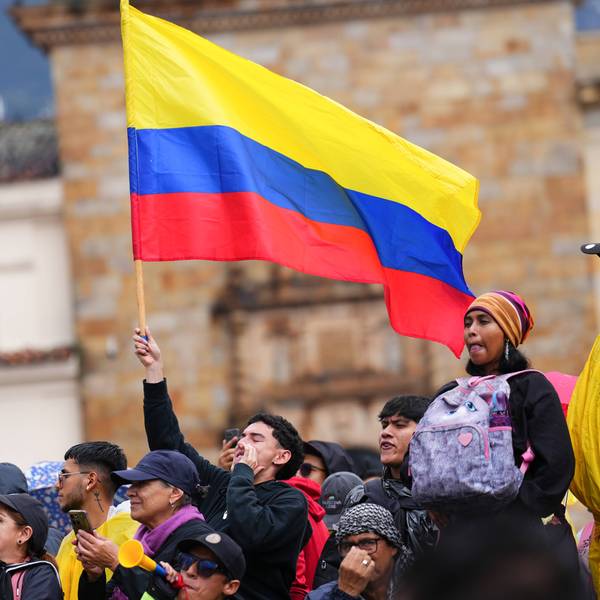
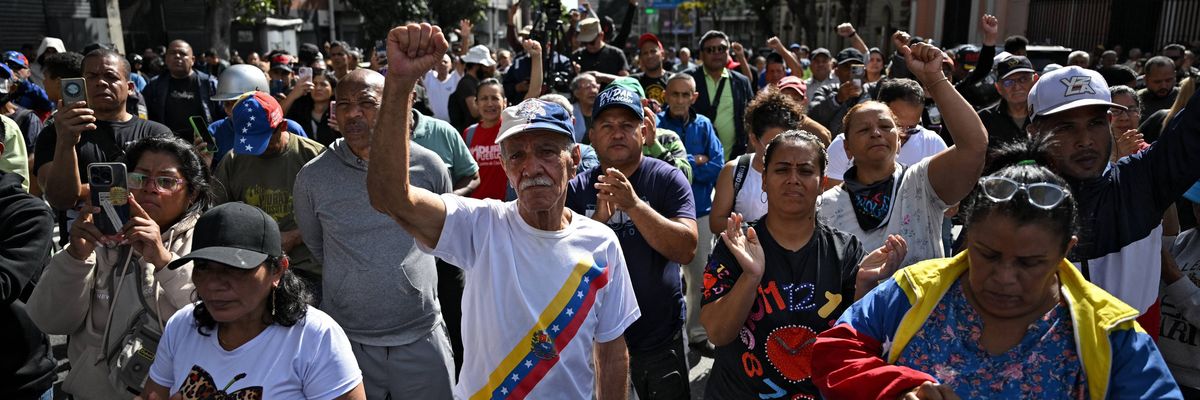
Supporters of Venezuela's President Nicolas Maduro gather in the streets of Caracas on January 3, 2026, after US forces captured him.
Venezuela and the Return of Empire
The global rallying cry of the Global South should, by now, be unmistakable. Down with imperialism: not as a slogan of nostalgia, but as a political necessity.
The seizure of Venezuelan President Nicolás Maduro by the United States marks a dangerous moment in international politics. A sitting head of state was forcibly removed from his country, flown to the United States, and placed on trial under American law. Washington has described this as justice. Under international law, it is an abduction.
President Donald Trump openly justified the attack by invoking the Monroe Doctrine, a 19th-century policy that treats Latin America as the United States’ exclusive sphere of influence. Trump went further, saying the doctrine had been “updated” and renamed, declaring that the United States would “run” Venezuela until it approved a political transition. He also made clear that American oil companies would move in to control Venezuela’s oil reserves, the largest in the world.
This was not hidden. It was stated plainly.
What is happening in Venezuela is not new. It follows a long and well-documented pattern. Latin America has repeatedly been subjected to US-backed coups, regime change operations, and military interventions, all justified under shifting narratives of freedom, security, or democracy.
Without unified voices of resistance, the unshackled advance of empire will continue, reshaping borders, governments, and lives at will.
From the overthrow of Guatemala’s Jacobo Árbenz in 1954 to the CIA-backed coup against Chile’s Salvador Allende in 1973, the region carries the weight of this history. The United States supported military dictatorships across Argentina, Chile, El Salvador, and Guatemala, governments responsible for mass killings, torture, and disappearances. It trained and funded armed groups like the Contras in Nicaragua, whose violence devastated civilian populations. The Monroe Doctrine has always meant one thing in practice: Latin America’s sovereignty is conditional.
Trump’s actions in Venezuela are simply a continuation of this logic.
As expected, Venezuela has now faced the full might of imperial power. Maduro sits in a US courtroom, while American oil companies prepare to rake in profits from the largest proven oil reserves on the planet. And the Global South remains divided and fragmented, offering no unequivocal, unified defense of Venezuelan sovereignty.
We have seen this paralysis before. We have been watching it unfold in Gaza for the past three years. There, too, a neocolonial imperialist order operates with impunity—bombing hospitals, leveling neighborhoods, killing thousands of children while invoking the rhetoric of security and self-defense. And there, too, the response has been fractured. Murmurs of resistance emerge, fragile and disconnected: a statement here, a protest there. Meanwhile, the so-called civilized West offers apathy at best. Even the peoples of the Global South, themselves shaped by histories of colonization and plunder, often look on in exhausted silence.
But is there anything truly new about Venezuela? Have we forgotten Iraq and Afghanistan—empire’s forever wars, launched on lies? Have we forgotten Libya, Syria, or the endless cycle of coups and regime-change operations that have defined Washington’s relationship with Latin America, its so-called backyard? The method remains the same: Violence exercised without consequence, legality bent to power, sovereignty treated as conditional.
What has changed is not the Empire but the resistance. There are no Che Guevaras, no Castros, no Chávezes today with the moral gravity to name imperialism for what it is, without apology or ambiguity. There are no leaders alive who dare to raise, unfiltered, the cry of resistance against empire. Instead, what we increasingly see are local elites who serve as intermediaries of domination, eager to trade sovereignty for approval, legitimacy, or personal gain. Nations are bartered away for access, status, and survival within an imperial order they dare not challenge.
Those who still speak out are swiftly disciplined. The Empire’s media brands them radicals, extremists, pariahs unfit for polite conversation, unworthy of seats at the tables of “civilization” and “progress.” They are sanctioned, silenced, or erased. And the rest? Hollowed out by petty self-interest and political cowardice.
In my own country, we carry a long and inglorious tradition of Napoleonic generals and compliant elites serving foreign empires—a tradition that has not ended, only adapted.
Today it is Gaza and Venezuela. Tomorrow it may be Iran. And one day, inevitably, it will be someone else—perhaps even us. This is how empire advances. Each violation normalizes the next. Each kidnapping, bombing, or occupation becomes the justification for another.
The global rallying cry of the Global South should, by now, be unmistakable. Down with imperialism: not as a slogan of nostalgia, but as a political necessity. Without unified voices of resistance, the unshackled advance of empire will continue, reshaping borders, governments, and lives at will.
The question is no longer whether the imperial order is collapsing. It is whether, in a fractured and conflict-ridden multipolar world, the victims of empire can overcome their divisions long enough to build something better.
And that question remains unanswered.
We are at a crossroads
This country and this world are at a monumental crossroads. In a few short weeks, US voters will have an opportunity to beat back the forces of fascism and confront the billionaires who are rigging the economy, our media system, and our democracy, making it increasingly impossible for ordinary people to get by. We’re not just talking about the election. We’re talking about what must be done once these fascist elements are vanquished from power. We need a bolder set of solutions than what either major party has so far been willing to offer and a working-class movement ready to fight like hell for it. Trump didn't emerge from nowhere. The conditions that fueled MAGA authoritarianism were created by decades of radical neoliberal economic policies and a corrupt political system dominated by corporate interests. They slashed taxes on the super-rich, promising that the benefits would trickle down. They said giveaways to the corporate titans would make life more affordable for the rest of us. It was all bullshit. And when a bitter, betrayed populace searches for someone to blame, right-wing demagogues have little trouble finding scapegoats. People know when they're being lied to, but you won't hear any of this from the corporate media. Only independent journalism—powered and funded by people who believe in building a better world—can deliver truly trustworthy daily news. Our Fall Campaign is underway, and we need your help. To power our newsroom through the rest of the year, we need to raise $125,000 by midnight on October 31. So if you share our vision, please contribute whatever you can to sustain our work. |
The seizure of Venezuelan President Nicolás Maduro by the United States marks a dangerous moment in international politics. A sitting head of state was forcibly removed from his country, flown to the United States, and placed on trial under American law. Washington has described this as justice. Under international law, it is an abduction.
President Donald Trump openly justified the attack by invoking the Monroe Doctrine, a 19th-century policy that treats Latin America as the United States’ exclusive sphere of influence. Trump went further, saying the doctrine had been “updated” and renamed, declaring that the United States would “run” Venezuela until it approved a political transition. He also made clear that American oil companies would move in to control Venezuela’s oil reserves, the largest in the world.
This was not hidden. It was stated plainly.
What is happening in Venezuela is not new. It follows a long and well-documented pattern. Latin America has repeatedly been subjected to US-backed coups, regime change operations, and military interventions, all justified under shifting narratives of freedom, security, or democracy.
Without unified voices of resistance, the unshackled advance of empire will continue, reshaping borders, governments, and lives at will.
From the overthrow of Guatemala’s Jacobo Árbenz in 1954 to the CIA-backed coup against Chile’s Salvador Allende in 1973, the region carries the weight of this history. The United States supported military dictatorships across Argentina, Chile, El Salvador, and Guatemala, governments responsible for mass killings, torture, and disappearances. It trained and funded armed groups like the Contras in Nicaragua, whose violence devastated civilian populations. The Monroe Doctrine has always meant one thing in practice: Latin America’s sovereignty is conditional.
Trump’s actions in Venezuela are simply a continuation of this logic.
As expected, Venezuela has now faced the full might of imperial power. Maduro sits in a US courtroom, while American oil companies prepare to rake in profits from the largest proven oil reserves on the planet. And the Global South remains divided and fragmented, offering no unequivocal, unified defense of Venezuelan sovereignty.
We have seen this paralysis before. We have been watching it unfold in Gaza for the past three years. There, too, a neocolonial imperialist order operates with impunity—bombing hospitals, leveling neighborhoods, killing thousands of children while invoking the rhetoric of security and self-defense. And there, too, the response has been fractured. Murmurs of resistance emerge, fragile and disconnected: a statement here, a protest there. Meanwhile, the so-called civilized West offers apathy at best. Even the peoples of the Global South, themselves shaped by histories of colonization and plunder, often look on in exhausted silence.
But is there anything truly new about Venezuela? Have we forgotten Iraq and Afghanistan—empire’s forever wars, launched on lies? Have we forgotten Libya, Syria, or the endless cycle of coups and regime-change operations that have defined Washington’s relationship with Latin America, its so-called backyard? The method remains the same: Violence exercised without consequence, legality bent to power, sovereignty treated as conditional.
What has changed is not the Empire but the resistance. There are no Che Guevaras, no Castros, no Chávezes today with the moral gravity to name imperialism for what it is, without apology or ambiguity. There are no leaders alive who dare to raise, unfiltered, the cry of resistance against empire. Instead, what we increasingly see are local elites who serve as intermediaries of domination, eager to trade sovereignty for approval, legitimacy, or personal gain. Nations are bartered away for access, status, and survival within an imperial order they dare not challenge.
Those who still speak out are swiftly disciplined. The Empire’s media brands them radicals, extremists, pariahs unfit for polite conversation, unworthy of seats at the tables of “civilization” and “progress.” They are sanctioned, silenced, or erased. And the rest? Hollowed out by petty self-interest and political cowardice.
In my own country, we carry a long and inglorious tradition of Napoleonic generals and compliant elites serving foreign empires—a tradition that has not ended, only adapted.
Today it is Gaza and Venezuela. Tomorrow it may be Iran. And one day, inevitably, it will be someone else—perhaps even us. This is how empire advances. Each violation normalizes the next. Each kidnapping, bombing, or occupation becomes the justification for another.
The global rallying cry of the Global South should, by now, be unmistakable. Down with imperialism: not as a slogan of nostalgia, but as a political necessity. Without unified voices of resistance, the unshackled advance of empire will continue, reshaping borders, governments, and lives at will.
The question is no longer whether the imperial order is collapsing. It is whether, in a fractured and conflict-ridden multipolar world, the victims of empire can overcome their divisions long enough to build something better.
And that question remains unanswered.
- If You Liked Libya, Iraq, Afghanistan, and Vietnam, You'll Love What Trump Is Offering in Venezuela ›
- The Oldest Colony, the Newest War: Puerto Rico as a Launchpad for War on Venezuela ›
- US Threats to Venezuela Are About Power, Not Drugs ›
- Opinion | Venezuela Buys Time to Rebuild While Under Siege | Common Dreams ›
- Opinion | Venezuela Under Siege: Defending the Bolivarian Revolution Against US Imperialism | Common Dreams ›
The seizure of Venezuelan President Nicolás Maduro by the United States marks a dangerous moment in international politics. A sitting head of state was forcibly removed from his country, flown to the United States, and placed on trial under American law. Washington has described this as justice. Under international law, it is an abduction.
President Donald Trump openly justified the attack by invoking the Monroe Doctrine, a 19th-century policy that treats Latin America as the United States’ exclusive sphere of influence. Trump went further, saying the doctrine had been “updated” and renamed, declaring that the United States would “run” Venezuela until it approved a political transition. He also made clear that American oil companies would move in to control Venezuela’s oil reserves, the largest in the world.
This was not hidden. It was stated plainly.
What is happening in Venezuela is not new. It follows a long and well-documented pattern. Latin America has repeatedly been subjected to US-backed coups, regime change operations, and military interventions, all justified under shifting narratives of freedom, security, or democracy.
Without unified voices of resistance, the unshackled advance of empire will continue, reshaping borders, governments, and lives at will.
From the overthrow of Guatemala’s Jacobo Árbenz in 1954 to the CIA-backed coup against Chile’s Salvador Allende in 1973, the region carries the weight of this history. The United States supported military dictatorships across Argentina, Chile, El Salvador, and Guatemala, governments responsible for mass killings, torture, and disappearances. It trained and funded armed groups like the Contras in Nicaragua, whose violence devastated civilian populations. The Monroe Doctrine has always meant one thing in practice: Latin America’s sovereignty is conditional.
Trump’s actions in Venezuela are simply a continuation of this logic.
As expected, Venezuela has now faced the full might of imperial power. Maduro sits in a US courtroom, while American oil companies prepare to rake in profits from the largest proven oil reserves on the planet. And the Global South remains divided and fragmented, offering no unequivocal, unified defense of Venezuelan sovereignty.
We have seen this paralysis before. We have been watching it unfold in Gaza for the past three years. There, too, a neocolonial imperialist order operates with impunity—bombing hospitals, leveling neighborhoods, killing thousands of children while invoking the rhetoric of security and self-defense. And there, too, the response has been fractured. Murmurs of resistance emerge, fragile and disconnected: a statement here, a protest there. Meanwhile, the so-called civilized West offers apathy at best. Even the peoples of the Global South, themselves shaped by histories of colonization and plunder, often look on in exhausted silence.
But is there anything truly new about Venezuela? Have we forgotten Iraq and Afghanistan—empire’s forever wars, launched on lies? Have we forgotten Libya, Syria, or the endless cycle of coups and regime-change operations that have defined Washington’s relationship with Latin America, its so-called backyard? The method remains the same: Violence exercised without consequence, legality bent to power, sovereignty treated as conditional.
What has changed is not the Empire but the resistance. There are no Che Guevaras, no Castros, no Chávezes today with the moral gravity to name imperialism for what it is, without apology or ambiguity. There are no leaders alive who dare to raise, unfiltered, the cry of resistance against empire. Instead, what we increasingly see are local elites who serve as intermediaries of domination, eager to trade sovereignty for approval, legitimacy, or personal gain. Nations are bartered away for access, status, and survival within an imperial order they dare not challenge.
Those who still speak out are swiftly disciplined. The Empire’s media brands them radicals, extremists, pariahs unfit for polite conversation, unworthy of seats at the tables of “civilization” and “progress.” They are sanctioned, silenced, or erased. And the rest? Hollowed out by petty self-interest and political cowardice.
In my own country, we carry a long and inglorious tradition of Napoleonic generals and compliant elites serving foreign empires—a tradition that has not ended, only adapted.
Today it is Gaza and Venezuela. Tomorrow it may be Iran. And one day, inevitably, it will be someone else—perhaps even us. This is how empire advances. Each violation normalizes the next. Each kidnapping, bombing, or occupation becomes the justification for another.
The global rallying cry of the Global South should, by now, be unmistakable. Down with imperialism: not as a slogan of nostalgia, but as a political necessity. Without unified voices of resistance, the unshackled advance of empire will continue, reshaping borders, governments, and lives at will.
The question is no longer whether the imperial order is collapsing. It is whether, in a fractured and conflict-ridden multipolar world, the victims of empire can overcome their divisions long enough to build something better.
And that question remains unanswered.
- If You Liked Libya, Iraq, Afghanistan, and Vietnam, You'll Love What Trump Is Offering in Venezuela ›
- The Oldest Colony, the Newest War: Puerto Rico as a Launchpad for War on Venezuela ›
- US Threats to Venezuela Are About Power, Not Drugs ›
- Opinion | Venezuela Buys Time to Rebuild While Under Siege | Common Dreams ›
- Opinion | Venezuela Under Siege: Defending the Bolivarian Revolution Against US Imperialism | Common Dreams ›