

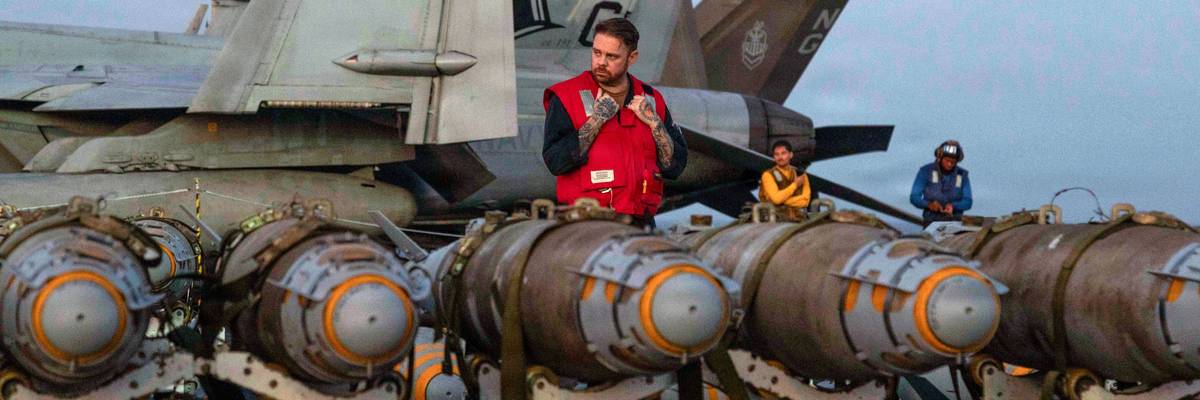
In this handout released by US Central Command, US Sailors transfer ordnance on the flight deck of Nimitz-class aircraft carrier USS Abraham Lincoln (CVN 72), on February 27, 2026 in the Arabian Sea.
Finally, Someone in Congress Is Listening to Our Pleas for Military Budget Cuts
While congressional efforts to reign in military spending face steep odds of passing, growing pushback shows us that a different path is possible.
Last week, Democratic Massachusetts Rep. Seth Moulton introduced an amendment to the National Defense Authorization Act, or NDAA, that would have cut $150 billion from the president’s proposed military budget. While it didn’t pass, 12 members of the House Armed Services Committee voted against advancing the bill, signaling a shift from decades of bipartisan support for unchecked spending on weapons and war.
Now the NDAA goes to the Senate, where resistance to unchecked military spending is also on the rise. The Senate Appropriations Committee has repeatedly delayed action on the budget because of disagreements between the parties over top-line numbers. This pushback is even more critical as the war in Iran again escalates. Congress must say no to more war and war funding.
The majority of people in the US don’t want endless wars that line the pockets of military contractors while making life harder for everyone else. If more lawmakers start following the will of their constituents, it could point the way to a brighter and safer future for all.
This year, the military budget soared past $1 trillion dollars, paid for by cuts made to Medicaid, food assistance programs, infrastructure funds, and more. Overall, nearly 72% of all discretionary spending went to pay for the military, homeland security, Immigration and Customs Enforcement, and other related programs. The National Priorities Project estimated that on Tax Day this year, the average taxpayer paid over $4,000 for weapons and war.
A $1 trillion military will not save us from climate change, overdose deaths, or industrial accidents. It won’t even save us from another military.
If President Donald Trump has his way, those numbers will be even higher next year. The presidential budget released this April seeks $1.5 trillion for military spending.
The $500 billion increase exceeds the total combined amounts the US spent in 2025 on public health, education, job training, transportation, agriculture, and vital safety net programs like the Supplemental Nutrition Assistance Program and childcare. And even these massive cuts to lifesaving social programs are not enough to cover the massive proposed military expenditure. Trump’s budget would drive the country further into debt.
The president, the weapons company lobbyists, and most of Congress want us to believe that this money is a generational investment in our security. They want us to believe that there is no price too high for safety. But a $1 trillion investment in weapons won’t keep us safe in the same way that a $1 trillion investment in umbrellas won’t keep us dry in the ocean. The problems we face—in our communities, in the United States, and globally—require solutions that reduce violence rather than compounding it.
Over the past quarter century the US has spent trillions of dollars on wars and militarism, but global and national risks have only increased. The post-9/11 "War on Terror" resulted in up to 5 million direct and indirect deaths, yet the Taliban is back in power in Afghanistan, the destabilization of Iraq directly contributed to the creation of ISIS, and in 2025 there were more violent conflicts between states than any time since WWII.
The Trump administration’s unprovoked war against Iran is just the latest example of the spectacular failures of military force. While the US was able to quickly destroy key Iranian infrastructure, months later they are now in a weaker negotiating position than at the outset. The cost of continued war—both in dollars and lives—is unconscionable.
The US military is the most expensive, lethal, and technologically advanced the world has ever seen, and US military spending is more than 60 times that of Iran. The idea that we can, and should, resource an enormous military prepared to fight both Russia and China simultaneously is preposterous. Continuing to throw trillions of dollars away on weapons that we hope to never use in wars that we can never win makes no sense. Peace, not war, requires generational investments in security. Getting there will require courageous action from our elected officials.
A $1 trillion military will not save us from climate change, overdose deaths, or industrial accidents. It won’t even save us from another military. It is time for a new paradigm. Real generational security comes when people are housed, fed, healthy, and have hope for a better future.
This is not a call to turn inward, but to invest in international cooperation rather than international destruction. Addressing global problems through international investment isn’t a utopian vision. Spending even a fraction of the military budget to address the root causes of poverty and conflict would have a massive domestic and global impact. If the US reduced military spending, other countries would be likely to follow, freeing up global resources to meet human needs.
Internationally, the World Food Program estimates that it would cost $93 billion per year to end world hunger by 2030. Ending extreme global poverty would cost approximately $300 billion per year—a fraction of the US military budget. At home, the child tax credit gave $2,000 per child to all US families with children. That program could be continued with less than half of the increase sought for the military.
There are some signs of hope. Recent war powers votes have received far more support, across party lines, than previous ones. While congressional efforts to reign in military spending face steep odds of passing, growing pushback shows us that a different path is possible. Refusing to rubber stamp a deadly status quo takes courage and resolve. Congress must vote against military spending increases; continue to advocate for spending cuts; and invest in diplomacy, development, human rights, and human needs. That is where real security can be found.
We are at a crossroads
This country and this world are at a monumental crossroads. In a few short weeks, US voters will have an opportunity to beat back the forces of fascism and confront the billionaires who are rigging the economy, our media system, and our democracy, making it increasingly impossible for ordinary people to get by. We’re not just talking about the election. We’re talking about what must be done once these fascist elements are vanquished from power. We need a bolder set of solutions than what either major party has so far been willing to offer and a working-class movement ready to fight like hell for it. Trump didn't emerge from nowhere. The conditions that fueled MAGA authoritarianism were created by decades of radical neoliberal economic policies and a corrupt political system dominated by corporate interests. They slashed taxes on the super-rich, promising that the benefits would trickle down. They said giveaways to the corporate titans would make life more affordable for the rest of us. It was all bullshit. And when a bitter, betrayed populace searches for someone to blame, right-wing demagogues have little trouble finding scapegoats. People know when they're being lied to, but you won't hear any of this from the corporate media. Only independent journalism—powered and funded by people who believe in building a better world—can deliver truly trustworthy daily news. Our Fall Campaign is underway, and we need your help. To power our newsroom through the rest of the year, we need to raise $125,000 by midnight on October 31. So if you share our vision, please contribute whatever you can to sustain our work. |
Last week, Democratic Massachusetts Rep. Seth Moulton introduced an amendment to the National Defense Authorization Act, or NDAA, that would have cut $150 billion from the president’s proposed military budget. While it didn’t pass, 12 members of the House Armed Services Committee voted against advancing the bill, signaling a shift from decades of bipartisan support for unchecked spending on weapons and war.
Now the NDAA goes to the Senate, where resistance to unchecked military spending is also on the rise. The Senate Appropriations Committee has repeatedly delayed action on the budget because of disagreements between the parties over top-line numbers. This pushback is even more critical as the war in Iran again escalates. Congress must say no to more war and war funding.
The majority of people in the US don’t want endless wars that line the pockets of military contractors while making life harder for everyone else. If more lawmakers start following the will of their constituents, it could point the way to a brighter and safer future for all.
This year, the military budget soared past $1 trillion dollars, paid for by cuts made to Medicaid, food assistance programs, infrastructure funds, and more. Overall, nearly 72% of all discretionary spending went to pay for the military, homeland security, Immigration and Customs Enforcement, and other related programs. The National Priorities Project estimated that on Tax Day this year, the average taxpayer paid over $4,000 for weapons and war.
A $1 trillion military will not save us from climate change, overdose deaths, or industrial accidents. It won’t even save us from another military.
If President Donald Trump has his way, those numbers will be even higher next year. The presidential budget released this April seeks $1.5 trillion for military spending.
The $500 billion increase exceeds the total combined amounts the US spent in 2025 on public health, education, job training, transportation, agriculture, and vital safety net programs like the Supplemental Nutrition Assistance Program and childcare. And even these massive cuts to lifesaving social programs are not enough to cover the massive proposed military expenditure. Trump’s budget would drive the country further into debt.
The president, the weapons company lobbyists, and most of Congress want us to believe that this money is a generational investment in our security. They want us to believe that there is no price too high for safety. But a $1 trillion investment in weapons won’t keep us safe in the same way that a $1 trillion investment in umbrellas won’t keep us dry in the ocean. The problems we face—in our communities, in the United States, and globally—require solutions that reduce violence rather than compounding it.
Over the past quarter century the US has spent trillions of dollars on wars and militarism, but global and national risks have only increased. The post-9/11 "War on Terror" resulted in up to 5 million direct and indirect deaths, yet the Taliban is back in power in Afghanistan, the destabilization of Iraq directly contributed to the creation of ISIS, and in 2025 there were more violent conflicts between states than any time since WWII.
The Trump administration’s unprovoked war against Iran is just the latest example of the spectacular failures of military force. While the US was able to quickly destroy key Iranian infrastructure, months later they are now in a weaker negotiating position than at the outset. The cost of continued war—both in dollars and lives—is unconscionable.
The US military is the most expensive, lethal, and technologically advanced the world has ever seen, and US military spending is more than 60 times that of Iran. The idea that we can, and should, resource an enormous military prepared to fight both Russia and China simultaneously is preposterous. Continuing to throw trillions of dollars away on weapons that we hope to never use in wars that we can never win makes no sense. Peace, not war, requires generational investments in security. Getting there will require courageous action from our elected officials.
A $1 trillion military will not save us from climate change, overdose deaths, or industrial accidents. It won’t even save us from another military. It is time for a new paradigm. Real generational security comes when people are housed, fed, healthy, and have hope for a better future.
This is not a call to turn inward, but to invest in international cooperation rather than international destruction. Addressing global problems through international investment isn’t a utopian vision. Spending even a fraction of the military budget to address the root causes of poverty and conflict would have a massive domestic and global impact. If the US reduced military spending, other countries would be likely to follow, freeing up global resources to meet human needs.
Internationally, the World Food Program estimates that it would cost $93 billion per year to end world hunger by 2030. Ending extreme global poverty would cost approximately $300 billion per year—a fraction of the US military budget. At home, the child tax credit gave $2,000 per child to all US families with children. That program could be continued with less than half of the increase sought for the military.
There are some signs of hope. Recent war powers votes have received far more support, across party lines, than previous ones. While congressional efforts to reign in military spending face steep odds of passing, growing pushback shows us that a different path is possible. Refusing to rubber stamp a deadly status quo takes courage and resolve. Congress must vote against military spending increases; continue to advocate for spending cuts; and invest in diplomacy, development, human rights, and human needs. That is where real security can be found.
- "The Fight Isn't Over," Say Anti-War Groups as 139 House Democrats Vote With GOP to Reject 10% Pentagon Budget Cut ›
- Nearly 50 Groups Demand Passage of Amendments to Cut Pentagon Budget ›
- Day After Voting Down 10% Pentagon Cut, 37 Senate Dems Join GOP to Approve $740 Billion War Budget ›
- Lee, Pocan Revive Bill to Cut Military Budget by $100 Billion ›
- House Votes Down Amendments to Cut 'Outrageous' Military Budget ›
- 'A Moral Obscenity': Trump Budget Pairs Record Military Boost With Billions in Cuts to Social Programs ›
Last week, Democratic Massachusetts Rep. Seth Moulton introduced an amendment to the National Defense Authorization Act, or NDAA, that would have cut $150 billion from the president’s proposed military budget. While it didn’t pass, 12 members of the House Armed Services Committee voted against advancing the bill, signaling a shift from decades of bipartisan support for unchecked spending on weapons and war.
Now the NDAA goes to the Senate, where resistance to unchecked military spending is also on the rise. The Senate Appropriations Committee has repeatedly delayed action on the budget because of disagreements between the parties over top-line numbers. This pushback is even more critical as the war in Iran again escalates. Congress must say no to more war and war funding.
The majority of people in the US don’t want endless wars that line the pockets of military contractors while making life harder for everyone else. If more lawmakers start following the will of their constituents, it could point the way to a brighter and safer future for all.
This year, the military budget soared past $1 trillion dollars, paid for by cuts made to Medicaid, food assistance programs, infrastructure funds, and more. Overall, nearly 72% of all discretionary spending went to pay for the military, homeland security, Immigration and Customs Enforcement, and other related programs. The National Priorities Project estimated that on Tax Day this year, the average taxpayer paid over $4,000 for weapons and war.
A $1 trillion military will not save us from climate change, overdose deaths, or industrial accidents. It won’t even save us from another military.
If President Donald Trump has his way, those numbers will be even higher next year. The presidential budget released this April seeks $1.5 trillion for military spending.
The $500 billion increase exceeds the total combined amounts the US spent in 2025 on public health, education, job training, transportation, agriculture, and vital safety net programs like the Supplemental Nutrition Assistance Program and childcare. And even these massive cuts to lifesaving social programs are not enough to cover the massive proposed military expenditure. Trump’s budget would drive the country further into debt.
The president, the weapons company lobbyists, and most of Congress want us to believe that this money is a generational investment in our security. They want us to believe that there is no price too high for safety. But a $1 trillion investment in weapons won’t keep us safe in the same way that a $1 trillion investment in umbrellas won’t keep us dry in the ocean. The problems we face—in our communities, in the United States, and globally—require solutions that reduce violence rather than compounding it.
Over the past quarter century the US has spent trillions of dollars on wars and militarism, but global and national risks have only increased. The post-9/11 "War on Terror" resulted in up to 5 million direct and indirect deaths, yet the Taliban is back in power in Afghanistan, the destabilization of Iraq directly contributed to the creation of ISIS, and in 2025 there were more violent conflicts between states than any time since WWII.
The Trump administration’s unprovoked war against Iran is just the latest example of the spectacular failures of military force. While the US was able to quickly destroy key Iranian infrastructure, months later they are now in a weaker negotiating position than at the outset. The cost of continued war—both in dollars and lives—is unconscionable.
The US military is the most expensive, lethal, and technologically advanced the world has ever seen, and US military spending is more than 60 times that of Iran. The idea that we can, and should, resource an enormous military prepared to fight both Russia and China simultaneously is preposterous. Continuing to throw trillions of dollars away on weapons that we hope to never use in wars that we can never win makes no sense. Peace, not war, requires generational investments in security. Getting there will require courageous action from our elected officials.
A $1 trillion military will not save us from climate change, overdose deaths, or industrial accidents. It won’t even save us from another military. It is time for a new paradigm. Real generational security comes when people are housed, fed, healthy, and have hope for a better future.
This is not a call to turn inward, but to invest in international cooperation rather than international destruction. Addressing global problems through international investment isn’t a utopian vision. Spending even a fraction of the military budget to address the root causes of poverty and conflict would have a massive domestic and global impact. If the US reduced military spending, other countries would be likely to follow, freeing up global resources to meet human needs.
Internationally, the World Food Program estimates that it would cost $93 billion per year to end world hunger by 2030. Ending extreme global poverty would cost approximately $300 billion per year—a fraction of the US military budget. At home, the child tax credit gave $2,000 per child to all US families with children. That program could be continued with less than half of the increase sought for the military.
There are some signs of hope. Recent war powers votes have received far more support, across party lines, than previous ones. While congressional efforts to reign in military spending face steep odds of passing, growing pushback shows us that a different path is possible. Refusing to rubber stamp a deadly status quo takes courage and resolve. Congress must vote against military spending increases; continue to advocate for spending cuts; and invest in diplomacy, development, human rights, and human needs. That is where real security can be found.
- "The Fight Isn't Over," Say Anti-War Groups as 139 House Democrats Vote With GOP to Reject 10% Pentagon Budget Cut ›
- Nearly 50 Groups Demand Passage of Amendments to Cut Pentagon Budget ›
- Day After Voting Down 10% Pentagon Cut, 37 Senate Dems Join GOP to Approve $740 Billion War Budget ›
- Lee, Pocan Revive Bill to Cut Military Budget by $100 Billion ›
- House Votes Down Amendments to Cut 'Outrageous' Military Budget ›
- 'A Moral Obscenity': Trump Budget Pairs Record Military Boost With Billions in Cuts to Social Programs ›