
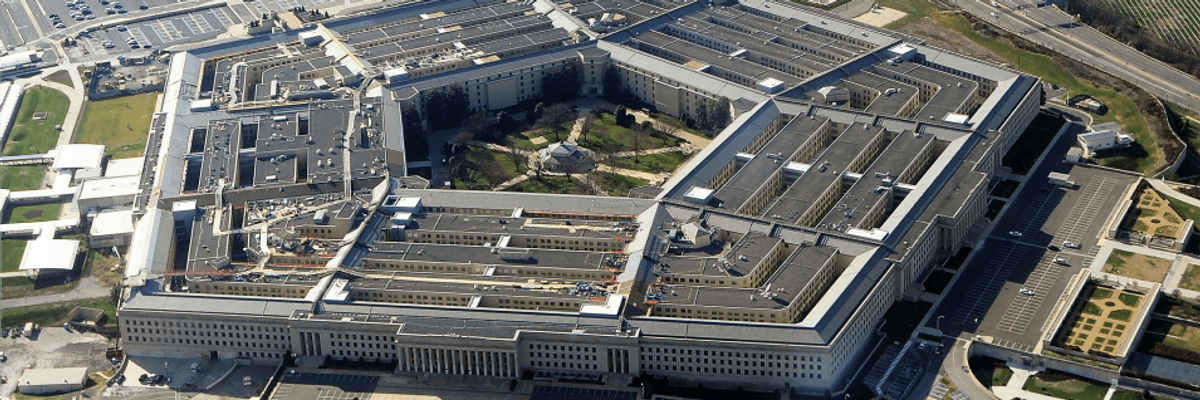
This picture taken on December 26, 2011 shows the Pentagon building in Washington, D.C. (Photo: Staff/AFP via Getty Images)
"The Fight Isn't Over," Say Anti-War Groups as 139 House Democrats Vote With GOP to Reject 10% Pentagon Budget Cut
"Though our amendment didn't pass, progressive power is stronger than ever. We will keep fighting for pro-peace, pro-people budgets until it becomes a reality," said Rep. Mark Pocan.
Anti-war groups vowed to keep fighting to slash the bloated Pentagon budget after the House of Representatives on Tuesday rejected a proposal to cut U.S. military spending by 10% and invest the savings in housing, healthcare, and education in poor communities.
The final vote on the National Defense Authorization Act (NDAA) amendment sponsored by Reps. Barbara Lee (D-Calif.) and Mark Pocan (D-Wis.) was 93-324, with 139 Democrats joining 185 Republicans in voting no. The failure of the Lee-Pocan amendment means the final version of the House NDAA will propose a $740.5 military budget for fiscal year 2021, a more than $2 billion increase from the previous year.
"Ninety-three members of Congress stood together to oppose a bloated $740 billion defense budget," Pocan, co-chair of the Congressional Progressive Caucus, tweeted following the vote. "Though our amendment didn't pass, progressive power is stronger than ever. We will keep fighting for pro-peace, pro-people budgets until it becomes a reality."
The Senate is expected to vote later Tuesday on a companion to the Lee-Pocan amendment sponsored by Sens. Bernie Sanders (I-Vt.) and Ed Markey (D-Mass.).
While voicing disappointment in the amendment's defeat, Win Without War tweeted that just a few years ago it "would have been unthinkable" for 93 members of Congress to vote in favor of a 10% cut to the Pentagon budget.
"If we keep up this momentum, there's no doubt: change is coming," the group said.
Paul Kawika Martin, senior director for policy and political affairs at Peace Action, said in a statement that "more representatives voted today for the largest reduction in Pentagon spending than in recent history."
"Congress still needs to catch up with the will and needs of the electorate, where over half want to see reductions in the bloated Pentagon to pay for other priorities," said Martin. "The main threats to America's security, like the global health pandemic and economic crisis, have no military solution. Right now, Congress must prioritize our spending on helping Americans during this pandemic."
We are at a crossroads
This country and this world are at a monumental crossroads. In a few short weeks, US voters will have an opportunity to beat back the forces of fascism and confront the billionaires who are rigging the economy, our media system, and our democracy, making it increasingly impossible for ordinary people to get by. We’re not just talking about the election. We’re talking about what must be done once these fascist elements are vanquished from power. We need a bolder set of solutions than what either major party has so far been willing to offer and a working-class movement ready to fight like hell for it. Trump didn't emerge from nowhere. The conditions that fueled MAGA authoritarianism were created by decades of radical neoliberal economic policies and a corrupt political system dominated by corporate interests. They slashed taxes on the super-rich, promising that the benefits would trickle down. They said giveaways to the corporate titans would make life more affordable for the rest of us. It was all bullshit. And when a bitter, betrayed populace searches for someone to blame, right-wing demagogues have little trouble finding scapegoats. People know when they're being lied to, but you won't hear any of this from the corporate media. Only independent journalism—powered and funded by people who believe in building a better world—can deliver truly trustworthy daily news. Our Fall Campaign is underway, and we need your help. To power our newsroom through the rest of the year, we need to raise $125,000 by midnight on October 31. So if you share our vision, please contribute whatever you can to sustain our work. |
Anti-war groups vowed to keep fighting to slash the bloated Pentagon budget after the House of Representatives on Tuesday rejected a proposal to cut U.S. military spending by 10% and invest the savings in housing, healthcare, and education in poor communities.
The final vote on the National Defense Authorization Act (NDAA) amendment sponsored by Reps. Barbara Lee (D-Calif.) and Mark Pocan (D-Wis.) was 93-324, with 139 Democrats joining 185 Republicans in voting no. The failure of the Lee-Pocan amendment means the final version of the House NDAA will propose a $740.5 military budget for fiscal year 2021, a more than $2 billion increase from the previous year.
"Ninety-three members of Congress stood together to oppose a bloated $740 billion defense budget," Pocan, co-chair of the Congressional Progressive Caucus, tweeted following the vote. "Though our amendment didn't pass, progressive power is stronger than ever. We will keep fighting for pro-peace, pro-people budgets until it becomes a reality."
The Senate is expected to vote later Tuesday on a companion to the Lee-Pocan amendment sponsored by Sens. Bernie Sanders (I-Vt.) and Ed Markey (D-Mass.).
While voicing disappointment in the amendment's defeat, Win Without War tweeted that just a few years ago it "would have been unthinkable" for 93 members of Congress to vote in favor of a 10% cut to the Pentagon budget.
"If we keep up this momentum, there's no doubt: change is coming," the group said.
Paul Kawika Martin, senior director for policy and political affairs at Peace Action, said in a statement that "more representatives voted today for the largest reduction in Pentagon spending than in recent history."
"Congress still needs to catch up with the will and needs of the electorate, where over half want to see reductions in the bloated Pentagon to pay for other priorities," said Martin. "The main threats to America's security, like the global health pandemic and economic crisis, have no military solution. Right now, Congress must prioritize our spending on helping Americans during this pandemic."
Anti-war groups vowed to keep fighting to slash the bloated Pentagon budget after the House of Representatives on Tuesday rejected a proposal to cut U.S. military spending by 10% and invest the savings in housing, healthcare, and education in poor communities.
The final vote on the National Defense Authorization Act (NDAA) amendment sponsored by Reps. Barbara Lee (D-Calif.) and Mark Pocan (D-Wis.) was 93-324, with 139 Democrats joining 185 Republicans in voting no. The failure of the Lee-Pocan amendment means the final version of the House NDAA will propose a $740.5 military budget for fiscal year 2021, a more than $2 billion increase from the previous year.
"Ninety-three members of Congress stood together to oppose a bloated $740 billion defense budget," Pocan, co-chair of the Congressional Progressive Caucus, tweeted following the vote. "Though our amendment didn't pass, progressive power is stronger than ever. We will keep fighting for pro-peace, pro-people budgets until it becomes a reality."
The Senate is expected to vote later Tuesday on a companion to the Lee-Pocan amendment sponsored by Sens. Bernie Sanders (I-Vt.) and Ed Markey (D-Mass.).
While voicing disappointment in the amendment's defeat, Win Without War tweeted that just a few years ago it "would have been unthinkable" for 93 members of Congress to vote in favor of a 10% cut to the Pentagon budget.
"If we keep up this momentum, there's no doubt: change is coming," the group said.
Paul Kawika Martin, senior director for policy and political affairs at Peace Action, said in a statement that "more representatives voted today for the largest reduction in Pentagon spending than in recent history."
"Congress still needs to catch up with the will and needs of the electorate, where over half want to see reductions in the bloated Pentagon to pay for other priorities," said Martin. "The main threats to America's security, like the global health pandemic and economic crisis, have no military solution. Right now, Congress must prioritize our spending on helping Americans during this pandemic."