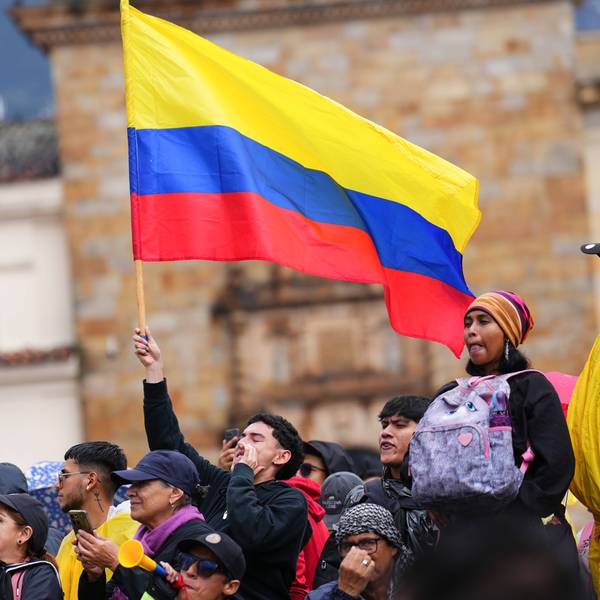

Then-Colombian presidential candidate Abelardo De La Espriella, a far-right figure, addresses his supporters after the announcement of the results of the first round of the presidential elections in Barranquilla, Colombia, on May 31, 2026.
Colombia’s First 'Republican' President Is Going Full MAGA
Abelardo de la Espriella’s young administration has enthusiastically embraced Washington’s interventionist security agenda while, like Trump in the US, advancing its own confrontational eradication campaign against progressive institutions and social movements.
The empty spaces inside Colombia’s National Museum in Bogotá offer a dramatic, if not painful introduction to its new, right-wing government. Several dozen objects related to the peace process with the M-19 rebel group; the historic 1991 Constitution; and mementos of social movements, LGBTQ rights, and other artifacts of the country’s complex history have disappeared from public view. Those objects included a Carlos Pizarro campaign poster, an armband from the political movement that emerged from the M-19’s demobilization, and the student ballot associated with the constituent process that produced the 1991 Constitution.
These histories record how Colombians previously excluded from national power fought to enter public life in a country governed for generations by a white, economically powerful, and politically exclusionary elite. Critics say removing them from the public view diminishes the evidence of that decades-long struggle. Museum anthropologist Andrés Góngora described it in El País as a “mutilated museum.”
The unexpected decommissioning of these items sparked a spontaneous citizen’s protest outside the museum in mid-October, where hundreds of angry people gathered with signs that read, “Poetry is necessary, military domination is not!” and “We’re artists, not terrorists.”
In both cases, political leaders claim authority to determine which historical interpretations belong in public institutions, a unilateral, authoritarian approach to erasing history.
Not surprisingly, the protesters were quickly confronted by highly armed riot police using heavy-handed tactics to block off the entrance to the museum, a show of force designed to demonstrate who was now in control. Barely three months into Abelardo de la Espriella’s presidency, the fight over who belongs in the country’s history has become a fight over who has the right to openly challenge its current trajectory.
The parallel with Donald Trump’s campaign against the Smithsonian and other cultural institutions is unmistakable. Trump’s March 2025 executive order seeks “to remove improper ideology” from the institution. In both cases, political leaders claim authority to determine which historical interpretations belong in public institutions, a unilateral, authoritarian approach to erasing history.
This is just one of a list of concrete policy decisions made by De la Espriella that indicate that Colombia’s first-ever Republican president is going full-on MAGA as he settles into his new executive office.
Seriously.
Deep Ties to Conservative Leaders in US
De la Espriella’s connections to the US Republican Party are concrete and extensive. A naturalized US citizen since 2023, he has donated to Republican Rep. María Elvira Salazar of Florida and publicly endorsed her reelection. He’s met with Colombian American Sen. Bernie Moreno (R-Ohio) on several occasions, including when Moreno visited Colombia during the runoff election explicitly to endorse his candidacy, what some critics saw as direct US meddling in the electoral process.
The new president’s social media posts during the campaign included images of him and his family proudly waving the “Stars and Stripes” while sporting MAGA caps. It’s no secret that Colombia’s president has become an active and vocal participant in the partisan politics of his adopted country, while moving his actual homeland ever closer to Trump.
De la Espriella’s young administration has enthusiastically embraced Washington’s interventionist security agenda while, like Trump in the US, advancing its own confrontational eradication campaign against progressive institutions and social movements. His unwavering genuflection to Donald Trump goes far beyond the familiar, decades-long accommodations that Colombian dependence on its more powerful ally has required of its elected leaders. He appears intent on making the MAGA approach to government his own, but with a distinct criollo flavor.
Like Trump, his highly mediated performances invite viewers to mistake that victory for a license to dominate everything.
The danger is that in the Colombian context of generational political violence, the consequences could be pretty severe for those sectors at the receiving end.
De la Espriella’s over-the-top, high-volume theatrical delivery makes the bilateral relationship with the US easier to sell to his enthusiastic followers. The roaring “Tiger” persona he has adopted, the inflated rhetorical threats and melodramatic public scoldings directed at his detractors, resembles the stereotyped performance of a B-list actor playing out strongman omnipotence in a low-budget narco-telenovela. As a former defense attorney of accused drug traffickers and paramilitaries, he’s had ample time to rehearse the part, which today he is playing out on a much grander stage.
He’s done photo ops with corpses in body bags and captured prisoners in handcuffs, trophies of his self-declared war on “narco-terrorists.” On October 22, the presidency released a video showing him authorizing an aerial bombardment against the ELN, one of Colombia’s many armed groups he's declared open war against. Military command becomes an opportunity for content creation, with the president—decked out in army greens and walkie-talkie in hand—cast as its indispensable protagonist.
The circus-like spectacle carries a deliberate political message. More than 12 million Colombians supported his opponent, the left-wing Senator Iván Cepeda, in June’s runoff election. It was the closest election in Colombia’s history. This extremely narrow victory gave De la Espriella the presidency, so, like Trump, his highly mediated performances invite viewers to mistake that victory for a license to dominate everything. Trump’s own campaign endorsement of “el Tigre” promised him the “total support and strength of the United States,” something De la Espriella is quick to remind audiences about regularly on live television and social media posts. For the new president, Washington’s stamp of approval helps project power over a country that remains profoundly divided.
Political Approval Comes With Concrete Material Commitments
In September, Secretary of State Marco Rubio and Colombian Foreign Minister Omar Bula signed memorandums in the Caribbean coastal city of Barranquilla covering critical minerals and civil nuclear cooperation. News reports of the encounter situated the initiative within Trump’s competition with China and Washington’s effort to secure strategic mineral supplies, especially through its obedient neighbors to the south.
The documents signed in Barranquilla establish a nonbinding framework for technical cooperation, investment, and processing. While they do not necessarily hand ownership of Colombia’s deposits of rare earth minerals to the United States, their significance lies in the extractive development priorities they encourage: Colombia is positioning its resources within Washington’s strategic supply chains, radically reversing the previous government’s efforts at ecological sustainability and economic diversification. Opposition leaders in the Congress, excluded from any consultation in this process, argue that the public deserves to know how communities near these proposed projects will participate, what environmental protections will apply, and who will capture the benefits. Up to now, it’s anybody’s guess, and De la Espriella is in no rush to explain.
As if the extractive collaboration with Washington weren’t enough, the strategic security alignment between the US and Colombia is even more explicit, and alarming. Speaking in Panama on August 12, the bellicose US Secretary of Defense Pete Hegseth announced that Colombia had requested US participation, authorizing “joint military operations to destroy terrorists and terrorist networks.” Colombia also joined the US-led regional counter-cartel coalition, known as the Spear of the Americas. Critics of these announcements—left-wing lawmakers, progressive political analysts, and human rights workers—focused on national sovereignty and the constitutional role of the Senate in authorizing foreign troops.
De la Espriella’s proposals for more coca eradication, aerial bombing, extraditions, and building enormous prisons, a crackdown The New York Times refers to as the “Bukelization” of Colombia, offer the promise of heavy-handed solutions. But they also risk renewing familiar cycles of violence that have shaped Colombian history since the 1950s.
Hegseth’s announcement does not necessarily mean that US soldiers have already carried out attacks inside Colombia, although that is always hard to determine. It does establish the Colombian government’s willingness to invite a deeper military role for Washington in its internal strategic affairs, a trend we’ve already seen in Ecuador, Peru, and El Salvador.
The designation of the declared enemy as “narco-terrorists” makes that invitation sound straightforward and even justifiable, obscuring complex questions about who they are targeting, civilian protection, and accountability. It’s important to point out that the term “narco-terrorist” has been employed by Colombian security forces and government officials repeatedly for almost 40 years to deliberately target opposition and social movement leaders, human rights defenders, and even independent journalists. The probability of this repressive history repeating itself today is very high, considering the current belligerent leadership in both Washington and Bogotá.
Combined with De la Espriella’s public applause for the illegal bombings of alleged drug boats in the Caribbean and Pacific by US forces, attacks which have resulted in over 235 deaths since last October, the current rules of engagement on the ground amount to the worst-case scenario that any of us who have fought against direct US military involvement in Colombia could have imagined.
There’s no question that the security crisis De la Espriella inherited is real, and in many ways led to his narrow election victory in the first place. The policy of “total peace” carried out by former President Gustavo Petro failed to halt the expansion of armed organizations throughout the country. Rural communities continue to endure displacement, extortion, and child recruitment despite Petro’s sincere efforts at negotiating with at least 14 different armed and criminal groups during his mandate, according to the International Crisis Group.
But if history has taught us anything, there are no guarantees that military escalation will work to bring the country security. In the past, the crackdown and capture of leaders of armed groups led to the fragmentation of those organizations, resulting in further, more widespread territorial warfare, while bombardments and sweeping arrests resulted in high levels of civilian casualties and other human rights violations. De la Espriella’s proposals for more coca eradication, aerial bombing, extraditions, and building enormous prisons, a crackdown The New York Times refers to as the “Bukelization” of Colombia, offer the promise of heavy-handed solutions. But they also risk renewing familiar cycles of violence that have shaped Colombian history since the 1950s. People living under armed coercion in high conflict areas need a range of protections and guarantees. And that protection must last beyond the next televised military operation or social media post.
Other MAGA-like Moves by the New Administration
There are other examples of policy decisions that demonstrate how radically De la Espriella has pivoted toward a MAGA agenda. One recent rupture relates to international human rights policy that aligns closely with MAGA’s obsessive anti-wokeism. In mid-September, Colombia withdrew from the Equal Rights Coalition, an intergovernmental alliance which promotes LGBTQ+ rights and which Colombia had been co-chairing with Spain. The Foreign Ministry explained that participation in the coalition “was not a priority.”
The positioning of Colombia as an uncompromising and committed ally of Israel is another stark shift from Petro’s open and vocal criticism of Benjamin Netanyahu for the genocide in Gaza. This pro-Israel stance coincides with an almost fanatical fascination with and embrace of Christian Evangelicals within Colombia, with the formerly self-described atheist president regularly performing the rituals of a true believer in front of the cameras during his first several weeks in office, openly declaring, “Long Live Christ the King!”
De la Espriella’s admirers may enjoy watching the Tiger perform. Colombians, particularly the most vulnerable and traditionally marginalized, will have to live with the policies enacted between those mediated appearances.
It’s hard to understand how any of these policy shifts will materially benefit the Colombian people, including those who voted for him. But there’s no question that these decisions put the new government even further into the good graces of the Rubio-Vance-Trump sphere of influence that the US citizen-turned Colombian president so fondly desires.
Resistance has already complicated the Colombian government’s plans. For example, a judge ordered the removed objects from the National Museum protected and barred further removals pending review.
These kind of decisions give the political opposition compelling reasons to continue to organize and mobilize. On October 14, unions, students, and Indigenous organizations took to the streets in large and small cities all over the country, speaking out against De la Espriella’s authoritarian dictates. It is already clear that popular sectors will not easily abandon their demands because the president commands the cameras. A larger call for a general strike in November is already in the works. Repression could deepen the confrontation, especially if security officials treat resistance to economic, cultural, and social policy as a security problem.
De la Espriella’s admirers may enjoy watching the Tiger perform. Colombians, particularly the most vulnerable and traditionally marginalized, will have to live with the policies enacted between those mediated appearances.
It would be naïve to think they will not stop demanding their rights and livelihoods be protected.
A president who treats those demands as obstacles to his authority is giving the country ample reason to resist.
We are at a crossroads
This country and this world are at a monumental crossroads. In a few short weeks, US voters will have an opportunity to beat back the forces of fascism and confront the billionaires who are rigging the economy, our media system, and our democracy, making it increasingly impossible for ordinary people to get by. We’re not just talking about the election. We’re talking about what must be done once these fascist elements are vanquished from power. We need a bolder set of solutions than what either major party has so far been willing to offer and a working-class movement ready to fight like hell for it. Trump didn't emerge from nowhere. The conditions that fueled MAGA authoritarianism were created by decades of radical neoliberal economic policies and a corrupt political system dominated by corporate interests. They slashed taxes on the super-rich, promising that the benefits would trickle down. They said giveaways to the corporate titans would make life more affordable for the rest of us. It was all bullshit. And when a bitter, betrayed populace searches for someone to blame, right-wing demagogues have little trouble finding scapegoats. People know when they're being lied to, but you won't hear any of this from the corporate media. Only independent journalism—powered and funded by people who believe in building a better world—can deliver truly trustworthy daily news. Our Fall Campaign is underway, and we need your help. To power our newsroom through the rest of the year, we need to raise $125,000 by midnight on October 31. So if you share our vision, please contribute whatever you can to sustain our work. |
The empty spaces inside Colombia’s National Museum in Bogotá offer a dramatic, if not painful introduction to its new, right-wing government. Several dozen objects related to the peace process with the M-19 rebel group; the historic 1991 Constitution; and mementos of social movements, LGBTQ rights, and other artifacts of the country’s complex history have disappeared from public view. Those objects included a Carlos Pizarro campaign poster, an armband from the political movement that emerged from the M-19’s demobilization, and the student ballot associated with the constituent process that produced the 1991 Constitution.
These histories record how Colombians previously excluded from national power fought to enter public life in a country governed for generations by a white, economically powerful, and politically exclusionary elite. Critics say removing them from the public view diminishes the evidence of that decades-long struggle. Museum anthropologist Andrés Góngora described it in El País as a “mutilated museum.”
The unexpected decommissioning of these items sparked a spontaneous citizen’s protest outside the museum in mid-October, where hundreds of angry people gathered with signs that read, “Poetry is necessary, military domination is not!” and “We’re artists, not terrorists.”
In both cases, political leaders claim authority to determine which historical interpretations belong in public institutions, a unilateral, authoritarian approach to erasing history.
Not surprisingly, the protesters were quickly confronted by highly armed riot police using heavy-handed tactics to block off the entrance to the museum, a show of force designed to demonstrate who was now in control. Barely three months into Abelardo de la Espriella’s presidency, the fight over who belongs in the country’s history has become a fight over who has the right to openly challenge its current trajectory.
The parallel with Donald Trump’s campaign against the Smithsonian and other cultural institutions is unmistakable. Trump’s March 2025 executive order seeks “to remove improper ideology” from the institution. In both cases, political leaders claim authority to determine which historical interpretations belong in public institutions, a unilateral, authoritarian approach to erasing history.
This is just one of a list of concrete policy decisions made by De la Espriella that indicate that Colombia’s first-ever Republican president is going full-on MAGA as he settles into his new executive office.
Seriously.
Deep Ties to Conservative Leaders in US
De la Espriella’s connections to the US Republican Party are concrete and extensive. A naturalized US citizen since 2023, he has donated to Republican Rep. María Elvira Salazar of Florida and publicly endorsed her reelection. He’s met with Colombian American Sen. Bernie Moreno (R-Ohio) on several occasions, including when Moreno visited Colombia during the runoff election explicitly to endorse his candidacy, what some critics saw as direct US meddling in the electoral process.
The new president’s social media posts during the campaign included images of him and his family proudly waving the “Stars and Stripes” while sporting MAGA caps. It’s no secret that Colombia’s president has become an active and vocal participant in the partisan politics of his adopted country, while moving his actual homeland ever closer to Trump.
De la Espriella’s young administration has enthusiastically embraced Washington’s interventionist security agenda while, like Trump in the US, advancing its own confrontational eradication campaign against progressive institutions and social movements. His unwavering genuflection to Donald Trump goes far beyond the familiar, decades-long accommodations that Colombian dependence on its more powerful ally has required of its elected leaders. He appears intent on making the MAGA approach to government his own, but with a distinct criollo flavor.
Like Trump, his highly mediated performances invite viewers to mistake that victory for a license to dominate everything.
The danger is that in the Colombian context of generational political violence, the consequences could be pretty severe for those sectors at the receiving end.
De la Espriella’s over-the-top, high-volume theatrical delivery makes the bilateral relationship with the US easier to sell to his enthusiastic followers. The roaring “Tiger” persona he has adopted, the inflated rhetorical threats and melodramatic public scoldings directed at his detractors, resembles the stereotyped performance of a B-list actor playing out strongman omnipotence in a low-budget narco-telenovela. As a former defense attorney of accused drug traffickers and paramilitaries, he’s had ample time to rehearse the part, which today he is playing out on a much grander stage.
He’s done photo ops with corpses in body bags and captured prisoners in handcuffs, trophies of his self-declared war on “narco-terrorists.” On October 22, the presidency released a video showing him authorizing an aerial bombardment against the ELN, one of Colombia’s many armed groups he's declared open war against. Military command becomes an opportunity for content creation, with the president—decked out in army greens and walkie-talkie in hand—cast as its indispensable protagonist.
The circus-like spectacle carries a deliberate political message. More than 12 million Colombians supported his opponent, the left-wing Senator Iván Cepeda, in June’s runoff election. It was the closest election in Colombia’s history. This extremely narrow victory gave De la Espriella the presidency, so, like Trump, his highly mediated performances invite viewers to mistake that victory for a license to dominate everything. Trump’s own campaign endorsement of “el Tigre” promised him the “total support and strength of the United States,” something De la Espriella is quick to remind audiences about regularly on live television and social media posts. For the new president, Washington’s stamp of approval helps project power over a country that remains profoundly divided.
Political Approval Comes With Concrete Material Commitments
In September, Secretary of State Marco Rubio and Colombian Foreign Minister Omar Bula signed memorandums in the Caribbean coastal city of Barranquilla covering critical minerals and civil nuclear cooperation. News reports of the encounter situated the initiative within Trump’s competition with China and Washington’s effort to secure strategic mineral supplies, especially through its obedient neighbors to the south.
The documents signed in Barranquilla establish a nonbinding framework for technical cooperation, investment, and processing. While they do not necessarily hand ownership of Colombia’s deposits of rare earth minerals to the United States, their significance lies in the extractive development priorities they encourage: Colombia is positioning its resources within Washington’s strategic supply chains, radically reversing the previous government’s efforts at ecological sustainability and economic diversification. Opposition leaders in the Congress, excluded from any consultation in this process, argue that the public deserves to know how communities near these proposed projects will participate, what environmental protections will apply, and who will capture the benefits. Up to now, it’s anybody’s guess, and De la Espriella is in no rush to explain.
As if the extractive collaboration with Washington weren’t enough, the strategic security alignment between the US and Colombia is even more explicit, and alarming. Speaking in Panama on August 12, the bellicose US Secretary of Defense Pete Hegseth announced that Colombia had requested US participation, authorizing “joint military operations to destroy terrorists and terrorist networks.” Colombia also joined the US-led regional counter-cartel coalition, known as the Spear of the Americas. Critics of these announcements—left-wing lawmakers, progressive political analysts, and human rights workers—focused on national sovereignty and the constitutional role of the Senate in authorizing foreign troops.
De la Espriella’s proposals for more coca eradication, aerial bombing, extraditions, and building enormous prisons, a crackdown The New York Times refers to as the “Bukelization” of Colombia, offer the promise of heavy-handed solutions. But they also risk renewing familiar cycles of violence that have shaped Colombian history since the 1950s.
Hegseth’s announcement does not necessarily mean that US soldiers have already carried out attacks inside Colombia, although that is always hard to determine. It does establish the Colombian government’s willingness to invite a deeper military role for Washington in its internal strategic affairs, a trend we’ve already seen in Ecuador, Peru, and El Salvador.
The designation of the declared enemy as “narco-terrorists” makes that invitation sound straightforward and even justifiable, obscuring complex questions about who they are targeting, civilian protection, and accountability. It’s important to point out that the term “narco-terrorist” has been employed by Colombian security forces and government officials repeatedly for almost 40 years to deliberately target opposition and social movement leaders, human rights defenders, and even independent journalists. The probability of this repressive history repeating itself today is very high, considering the current belligerent leadership in both Washington and Bogotá.
Combined with De la Espriella’s public applause for the illegal bombings of alleged drug boats in the Caribbean and Pacific by US forces, attacks which have resulted in over 235 deaths since last October, the current rules of engagement on the ground amount to the worst-case scenario that any of us who have fought against direct US military involvement in Colombia could have imagined.
There’s no question that the security crisis De la Espriella inherited is real, and in many ways led to his narrow election victory in the first place. The policy of “total peace” carried out by former President Gustavo Petro failed to halt the expansion of armed organizations throughout the country. Rural communities continue to endure displacement, extortion, and child recruitment despite Petro’s sincere efforts at negotiating with at least 14 different armed and criminal groups during his mandate, according to the International Crisis Group.
But if history has taught us anything, there are no guarantees that military escalation will work to bring the country security. In the past, the crackdown and capture of leaders of armed groups led to the fragmentation of those organizations, resulting in further, more widespread territorial warfare, while bombardments and sweeping arrests resulted in high levels of civilian casualties and other human rights violations. De la Espriella’s proposals for more coca eradication, aerial bombing, extraditions, and building enormous prisons, a crackdown The New York Times refers to as the “Bukelization” of Colombia, offer the promise of heavy-handed solutions. But they also risk renewing familiar cycles of violence that have shaped Colombian history since the 1950s. People living under armed coercion in high conflict areas need a range of protections and guarantees. And that protection must last beyond the next televised military operation or social media post.
Other MAGA-like Moves by the New Administration
There are other examples of policy decisions that demonstrate how radically De la Espriella has pivoted toward a MAGA agenda. One recent rupture relates to international human rights policy that aligns closely with MAGA’s obsessive anti-wokeism. In mid-September, Colombia withdrew from the Equal Rights Coalition, an intergovernmental alliance which promotes LGBTQ+ rights and which Colombia had been co-chairing with Spain. The Foreign Ministry explained that participation in the coalition “was not a priority.”
The positioning of Colombia as an uncompromising and committed ally of Israel is another stark shift from Petro’s open and vocal criticism of Benjamin Netanyahu for the genocide in Gaza. This pro-Israel stance coincides with an almost fanatical fascination with and embrace of Christian Evangelicals within Colombia, with the formerly self-described atheist president regularly performing the rituals of a true believer in front of the cameras during his first several weeks in office, openly declaring, “Long Live Christ the King!”
De la Espriella’s admirers may enjoy watching the Tiger perform. Colombians, particularly the most vulnerable and traditionally marginalized, will have to live with the policies enacted between those mediated appearances.
It’s hard to understand how any of these policy shifts will materially benefit the Colombian people, including those who voted for him. But there’s no question that these decisions put the new government even further into the good graces of the Rubio-Vance-Trump sphere of influence that the US citizen-turned Colombian president so fondly desires.
Resistance has already complicated the Colombian government’s plans. For example, a judge ordered the removed objects from the National Museum protected and barred further removals pending review.
These kind of decisions give the political opposition compelling reasons to continue to organize and mobilize. On October 14, unions, students, and Indigenous organizations took to the streets in large and small cities all over the country, speaking out against De la Espriella’s authoritarian dictates. It is already clear that popular sectors will not easily abandon their demands because the president commands the cameras. A larger call for a general strike in November is already in the works. Repression could deepen the confrontation, especially if security officials treat resistance to economic, cultural, and social policy as a security problem.
De la Espriella’s admirers may enjoy watching the Tiger perform. Colombians, particularly the most vulnerable and traditionally marginalized, will have to live with the policies enacted between those mediated appearances.
It would be naïve to think they will not stop demanding their rights and livelihoods be protected.
A president who treats those demands as obstacles to his authority is giving the country ample reason to resist.
- 'An SOS Has Sounded in Colombia': Rights Groups Blast Deadly Repression of National Strike ›
- MAGA's Global Roots: Why 'America First' Isn't American ›
- Colombians Defy Presidential Decree 'Criminalizing Protest' in Rallies Against Right-Wing Government ›
- Colombians Voted Against Their Collective Memory on Sunday ›
- Far-Right Upstart de la Espriella Advances to Runoff in Colombia's Presidential Election ›