SUBSCRIBE TO OUR FREE NEWSLETTER
Daily news & progressive opinion—funded by the people, not the corporations—delivered straight to your inbox.
5
#000000
#FFFFFF
To donate by check, phone, or other method, see our More Ways to Give page.
Daily news & progressive opinion—funded by the people, not the corporations—delivered straight to your inbox.
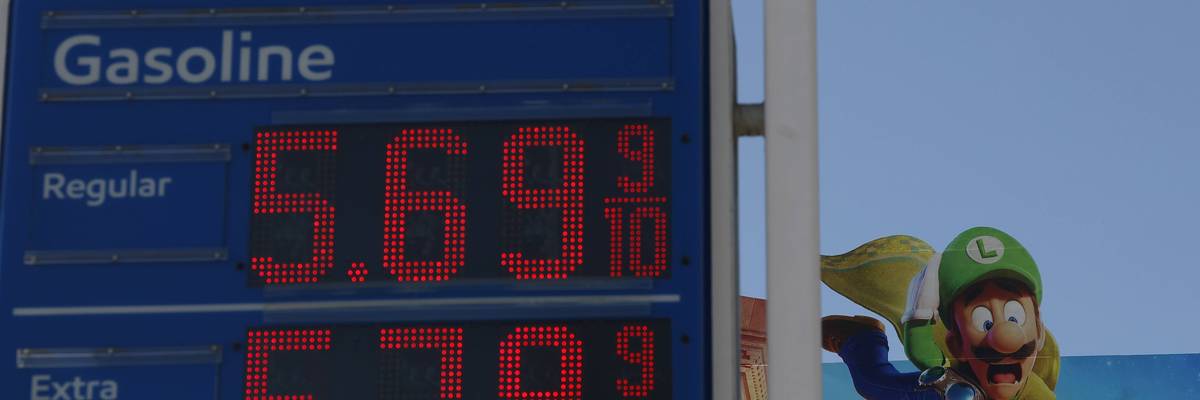
Gas prices over $5 a gallon are displayed at a Mobil station on March 11, 2026 in Los Angeles, California.
As the cost of clean energy keeps plummeting, it gets more and more obvious how much money we waste, and how much financial risk we incur, by staying with fossil fuel.
Beginning next week, Australians across a huge swath of the continent will begin getting three free hours of electricity every afternoon—to charge their cars, runs their dishwashers, fill up a storage battery to run the house at night. I’ve written about this before, so I won’t belabor it here, except to say that humans have spent the last 1.79 million years (according to new research last week) working hard for energy: spending time gathering firewood, spending time working to pay the power bill. Now, in one large part of the Earth, for one large part of the day, electricity will be too cheap to meter. You want some abundance? Here you go.
So it seems like a good time to dig in to the larger questions of energy, climate, pollution, and money—an interrelated set of issues, and one where the numbers are shifting quickly and dramatically almost every month. Here’s the bottom line, which I think is beginning to drive public policy almost every place except the US, where we have lots and lots of work to do: As the cost of clean energy keeps plummeting, it gets more and more obvious how much money we waste, and how much financial risk we incur, by staying with fossil fuel.
Let’s start first by talking about the climate crisis, and the ways it’s rapidly becoming an economic crisis. My old colleagues at 350.org have been publishing a series of quite brilliant reports on the subject in recent weeks. One, for instance, is on the insurance crisis, which is growing across the planet. This is from Risalat Khan and Kenny Stancil:
In the United States, homeowner insurance premiums increased by 29% from January 2021 to January 2026, and personal auto insurance rose nearly 25% over the same period. These mounting costs are among the biggest contributors to overall inflation.
France raised its mandatory natural catastrophe surcharge on property insurance from 12% to 20%, effective January 2025. In northern Australia, premiums climbed more than 130% in real terms between 2007 and 2022, a 6% growth year on year.
Across most low- and middle-income countries, insurance coverage is usually less than 10%, and sometimes far less, leaving uninsured communities and businesses to bear most of the risks and losses from climate disasters.
Somewhat karmically, a new report from risk analysts First Street finds that… data centers face much of this risk from extreme weather:
Approximately 54% of global data center capacity operates in markets facing elevated chronic heat or drought stress, while 79% is exposed to significant acute hazards such as flood, wind, or wildfire. For many markets, climate risk should now be considered part of the base case rather than a tail-risk scenario.
But most of us only buy insurance once a year, and it’s such a depressing task that we try to forget about it immediately. Groceries are different, and as Nicole Pita points out, the link to climate change is pretty clear.
Droughts in the US Midwest and Canada destroyed harvests in 2022. Floods in India and South Asia pushed up rice prices in 2023 and 2025. The climate crisis is affecting crop production itself, making food harder to grow. The irony is that food systems produce one-third of global greenhouse gas emissions, making them both a victim and a driver of the crisis.
And it will get worse. Here’s a new report from the Autonomy Institute on what the climate crisis is doing to the cost of “Five a day” in the UK:
Heatwaves are projected to add around 11% to the price of the UK’s top 20 fruit and vegetables by 2035 and around 68% by 2050 under a high emissions scenario, on top of normal inflation. Imported tropical fruit such as melons, oranges, bananas, easy peelers, and grapes will rise 12% to 14% by 2035 and 80% to 93% by 2050 on these climate grounds alone.
• Compounded with estimated normal inflation, total average shelf prices of the overall basket of fruit and veg will reach upwards of 170% above today’s level by 2050.
• This means that climate-flation will be contributing 40% of total inflation across the basket of basic goods by 2035 and over 60% of it by 2050. Climate change will have gone from a junior contributor to the dominant driver of shelf-price inflation on fresh produce inside the working lifetime of someone in their 30s today.
(A note to the perplexed: “Easy peelers” turns out to be what Brits call mandarin oranges and clementines. I like it.)
Here’s how Emma Court and Kyle Kim summed it up in a comprehensive Bloomberg account:
Extreme weather also makes growing crops more expensive. For example, Del Monte Corp., which sold more than $4 billion of bananas, pineapples, avocados, and other food products last year, has been investing in measures to shield crops from rising temperatures and sun damage. This includes covering them with shade cloth and spraying them with a reflective layer of so-called plant sunscreen. The company is also paying more for cooling throughout its supply chain, including by requiring upgrades in fruit-processing plants in the Midwest that were originally designed for lower temperatures.
The effects of climate on pricing are difficult to capture, because they build gradually, says Hans Sauter, Del Monte’s chief sustainability officer. But lower yields, increasing disease threats, and higher costs can all contribute to more expensive produce. “This is part of our DNA. We have been dealing with climate events forever,” he says. “But these new circumstances are making it more expensive.”
Regions where temperatures are already warm will likely be the most exposed to climate inflation, in part because additional heat can more readily slash agricultural harvests. Among the worst-off are countries in Africa and South America, which also tend to have lower incomes, with less infrastructure, and fewer resources to guard against climate change.
But the fossil fuel that drives climate change raises costs in other ways too. The most obvious is their effect on public health. It’s hard, of course, to calculate this with precision, but the attempts leave us with staggering numbers: The Natural Resource Defense Council, five years ago, demonstrated that fossil fuel pollution was costing America $820 billion a year. (That’s nearly a Musk). The numbers elsewhere are much higher.
Sometimes, though, it’s easier to see them in reverse. A new study this month, described by Gary Fuller, finds that when London cut down sharply on urban air pollution with its congestion pricing zone, remarkable things followed:
Low emission and clean air zones attract controversy whenever they are proposed, but there is growing evidence that they work in improving air quality. The Bradford zone was followed by a reduction of about 25% in GP visits for heart and breathing problems and survey data shows that the central London zone was followed by a reduction in the likelihood of a person taking sick leave…
The researchers looked at emergency admissions to hospital, excluding cases such as accidents, burns, drug overdose, poisoning, or self-harm. For people living in the central London zone, admissions increased at 3% per year before the schemes started. After their launch this trend was altered, with a 3% reduction in annual trends for emergency admissions, including an 8% reduction for heart problems and a 6% reduction for breathing problems.
That adds up to real money. Not only that, but people can breathe, always a plus!
If you try to add all this up, you get some interesting numbers. As Kate Yoder reports:
“What’s striking is that already, households are bearing serious costs,” said Kimberly Clausing, a law professor at the University of California, Los Angeles. She co-authored a paper from earlier this year finding that families were paying between $400 and $900 more each year because of the effects of climate change, with the costs above $1,300 in the 10% hardest-hit counties, many of them found in Florida, Louisiana, Nebraska, Colorado, and California.
What’s more, people are figuring all this out:
Two-thirds of US voters agree that global warming is affecting the cost of living to some degree, according to new survey data from the Yale Program on Climate Change Communication, including most Democrats and moderate Republicans. Of those two-thirds, a majority of them said that climate change was driving up what they pay for groceries, utility bills, and home insurance.
And then there’s the sheer cost of energy itself—of the need to keep paying for coal and gas and oil while the far-cheaper sun and wind goes to waste. We’re stuck in a political moment when feckless Democratic politicians (paging Kathy Hochul) are making “affordability” their excuse for going along with Big Oil. But in fact one example after another is making it clear that, as Ray Wills writes, “what is making us poorer is not the move to clean energy—it is doing the transition slowly and badly. His examples are back in Australia:
The Australian Energy Market Commission’s latest Residential Electricity Price Trends work is blunt: Accelerating renewable generation, transmission, and battery storage is "essential" to keep electricity prices affordable over the next decade.
In scenarios where new wind, solar, and transmission arrive on schedule, household bills fall compared to today. When those projects are delayed, prices remain higher for longer because the system leans more heavily on expensive gas and unreliable old coal.
Independent modelling tells a similar story. Analysis for the Clean Energy Council shows that if Australia stalls the rollout of renewables, household bills in 2030 could be around 30% higher than on a timely transition path—roughly $449 a year extra for a typical household, and even more for small businesses.
Nexa Advisory’s work finds that transition delays that lock in more gas-fired generation could add about $115.7 billion to wholesale costs between now and 2050.
Individuals can and do figure out some of the ways to lower their own costs. Not surprisingly, the spike in gas prices for Americans during our farcical Iranian excursion convinced some to change their habits or their technology. Lydia DePillis looked at the numbers:
Americans are powerfully attached to their cars, and their spending at gasoline stations jumped 21% from February to May. But that ability to spend has limits. According to Dow Jones Energy, consumption was 6.1% lower in May from a year earlier. Some of that is a long-running trend owing to the increasing efficiency of passenger vehicles, said Denton Cinquegrana, the company’s chief oil analyst, and about half is probably a consumer response to higher prices.
But much of the real work needs to be done by governments: Nothing people can do by themselves will have much affect on the cost of food, healthcare, or energy. And when governments do their job well, the results can be amazing. I began with Australia and its free afternoon electricity; let’s close with Europe. As Jan Rosenow points out, the continent’s commitment to energy efficiency is paying off: It’s spending 29% less on energy than it would have if consumption had kept growing this century:
Importantly that is energy nobody had to generate, import, or pay for. It built up slowly, over 25 years, across 27 countries, in warmer buildings, more efficient factories, better appliances, the switch to LED lighting, and steadily more efficient transport. At any given price Europe now pays around a third less than it would have without those gains.
This shield holds whichever direction the next shock arrives from. If anything, the figure undersells the benefit, because it counts only the energy saved and not the power stations, pipelines, and grid connections nobody had to build. It is one of the most effective protection measures against future energy crisis: The energy not consumed cannot be withheld, weaponised, or made more expensive by a supplier you do not control.
As he points out, there’s vast room for expansion:
A heat pump in a well-insulated home on clean electricity cuts the energy the building needs, replaces the gas boiler, and runs on a grid that keeps getting cleaner. That single device also pulls the household out of the gas import chain for good, and as a side effect keeps it cooler through the sort of summer Europe now gets most years.
In the Netherlands, for instance, you can sign up for free clothes-washing, drying, and dishwashing between noon and 5:00 pm, part of a scheme from a company called CoolBlue.
People are quickly figuring all this out across much of the world. It remains for a savvy American politician to really lay out the case. But when she does the rewards will be high. “Free” would be a popular thing.
Dear Common Dreams reader, It’s been nearly 30 years since I co-founded Common Dreams with my late wife, Lina Newhouser. We had the radical notion that journalism should serve the public good, not corporate profits. It was clear to us from the outset what it would take to build such a project. No paid advertisements. No corporate sponsors. No millionaire publisher telling us what to think or do. Many people said we wouldn't last a year, but we proved those doubters wrong. Together with a tremendous team of journalists and dedicated staff, we built an independent media outlet free from the constraints of profits and corporate control. Our mission has always been simple: To inform. To inspire. To ignite change for the common good. Building Common Dreams was not easy. Our survival was never guaranteed. When you take on the most powerful forces—Wall Street greed, fossil fuel industry destruction, Big Tech lobbyists, and uber-rich oligarchs who have spent billions upon billions rigging the economy and democracy in their favor—the only bulwark you have is supporters who believe in your work. But here’s the urgent message from me today. It's never been this bad out there. And it's never been this hard to keep us going. At the very moment Common Dreams is most needed, the threats we face are intensifying. We need your support now more than ever. We don't accept corporate advertising and never will. We don't have a paywall because we don't think people should be blocked from critical news based on their ability to pay. Everything we do is funded by the donations of readers like you. When everyone does the little they can afford, we are strong. But if that support retreats or dries up, so do we. Will you donate now to make sure Common Dreams not only survives but thrives? —Craig Brown, Co-founder |
Beginning next week, Australians across a huge swath of the continent will begin getting three free hours of electricity every afternoon—to charge their cars, runs their dishwashers, fill up a storage battery to run the house at night. I’ve written about this before, so I won’t belabor it here, except to say that humans have spent the last 1.79 million years (according to new research last week) working hard for energy: spending time gathering firewood, spending time working to pay the power bill. Now, in one large part of the Earth, for one large part of the day, electricity will be too cheap to meter. You want some abundance? Here you go.
So it seems like a good time to dig in to the larger questions of energy, climate, pollution, and money—an interrelated set of issues, and one where the numbers are shifting quickly and dramatically almost every month. Here’s the bottom line, which I think is beginning to drive public policy almost every place except the US, where we have lots and lots of work to do: As the cost of clean energy keeps plummeting, it gets more and more obvious how much money we waste, and how much financial risk we incur, by staying with fossil fuel.
Let’s start first by talking about the climate crisis, and the ways it’s rapidly becoming an economic crisis. My old colleagues at 350.org have been publishing a series of quite brilliant reports on the subject in recent weeks. One, for instance, is on the insurance crisis, which is growing across the planet. This is from Risalat Khan and Kenny Stancil:
In the United States, homeowner insurance premiums increased by 29% from January 2021 to January 2026, and personal auto insurance rose nearly 25% over the same period. These mounting costs are among the biggest contributors to overall inflation.
France raised its mandatory natural catastrophe surcharge on property insurance from 12% to 20%, effective January 2025. In northern Australia, premiums climbed more than 130% in real terms between 2007 and 2022, a 6% growth year on year.
Across most low- and middle-income countries, insurance coverage is usually less than 10%, and sometimes far less, leaving uninsured communities and businesses to bear most of the risks and losses from climate disasters.
Somewhat karmically, a new report from risk analysts First Street finds that… data centers face much of this risk from extreme weather:
Approximately 54% of global data center capacity operates in markets facing elevated chronic heat or drought stress, while 79% is exposed to significant acute hazards such as flood, wind, or wildfire. For many markets, climate risk should now be considered part of the base case rather than a tail-risk scenario.
But most of us only buy insurance once a year, and it’s such a depressing task that we try to forget about it immediately. Groceries are different, and as Nicole Pita points out, the link to climate change is pretty clear.
Droughts in the US Midwest and Canada destroyed harvests in 2022. Floods in India and South Asia pushed up rice prices in 2023 and 2025. The climate crisis is affecting crop production itself, making food harder to grow. The irony is that food systems produce one-third of global greenhouse gas emissions, making them both a victim and a driver of the crisis.
And it will get worse. Here’s a new report from the Autonomy Institute on what the climate crisis is doing to the cost of “Five a day” in the UK:
Heatwaves are projected to add around 11% to the price of the UK’s top 20 fruit and vegetables by 2035 and around 68% by 2050 under a high emissions scenario, on top of normal inflation. Imported tropical fruit such as melons, oranges, bananas, easy peelers, and grapes will rise 12% to 14% by 2035 and 80% to 93% by 2050 on these climate grounds alone.
• Compounded with estimated normal inflation, total average shelf prices of the overall basket of fruit and veg will reach upwards of 170% above today’s level by 2050.
• This means that climate-flation will be contributing 40% of total inflation across the basket of basic goods by 2035 and over 60% of it by 2050. Climate change will have gone from a junior contributor to the dominant driver of shelf-price inflation on fresh produce inside the working lifetime of someone in their 30s today.
(A note to the perplexed: “Easy peelers” turns out to be what Brits call mandarin oranges and clementines. I like it.)
Here’s how Emma Court and Kyle Kim summed it up in a comprehensive Bloomberg account:
Extreme weather also makes growing crops more expensive. For example, Del Monte Corp., which sold more than $4 billion of bananas, pineapples, avocados, and other food products last year, has been investing in measures to shield crops from rising temperatures and sun damage. This includes covering them with shade cloth and spraying them with a reflective layer of so-called plant sunscreen. The company is also paying more for cooling throughout its supply chain, including by requiring upgrades in fruit-processing plants in the Midwest that were originally designed for lower temperatures.
The effects of climate on pricing are difficult to capture, because they build gradually, says Hans Sauter, Del Monte’s chief sustainability officer. But lower yields, increasing disease threats, and higher costs can all contribute to more expensive produce. “This is part of our DNA. We have been dealing with climate events forever,” he says. “But these new circumstances are making it more expensive.”
Regions where temperatures are already warm will likely be the most exposed to climate inflation, in part because additional heat can more readily slash agricultural harvests. Among the worst-off are countries in Africa and South America, which also tend to have lower incomes, with less infrastructure, and fewer resources to guard against climate change.
But the fossil fuel that drives climate change raises costs in other ways too. The most obvious is their effect on public health. It’s hard, of course, to calculate this with precision, but the attempts leave us with staggering numbers: The Natural Resource Defense Council, five years ago, demonstrated that fossil fuel pollution was costing America $820 billion a year. (That’s nearly a Musk). The numbers elsewhere are much higher.
Sometimes, though, it’s easier to see them in reverse. A new study this month, described by Gary Fuller, finds that when London cut down sharply on urban air pollution with its congestion pricing zone, remarkable things followed:
Low emission and clean air zones attract controversy whenever they are proposed, but there is growing evidence that they work in improving air quality. The Bradford zone was followed by a reduction of about 25% in GP visits for heart and breathing problems and survey data shows that the central London zone was followed by a reduction in the likelihood of a person taking sick leave…
The researchers looked at emergency admissions to hospital, excluding cases such as accidents, burns, drug overdose, poisoning, or self-harm. For people living in the central London zone, admissions increased at 3% per year before the schemes started. After their launch this trend was altered, with a 3% reduction in annual trends for emergency admissions, including an 8% reduction for heart problems and a 6% reduction for breathing problems.
That adds up to real money. Not only that, but people can breathe, always a plus!
If you try to add all this up, you get some interesting numbers. As Kate Yoder reports:
“What’s striking is that already, households are bearing serious costs,” said Kimberly Clausing, a law professor at the University of California, Los Angeles. She co-authored a paper from earlier this year finding that families were paying between $400 and $900 more each year because of the effects of climate change, with the costs above $1,300 in the 10% hardest-hit counties, many of them found in Florida, Louisiana, Nebraska, Colorado, and California.
What’s more, people are figuring all this out:
Two-thirds of US voters agree that global warming is affecting the cost of living to some degree, according to new survey data from the Yale Program on Climate Change Communication, including most Democrats and moderate Republicans. Of those two-thirds, a majority of them said that climate change was driving up what they pay for groceries, utility bills, and home insurance.
And then there’s the sheer cost of energy itself—of the need to keep paying for coal and gas and oil while the far-cheaper sun and wind goes to waste. We’re stuck in a political moment when feckless Democratic politicians (paging Kathy Hochul) are making “affordability” their excuse for going along with Big Oil. But in fact one example after another is making it clear that, as Ray Wills writes, “what is making us poorer is not the move to clean energy—it is doing the transition slowly and badly. His examples are back in Australia:
The Australian Energy Market Commission’s latest Residential Electricity Price Trends work is blunt: Accelerating renewable generation, transmission, and battery storage is "essential" to keep electricity prices affordable over the next decade.
In scenarios where new wind, solar, and transmission arrive on schedule, household bills fall compared to today. When those projects are delayed, prices remain higher for longer because the system leans more heavily on expensive gas and unreliable old coal.
Independent modelling tells a similar story. Analysis for the Clean Energy Council shows that if Australia stalls the rollout of renewables, household bills in 2030 could be around 30% higher than on a timely transition path—roughly $449 a year extra for a typical household, and even more for small businesses.
Nexa Advisory’s work finds that transition delays that lock in more gas-fired generation could add about $115.7 billion to wholesale costs between now and 2050.
Individuals can and do figure out some of the ways to lower their own costs. Not surprisingly, the spike in gas prices for Americans during our farcical Iranian excursion convinced some to change their habits or their technology. Lydia DePillis looked at the numbers:
Americans are powerfully attached to their cars, and their spending at gasoline stations jumped 21% from February to May. But that ability to spend has limits. According to Dow Jones Energy, consumption was 6.1% lower in May from a year earlier. Some of that is a long-running trend owing to the increasing efficiency of passenger vehicles, said Denton Cinquegrana, the company’s chief oil analyst, and about half is probably a consumer response to higher prices.
But much of the real work needs to be done by governments: Nothing people can do by themselves will have much affect on the cost of food, healthcare, or energy. And when governments do their job well, the results can be amazing. I began with Australia and its free afternoon electricity; let’s close with Europe. As Jan Rosenow points out, the continent’s commitment to energy efficiency is paying off: It’s spending 29% less on energy than it would have if consumption had kept growing this century:
Importantly that is energy nobody had to generate, import, or pay for. It built up slowly, over 25 years, across 27 countries, in warmer buildings, more efficient factories, better appliances, the switch to LED lighting, and steadily more efficient transport. At any given price Europe now pays around a third less than it would have without those gains.
This shield holds whichever direction the next shock arrives from. If anything, the figure undersells the benefit, because it counts only the energy saved and not the power stations, pipelines, and grid connections nobody had to build. It is one of the most effective protection measures against future energy crisis: The energy not consumed cannot be withheld, weaponised, or made more expensive by a supplier you do not control.
As he points out, there’s vast room for expansion:
A heat pump in a well-insulated home on clean electricity cuts the energy the building needs, replaces the gas boiler, and runs on a grid that keeps getting cleaner. That single device also pulls the household out of the gas import chain for good, and as a side effect keeps it cooler through the sort of summer Europe now gets most years.
In the Netherlands, for instance, you can sign up for free clothes-washing, drying, and dishwashing between noon and 5:00 pm, part of a scheme from a company called CoolBlue.
People are quickly figuring all this out across much of the world. It remains for a savvy American politician to really lay out the case. But when she does the rewards will be high. “Free” would be a popular thing.
Beginning next week, Australians across a huge swath of the continent will begin getting three free hours of electricity every afternoon—to charge their cars, runs their dishwashers, fill up a storage battery to run the house at night. I’ve written about this before, so I won’t belabor it here, except to say that humans have spent the last 1.79 million years (according to new research last week) working hard for energy: spending time gathering firewood, spending time working to pay the power bill. Now, in one large part of the Earth, for one large part of the day, electricity will be too cheap to meter. You want some abundance? Here you go.
So it seems like a good time to dig in to the larger questions of energy, climate, pollution, and money—an interrelated set of issues, and one where the numbers are shifting quickly and dramatically almost every month. Here’s the bottom line, which I think is beginning to drive public policy almost every place except the US, where we have lots and lots of work to do: As the cost of clean energy keeps plummeting, it gets more and more obvious how much money we waste, and how much financial risk we incur, by staying with fossil fuel.
Let’s start first by talking about the climate crisis, and the ways it’s rapidly becoming an economic crisis. My old colleagues at 350.org have been publishing a series of quite brilliant reports on the subject in recent weeks. One, for instance, is on the insurance crisis, which is growing across the planet. This is from Risalat Khan and Kenny Stancil:
In the United States, homeowner insurance premiums increased by 29% from January 2021 to January 2026, and personal auto insurance rose nearly 25% over the same period. These mounting costs are among the biggest contributors to overall inflation.
France raised its mandatory natural catastrophe surcharge on property insurance from 12% to 20%, effective January 2025. In northern Australia, premiums climbed more than 130% in real terms between 2007 and 2022, a 6% growth year on year.
Across most low- and middle-income countries, insurance coverage is usually less than 10%, and sometimes far less, leaving uninsured communities and businesses to bear most of the risks and losses from climate disasters.
Somewhat karmically, a new report from risk analysts First Street finds that… data centers face much of this risk from extreme weather:
Approximately 54% of global data center capacity operates in markets facing elevated chronic heat or drought stress, while 79% is exposed to significant acute hazards such as flood, wind, or wildfire. For many markets, climate risk should now be considered part of the base case rather than a tail-risk scenario.
But most of us only buy insurance once a year, and it’s such a depressing task that we try to forget about it immediately. Groceries are different, and as Nicole Pita points out, the link to climate change is pretty clear.
Droughts in the US Midwest and Canada destroyed harvests in 2022. Floods in India and South Asia pushed up rice prices in 2023 and 2025. The climate crisis is affecting crop production itself, making food harder to grow. The irony is that food systems produce one-third of global greenhouse gas emissions, making them both a victim and a driver of the crisis.
And it will get worse. Here’s a new report from the Autonomy Institute on what the climate crisis is doing to the cost of “Five a day” in the UK:
Heatwaves are projected to add around 11% to the price of the UK’s top 20 fruit and vegetables by 2035 and around 68% by 2050 under a high emissions scenario, on top of normal inflation. Imported tropical fruit such as melons, oranges, bananas, easy peelers, and grapes will rise 12% to 14% by 2035 and 80% to 93% by 2050 on these climate grounds alone.
• Compounded with estimated normal inflation, total average shelf prices of the overall basket of fruit and veg will reach upwards of 170% above today’s level by 2050.
• This means that climate-flation will be contributing 40% of total inflation across the basket of basic goods by 2035 and over 60% of it by 2050. Climate change will have gone from a junior contributor to the dominant driver of shelf-price inflation on fresh produce inside the working lifetime of someone in their 30s today.
(A note to the perplexed: “Easy peelers” turns out to be what Brits call mandarin oranges and clementines. I like it.)
Here’s how Emma Court and Kyle Kim summed it up in a comprehensive Bloomberg account:
Extreme weather also makes growing crops more expensive. For example, Del Monte Corp., which sold more than $4 billion of bananas, pineapples, avocados, and other food products last year, has been investing in measures to shield crops from rising temperatures and sun damage. This includes covering them with shade cloth and spraying them with a reflective layer of so-called plant sunscreen. The company is also paying more for cooling throughout its supply chain, including by requiring upgrades in fruit-processing plants in the Midwest that were originally designed for lower temperatures.
The effects of climate on pricing are difficult to capture, because they build gradually, says Hans Sauter, Del Monte’s chief sustainability officer. But lower yields, increasing disease threats, and higher costs can all contribute to more expensive produce. “This is part of our DNA. We have been dealing with climate events forever,” he says. “But these new circumstances are making it more expensive.”
Regions where temperatures are already warm will likely be the most exposed to climate inflation, in part because additional heat can more readily slash agricultural harvests. Among the worst-off are countries in Africa and South America, which also tend to have lower incomes, with less infrastructure, and fewer resources to guard against climate change.
But the fossil fuel that drives climate change raises costs in other ways too. The most obvious is their effect on public health. It’s hard, of course, to calculate this with precision, but the attempts leave us with staggering numbers: The Natural Resource Defense Council, five years ago, demonstrated that fossil fuel pollution was costing America $820 billion a year. (That’s nearly a Musk). The numbers elsewhere are much higher.
Sometimes, though, it’s easier to see them in reverse. A new study this month, described by Gary Fuller, finds that when London cut down sharply on urban air pollution with its congestion pricing zone, remarkable things followed:
Low emission and clean air zones attract controversy whenever they are proposed, but there is growing evidence that they work in improving air quality. The Bradford zone was followed by a reduction of about 25% in GP visits for heart and breathing problems and survey data shows that the central London zone was followed by a reduction in the likelihood of a person taking sick leave…
The researchers looked at emergency admissions to hospital, excluding cases such as accidents, burns, drug overdose, poisoning, or self-harm. For people living in the central London zone, admissions increased at 3% per year before the schemes started. After their launch this trend was altered, with a 3% reduction in annual trends for emergency admissions, including an 8% reduction for heart problems and a 6% reduction for breathing problems.
That adds up to real money. Not only that, but people can breathe, always a plus!
If you try to add all this up, you get some interesting numbers. As Kate Yoder reports:
“What’s striking is that already, households are bearing serious costs,” said Kimberly Clausing, a law professor at the University of California, Los Angeles. She co-authored a paper from earlier this year finding that families were paying between $400 and $900 more each year because of the effects of climate change, with the costs above $1,300 in the 10% hardest-hit counties, many of them found in Florida, Louisiana, Nebraska, Colorado, and California.
What’s more, people are figuring all this out:
Two-thirds of US voters agree that global warming is affecting the cost of living to some degree, according to new survey data from the Yale Program on Climate Change Communication, including most Democrats and moderate Republicans. Of those two-thirds, a majority of them said that climate change was driving up what they pay for groceries, utility bills, and home insurance.
And then there’s the sheer cost of energy itself—of the need to keep paying for coal and gas and oil while the far-cheaper sun and wind goes to waste. We’re stuck in a political moment when feckless Democratic politicians (paging Kathy Hochul) are making “affordability” their excuse for going along with Big Oil. But in fact one example after another is making it clear that, as Ray Wills writes, “what is making us poorer is not the move to clean energy—it is doing the transition slowly and badly. His examples are back in Australia:
The Australian Energy Market Commission’s latest Residential Electricity Price Trends work is blunt: Accelerating renewable generation, transmission, and battery storage is "essential" to keep electricity prices affordable over the next decade.
In scenarios where new wind, solar, and transmission arrive on schedule, household bills fall compared to today. When those projects are delayed, prices remain higher for longer because the system leans more heavily on expensive gas and unreliable old coal.
Independent modelling tells a similar story. Analysis for the Clean Energy Council shows that if Australia stalls the rollout of renewables, household bills in 2030 could be around 30% higher than on a timely transition path—roughly $449 a year extra for a typical household, and even more for small businesses.
Nexa Advisory’s work finds that transition delays that lock in more gas-fired generation could add about $115.7 billion to wholesale costs between now and 2050.
Individuals can and do figure out some of the ways to lower their own costs. Not surprisingly, the spike in gas prices for Americans during our farcical Iranian excursion convinced some to change their habits or their technology. Lydia DePillis looked at the numbers:
Americans are powerfully attached to their cars, and their spending at gasoline stations jumped 21% from February to May. But that ability to spend has limits. According to Dow Jones Energy, consumption was 6.1% lower in May from a year earlier. Some of that is a long-running trend owing to the increasing efficiency of passenger vehicles, said Denton Cinquegrana, the company’s chief oil analyst, and about half is probably a consumer response to higher prices.
But much of the real work needs to be done by governments: Nothing people can do by themselves will have much affect on the cost of food, healthcare, or energy. And when governments do their job well, the results can be amazing. I began with Australia and its free afternoon electricity; let’s close with Europe. As Jan Rosenow points out, the continent’s commitment to energy efficiency is paying off: It’s spending 29% less on energy than it would have if consumption had kept growing this century:
Importantly that is energy nobody had to generate, import, or pay for. It built up slowly, over 25 years, across 27 countries, in warmer buildings, more efficient factories, better appliances, the switch to LED lighting, and steadily more efficient transport. At any given price Europe now pays around a third less than it would have without those gains.
This shield holds whichever direction the next shock arrives from. If anything, the figure undersells the benefit, because it counts only the energy saved and not the power stations, pipelines, and grid connections nobody had to build. It is one of the most effective protection measures against future energy crisis: The energy not consumed cannot be withheld, weaponised, or made more expensive by a supplier you do not control.
As he points out, there’s vast room for expansion:
A heat pump in a well-insulated home on clean electricity cuts the energy the building needs, replaces the gas boiler, and runs on a grid that keeps getting cleaner. That single device also pulls the household out of the gas import chain for good, and as a side effect keeps it cooler through the sort of summer Europe now gets most years.
In the Netherlands, for instance, you can sign up for free clothes-washing, drying, and dishwashing between noon and 5:00 pm, part of a scheme from a company called CoolBlue.
People are quickly figuring all this out across much of the world. It remains for a savvy American politician to really lay out the case. But when she does the rewards will be high. “Free” would be a popular thing.