SUBSCRIBE TO OUR FREE NEWSLETTER
Daily news & progressive opinion—funded by the people, not the corporations—delivered straight to your inbox.
5
#000000
#FFFFFF
To donate by check, phone, or other method, see our More Ways to Give page.
Daily news & progressive opinion—funded by the people, not the corporations—delivered straight to your inbox.
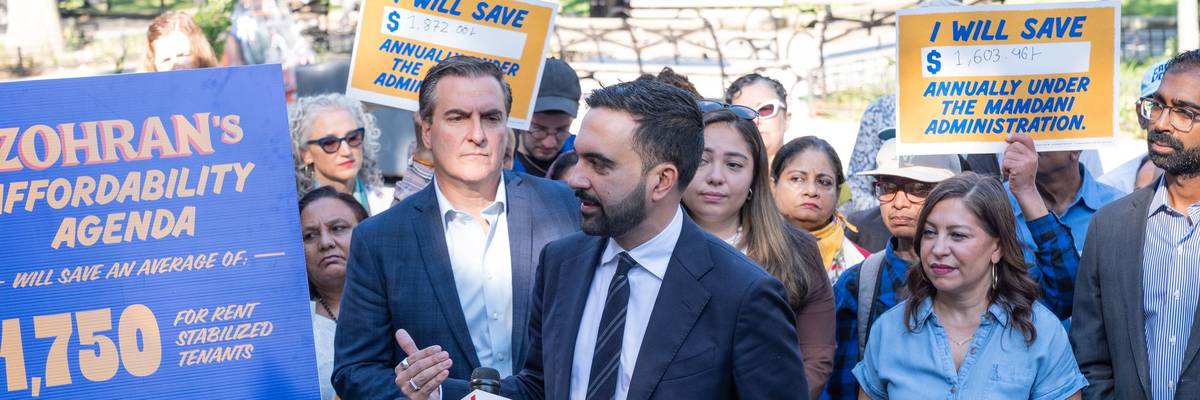
Mayoral candidate Zohran Mamdani speaks at the rally with local elected officials to promote his affordability agenda for election to be the next mayor of the city at Travers Park. He was joined by State Senators Michael Gianaris, Jessica Ramos, Kristen Gonzalez, and Council Member Shekar Krishnan.
A growing number of Americans are ready for transformative change. Now is the time to forge a mighty movement of movements, one aimed squarely at political action.
Progressives of various stripes are attracted these days to several political ideas that must be handled with care or they could come back to haunt us. Considering these ideas points to the need for a new agenda for Americans concerned about climate and the environment.
Key Differences Between 'Affordability' and 'Abundance'
"Affordability" is a huge, legitimate concern for Americans and those who purport to represent us politically. Many progressives are using "affordability" as the rallying cry and point to high prices and inflation. As the success of Zohran Mamdani in NYC shows, it is a powerful political issue, and rightly so.
As I write, Trump just confirmed all this by calling affordability a hoax concocted by Democrats.
But here is something on which we should keep an eye. The underlying problem is not inflation or prices but simply that in our land of affluence, most Americans don't have enough money to live normal, secure lives. Progressives should follow Bernie Sanders’ and Robert Reich’s lead and focus heavily on that and on the vast social inequality government policies have allowed to accumulate. In addition to making prices honest, there are many, many ways for government to get actual money into the hands of people who need it. (Disclosure: in 1968—which feels just like yesterday—I helped draft model negative income tax legislation!)
Meanwhile, the "abundance movement" is a growing political force. There are already examples of it seeking to undermine public protection regulations and other guardrails that are alleged to slow or thwart progress towards abundance.
A looming issue here is that abundance advocates are moving to take advantage of affordability concerns and seeking to draw strength and momentum from those concerns. Abundance advocates must be forced at every turn to answer "abundance of what, for whom, and at what costs?"
The easy path to more and more has always been overall economic growth. It is not hard to imagine a focus on abundance supporting an effort to push GDP growth into ever higher gears. But GDP is a terrible guide to creating more abundance where it is needed. Lots of things do indeed need to grow and become more abundant, but many of them are things not reflected in GDP. And lots of things that are included in GDP need to shrink, and many of them, like fossil fuel use, need to shrink dramatically.
Also, a focus on creating abundance can implicitly endorse a national obscenity—our boundless consumerism. We should remember Wordsworth’s warning from long ago, “Getting and spending, we lay waste our powers.” Americans should now be moving, belatedly, from a consumer society to a conserver society.
Here is my third issue. A position progressives often take is to defend climate action because it “produces jobs,” “lowers energy costs," and in general “helps the economy.” That is often true, but such arguments can be a problem. These arguments can leave environmental and climate advocates in a bad place. We cannot allow ourselves to appear to enshrine the primacy of economic values. We don’t want to be able to save the climate only if it helps the economy. Societies must act to prevent global climate chaos, even if their climate actions slow or hurt the economy in certain ways. Similarly, societies cannot let climate progress be halted or undone whenever the economy heads south.
Also, recall that the US economy still runs on about 82% fossil energy. Doing what now must be done on climate—achieving net zero fossil emissions by 2050, just 25 years away—is likely to be problematic both for low energy prices and the economy. Rather than over relying on the economic benefits of climate action, progressives should focus on measures to ensure economic security for Americans during the dramatic transition ahead, ensuring sufficient income for a decent life for those now living paycheck to paycheck or worse.
(Of course, what we are seeing today from theTrump Administration is the worst of all worlds: a determined attack on all climate progress despite its national economic benefits, all in an effort to sustain profitability of the fossil and AI industries while venomously undoing climate initiatives of the Obama and Biden Administrations.)
Past Failures and a Better Path for the Future
These issues bring into focus three great failures of US climate and environmental advocacy. I have been associated with this advocacy for many years, so I bear some responsibility. I hope these shortcomings will now be addressed with urgency.
1. First is the failure over recent decades to build a powerful political force for climate action. US environmental groups have been weak politically and especially weak when it comes to climate. We should blame section 501(c)(3) of the Internal Revenue Code for some of that. Except around the edges, our leading groups have not broken out of the 501(c)(3) cocoon and its proscription of political activity and electioneering. The leaders of our environmental and climate groups should now come together and build a powerful, politically engaged movement, a fusion of forces, first among themselves and then with allied progressive constituencies.
2. We can see failure also in the absence of any real campaign to dethrone GDP as a measure of national progress and to replace it with an alternative like the Genuine Progress Indicator or something better. As Herman Daly pointed out, we have been living in a period of "uneconomic growth" for quite a while, with costs of aggregate GDP growth exceeding benefits. The best way to get beyond our current GDP fetish is to adopt a new measure or measures of national well-being and progress. One such measure should be a monetized one so that it can be compared quarterly with GDP. In various economies, analyses have shown that in recent decades while GDP rose wellbeing has tended to stagnate or even decline.
3. The third, and biggest, of our failures is the failure to appreciate and act on the underlying reasons for environmental decline. We environmentalists must confront a haunting paradox. Our groups have grown ever stronger, more sophisticated, and better funded, winning many battles along the way. Yet, 55 years after the first Earth Day, we find ourselves on the cusp of a ruined planet.
How can we make sense of that? We must begin by asking anew: What is an environmental issue? The answer must surely include this: “any issue that significantly affects environmental performance and outcomes.” When answered that way, focusing on roadblocks to environmental solutions, environmental issues will include: 1) our distorted political system; 2) a pervasive economic disparity and insecurity that paralyzes political action; and 3) the materialistic and anthropocentric values that dominate our culture. Environmental degradation is also powerfully driven by a triple imperative: 4) GDP growth at almost any cost, 5) ever-enlarging corporate profit, and 6) insatiable consumerism.
These six factors form an interacting, mutually supportive complex and are dominant features of our current system of political economy. It is no wonder that a frequent banner at climate demonstrations is “System Change, Not Climate Change!”
Regarding our political system, consider the following. When economic inequality mocks political equality, democratic progress is difficult. When corporate power dwarfs people power, democratic progress is difficult. When big money is central to campaign success, democratic progress is difficult. When the voting public is subjected to repeated lies and endless misinformation and propaganda, democratic functioning is difficult. When future generations and the natural world are not accorded political rights, democracy is deprived and unrepresentative.
These are among the underlying, root causes of our environmental decline and the climate crisis to which the US is the dominant contributor. If we hope to ever succeed at the level needed in our climate and other efforts, we must find ways to address these systemic issues, which to date our movement has largely ignored.
As I view America’s political landscape today, I think there are growing numbers of Americans who are ready for transformative change. We see that in the crowds Bernie Sanders motivates, in the many devoted followers of Bishop William Barber, and in the banners and signs at No Kings. Their numbers will continue to grow as the appalling horror show of the Trump administration continues and the need for deep change is laid bare. The message to progressive leaders, I believe, is carpe diem. Seize this day. Now is the time to forge a mighty movement of movements, one aimed squarely at political action. Those who are members of progressive organizations might well ask their leaders to get this job done.Dear Common Dreams reader, It’s been nearly 30 years since I co-founded Common Dreams with my late wife, Lina Newhouser. We had the radical notion that journalism should serve the public good, not corporate profits. It was clear to us from the outset what it would take to build such a project. No paid advertisements. No corporate sponsors. No millionaire publisher telling us what to think or do. Many people said we wouldn't last a year, but we proved those doubters wrong. Together with a tremendous team of journalists and dedicated staff, we built an independent media outlet free from the constraints of profits and corporate control. Our mission has always been simple: To inform. To inspire. To ignite change for the common good. Building Common Dreams was not easy. Our survival was never guaranteed. When you take on the most powerful forces—Wall Street greed, fossil fuel industry destruction, Big Tech lobbyists, and uber-rich oligarchs who have spent billions upon billions rigging the economy and democracy in their favor—the only bulwark you have is supporters who believe in your work. But here’s the urgent message from me today. It's never been this bad out there. And it's never been this hard to keep us going. At the very moment Common Dreams is most needed, the threats we face are intensifying. We need your support now more than ever. We don't accept corporate advertising and never will. We don't have a paywall because we don't think people should be blocked from critical news based on their ability to pay. Everything we do is funded by the donations of readers like you. When everyone does the little they can afford, we are strong. But if that support retreats or dries up, so do we. Will you donate now to make sure Common Dreams not only survives but thrives? —Craig Brown, Co-founder |
Progressives of various stripes are attracted these days to several political ideas that must be handled with care or they could come back to haunt us. Considering these ideas points to the need for a new agenda for Americans concerned about climate and the environment.
Key Differences Between 'Affordability' and 'Abundance'
"Affordability" is a huge, legitimate concern for Americans and those who purport to represent us politically. Many progressives are using "affordability" as the rallying cry and point to high prices and inflation. As the success of Zohran Mamdani in NYC shows, it is a powerful political issue, and rightly so.
As I write, Trump just confirmed all this by calling affordability a hoax concocted by Democrats.
But here is something on which we should keep an eye. The underlying problem is not inflation or prices but simply that in our land of affluence, most Americans don't have enough money to live normal, secure lives. Progressives should follow Bernie Sanders’ and Robert Reich’s lead and focus heavily on that and on the vast social inequality government policies have allowed to accumulate. In addition to making prices honest, there are many, many ways for government to get actual money into the hands of people who need it. (Disclosure: in 1968—which feels just like yesterday—I helped draft model negative income tax legislation!)
Meanwhile, the "abundance movement" is a growing political force. There are already examples of it seeking to undermine public protection regulations and other guardrails that are alleged to slow or thwart progress towards abundance.
A looming issue here is that abundance advocates are moving to take advantage of affordability concerns and seeking to draw strength and momentum from those concerns. Abundance advocates must be forced at every turn to answer "abundance of what, for whom, and at what costs?"
The easy path to more and more has always been overall economic growth. It is not hard to imagine a focus on abundance supporting an effort to push GDP growth into ever higher gears. But GDP is a terrible guide to creating more abundance where it is needed. Lots of things do indeed need to grow and become more abundant, but many of them are things not reflected in GDP. And lots of things that are included in GDP need to shrink, and many of them, like fossil fuel use, need to shrink dramatically.
Also, a focus on creating abundance can implicitly endorse a national obscenity—our boundless consumerism. We should remember Wordsworth’s warning from long ago, “Getting and spending, we lay waste our powers.” Americans should now be moving, belatedly, from a consumer society to a conserver society.
Here is my third issue. A position progressives often take is to defend climate action because it “produces jobs,” “lowers energy costs," and in general “helps the economy.” That is often true, but such arguments can be a problem. These arguments can leave environmental and climate advocates in a bad place. We cannot allow ourselves to appear to enshrine the primacy of economic values. We don’t want to be able to save the climate only if it helps the economy. Societies must act to prevent global climate chaos, even if their climate actions slow or hurt the economy in certain ways. Similarly, societies cannot let climate progress be halted or undone whenever the economy heads south.
Also, recall that the US economy still runs on about 82% fossil energy. Doing what now must be done on climate—achieving net zero fossil emissions by 2050, just 25 years away—is likely to be problematic both for low energy prices and the economy. Rather than over relying on the economic benefits of climate action, progressives should focus on measures to ensure economic security for Americans during the dramatic transition ahead, ensuring sufficient income for a decent life for those now living paycheck to paycheck or worse.
(Of course, what we are seeing today from theTrump Administration is the worst of all worlds: a determined attack on all climate progress despite its national economic benefits, all in an effort to sustain profitability of the fossil and AI industries while venomously undoing climate initiatives of the Obama and Biden Administrations.)
Past Failures and a Better Path for the Future
These issues bring into focus three great failures of US climate and environmental advocacy. I have been associated with this advocacy for many years, so I bear some responsibility. I hope these shortcomings will now be addressed with urgency.
1. First is the failure over recent decades to build a powerful political force for climate action. US environmental groups have been weak politically and especially weak when it comes to climate. We should blame section 501(c)(3) of the Internal Revenue Code for some of that. Except around the edges, our leading groups have not broken out of the 501(c)(3) cocoon and its proscription of political activity and electioneering. The leaders of our environmental and climate groups should now come together and build a powerful, politically engaged movement, a fusion of forces, first among themselves and then with allied progressive constituencies.
2. We can see failure also in the absence of any real campaign to dethrone GDP as a measure of national progress and to replace it with an alternative like the Genuine Progress Indicator or something better. As Herman Daly pointed out, we have been living in a period of "uneconomic growth" for quite a while, with costs of aggregate GDP growth exceeding benefits. The best way to get beyond our current GDP fetish is to adopt a new measure or measures of national well-being and progress. One such measure should be a monetized one so that it can be compared quarterly with GDP. In various economies, analyses have shown that in recent decades while GDP rose wellbeing has tended to stagnate or even decline.
3. The third, and biggest, of our failures is the failure to appreciate and act on the underlying reasons for environmental decline. We environmentalists must confront a haunting paradox. Our groups have grown ever stronger, more sophisticated, and better funded, winning many battles along the way. Yet, 55 years after the first Earth Day, we find ourselves on the cusp of a ruined planet.
How can we make sense of that? We must begin by asking anew: What is an environmental issue? The answer must surely include this: “any issue that significantly affects environmental performance and outcomes.” When answered that way, focusing on roadblocks to environmental solutions, environmental issues will include: 1) our distorted political system; 2) a pervasive economic disparity and insecurity that paralyzes political action; and 3) the materialistic and anthropocentric values that dominate our culture. Environmental degradation is also powerfully driven by a triple imperative: 4) GDP growth at almost any cost, 5) ever-enlarging corporate profit, and 6) insatiable consumerism.
These six factors form an interacting, mutually supportive complex and are dominant features of our current system of political economy. It is no wonder that a frequent banner at climate demonstrations is “System Change, Not Climate Change!”
Regarding our political system, consider the following. When economic inequality mocks political equality, democratic progress is difficult. When corporate power dwarfs people power, democratic progress is difficult. When big money is central to campaign success, democratic progress is difficult. When the voting public is subjected to repeated lies and endless misinformation and propaganda, democratic functioning is difficult. When future generations and the natural world are not accorded political rights, democracy is deprived and unrepresentative.
These are among the underlying, root causes of our environmental decline and the climate crisis to which the US is the dominant contributor. If we hope to ever succeed at the level needed in our climate and other efforts, we must find ways to address these systemic issues, which to date our movement has largely ignored.
As I view America’s political landscape today, I think there are growing numbers of Americans who are ready for transformative change. We see that in the crowds Bernie Sanders motivates, in the many devoted followers of Bishop William Barber, and in the banners and signs at No Kings. Their numbers will continue to grow as the appalling horror show of the Trump administration continues and the need for deep change is laid bare. The message to progressive leaders, I believe, is carpe diem. Seize this day. Now is the time to forge a mighty movement of movements, one aimed squarely at political action. Those who are members of progressive organizations might well ask their leaders to get this job done.Progressives of various stripes are attracted these days to several political ideas that must be handled with care or they could come back to haunt us. Considering these ideas points to the need for a new agenda for Americans concerned about climate and the environment.
Key Differences Between 'Affordability' and 'Abundance'
"Affordability" is a huge, legitimate concern for Americans and those who purport to represent us politically. Many progressives are using "affordability" as the rallying cry and point to high prices and inflation. As the success of Zohran Mamdani in NYC shows, it is a powerful political issue, and rightly so.
As I write, Trump just confirmed all this by calling affordability a hoax concocted by Democrats.
But here is something on which we should keep an eye. The underlying problem is not inflation or prices but simply that in our land of affluence, most Americans don't have enough money to live normal, secure lives. Progressives should follow Bernie Sanders’ and Robert Reich’s lead and focus heavily on that and on the vast social inequality government policies have allowed to accumulate. In addition to making prices honest, there are many, many ways for government to get actual money into the hands of people who need it. (Disclosure: in 1968—which feels just like yesterday—I helped draft model negative income tax legislation!)
Meanwhile, the "abundance movement" is a growing political force. There are already examples of it seeking to undermine public protection regulations and other guardrails that are alleged to slow or thwart progress towards abundance.
A looming issue here is that abundance advocates are moving to take advantage of affordability concerns and seeking to draw strength and momentum from those concerns. Abundance advocates must be forced at every turn to answer "abundance of what, for whom, and at what costs?"
The easy path to more and more has always been overall economic growth. It is not hard to imagine a focus on abundance supporting an effort to push GDP growth into ever higher gears. But GDP is a terrible guide to creating more abundance where it is needed. Lots of things do indeed need to grow and become more abundant, but many of them are things not reflected in GDP. And lots of things that are included in GDP need to shrink, and many of them, like fossil fuel use, need to shrink dramatically.
Also, a focus on creating abundance can implicitly endorse a national obscenity—our boundless consumerism. We should remember Wordsworth’s warning from long ago, “Getting and spending, we lay waste our powers.” Americans should now be moving, belatedly, from a consumer society to a conserver society.
Here is my third issue. A position progressives often take is to defend climate action because it “produces jobs,” “lowers energy costs," and in general “helps the economy.” That is often true, but such arguments can be a problem. These arguments can leave environmental and climate advocates in a bad place. We cannot allow ourselves to appear to enshrine the primacy of economic values. We don’t want to be able to save the climate only if it helps the economy. Societies must act to prevent global climate chaos, even if their climate actions slow or hurt the economy in certain ways. Similarly, societies cannot let climate progress be halted or undone whenever the economy heads south.
Also, recall that the US economy still runs on about 82% fossil energy. Doing what now must be done on climate—achieving net zero fossil emissions by 2050, just 25 years away—is likely to be problematic both for low energy prices and the economy. Rather than over relying on the economic benefits of climate action, progressives should focus on measures to ensure economic security for Americans during the dramatic transition ahead, ensuring sufficient income for a decent life for those now living paycheck to paycheck or worse.
(Of course, what we are seeing today from theTrump Administration is the worst of all worlds: a determined attack on all climate progress despite its national economic benefits, all in an effort to sustain profitability of the fossil and AI industries while venomously undoing climate initiatives of the Obama and Biden Administrations.)
Past Failures and a Better Path for the Future
These issues bring into focus three great failures of US climate and environmental advocacy. I have been associated with this advocacy for many years, so I bear some responsibility. I hope these shortcomings will now be addressed with urgency.
1. First is the failure over recent decades to build a powerful political force for climate action. US environmental groups have been weak politically and especially weak when it comes to climate. We should blame section 501(c)(3) of the Internal Revenue Code for some of that. Except around the edges, our leading groups have not broken out of the 501(c)(3) cocoon and its proscription of political activity and electioneering. The leaders of our environmental and climate groups should now come together and build a powerful, politically engaged movement, a fusion of forces, first among themselves and then with allied progressive constituencies.
2. We can see failure also in the absence of any real campaign to dethrone GDP as a measure of national progress and to replace it with an alternative like the Genuine Progress Indicator or something better. As Herman Daly pointed out, we have been living in a period of "uneconomic growth" for quite a while, with costs of aggregate GDP growth exceeding benefits. The best way to get beyond our current GDP fetish is to adopt a new measure or measures of national well-being and progress. One such measure should be a monetized one so that it can be compared quarterly with GDP. In various economies, analyses have shown that in recent decades while GDP rose wellbeing has tended to stagnate or even decline.
3. The third, and biggest, of our failures is the failure to appreciate and act on the underlying reasons for environmental decline. We environmentalists must confront a haunting paradox. Our groups have grown ever stronger, more sophisticated, and better funded, winning many battles along the way. Yet, 55 years after the first Earth Day, we find ourselves on the cusp of a ruined planet.
How can we make sense of that? We must begin by asking anew: What is an environmental issue? The answer must surely include this: “any issue that significantly affects environmental performance and outcomes.” When answered that way, focusing on roadblocks to environmental solutions, environmental issues will include: 1) our distorted political system; 2) a pervasive economic disparity and insecurity that paralyzes political action; and 3) the materialistic and anthropocentric values that dominate our culture. Environmental degradation is also powerfully driven by a triple imperative: 4) GDP growth at almost any cost, 5) ever-enlarging corporate profit, and 6) insatiable consumerism.
These six factors form an interacting, mutually supportive complex and are dominant features of our current system of political economy. It is no wonder that a frequent banner at climate demonstrations is “System Change, Not Climate Change!”
Regarding our political system, consider the following. When economic inequality mocks political equality, democratic progress is difficult. When corporate power dwarfs people power, democratic progress is difficult. When big money is central to campaign success, democratic progress is difficult. When the voting public is subjected to repeated lies and endless misinformation and propaganda, democratic functioning is difficult. When future generations and the natural world are not accorded political rights, democracy is deprived and unrepresentative.
These are among the underlying, root causes of our environmental decline and the climate crisis to which the US is the dominant contributor. If we hope to ever succeed at the level needed in our climate and other efforts, we must find ways to address these systemic issues, which to date our movement has largely ignored.
As I view America’s political landscape today, I think there are growing numbers of Americans who are ready for transformative change. We see that in the crowds Bernie Sanders motivates, in the many devoted followers of Bishop William Barber, and in the banners and signs at No Kings. Their numbers will continue to grow as the appalling horror show of the Trump administration continues and the need for deep change is laid bare. The message to progressive leaders, I believe, is carpe diem. Seize this day. Now is the time to forge a mighty movement of movements, one aimed squarely at political action. Those who are members of progressive organizations might well ask their leaders to get this job done.