SUBSCRIBE TO OUR FREE NEWSLETTER
Daily news & progressive opinion—funded by the people, not the corporations—delivered straight to your inbox.
5
#000000
#FFFFFF
To donate by check, phone, or other method, see our More Ways to Give page.
Daily news & progressive opinion—funded by the people, not the corporations—delivered straight to your inbox.
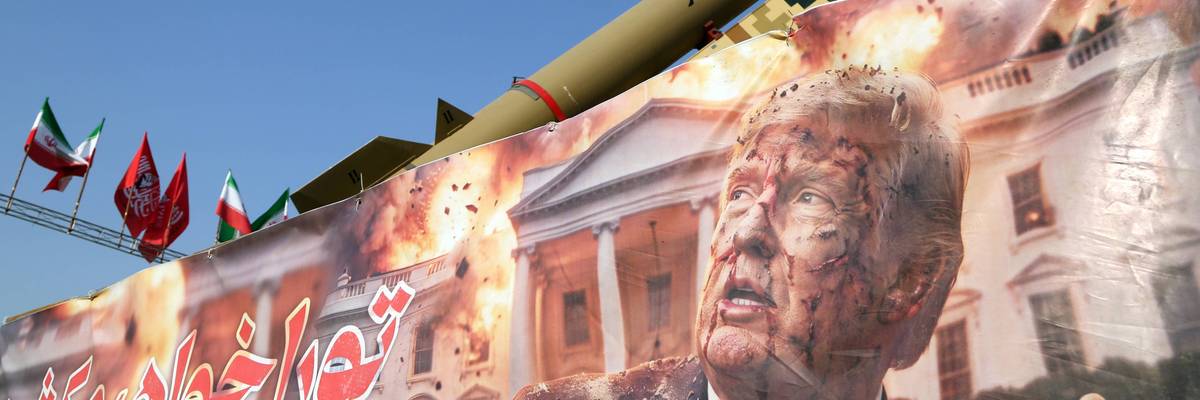
A banner depicting US President Donald Trump and bearing messages was displayed in front of the Zolfaghar and Zolghadr ballistic missiles exhibited at Azadi Square in Tehran, Iran's capital, on August 2, 2026.
As it becomes clear that there is "no escalatory military path out of this war," Iran is demanding an even steeper toll for Trump to pull out.
President Donald Trump is now quietly conceding that he's willing to walk away from his Iran war without meeting all of his demands if they agree to reopen the Strait of Hormuz. But Iran won't let him back out of the quagmire without a steep price.
Iran is in the process of negotiating a limited reopening of the critical waterway with Oman. But Mohammad Bagher Zolghadr, the secretary of Iran's Supreme National Security Council, said on Saturday that "until America corrects its behavior, the Strait of Hormuz will not open.”
He outlined a list of demands on Saturday, even harsher than those Trump walked away from when he abandoned the "memorandum of understanding" negotiated in June.
Zolghadr said the US must permanently end its war and naval blockade against Iran, and withdraw military forces from the region. He also said the US must fully compensate Iran for damages from the war, lift sanctions, and unfreeze assets abroad.
This demand for an end to US "aggression" applies not just to Iran, but to its allies in the region: Zolghadr also demanded an end to Israel's attacks on Palestinians and a withdrawal of Israeli forces from southern Lebanon, as well as an end to US and Israeli attacks against the Houthis in Yemen.
The Trump administration, which is not known to be in direct talks with Iran, has not yet responded to the demands. Trump told Axios on Sunday that "We are low-keying it" and "only semi-negotiating with Iran," claiming that it was "in very bad shape" economically.
It's clear, however, that the Iranians believe they have enough of an upper hand to make Trump grovel, especially as news emerges that the US has burned through nearly all its available stocks of long-range precision weapons, making the war increasingly costly, though the administration has denied this.
Domestic concerns are also weighing on Trump. Over the past month, as the war heated up again, average gas prices in the US have shot back up above $4 a gallon, a major liability for Republicans heading into a midterm election cycle in which many voters say the cost of living is a top concern.
Approval of Trump among Americans has fallen to a new all-time low of 34% according to a YouGov poll late last month. And just 28% of Americans say they approve of his handling of the war, according to an Associated Press/NORC poll.
As the Wall Street Journal reported, Trump has privately signaled a willingness to declare victory if Iran opens the strait, even without getting any sort of nuclear agreement, which was purportedly the reason he launched the war in the first place.
Kenneth Roth, the former executive director of Human Rights Watch, said Trump was "showing his desperation for a deal before it is completed, so Iran predictably demand[ed] major new concessions," adding that it was a "masterclass in how not to negotiate."
"As time passes, Tehran appears increasingly confident that the pressure is shifting onto Washington," said the Israeli national security analyst Danny Citrinowicz. "Iranian leaders seem to believe that the United States is now more eager than Iran to bring the confrontation in the Strait of Hormuz to an end, and, crucially, that Washington has few attractive military options for changing that equation."
Trita Parsi, the executive vice president of the Quincy Institute for Responsible Statecraft, told CNN, "At this point, it is absolutely clear that there is no escalatory military path out of this war."
"It's been tried in several different variations, and it has not ended up particularly well," Parsi said. "In fact, the US's position has been weakened, in my view, by additional military action. And as a result, I think there needs to be a full dedication to the diplomatic pathway."
He added that for the Iranians, "the promise and the credibility of sanctions relief will carry far more weight than threats of further bombings."
Dear Common Dreams reader, It’s been nearly 30 years since I co-founded Common Dreams with my late wife, Lina Newhouser. We had the radical notion that journalism should serve the public good, not corporate profits. It was clear to us from the outset what it would take to build such a project. No paid advertisements. No corporate sponsors. No millionaire publisher telling us what to think or do. Many people said we wouldn't last a year, but we proved those doubters wrong. Together with a tremendous team of journalists and dedicated staff, we built an independent media outlet free from the constraints of profits and corporate control. Our mission has always been simple: To inform. To inspire. To ignite change for the common good. Building Common Dreams was not easy. Our survival was never guaranteed. When you take on the most powerful forces—Wall Street greed, fossil fuel industry destruction, Big Tech lobbyists, and uber-rich oligarchs who have spent billions upon billions rigging the economy and democracy in their favor—the only bulwark you have is supporters who believe in your work. But here’s the urgent message from me today. It's never been this bad out there. And it's never been this hard to keep us going. At the very moment Common Dreams is most needed, the threats we face are intensifying. We need your support now more than ever. We don't accept corporate advertising and never will. We don't have a paywall because we don't think people should be blocked from critical news based on their ability to pay. Everything we do is funded by the donations of readers like you. When everyone does the little they can afford, we are strong. But if that support retreats or dries up, so do we. Will you donate now to make sure Common Dreams not only survives but thrives? —Craig Brown, Co-founder |
President Donald Trump is now quietly conceding that he's willing to walk away from his Iran war without meeting all of his demands if they agree to reopen the Strait of Hormuz. But Iran won't let him back out of the quagmire without a steep price.
Iran is in the process of negotiating a limited reopening of the critical waterway with Oman. But Mohammad Bagher Zolghadr, the secretary of Iran's Supreme National Security Council, said on Saturday that "until America corrects its behavior, the Strait of Hormuz will not open.”
He outlined a list of demands on Saturday, even harsher than those Trump walked away from when he abandoned the "memorandum of understanding" negotiated in June.
Zolghadr said the US must permanently end its war and naval blockade against Iran, and withdraw military forces from the region. He also said the US must fully compensate Iran for damages from the war, lift sanctions, and unfreeze assets abroad.
This demand for an end to US "aggression" applies not just to Iran, but to its allies in the region: Zolghadr also demanded an end to Israel's attacks on Palestinians and a withdrawal of Israeli forces from southern Lebanon, as well as an end to US and Israeli attacks against the Houthis in Yemen.
The Trump administration, which is not known to be in direct talks with Iran, has not yet responded to the demands. Trump told Axios on Sunday that "We are low-keying it" and "only semi-negotiating with Iran," claiming that it was "in very bad shape" economically.
It's clear, however, that the Iranians believe they have enough of an upper hand to make Trump grovel, especially as news emerges that the US has burned through nearly all its available stocks of long-range precision weapons, making the war increasingly costly, though the administration has denied this.
Domestic concerns are also weighing on Trump. Over the past month, as the war heated up again, average gas prices in the US have shot back up above $4 a gallon, a major liability for Republicans heading into a midterm election cycle in which many voters say the cost of living is a top concern.
Approval of Trump among Americans has fallen to a new all-time low of 34% according to a YouGov poll late last month. And just 28% of Americans say they approve of his handling of the war, according to an Associated Press/NORC poll.
As the Wall Street Journal reported, Trump has privately signaled a willingness to declare victory if Iran opens the strait, even without getting any sort of nuclear agreement, which was purportedly the reason he launched the war in the first place.
Kenneth Roth, the former executive director of Human Rights Watch, said Trump was "showing his desperation for a deal before it is completed, so Iran predictably demand[ed] major new concessions," adding that it was a "masterclass in how not to negotiate."
"As time passes, Tehran appears increasingly confident that the pressure is shifting onto Washington," said the Israeli national security analyst Danny Citrinowicz. "Iranian leaders seem to believe that the United States is now more eager than Iran to bring the confrontation in the Strait of Hormuz to an end, and, crucially, that Washington has few attractive military options for changing that equation."
Trita Parsi, the executive vice president of the Quincy Institute for Responsible Statecraft, told CNN, "At this point, it is absolutely clear that there is no escalatory military path out of this war."
"It's been tried in several different variations, and it has not ended up particularly well," Parsi said. "In fact, the US's position has been weakened, in my view, by additional military action. And as a result, I think there needs to be a full dedication to the diplomatic pathway."
He added that for the Iranians, "the promise and the credibility of sanctions relief will carry far more weight than threats of further bombings."
President Donald Trump is now quietly conceding that he's willing to walk away from his Iran war without meeting all of his demands if they agree to reopen the Strait of Hormuz. But Iran won't let him back out of the quagmire without a steep price.
Iran is in the process of negotiating a limited reopening of the critical waterway with Oman. But Mohammad Bagher Zolghadr, the secretary of Iran's Supreme National Security Council, said on Saturday that "until America corrects its behavior, the Strait of Hormuz will not open.”
He outlined a list of demands on Saturday, even harsher than those Trump walked away from when he abandoned the "memorandum of understanding" negotiated in June.
Zolghadr said the US must permanently end its war and naval blockade against Iran, and withdraw military forces from the region. He also said the US must fully compensate Iran for damages from the war, lift sanctions, and unfreeze assets abroad.
This demand for an end to US "aggression" applies not just to Iran, but to its allies in the region: Zolghadr also demanded an end to Israel's attacks on Palestinians and a withdrawal of Israeli forces from southern Lebanon, as well as an end to US and Israeli attacks against the Houthis in Yemen.
The Trump administration, which is not known to be in direct talks with Iran, has not yet responded to the demands. Trump told Axios on Sunday that "We are low-keying it" and "only semi-negotiating with Iran," claiming that it was "in very bad shape" economically.
It's clear, however, that the Iranians believe they have enough of an upper hand to make Trump grovel, especially as news emerges that the US has burned through nearly all its available stocks of long-range precision weapons, making the war increasingly costly, though the administration has denied this.
Domestic concerns are also weighing on Trump. Over the past month, as the war heated up again, average gas prices in the US have shot back up above $4 a gallon, a major liability for Republicans heading into a midterm election cycle in which many voters say the cost of living is a top concern.
Approval of Trump among Americans has fallen to a new all-time low of 34% according to a YouGov poll late last month. And just 28% of Americans say they approve of his handling of the war, according to an Associated Press/NORC poll.
As the Wall Street Journal reported, Trump has privately signaled a willingness to declare victory if Iran opens the strait, even without getting any sort of nuclear agreement, which was purportedly the reason he launched the war in the first place.
Kenneth Roth, the former executive director of Human Rights Watch, said Trump was "showing his desperation for a deal before it is completed, so Iran predictably demand[ed] major new concessions," adding that it was a "masterclass in how not to negotiate."
"As time passes, Tehran appears increasingly confident that the pressure is shifting onto Washington," said the Israeli national security analyst Danny Citrinowicz. "Iranian leaders seem to believe that the United States is now more eager than Iran to bring the confrontation in the Strait of Hormuz to an end, and, crucially, that Washington has few attractive military options for changing that equation."
Trita Parsi, the executive vice president of the Quincy Institute for Responsible Statecraft, told CNN, "At this point, it is absolutely clear that there is no escalatory military path out of this war."
"It's been tried in several different variations, and it has not ended up particularly well," Parsi said. "In fact, the US's position has been weakened, in my view, by additional military action. And as a result, I think there needs to be a full dedication to the diplomatic pathway."
He added that for the Iranians, "the promise and the credibility of sanctions relief will carry far more weight than threats of further bombings."