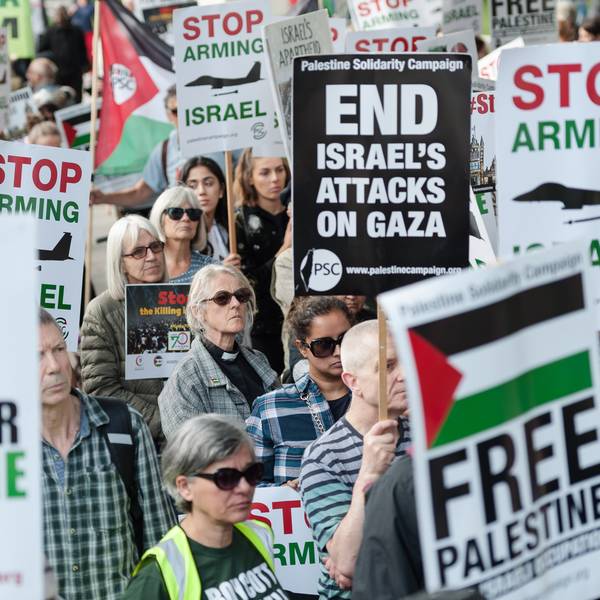
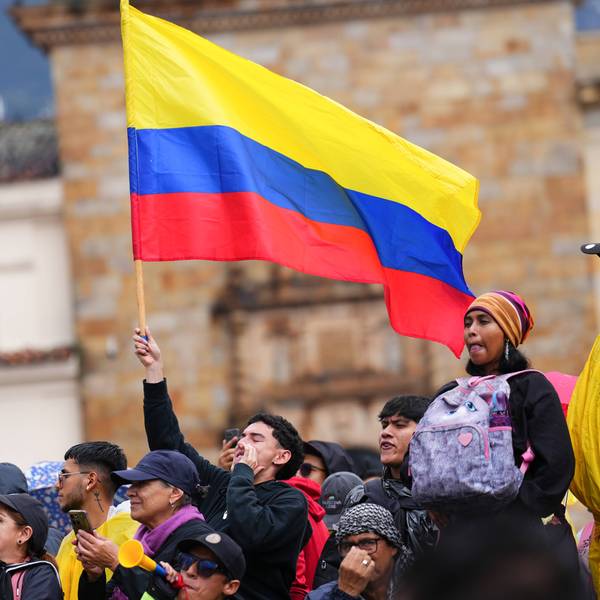
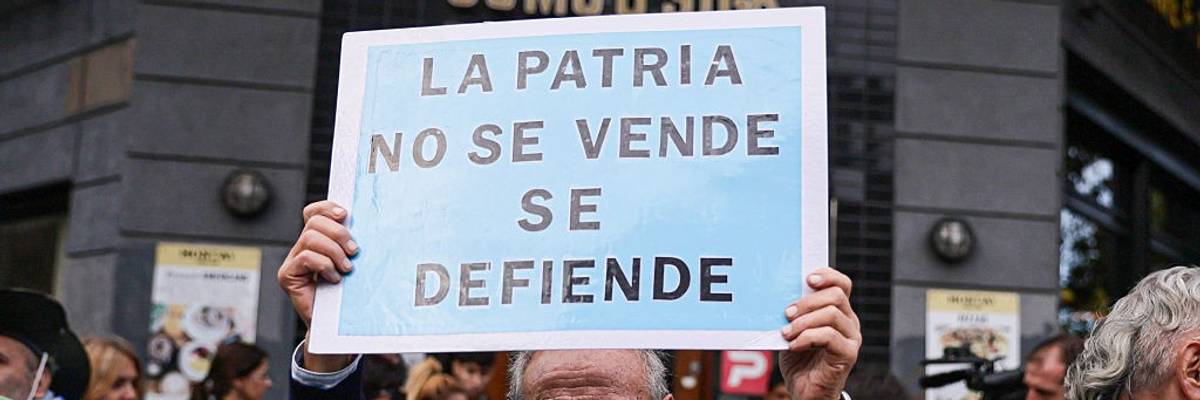
Retirees, labor unions, and social organizations march in front of the National Congress to demand improved pensions and living conditions in Buenos Aires, Argentina, on April 9, 2025 in protest of Javier Milei's austerity policies.
Who Speaks for Argentina? Football, Palestine, and the Politics of Representation
The Argentine national football team does not belong to Javier Milei. Nor does it belong to Benjamin Netanyahu. Argentina does not speak with one voice.
One day before the FIFA Men’s World Cup final between Argentina and Spain, Israeli Prime Minister Benjamin Netanyahu expressed his support for Argentina. In a video released before the match, he said: “I don’t hide that I’m a fan of Argentina. I think most Israeli citizens do. That is because President Milei has revolutionized Israel’s relationship with Argentina, and we have no greater nor better friends. Which is why we support them.”
Both media outlets known for supporting Palestinian solidarity and media outlets affiliated with or supportive of the Israeli state immediately framed the World Cup final as a proxy for the relationship between Palestine and Israel. The final turned into a symbolic contest due to the official state policies of Argentina and Spain toward Palestine and Israel. Acts of individual actors, for example, Lionel Messi’s commercial connection with Israeli companies or his visit to Israel and the occupied West Bank as part of a 2013 “Peace Tour” organized by Barcelona or Lamin Yamal’s waving of a Palestinian flag after the La Liga championship, were turned into symbols of the collective stance of a nation and became reasons enough to support or oppose a specific team in the World Cup final.
As a Bangladeshi-American who grew up in Bangladesh—a country known for its passion for Latin American football powerhouses and its split loyalties between Argentina and Brazil—I have been a fan of the Argentine men’s football team since the age of 10. I have also been in solidarity with the Palestinian struggle for freedom since I was old enough to read newspapers. I found it appalling to see the head of a genocidal state publicly endorse my favorite men’s football team and to watch Palestinian solidarity become over simplistically reduced to supporting or opposing a football team. Can we end settler-colonial violence by winning a football match?
While people have argued that symbols matter, I would urge them to consider how such symbolism ignores two important points: First, it overlooks the problem of transforming one of the world’s most celebrated sporting spectacles into a stage upon which Benjamin Netanyahu’s ethnonationalist genocidal project can be publicly performed and normalized. Second, people are not their governments. Argentina’s self-proclaimed “most Zionist president in the world” Javier Milei’s unconditional alignment with Netanyahu’s government does not reflect the fact that Argentina is also the home to a substantial and increasingly visible Palestinian solidarity movement.
To reduce Argentina to its president is to reproduce a colonial logic that erases the vibrant historical and contemporary social movements, labor struggles, Indigenous resistance, feminist and queer organizing, anti-racist and anti-fascist activism, and transnational solidarity engagements that have long shaped political life in Argentina.
Using sports as a platform for promoting geopolitical interests is not new. Sports have always been entangled with powerful states and institutions. They were exported globally as tools of European colonial expansion, serving as instruments of the so-called civilizing mission, mechanisms of control, and tactics of assimilation between the 16th and the 20th centuries. Many colonized and indigenous communities have also turned sports into powerful symbols of defiance, through which they subverted the master’s tools, beat the colonizers at their own game, and transformed stadiums and playing fields into communal spaces for practicing decolonial solidarity and organizing resistance away from colonial surveillance and policing.
Football is no exception. The imperial and colonial legacy still shapes the way football—especially the FIFA Men’s World Cup—is organized, governed, and experienced today. Concerns have been raised about the displacement of the unhoused population by local governments in US host cities. Immigration and Customs Enforcement continued to arbitrarily and violently target, deport, and kill members of communities of color through paramilitary-style operations while World Cup matches were held across US cities. In Canadian and Mexican host cities, marginalized and minoritized communities expressed concerns about disruptions to water supplies, threats to land access, rising living costs, and disruptive infrastructural development.
Even though FIFA has chosen the official slogan “United as One” for the 2026 Men’s World Cup, a series of events has already demonstrated that the powerful and the powerless are not united and that the playing field is not level for everyone. US President Donald Trump has publicly intervened in FIFA’s disciplinary process, and FIFA President Gianni Infantino’s cozy relationship with Trump has raised serious concerns. Unusually strict travel restrictions disproportionately affected the Iranian team's World Cup experience. The 2026 FIFA World Cup has repeatedly been used and abused to exert both hard and soft neoliberal, disciplinary, and diplomatic power.
By expressing support for the Argentine men’s football team, Netanyahu also utilized the World Cup to manufacture legitimacy for the Israeli settler-colonial apartheid state that has a long history of systematically evicting, segregating, displacing, and killing Indigenous Palestinians. He has appropriated this transnational sporting spectacle as an instrument for promoting and normalizing his settler-colonial mission.
What is at stake, however, extends beyond the universalization of a violent settler-colonial regime.
Drawing on Edward Said, I would argue that Netanyahu’s embrace of Argentina illustrates how the Israeli settler-colonial project is not just about colonizing Palestinian land and annihilating the Indigenous Palestinian population. The settler-colonial project involves careful production of knowledge through a politics of representation, turning representation into a technology of discursive and political rule. Through his symbolic embrace, Netanyahu deliberately erases complexities and contradictions, propagating an oversimplified and monolithic discourse about the state of Argentina and its communities. In his representation, Argentina is no longer a society of millions negotiating overlapping and competing political traditions; it becomes merely an extension of President Javier Milei’s geopolitical loyalties.
Yet Milei does not constitute Argentina.
To reduce Argentina to its president is to reproduce a colonial logic that erases the vibrant historical and contemporary social movements, labor struggles, Indigenous resistance, feminist and queer organizing, anti-racist and anti-fascist activism, and transnational solidarity engagements that have long shaped political life in Argentina. It renders invisible the thousands of Argentines who have mobilized in solidarity with Palestinians despite President Milei’s continuing unabashed support for Israel, including members of Argentine Jewish organizations critical of Israeli state-sponsored settler-colonial violence, as well as union organizers, students, artists, and social justice activists who refuse to equate support for Palestinian liberation with hostility toward Jewish lives and communities.
For example, the Comité Argentino de Solidaridad con el Pueblo Palestino (Argentine Solidarity Committee with the Palestinian People) organizes national demonstrations, educational events, BDS campaigns, and solidarity actions across Argentina. It ran a nationwide campaign under the slogan, “Argentina Rejects Genocide in Gaza” and mobilized a massive demonstration involving thousands of people in Buenos Aires in July 2025. A diverse collective of Argentine lawyers, doctors, educators, politicians, journalists, and activists participated in the Global Sumud Flotilla, which attempted to break the Israeli criminal blockade and carried humanitarian aid to Gaza. Judíos por Palestina (Jews for Palestine) operates in Argentina as part of the Global Jews for Palestine Network, which is known for its rejection of Zionism, Israeli apartheid, and genocidal state policies.
A 2026 Pew Research Center survey found that 55% of Argentines hold “very unfavorable” or “somewhat unfavorable” views of Israel. Only 21% view the country favorably. Argentina recognized Palestine as a “free and independent state” under former President Cristina Fernández de Kirchner back in 2010—more than 13 years before Spain formally recognized the state of Palestine. The Argentine football legend Diego Maradona, who famously said, “In my heart, I am Palestinian,” was known for his vocal critiques of the settler-colonial violence of the Israeli state.
The issue is not whether a political leader may cheer for Argentina. The issue is how the imperial and settler-colonial power repeatedly attempts to equate a diplomatic alliance between Milei and Netanyahu with the political imagination of the entire population of Argentina.
The Argentine national football team does not belong to Javier Milei. Nor does it belong to Benjamin Netanyahu. Argentina does not speak with one voice. The Argentine football team belongs to generations of communities that have transformed football into an archive of collective memory—of neighborhood life, working-class identity, migration, anti-authoritarian and democratic struggles, joy, grief, and resistance. To appropriate that symbolic inheritance for the purpose of normalizing settler-colonial violence is to strip football of its decolonial legacy. No geopolitical alliance—and no World Cup final—can or should erase that legacy.
An Urgent Message From Our Co-Founder
Dear Common Dreams reader, It’s been nearly 30 years since I co-founded Common Dreams with my late wife, Lina Newhouser. We had the radical notion that journalism should serve the public good, not corporate profits. It was clear to us from the outset what it would take to build such a project. No paid advertisements. No corporate sponsors. No millionaire publisher telling us what to think or do. Many people said we wouldn't last a year, but we proved those doubters wrong. Together with a tremendous team of journalists and dedicated staff, we built an independent media outlet free from the constraints of profits and corporate control. Our mission has always been simple: To inform. To inspire. To ignite change for the common good. Building Common Dreams was not easy. Our survival was never guaranteed. When you take on the most powerful forces—Wall Street greed, fossil fuel industry destruction, Big Tech lobbyists, and uber-rich oligarchs who have spent billions upon billions rigging the economy and democracy in their favor—the only bulwark you have is supporters who believe in your work. But here’s the urgent message from me today. It's never been this bad out there. And it's never been this hard to keep us going. At the very moment Common Dreams is most needed, the threats we face are intensifying. We need your support now more than ever. We don't accept corporate advertising and never will. We don't have a paywall because we don't think people should be blocked from critical news based on their ability to pay. Everything we do is funded by the donations of readers like you. When everyone does the little they can afford, we are strong. But if that support retreats or dries up, so do we. Will you donate now to make sure Common Dreams not only survives but thrives? —Craig Brown, Co-founder |
One day before the FIFA Men’s World Cup final between Argentina and Spain, Israeli Prime Minister Benjamin Netanyahu expressed his support for Argentina. In a video released before the match, he said: “I don’t hide that I’m a fan of Argentina. I think most Israeli citizens do. That is because President Milei has revolutionized Israel’s relationship with Argentina, and we have no greater nor better friends. Which is why we support them.”
Both media outlets known for supporting Palestinian solidarity and media outlets affiliated with or supportive of the Israeli state immediately framed the World Cup final as a proxy for the relationship between Palestine and Israel. The final turned into a symbolic contest due to the official state policies of Argentina and Spain toward Palestine and Israel. Acts of individual actors, for example, Lionel Messi’s commercial connection with Israeli companies or his visit to Israel and the occupied West Bank as part of a 2013 “Peace Tour” organized by Barcelona or Lamin Yamal’s waving of a Palestinian flag after the La Liga championship, were turned into symbols of the collective stance of a nation and became reasons enough to support or oppose a specific team in the World Cup final.
As a Bangladeshi-American who grew up in Bangladesh—a country known for its passion for Latin American football powerhouses and its split loyalties between Argentina and Brazil—I have been a fan of the Argentine men’s football team since the age of 10. I have also been in solidarity with the Palestinian struggle for freedom since I was old enough to read newspapers. I found it appalling to see the head of a genocidal state publicly endorse my favorite men’s football team and to watch Palestinian solidarity become over simplistically reduced to supporting or opposing a football team. Can we end settler-colonial violence by winning a football match?
While people have argued that symbols matter, I would urge them to consider how such symbolism ignores two important points: First, it overlooks the problem of transforming one of the world’s most celebrated sporting spectacles into a stage upon which Benjamin Netanyahu’s ethnonationalist genocidal project can be publicly performed and normalized. Second, people are not their governments. Argentina’s self-proclaimed “most Zionist president in the world” Javier Milei’s unconditional alignment with Netanyahu’s government does not reflect the fact that Argentina is also the home to a substantial and increasingly visible Palestinian solidarity movement.
To reduce Argentina to its president is to reproduce a colonial logic that erases the vibrant historical and contemporary social movements, labor struggles, Indigenous resistance, feminist and queer organizing, anti-racist and anti-fascist activism, and transnational solidarity engagements that have long shaped political life in Argentina.
Using sports as a platform for promoting geopolitical interests is not new. Sports have always been entangled with powerful states and institutions. They were exported globally as tools of European colonial expansion, serving as instruments of the so-called civilizing mission, mechanisms of control, and tactics of assimilation between the 16th and the 20th centuries. Many colonized and indigenous communities have also turned sports into powerful symbols of defiance, through which they subverted the master’s tools, beat the colonizers at their own game, and transformed stadiums and playing fields into communal spaces for practicing decolonial solidarity and organizing resistance away from colonial surveillance and policing.
Football is no exception. The imperial and colonial legacy still shapes the way football—especially the FIFA Men’s World Cup—is organized, governed, and experienced today. Concerns have been raised about the displacement of the unhoused population by local governments in US host cities. Immigration and Customs Enforcement continued to arbitrarily and violently target, deport, and kill members of communities of color through paramilitary-style operations while World Cup matches were held across US cities. In Canadian and Mexican host cities, marginalized and minoritized communities expressed concerns about disruptions to water supplies, threats to land access, rising living costs, and disruptive infrastructural development.
Even though FIFA has chosen the official slogan “United as One” for the 2026 Men’s World Cup, a series of events has already demonstrated that the powerful and the powerless are not united and that the playing field is not level for everyone. US President Donald Trump has publicly intervened in FIFA’s disciplinary process, and FIFA President Gianni Infantino’s cozy relationship with Trump has raised serious concerns. Unusually strict travel restrictions disproportionately affected the Iranian team's World Cup experience. The 2026 FIFA World Cup has repeatedly been used and abused to exert both hard and soft neoliberal, disciplinary, and diplomatic power.
By expressing support for the Argentine men’s football team, Netanyahu also utilized the World Cup to manufacture legitimacy for the Israeli settler-colonial apartheid state that has a long history of systematically evicting, segregating, displacing, and killing Indigenous Palestinians. He has appropriated this transnational sporting spectacle as an instrument for promoting and normalizing his settler-colonial mission.
What is at stake, however, extends beyond the universalization of a violent settler-colonial regime.
Drawing on Edward Said, I would argue that Netanyahu’s embrace of Argentina illustrates how the Israeli settler-colonial project is not just about colonizing Palestinian land and annihilating the Indigenous Palestinian population. The settler-colonial project involves careful production of knowledge through a politics of representation, turning representation into a technology of discursive and political rule. Through his symbolic embrace, Netanyahu deliberately erases complexities and contradictions, propagating an oversimplified and monolithic discourse about the state of Argentina and its communities. In his representation, Argentina is no longer a society of millions negotiating overlapping and competing political traditions; it becomes merely an extension of President Javier Milei’s geopolitical loyalties.
Yet Milei does not constitute Argentina.
To reduce Argentina to its president is to reproduce a colonial logic that erases the vibrant historical and contemporary social movements, labor struggles, Indigenous resistance, feminist and queer organizing, anti-racist and anti-fascist activism, and transnational solidarity engagements that have long shaped political life in Argentina. It renders invisible the thousands of Argentines who have mobilized in solidarity with Palestinians despite President Milei’s continuing unabashed support for Israel, including members of Argentine Jewish organizations critical of Israeli state-sponsored settler-colonial violence, as well as union organizers, students, artists, and social justice activists who refuse to equate support for Palestinian liberation with hostility toward Jewish lives and communities.
For example, the Comité Argentino de Solidaridad con el Pueblo Palestino (Argentine Solidarity Committee with the Palestinian People) organizes national demonstrations, educational events, BDS campaigns, and solidarity actions across Argentina. It ran a nationwide campaign under the slogan, “Argentina Rejects Genocide in Gaza” and mobilized a massive demonstration involving thousands of people in Buenos Aires in July 2025. A diverse collective of Argentine lawyers, doctors, educators, politicians, journalists, and activists participated in the Global Sumud Flotilla, which attempted to break the Israeli criminal blockade and carried humanitarian aid to Gaza. Judíos por Palestina (Jews for Palestine) operates in Argentina as part of the Global Jews for Palestine Network, which is known for its rejection of Zionism, Israeli apartheid, and genocidal state policies.
A 2026 Pew Research Center survey found that 55% of Argentines hold “very unfavorable” or “somewhat unfavorable” views of Israel. Only 21% view the country favorably. Argentina recognized Palestine as a “free and independent state” under former President Cristina Fernández de Kirchner back in 2010—more than 13 years before Spain formally recognized the state of Palestine. The Argentine football legend Diego Maradona, who famously said, “In my heart, I am Palestinian,” was known for his vocal critiques of the settler-colonial violence of the Israeli state.
The issue is not whether a political leader may cheer for Argentina. The issue is how the imperial and settler-colonial power repeatedly attempts to equate a diplomatic alliance between Milei and Netanyahu with the political imagination of the entire population of Argentina.
The Argentine national football team does not belong to Javier Milei. Nor does it belong to Benjamin Netanyahu. Argentina does not speak with one voice. The Argentine football team belongs to generations of communities that have transformed football into an archive of collective memory—of neighborhood life, working-class identity, migration, anti-authoritarian and democratic struggles, joy, grief, and resistance. To appropriate that symbolic inheritance for the purpose of normalizing settler-colonial violence is to strip football of its decolonial legacy. No geopolitical alliance—and no World Cup final—can or should erase that legacy.
- If Ronaldo Won't, Who Will Take a Stand Against Saudi Arabia's Human Rights Record? ›
- Israel Bombs the Beautiful Game—and So Much More—in Gaza ›
- Genocide in Gaza Means Empty Seats at the 2026 World Cup ›
- Italian Coaches Call for 'Genocidal' Israel's Suspension From FIFA, UEFA ›
- The Game Was Never Their Own ›
- FIFA Can No Longer Be Silent on Israel's Human Rights Atrocities in Gaza ›
- Opinion | A FIFA World Cup and a Village's Stolen Dream | Common Dreams ›
One day before the FIFA Men’s World Cup final between Argentina and Spain, Israeli Prime Minister Benjamin Netanyahu expressed his support for Argentina. In a video released before the match, he said: “I don’t hide that I’m a fan of Argentina. I think most Israeli citizens do. That is because President Milei has revolutionized Israel’s relationship with Argentina, and we have no greater nor better friends. Which is why we support them.”
Both media outlets known for supporting Palestinian solidarity and media outlets affiliated with or supportive of the Israeli state immediately framed the World Cup final as a proxy for the relationship between Palestine and Israel. The final turned into a symbolic contest due to the official state policies of Argentina and Spain toward Palestine and Israel. Acts of individual actors, for example, Lionel Messi’s commercial connection with Israeli companies or his visit to Israel and the occupied West Bank as part of a 2013 “Peace Tour” organized by Barcelona or Lamin Yamal’s waving of a Palestinian flag after the La Liga championship, were turned into symbols of the collective stance of a nation and became reasons enough to support or oppose a specific team in the World Cup final.
As a Bangladeshi-American who grew up in Bangladesh—a country known for its passion for Latin American football powerhouses and its split loyalties between Argentina and Brazil—I have been a fan of the Argentine men’s football team since the age of 10. I have also been in solidarity with the Palestinian struggle for freedom since I was old enough to read newspapers. I found it appalling to see the head of a genocidal state publicly endorse my favorite men’s football team and to watch Palestinian solidarity become over simplistically reduced to supporting or opposing a football team. Can we end settler-colonial violence by winning a football match?
While people have argued that symbols matter, I would urge them to consider how such symbolism ignores two important points: First, it overlooks the problem of transforming one of the world’s most celebrated sporting spectacles into a stage upon which Benjamin Netanyahu’s ethnonationalist genocidal project can be publicly performed and normalized. Second, people are not their governments. Argentina’s self-proclaimed “most Zionist president in the world” Javier Milei’s unconditional alignment with Netanyahu’s government does not reflect the fact that Argentina is also the home to a substantial and increasingly visible Palestinian solidarity movement.
To reduce Argentina to its president is to reproduce a colonial logic that erases the vibrant historical and contemporary social movements, labor struggles, Indigenous resistance, feminist and queer organizing, anti-racist and anti-fascist activism, and transnational solidarity engagements that have long shaped political life in Argentina.
Using sports as a platform for promoting geopolitical interests is not new. Sports have always been entangled with powerful states and institutions. They were exported globally as tools of European colonial expansion, serving as instruments of the so-called civilizing mission, mechanisms of control, and tactics of assimilation between the 16th and the 20th centuries. Many colonized and indigenous communities have also turned sports into powerful symbols of defiance, through which they subverted the master’s tools, beat the colonizers at their own game, and transformed stadiums and playing fields into communal spaces for practicing decolonial solidarity and organizing resistance away from colonial surveillance and policing.
Football is no exception. The imperial and colonial legacy still shapes the way football—especially the FIFA Men’s World Cup—is organized, governed, and experienced today. Concerns have been raised about the displacement of the unhoused population by local governments in US host cities. Immigration and Customs Enforcement continued to arbitrarily and violently target, deport, and kill members of communities of color through paramilitary-style operations while World Cup matches were held across US cities. In Canadian and Mexican host cities, marginalized and minoritized communities expressed concerns about disruptions to water supplies, threats to land access, rising living costs, and disruptive infrastructural development.
Even though FIFA has chosen the official slogan “United as One” for the 2026 Men’s World Cup, a series of events has already demonstrated that the powerful and the powerless are not united and that the playing field is not level for everyone. US President Donald Trump has publicly intervened in FIFA’s disciplinary process, and FIFA President Gianni Infantino’s cozy relationship with Trump has raised serious concerns. Unusually strict travel restrictions disproportionately affected the Iranian team's World Cup experience. The 2026 FIFA World Cup has repeatedly been used and abused to exert both hard and soft neoliberal, disciplinary, and diplomatic power.
By expressing support for the Argentine men’s football team, Netanyahu also utilized the World Cup to manufacture legitimacy for the Israeli settler-colonial apartheid state that has a long history of systematically evicting, segregating, displacing, and killing Indigenous Palestinians. He has appropriated this transnational sporting spectacle as an instrument for promoting and normalizing his settler-colonial mission.
What is at stake, however, extends beyond the universalization of a violent settler-colonial regime.
Drawing on Edward Said, I would argue that Netanyahu’s embrace of Argentina illustrates how the Israeli settler-colonial project is not just about colonizing Palestinian land and annihilating the Indigenous Palestinian population. The settler-colonial project involves careful production of knowledge through a politics of representation, turning representation into a technology of discursive and political rule. Through his symbolic embrace, Netanyahu deliberately erases complexities and contradictions, propagating an oversimplified and monolithic discourse about the state of Argentina and its communities. In his representation, Argentina is no longer a society of millions negotiating overlapping and competing political traditions; it becomes merely an extension of President Javier Milei’s geopolitical loyalties.
Yet Milei does not constitute Argentina.
To reduce Argentina to its president is to reproduce a colonial logic that erases the vibrant historical and contemporary social movements, labor struggles, Indigenous resistance, feminist and queer organizing, anti-racist and anti-fascist activism, and transnational solidarity engagements that have long shaped political life in Argentina. It renders invisible the thousands of Argentines who have mobilized in solidarity with Palestinians despite President Milei’s continuing unabashed support for Israel, including members of Argentine Jewish organizations critical of Israeli state-sponsored settler-colonial violence, as well as union organizers, students, artists, and social justice activists who refuse to equate support for Palestinian liberation with hostility toward Jewish lives and communities.
For example, the Comité Argentino de Solidaridad con el Pueblo Palestino (Argentine Solidarity Committee with the Palestinian People) organizes national demonstrations, educational events, BDS campaigns, and solidarity actions across Argentina. It ran a nationwide campaign under the slogan, “Argentina Rejects Genocide in Gaza” and mobilized a massive demonstration involving thousands of people in Buenos Aires in July 2025. A diverse collective of Argentine lawyers, doctors, educators, politicians, journalists, and activists participated in the Global Sumud Flotilla, which attempted to break the Israeli criminal blockade and carried humanitarian aid to Gaza. Judíos por Palestina (Jews for Palestine) operates in Argentina as part of the Global Jews for Palestine Network, which is known for its rejection of Zionism, Israeli apartheid, and genocidal state policies.
A 2026 Pew Research Center survey found that 55% of Argentines hold “very unfavorable” or “somewhat unfavorable” views of Israel. Only 21% view the country favorably. Argentina recognized Palestine as a “free and independent state” under former President Cristina Fernández de Kirchner back in 2010—more than 13 years before Spain formally recognized the state of Palestine. The Argentine football legend Diego Maradona, who famously said, “In my heart, I am Palestinian,” was known for his vocal critiques of the settler-colonial violence of the Israeli state.
The issue is not whether a political leader may cheer for Argentina. The issue is how the imperial and settler-colonial power repeatedly attempts to equate a diplomatic alliance between Milei and Netanyahu with the political imagination of the entire population of Argentina.
The Argentine national football team does not belong to Javier Milei. Nor does it belong to Benjamin Netanyahu. Argentina does not speak with one voice. The Argentine football team belongs to generations of communities that have transformed football into an archive of collective memory—of neighborhood life, working-class identity, migration, anti-authoritarian and democratic struggles, joy, grief, and resistance. To appropriate that symbolic inheritance for the purpose of normalizing settler-colonial violence is to strip football of its decolonial legacy. No geopolitical alliance—and no World Cup final—can or should erase that legacy.
- If Ronaldo Won't, Who Will Take a Stand Against Saudi Arabia's Human Rights Record? ›
- Israel Bombs the Beautiful Game—and So Much More—in Gaza ›
- Genocide in Gaza Means Empty Seats at the 2026 World Cup ›
- Italian Coaches Call for 'Genocidal' Israel's Suspension From FIFA, UEFA ›
- The Game Was Never Their Own ›
- FIFA Can No Longer Be Silent on Israel's Human Rights Atrocities in Gaza ›
- Opinion | A FIFA World Cup and a Village's Stolen Dream | Common Dreams ›