

SUBSCRIBE TO OUR FREE NEWSLETTER
Daily news & progressive opinion—funded by the people, not the corporations—delivered straight to your inbox.
5
#000000
#FFFFFF
To donate by check, phone, or other method, see our More Ways to Give page.
Daily news & progressive opinion—funded by the people, not the corporations—delivered straight to your inbox.

Amirah Sequeira, 240-447-0034, Chuleenan Svetvilas, 510-631-5337
Today the U.S. House of Representatives passed a groundbreaking federal bill to protect health care and social service workers from extremely high rates of workplace violence--H.R. 1309, the Workplace Violence Prevention for Health Care and Social Service Workers Act, authored by Rep. Joe Courtney.
The bill passed with strong bipartisan support and would set the highest standards yet for protecting workers in these industries from violence on the job. National Nurses United endorsed the bill. This legislation follows the adoption by California OSHA of the first workplace violence standard for health care workers, which was the result of state legislation sponsored by the California Nurses Association / National Nurses United.
"The U.S. House of Representatives took an historic step ... to get a vote, to finally recognize the skyrocketing, outrageous levels of workplace violence that America's good guys, the nurses, nurses assistants, physicians, the social workers are facing every single day," said Rep. Courtney at today's press conference after the vote. "H.R. 1309, the Workplace Violence Preventio for Health Care and Social Service Workers Act just passed by a wide bipartisan margin of 251 to 159. ... The evidence is overwhelming, and the severity of the problem is absolutely sickening and gut-wrenching."
"This legislation will hold our employers accountable, through federal OSHA, for having a prevention plan in place to stop workplace violence before it occurs," Zenei Cortez, RN, president, National Nurses United. "This is literally a life or death issue. Every moment we wait puts lives in jeopardy. We all deserve to feel safe in hospitals, clinics and social service settings, which should be places of healing."
"Our health care and social services workers deserve to work in an environment free from workplace violence," said Senator Baldwin, ranking member of the Senate Employment and Workplace Safety Subcommittee. "I'm proud to see this important effort pass the House of Representatives so we can provide overdue protections and safety standards to a workforce that serves people during some of their most vulnerable moments. This bill promotes a healthy environment that is good for both workers and those they serve, so we all need to work together to take action and pass this legislation in the Senate."
What H.R. 1309 does:
National Nurses United, with close to 185,000 members in every state, is the largest union and professional association of registered nurses in US history.
(240) 235-2000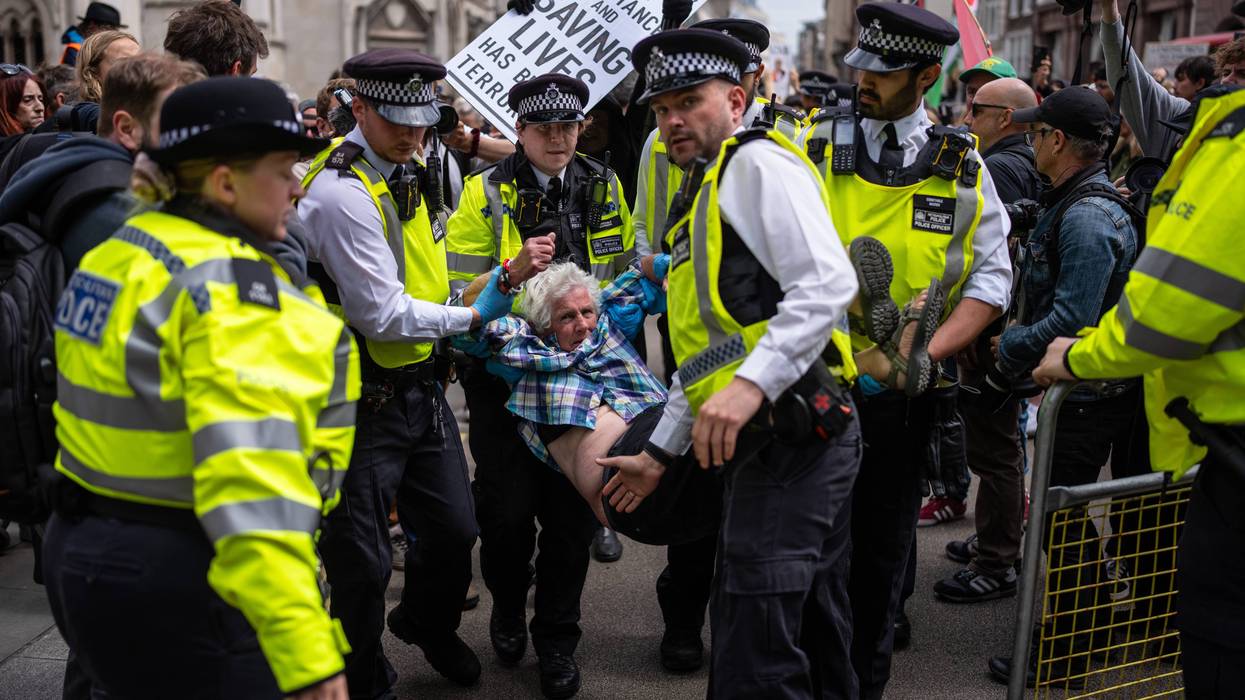
"Classifying protest through direct action as terrorism brings Parliament and our judicial system into disrepute," said one Labour MP.
A UK appeals court is being accused of flouting the law to allow the government to suppress free speech after it upheld a ban on the direct action group Palestine Action.
Just days after four young activists with the group were hit with unprecedented “terrorism” sentences over their 2024 vandalism of an Israeli-owned weapons facility that was being used to supply the genocidal assault on Gaza, the Court of Appeal in London on Monday upheld the Labour government’s proscription of Palestine Action under the Terrorism Act of 2000.
The ban was approved in Parliament in July 2025 and outlawed expressions of support for the group. According to Amnesty International, more than 3,300 people have been arrested across Britain since last July "simply for their engagement in acts of peaceful protest opposing the proscription"—including more than 2,000 who have been arrested simply for holding signs that read "I oppose genocide, I support Palestine Action.”
Outside the Royal Courts of Justice in London, where the decision was handed down, hundreds more Britons rallied in opposition.
“We acknowledge the Court of Appeal’s judgment that the home secretary’s decision to proscribe Palestine Action was lawful,” the Metropolitan Police said in a statement shortly after. “This means that expressing support for the organization remains a criminal offense, and officers will arrest those who break the law.”
“Officers are policing a protest outside the Royal Courts of Justice today where a number of people are displaying placards in support of Palestine Action," it continued. "Arrests are underway.”
Protesters were carried away, while onlookers shouted, “Shame” and “You’re complicit” at officers.
Arrests continue outside the Royal Courts of Justice after Court of Appeal find proscription of Palestine Action to be lawful.
We will continue to protest this Government’s embarrassing attempts to cover up its crimes with intimidation tactics.
Join us: https://t.co/XhFvPsZC3U pic.twitter.com/9okcFkVVtf
— Defend Our Juries (@DefendOurJuries) June 15, 2026
As The New York Times pointed out:
Palestine Action, which no longer exists in its original form, did not promote violence against individuals. But its members damaged sites linked to Elbit Systems, an Israeli weapons manufacturer, and last June broke into [Royal Air Force] Brize Norton, Britain’s largest air force base, in Oxfordshire, vandalizing two aircraft.
The activists who were given hefty sentences on Friday have argued that “innocent lives were saved” by their destruction of military equipment in the Elbit facility. Drones manufactured by the company have been documented in use during attacks on civilians, including the April 2024 strike on a World Central Kitchen convoy that killed seven aid workers.
But although members of the group have never been accused of any premeditated act of violence against other human beings, the British government’s terror designation puts it on the same level, legally speaking, as al-Qaeda, the Taliban, or the neo-Nazi Atomwaffen Division, and expressions of support can carry maximum sentences of 14 years in prison.
In February, the High Court sided with Palestine Action, ruling that the ban on support breached the rights to free expression and assembly under Articles 10 and 11 of the European Convention on Human Rights.
However, a five-judge appeals court panel overruled this decision on Monday, with Chief Justice Sue Carr writing that while the ban was “highly controversial,” and that the group “was supported by many otherwise law-abiding citizens,” it was a “fundamental mistake to overlook the fact that Palestine Action overtly promoted unlawful violence amounting to terrorism.”
Pointing to its sabotage of Elbit, she said the group's actions were “intended to close down lawful businesses” and said that "future threats and risks posed to third-party individuals and property by Palestine Action were perhaps the most important factors to weigh in the balance.”
Carr said that the ban would "not prevent public expressions of support for the Palestinian cause or opposition to Israel and to the Israel Defense Forces, or demonstrations targeted at Elbit."
But in the process, even she acknowledged that such a severe restriction on peaceful assembly in support of Palestine Action could indeed have a "chilling effect" on otherwise law-abiding citizens and cause them to be "deterred from assembling lawfully or making their strongly held anti-Israel and pro-Palestinian views public for fear of their actions being construed as support for Palestine Action."
Palestine Action co-founder Huda Ammori, who challenged the ban in court, said her group would "fight this all the way" and planned to appeal to the UK Supreme Court and potentially even the European Court of Human Rights.
"We will not stop fighting to overturn one of the most extreme attacks on free speech and the right to protest in modern British history," she said. "This unprecedented abuse of power has devastated the lives of thousands of people while silencing dissent over Israel’s slaughter of the Palestinian people during the genocide, when that dissent could not be more urgent.”
Today's ruling by the Court of Appeal is deeply disappointing.
This case remains about much more than one group.
What’s important for all of us to understand is that proscription is one of the strongest powers the government has.
Treating protest as terrorism leaves the… pic.twitter.com/WI3O05LYEn
— Amnesty UK (@AmnestyUK) June 15, 2026
The ruling was met with outrage from supporters of Palestinian rights and human rights groups.
Ammar Kazmi, the senior legal coordinator for the Derby-based Left Legal Fighting Fund, said that with this ruling, the judges allowed the political objective of criminalizing pro-Palestine speech to take precedence over the law.
"The judges allowed policy reasons to override strictly legal arguments, and they showed deference to ‘national security’ questions," he wrote on social media. "They also said that proscription is a ‘proportionate’ interference with free speech rights. In other words, they allowed the government to ride roughshod over the law."
Amnesty UK called the ruling "deeply disappointing," adding that the case "remains about much more than one group."
"What’s important for all of us to understand is that proscribing a group as a terrorist organization is one of the strongest powers the government has," the human rights group said. "The banning of Palestine Action as a terrorist organization is a grave misuse of counterterrorism powers with serious consequences for human rights."
Former Labour Party leader Jeremy Corbyn—whose successor, Prime Minister Keir Starmer—enacted the ban, said, "Today’s ruling to uphold the UK government's proscription of Palestine Action is a travesty of justice."
"One by one, the very foundations of our democracy are being destroyed—all to oil the wheels of British complicity in genocide," said Corbyn, who is leading an unofficial "tribunal" that presented evidence of UK participation in Israel's assault on Gaza to the International Criminal Court in March.
Noting the large number of pensioners who have been hauled off by police for holding protest signs opposing the ban—including dozens arrested on Friday for opposing the sentencing of those involved in the Elbit raid—Labour MP John McDonnell said, "Parliament should reverse the decision to proscribe Palestine Action urgently before we see large numbers of elderly people in particular being dragged before our courts."
He added that "classifying protest through direct action as terrorism brings Parliament and our judicial system into disrepute."
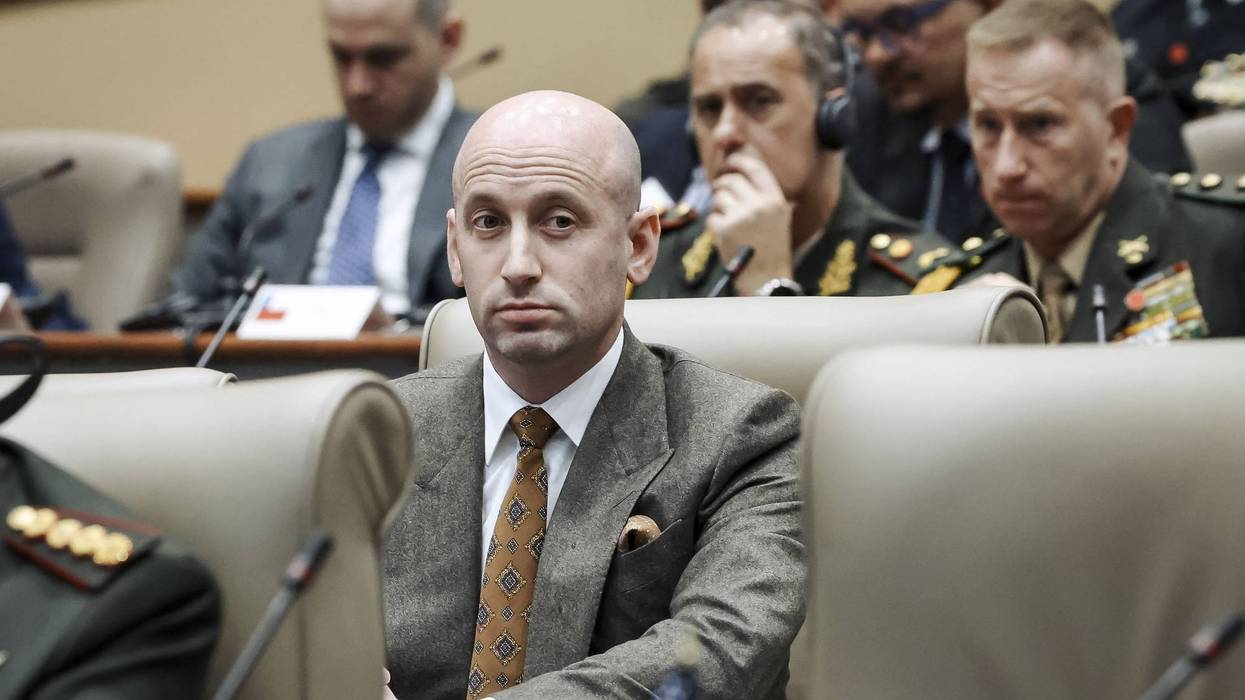
Reporting in The New York Times reveals Vance wanted to use the military "to crush the unrest in Minnesota."
A Monday report in The New York Times revealed what it described as the "alarm" felt by some White House lawyers at proposals made earlier this year by Vice President JD Vance and Trump adviser Stephen Miller as the administration was forced to contend with widespread anger over its anti-immigration agenda.
Among other things, the Times reported that Vance pushed for President Donald Trump to invoke the Insurrection Act, which would allow for the US military to be deployed on American streets, in an effort to shut down mass protests in Minnesota against federal immigration enforcement operations in the state.
A few days after US Immigration and Customs Enforcement (ICE) officers fatally shot demonstrator Alex Pretti in the streets of Minneapolis, the Times reported that Vance—who had also elevated a baseless claim by Miller that Pretti had been a "would-be assassin"—said invoking the Insurrection Act was necessary "to crush the unrest in Minnesota."
Vance also believed invoking the law would send a “message” that “paid agitators could not get away with disrupting ICE operations”—even though, as the Times noted, there is no evidence that Pretti; demonstrator Renee Good, who was also killed by federal agents; or any other organizers in Minnesota or elsewhere received any money in exchange for protesting.
However, right-wing attorney Will Scharf quickly shot down Vance's suggestion, noting that the Insurrection Act is an instrument aimed at putting down armed rebellions rather than groups of citizens blowing whistles at ICE officers.
Former White House Deputy Chief of Staff James Blair then made the political case against invoking the Insurrection Act.
"The scenes of federal agents in Minnesota already looked chaotic, he said, and the public was recoiling," reported the Times. "He put three questions to the room: What does the Insurrection Act give us that we don’t already have? What changes on the ground would be worth the heat? What else could they win that would justify the public relations cost?"
"The room was quiet," the Times added. "Nobody had a good answer."
The Times report also revealed that Trump adviser Stephen Miller, Trump's homeland security adviser and deputy chief of staff, repeatedly pushed the president to suspend the writ of habeas corpus for undocumented immigrants, which would give the administration the power to carry out mass deportations without being subjected to judicial oversight.
As in the case of Vance's proposal, Scharf pushed back against Miller's suggestion, noting that courts have long held that habeas corpus cannot be suspended unilaterally by the president and must be done by an act of Congress.
"Even where Congress has explicitly suspended habeas corpus rights," Scharf wrote in a legal memo obtained by the Times, "the Supreme Court has held that some alternative process must be provided to defendants, with procedural safeguards akin to a habeas corpus action."
Aaron Reichlin-Melnick, senior fellow at the American Immigration Council, said the Times' reporting showed Miller "would happily shred the Constitution into little pieces if he could," before hopefully noting that "even he wasn’t powerful enough to do it" in this instance.
University of Michigan Law School Professor Leah Litman argued that the Times report showed some in the administration were at least still somewhat conscious of public opinion when making decisions.
"In the story about the administration weighing suspending habeas corpus and invoking the Insurrection Act, what moved the needle against the Insurrection Act was concern about 'public relations,'" Litman wrote. "Public pushback, agitation, and outcry can work. Even now. Keep it up."

The announcement, said one advocate for the end of the conflict, "should mark not merely the end of this war, but the beginning of a new US approach rooted in diplomacy, accountability, and the simple truth that peace is the only way forward.”
After the Trump administration in the United States and the government of Iran both acknowledged late Sunday that a memorandum of understanding, or MOU, had been reached to end the war initiated by the US and Israel in February, advocates for peace heralded the interim deal but also noted difficult hurdles remain to secure a lasting peace in the region.
"This Great Deal will bring Peace and Security to the whole Region. Many presidents have tried to make Peace with Iran, and all have failed before me," declared a social media post from President Donald Trump, who failed to mention that he was the one who started the war, alongside Israeli forces, on February 28.
While the MOU, a text of which has yet to be formally released but scheduled to be signed Friday in Geneva, reportedly includes an end to hostilities for 60 days, the opening of the Strait of Hormuz as soon as this week, and a halt to the US-imposed naval blockade on Iran. Tougher issues—including Iran's nuclear program, the release of seized Iranian assets, possible war reparations, and Israel's ongoing assault on Lebanon—have yet to be fully ironed out.
Kazem Gharibabadi, Iran’s deputy foreign minister, said a broader deal that would cover sanctions relief for Iran would be worked out during the 60-day ceasefire.
“We have incorporated all our important positions into the draft MOU,” Gharibabadi said Sunday. “This memorandum does not mean trusting the enemy; it has been written with active distrust. We will monitor the implementation of US commitments.”
Speaking Monday on state television, Gharibabadi reiterated that "Iran’s approach combines diplomacy with readiness for defense," stressing that even with agreements in place, Iran "remains fully prepared to counter any future threats" from the US and Israel.
UN Secretary-General António Guterres was among those to welcome the diplomatic development, calling it a “critical step” toward resolving the regional conflict that has caused global economic pain far beyond the Middle East. In a statement from Guterres' office, the UN chief expressed hopes "that the parties will build on this new momentum and redouble their efforts towards a final resolution of the conflict" that includes a “durable and comprehensive peace."
Foreign policy experts said the deal must be embraced, even if all the details are not yet clear, in order to bring about a much needed peace and as a way to begin to heal the human and economic suffering it unleashed.
Jamal Abdi, president of the National Iranian American Council (NIAC), said the deal to "end the disastrous US-Israeli war on Iran" should be seen as "welcome news," but noted that the situation—not forgetting previous claims of a resolution that turned out to be false—remains fragile.
The deal, said Abdi, "was finalized despite the considerable effort of [Israel Prime Minister] Benjamin Netanyahu to sabotage it, striking into the southern suburbs of Beirut in a clear provocation intended to deter Iran from signing the deal. It didn’t work—this time—but his motivation to drag the US back into war with Iran will remain so long as he is in office. President Trump was right to sharply criticize Netanyahu again, and he will have to keep one eye on the Israeli Prime Minister if he wants his peace with Iran to stick."
While an end to Israel's bombing and incursion into southern Lebanon has been a key demand of Iran since the war began, Israel has continued to pound targets, including civilian infrastructure, as part of its ongoing effort to sabotage peace efforts in the region. Israel's Defense Minister Israel Katz told Haaretz on Monday that Israeli forces would not withdraw from positions in occupied Syria, Lebanon, or the Gaza Strip.
National Security Minister Itamar Ben-Gvir said, "Trump's agreement doesn't bind us. Israel is not subordinate to the United States; we are an independent and sovereign state."
Joe Kent, former director of the National Counterterrorism Center who resigned from the Trump administration in March in protest over the Iran war, said a change of US policy towards Israel is vital if the peace deal is to hold.
"We can strengthen our chances of this deal holding," said Kent, "by cutting all military and intelligence assistance to Israel, [which] took every opportunity to tank this deal and will likely do so again unless we take action."
US lawmakers opposed to Trump's invasion and ongoing policies in the region also welcomed the news of the agreement.
"The ceasefire agreement with Iran with the opening of the Strait of Hormuz is welcome news," said Rep. Ro Khanna (D-Calif.) in a statement late Sunday. "Democrats should support it. I am glad it includes a provision for mutual respect of the US and Iran's sovereignty so we do not launch a dumb war of choice again."
"The war was a costly lesson for the US," added Khanna. "As expected, Trump failed to bring about regime change. The terms seem no better than what [President Barack] Obama secured under the [Joint Comprehensive Plan of Action] JCPOA nearly a decade ago. America lost 14 precious service members and wasted billions of dollars on this foolish endeavor. But today, we can be relieved that gas and food costs will start coming down for Americans. And that no more American or civilian lives will be lost."
According to Abdi at NIAC, the US policy choice with Iran was always "between peace and war," but the deal on the table now means there are no excuses not to choose peace going forward.
"We know the price of war, and so we must do the hard work to forge a stronger peace. We have seen where maximum pressure, sabotage, and military escalation lead: impoverishment, repression, regional instability, and finally a disastrous war with global consequences. The lesson could not be clearer," Abdi said.
"The United States and Iran must now implement this deal in good faith, resist efforts to sabotage it, and use this opening to build a broader path away from sanctions, war, and collective punishment," he continued. "Today’s announcement should mark not merely the end of this war, but the beginning of a new US approach rooted in diplomacy, accountability, and the simple truth that peace is the only way forward."