January, 08 2018, 11:45am EDT

Senate Vote To Overturn The FCC's Unpopular Net Neutrality Repeal Now Guaranteed
Internet users are pledging to vote out lawmakers in 2018 if they do not support Congressional Review Act (CRA) resolution to restore FCC rules.
WASHINGTON
Net neutrality advocates have hit an important milestone and are gaining ground in Congress. A Congressional Review Act (CRA) resolution to overturn the FCC's repeal of net neutrality has hit the 30 sign-ons from Senators needed to force a vote on the Senate floor. The CRA allows Congress to overturn the FCC's decision, which has generated widespread bipartisan backlash, with a simple majority vote in the Senate and House, which is increasingly within reach with several Republicans already publicly criticizing the FCC's move.
Evan Greer, campaign director of Fight for the Future (pronouns: she/her), issued the following statement:
"Internet users are angry, educated, and organized. We refuse to back down. Net neutrality is too important to the future of our democracy. Today's news shows that lawmakers from both parties cannot hide from their constituents on this issue. Every member of the U.S. Senate will have to go on the record, during a tight election year, and either vote to save the Internet or rubber stamp its death warrant.
We will not be fooled by trojan horse legislation branded as a compromise. Millions of people from across the political spectrum fought hard to win the Title II net neutrality protections that the FCC just callously slashed at the behest of telecom lobbyists. The Congressional Review Act gives Congress the power to reverse that corrupt and illegitimate decision and restore the basic protections that enable free expression, creativity, and innovation online.
Any lawmaker foolish enough to be on the wrong side of history by voting against the free and open Internet will regret it come election day."
Last week, Fight for the Future announced a no holds barred campaign at VoteForNetNeutrality.com calling on Internet users to pledge to vote against lawmakers who don't support the CRA resolution to overturn the FCC decision and restore net neutrality protections. Millions of people have taken action in recent months, bombarding Congress with a flood of phone calls, emails, faxes, tweets, protests, and constituent meetings.
Fight for the Future is a group of artists, engineers, activists, and technologists who have been behind the largest online protests in human history, channeling Internet outrage into political power to win public interest victories previously thought to be impossible. We fight for a future where technology liberates -- not oppresses -- us.
(508) 368-3026LATEST NEWS
Watchdog Denounces Trump AI Order Seen as Giveaway to Big Tech Billionaire Buddies Like David Sacks
"David Sacks and Big Tech want free rein to use our children as lab rats for AI experiments and President Trump keeps trying to give it to them."
Dec 08, 2025
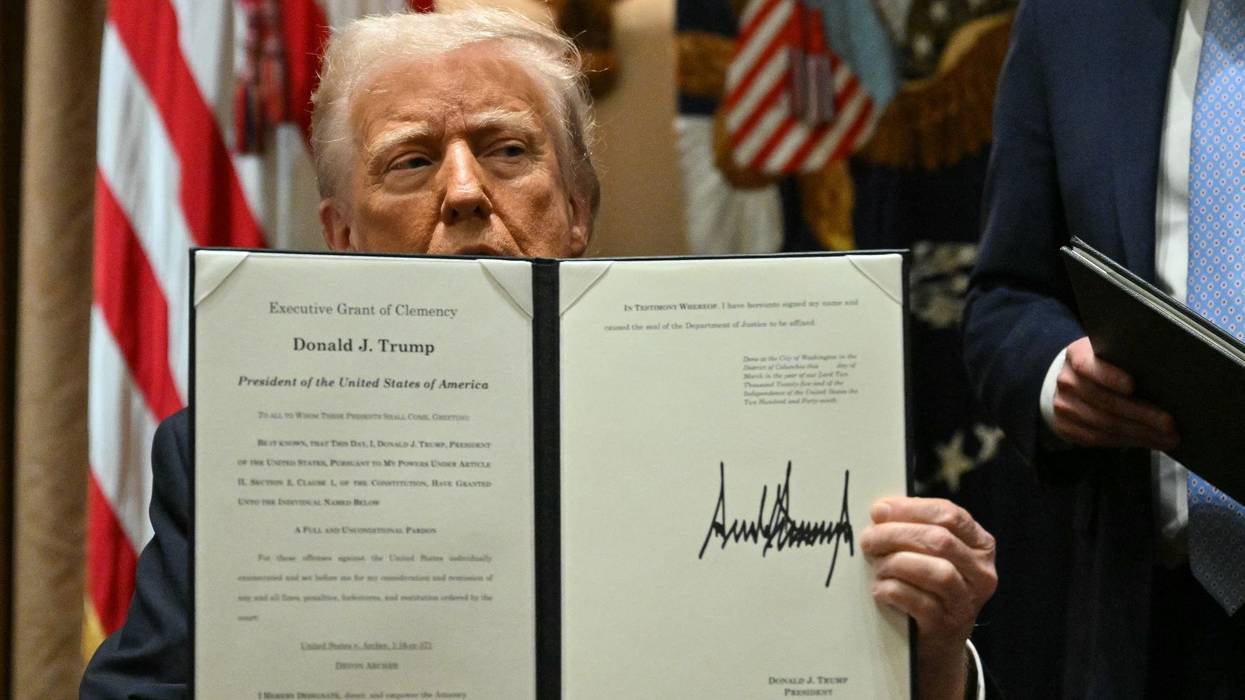
President Donald Trump is drawing swift criticism after announcing he would be signing an executive order aimed at clamping down on state governments' powers to regulate the artificial intelligence industry.
In a Monday morning Truth Social post, Trump said that the order was needed to prevent a fragmented regulatory landscape for AI companies.
"We are beating ALL COUNTRIES at this point in the race, but that won’t last long if we are going to have 50 States, many of them bad actors, involved in RULES and the APPROVAL PROCESS," the president wrote. "THERE CAN BE NO DOUBT ABOUT THIS! AI WILL BE DESTROYED IN ITS INFANCY! I will be doing a ONE RULE Executive Order this week. You can’t expect a company to get 50 Approvals every time they want to do something."
Although specifics on the Trump AI executive order are not yet known, a draft order that has been circulating in recent weeks would instruct the US Department of Justice to file lawsuits against states that pass AI-related regulations with the ultimate goal of overturning them.
Emily Peterson-Cassin, policy director at watchdog Demand Progress, slammed Trump over the looming AI order, which she said was a giveaway to big tech industry billionaire backers such as David Sacks, a major Trump donor who currently serves as the administration's czar on AI and cryptocurrency.
"David Sacks and Big Tech want free rein to use our children as lab rats for AI experiments and President Trump keeps trying to give it to them," she said. "Right now, state laws are our best defense against AI chatbots that have sexual conversations with kids and even encourage them to harm themselves, deepfake revenge porn, and half-baked algorithms that make decisions about our employment and health care."
Peterson-Cassin went on to say that blocking state-level regulations of AI "only makes sense if the president’s goal is to please the Big Tech elites who helped pay for his campaign, his inauguration and his ballroom."
Rep. Pramila Jayapal (D-Wash.) also accused Trump of selling out Americans to do the bidding of Silicon Valley oligarchs.
"This is a direct ask from Big Tech lobbyists (who also donated millions to Trump’s campaign and ballroom) who only care about their own profits, not our safety," Jayapal wrote in a social media post. "States must be able to regulate AI to protect Americans."
Some critics of the Trump AI order questioned whether it had any legal weight behind it. Travis Hall, the director for state engagement at the Center for Democracy and Technology, told the New York Times that Trump's order should not hinder state governments from passing and enforcing AI industry regulations going forward.
“The president cannot pre-empt state laws through an executive order, full stop,” Hall argued. “Pre-emption is a question for Congress, which they have considered and rejected, and should continue to reject.”
Matthew Stoller, an antitrust advocate and researcher at the American Economic Liberties Project, also expressed doubt that Trump's order would be effective at blocking state AI regulations.
"Trump can issue an executive order mandating it rain today, it doesn't really matter though," said Stoller.
Rep. Ted Lieu (D-Calif.) predicted the Trump order would be repeatedly struck down in courts.
"Trump’s one rule executive order on AI will fail," Lieu posted on social media. "Executive orders cannot create law. Only Congress can do so. That’s why Trump tried twice (and failed) to put AI preemption into law. Courts will rule against the EO because it will largely be based on a bill that failed."
Keep ReadingShow Less
Wyden Says Trump's $12 Billion Farmer Bailout Exposes Folly of 'Destructive Tariff Spree'
"Donald Trump’s trade war is taxing families, killing markets for our farm goods, and driving farmers into bankruptcy," said Democratic Sen. Ron Wyden.
Dec 08, 2025
Democratic US Sen. Ron Wyden was among those who emphasized Monday that President Donald Trump's erratic tariff policies have helped create the very conditions the White House is now citing to justify its new $12 billion relief plan for American farmers.
“Instead of proposing government handouts, Donald Trump should end his destructive tariff spree so American farmers can compete and win on a level playing field," said Wyden (D-Ore.), the top Democrat on the Senate Finance Committee. "Donald Trump’s trade war is taxing families, killing markets for our farm goods, and driving farmers into bankruptcy."
"Trump’s plan to bail out farmers won’t even get agriculture communities back to even," the senator added. "They’re still paying more for fertilizer, equipment, and seeds, while grown-in-the-USA farm goods are facing more obstacles than ever in foreign markets. Don’t forget that all of this trade destruction and taxing was to raise money for Trump’s massive handouts to billionaires and the ultra-wealthy.”
Trump formally unveiled the relief plan Monday afternoon at a White House roundtable with top officials, lawmakers, and farmers of corn, soybeans, and other crops. Reuters reported that up to $11 billion of the funds are "meant for a newly designed Farmer Bridge Assistance program for row crop farmers hurt by trade disputes and higher costs." The other $1 billion is earmarked for commodities not covered by the program.
"Quite an admission that his policies have hurt Americans," economist Justin Wolfers wrote in response to the plan.
Farm Action, a farmer-led agricultural watchdog group, welcomed the relief package but said it's not enough to end suffering caused by "tariffs, soaring input costs, and years of volatile markets."
"The current problems facing our agriculture system have been decades in the making due to failed policy that prioritizes commodity crops for export, which only benefits global grain traders and meatpackers," said Joe Maxwell, Farm Action’s co-founder and chief strategy officer. "Without addressing the root causes of this issue, farmers will be left to continue relying on government assistance into the future. That is why Congress must take action and fix our failed subsidy system in the next farm bill."
Rebecca Wolf, senior food policy analyst at Food & Water Watch, said that "bailouts are a denigrating Band-Aid to farmers whom decades of misguided domestic policy have left vulnerable to trade wars."
"Trump’s tariff tantrum and belittling bailouts will deepen agricultural sector consolidation, funneling money to a powerful few corporations, while running farmers further into the ground," said Wolf. "If Trump is serious about helping farmers, lowering sector consolidation and dropping food prices, he needs to look in the mirror. Chaotic tariff tantrums are no way to run farm policy. US farmers need fair prices, regional food markets, and policies that reward sustainable, humane production models—not trade wars.”
The $12 billion relief program comes after months of Trump tariffs and retaliatory actions by key nations—particularly China—that have amplified challenges facing US farmers, a key political constituency for the president.
Farmers and organizations representing them have been vocal in their criticism of Trump's tariffs and his proposed policy responses to the problems that the duties have intensified. As the Washington Post summarized:
Earlier this spring, Trump’s tariffs on China prompted the country to halt purchases of US soybeans. Then, the president offered a $20 billion bailout to Argentina, whose soybean crop sales to China have replaced those from US farmers. Later, Trump announced that the United States would buy beef from Argentina to bring down prices for US consumers, opening a new rift between Trump and cattle ranchers.
The new assistance package is particularly aimed at helping soybean farmers, who have seen a precipitous drop in sales this year, leaving them with extra supply, as the price of soybeans fell.
In October, Illinois soybean producer John Bartman said in a message to the Trump administration that "we don't want a bailout, we want a market."
"Bailouts don't work. Bailouts are band-aids," Bartman added. "What Trump is doing is destroying our markets, and when those markets disappear, we're not gonna get them back."
Ryan Mulholland and Mark Haggerty of the Center for American Progress echoed that sentiment in an analysis last month, noting that "writing a check to farmers helps in the short term, but even in the most optimistic scenario, input costs are likely to remain high, demand volatile, the climate ever-changing, and corporate consolidation and investor ownership of land firmly entrenched."
"Planning for next year’s planting season will be extremely difficult, but without a comprehensive plan to make farming a more sustainable, more prosperous enterprise, planning in subsequent years likely will not be any easier," they added. "President Trump’s 'solution' is to simply pay off farmers. Farmers want trade, not aid. And they want government policy that supports farmers and the communities where they live over the long term."
Keep ReadingShow Less
EU Ministers Ripped for 'Legitimizing Offshore Prisons, Racial Profiling, and Child Detention'
"Ministers' position on the return regulation reveals the EU's dogged and misguided insistence on ramping up deportations, raids, surveillance, and detention at any cost," said an Amnesty International campaigner.
Dec 08, 2025
Advocacy organizations on Monday renewed sharp criticism of European Union policymakers' plans for new rules targeting undocumented immigrants after the Council of the EU finalized its "return regulation" proposal at a meeting in Brussels.
Building on the EU's Pact on Migration and Asylum—set to take effect next June despite being denounced as a "bow to right-wing extremists and fascists"—the European Commission this past March proposed common rules for expelling migrants. The council's deal on Monday established its position on the proposal for negotiations with the European Parliament on the final text.
Despite serious pressure from civil society, including joint statements in September and last week, the Council of the EU—made up of national ministers from the bloc's 27 member states—agreed to support "strict obligations on returnees," such as limiting certain benefits, refusing or withdrawing work permits, and imposing criminal sanctions, including imprisonment.
The council also backed the creation of "return hubs" outside of the European Union, putting in place "special measures for people who pose a security risk," mutual recognition of bloc members' deportation decisions, and a form that will be filled out and added to the EU's information-sharing system for security and border management.
The EU Council’s recent Returns Regulation deal goes against key demands from about 70 civil society organisations.🔊The main demand: A rights-based approach focused on voluntary, dignified return, strict detention limits, and full compliance with EU and international law.
— ECRE (@theecre.bsky.social) December 8, 2025 at 8:44 AM
"EU ministers' position on the return regulation reveals the EU's dogged and misguided insistence on ramping up deportations, raids, surveillance, and detention at any cost," declared Olivia Sundberg Diez, Amnesty International's EU advocate on migration and asylum, in a statement. "These punitive measures amount to an unprecedented stripping of rights based on migration status and will leave more people in precarious situations and legal limbo."
"In addition, EU member states continue to push for cruel and unworkable 'return hubs,' or offshore deportation centers outside of the EU—forcibly transferring people to countries where they have no connection and may be detained for long periods, violating protections in international law," she continued. "This approach mirrors the harrowing, dehumanizing, and unlawful mass arrests, detention, and deportations in the US, which are tearing families apart and devastating communities."
US President Donald Trump returned to office in January, having campaigned on a promise of mass deportations despite facing global condemnation for his first-term immigration policies, particularly family separation. His second term has featured masked federal agents prowling the streets; engaging violently with undocumented immigrants, US citizens of color, and protesters, including Democratic politicians; and detaining migrants—most of whom lack criminal convictions—in inhumane conditions.
The Trump administration aims to boost a far-right movement already on the rise in Europe, claiming in a "national security strategy" document released last Thursday that the continent faces the "stark prospect of civilizational erasure" due to mass migration and the United States must take steps to help "correct its current trajectory."
As Agence France-Presse reported:
A decline in irregular entries to Europe—down by around 20% so far in 2025 compared to last year—has not eased the pressure to act on the hot-button issue.
"We have to speed up," said EU migration commissioner Magnus Brunner, "to give the people the feeling that we have control over what is happening."
...Under the impetus of Denmark, which holds the EU's rotating presidency and has long advocated for stricter migration rules, member states are moving forward at a rapid pace.
On Monday, as Sundberg Diez put it, the Council of the EU took "an already deeply flawed and restrictive commission proposal and opted to introduce new punitive measures, dismantling safeguards and weakening rights further, rather than advancing policies that promote dignity, safety, and health for all."
"They will inflict deep harm on migrants and the communities that welcome them," the campaigner added. "Amnesty International urges the European Parliament, which is yet to adopt its final position on the proposal, to reverse this approach and place human rights firmly at the center of upcoming negotiations."
The Platform for International Cooperation on Undocumented Migrants (PICUM)—which, like Amnesty, was among over 250 groups that signed the September statement—also urged the European Parliament to reject the council's policies, taking aim at plans for home raids; expansion of detention, including of children; deportation hubs outside the EU; 20-year entry bans; and more.
"This so-called 'return regulation' ushers in a deportation regime that entrenches punishment, violence, and discrimination," said PICUM advocacy officer Silvia Carta. "Instead of investing in safety, protection, and inclusion, the EU is choosing policies that will push more people into danger and legal limbo. The council's position goes against basic humanity and EU values. Now it is up to the European Parliament to reject this approach. Migration governance must be rooted in dignity and rights—not fear, racism, or exclusion."
Sarah Chander, director at the Equinox Initiative for Racial Justice, was similarly critical, arguing that with the proposal, "the EU is legitimizing offshore prisons, racial profiling, and child detention in ways we have never seen. Instead of finding ways to ensure safety and protection for everybody, the EU is pushing a punishment regime for migrants, which will help no one."
Alkistis Agrafioti Chatzigianni, an advocacy officer and lawyer at the Greek Council for Refugees, noted that "Greece has become one of the EU's starkest experiments in detaining asylum applicants—marked by prison-like conditions, a lack of effective monitoring mechanisms, and repeated findings of rights violations."
The return regulation, the expert warned, "threatens to replicate and entrench this model across Europe. Instead of learning from the profound failures of detention-based approaches, the EU is choosing to scale them up, turning border zones into sites of coercion and trauma for people seeking protection. This is a dangerous step backwards. A humane migration system must be built on dignity, transparency, and the right to seek safety."
Keep ReadingShow Less
Most Popular