Like every authoritarian before him, Trump is working to co-opt news sources and control what the public sees and hears. Too many corporate outlets are bending the knee—but not Common Dreams. We will never be intimidated, and we will never compromise the core values that define our community: social justice, universal human rights, equality, and peace. Because we are funded by ordinary people like you, our editorial freedom is guaranteed.
Our Summer Campaign fundraising drive is underway, and we need to raise $125,000 by midnight on August 31. Will you donate to help power the nonprofit, independent journalism of Common Dreams?
No Bending the Knee Here
Our Summer Campaign fundraising drive is underway, and we need to raise $125,000 by midnight on August 31. Will you donate to help power the nonprofit, independent journalism of Common Dreams?
Flames engulf the village of Gennadi, Greece on July 25, 2023.
(Photo: Christoph Reichwein/picture alliance via Getty Images)
'Climate Upheaval': Wildfires Kill Dozens Across Mediterranean
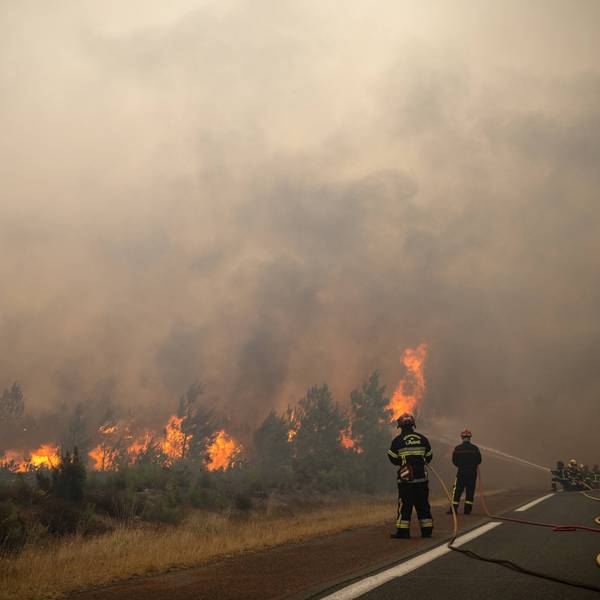
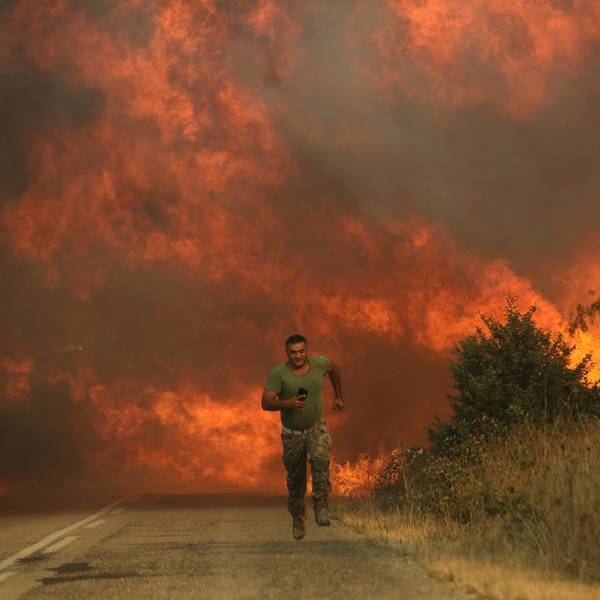
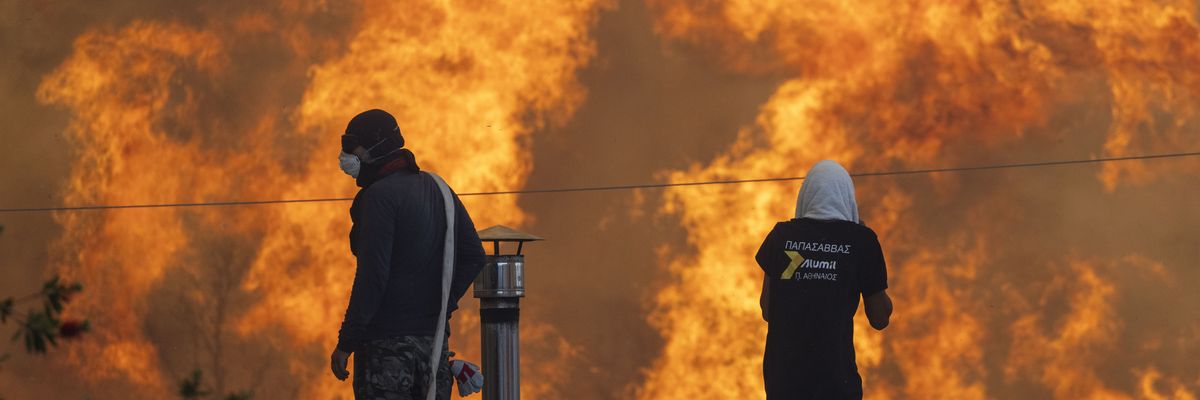
At least nine nations in northern Africa and southern Europe are struggling to contain blazes. Meanwhile, policymakers are still allowing corporate interests to pour more fossil fuels onto the raging fire of climate chaos.
What do these nine countries have in common? All of them are currently battling deadly infernos made worse by the fossil fuel-driven climate emergency.
And yet, governments worldwide continue to greenlight new coal, oil, and gas production—exacerbating planet-heating pollution and ensuring that heatwaves, wildfires, and other extreme weather disasters will increase in frequency, duration, and intensity.
Algeria and Tunisia
In Algeria, roughly 8,000 firefighters on Tuesday struggled to control conflagrations burning across 15 provinces in the country's drought-stricken north, where temperatures reached 122°F. The fires, which prompted the evacuation of more than 1,500 people, have killed at least 34 individuals so far.
"Witnesses described fleeing walls of flames that raged 'like a blowtorch,' destroying homes and coastal resorts and turning vast forest areas into blackened wastelands," The Guardian reported.
Amid heavy winds, two border crossings with neighboring Tunisia have been closed, as authorities there grapple with fires burning in the northwestern region of Tabarka.
Croatia
In Croatia, firefighters on Tuesday worked to contain blazes spreading just south of Dubrovnik, a major tourist destination. The task has been made more difficult by fierce winds in the area, which are keeping firefighting aircraft grounded.
France
In France, hundreds of firefighters were mobilized Tuesday in an attempt to control wildfires near the Nice international airport and on the outskirts of Arles.
Greece
In Greece, more than 20,000 people have been evacuated in recent days from homes and hotels as wildfires rage on the island of Rhodes.
At least three people have died so far, including two pilots whose firefighting plane crashed on Tuesday.
Italy
Italy has been pummeled by a combination of storms in the north, which killed at least seven people on Tuesday, and wildfires in the south, which have also led to multiple deaths.
"While the north was drenched, the heatwave across the south persisted, with temperatures of 47.6°C (117°F) recorded in the eastern Sicilian city of Catania on Monday," The Guardian reported. "The bodies of two people in [their] 70s were found in a house destroyed by the flames, while an 88-year-old woman was found near the Sicilian city of Palermo."
"Italian firefighters said they tackled nearly 1,400 fires between Sunday and Tuesday, including 650 in Sicily and 390 in Calabria, the southern mainland region where a bedridden 98-year-old man was killed as fire consumed his home," the newspaper noted.
On social media, Sicily's civil protection minister Nello Musumeci wrote: "We are experiencing in Italy one of the most complicated days in recent decades—rainstorms, tornadoes, and giant hail in the north, and scorching heat and devastating fires in the center and south. The climate upheaval that has hit our country demands of us all... a change of attitude."
Portugal
In Portugal, hundreds of firefighters scrambled Tuesday to extinguish blazes near Cascais, another popular tourist destination. The country is already hard-hit by drought, and wind gusts are accelerating the spread of flames.
Spain
A fast-moving wildfire in the heart of the Spanish island of Gran Canaria prompted authorities to order evacuations, close roads, and deploy dozens of firefighters and several helicopters on Tuesday.
Turkey
In Turkey, officials on Tuesday evacuated a hospital and a dozen homes in the coastal town of Kemer, where firefighters continued to battle flames.
Europe is the fastest-warming continent on the planet, which has already endured 1.3°C of temperature rise since the late 1800s. July has seen the hottest day and week in recorded history and is on pace to be the hottest month ever. 2023 will likely go down as the hottest year ever, though the potential record is not expected to last long because newly arrived El Niño conditions are projected to make 2024 even hotter.
Last year's brutal heatwaves killed more than 61,000 people in Europe alone. Existing policies put the world on track for up to 2.9°C of temperature rise by the end of the century, prompting United Nations Secretary-General António Guterres to call business-as-usual a civilizational "death sentence."
"Most people still don't know what peril they are in," climate scientist Peter Kalmus tweeted last week. "This will be the coolest summer for the rest of your life, and that shouldn't be just a meme—it should be actually terrifying. The only path out of this heat nightmare is to end fossil fuels ASAP."
"Keep in mind that climate catastrophe is caused by those who run the fossil fuel industry, who have lied and blocked action for decades," he added. "It will get far, far worse until we stop them. We can stop them, but we need to get angry, take risks, and do it!"
It’s been nearly 30 years since I co-founded Common Dreams with my late wife, Lina Newhouser. We had the radical notion that journalism should serve the public good, not corporate profits.
It was clear to us from the outset what it would take to build such a project. No paid advertisements. No corporate sponsors. No millionaire publisher telling us what to think or do.
Many people said we wouldn't last a year, but we proved those doubters wrong.
Together with a tremendous team of journalists and dedicated staff, we built an independent media outlet free from the constraints of profits and corporate control. Our mission has always been simple: To inform. To inspire. To ignite change for the common good.
Building Common Dreams was not easy. Our survival was never guaranteed. When you take on the most powerful forces—Wall Street greed, fossil fuel industry destruction, Big Tech lobbyists, and uber-rich oligarchs who have spent billions upon billions rigging the economy and democracy in their favor—the only bulwark you have is supporters who believe in your work.
But here’s the urgent message from me today. It's never been this bad out there. And it's never been this hard to keep us going. At the very moment Common Dreams is most needed, the threats we face are intensifying. We need your support now more than ever.
We don't accept corporate advertising and never will. We don't have a paywall because we don't think people should be blocked from critical news based on their ability to pay. Everything we do is funded by the donations of readers like you.
When everyone does the little they can afford, we are strong. But if that support retreats or dries up, so do we. Will you donate now to make sure Common Dreams not only survives but thrives?
—Craig Brown, Co-founder
Our work is licensed under Creative Commons (CC BY-NC-ND 3.0). Feel free to republish and share widely.
What do these nine countries have in common? All of them are currently battling deadly infernos made worse by the fossil fuel-driven climate emergency.
And yet, governments worldwide continue to greenlight new coal, oil, and gas production—exacerbating planet-heating pollution and ensuring that heatwaves, wildfires, and other extreme weather disasters will increase in frequency, duration, and intensity.
Algeria and Tunisia
In Algeria, roughly 8,000 firefighters on Tuesday struggled to control conflagrations burning across 15 provinces in the country's drought-stricken north, where temperatures reached 122°F. The fires, which prompted the evacuation of more than 1,500 people, have killed at least 34 individuals so far.
"Witnesses described fleeing walls of flames that raged 'like a blowtorch,' destroying homes and coastal resorts and turning vast forest areas into blackened wastelands," The Guardian reported.
Amid heavy winds, two border crossings with neighboring Tunisia have been closed, as authorities there grapple with fires burning in the northwestern region of Tabarka.
Croatia
In Croatia, firefighters on Tuesday worked to contain blazes spreading just south of Dubrovnik, a major tourist destination. The task has been made more difficult by fierce winds in the area, which are keeping firefighting aircraft grounded.
France
In France, hundreds of firefighters were mobilized Tuesday in an attempt to control wildfires near the Nice international airport and on the outskirts of Arles.
Greece
In Greece, more than 20,000 people have been evacuated in recent days from homes and hotels as wildfires rage on the island of Rhodes.
At least three people have died so far, including two pilots whose firefighting plane crashed on Tuesday.
Italy
Italy has been pummeled by a combination of storms in the north, which killed at least seven people on Tuesday, and wildfires in the south, which have also led to multiple deaths.
"While the north was drenched, the heatwave across the south persisted, with temperatures of 47.6°C (117°F) recorded in the eastern Sicilian city of Catania on Monday," The Guardian reported. "The bodies of two people in [their] 70s were found in a house destroyed by the flames, while an 88-year-old woman was found near the Sicilian city of Palermo."
"Italian firefighters said they tackled nearly 1,400 fires between Sunday and Tuesday, including 650 in Sicily and 390 in Calabria, the southern mainland region where a bedridden 98-year-old man was killed as fire consumed his home," the newspaper noted.
On social media, Sicily's civil protection minister Nello Musumeci wrote: "We are experiencing in Italy one of the most complicated days in recent decades—rainstorms, tornadoes, and giant hail in the north, and scorching heat and devastating fires in the center and south. The climate upheaval that has hit our country demands of us all... a change of attitude."
Portugal
In Portugal, hundreds of firefighters scrambled Tuesday to extinguish blazes near Cascais, another popular tourist destination. The country is already hard-hit by drought, and wind gusts are accelerating the spread of flames.
Spain
A fast-moving wildfire in the heart of the Spanish island of Gran Canaria prompted authorities to order evacuations, close roads, and deploy dozens of firefighters and several helicopters on Tuesday.
Turkey
In Turkey, officials on Tuesday evacuated a hospital and a dozen homes in the coastal town of Kemer, where firefighters continued to battle flames.
Europe is the fastest-warming continent on the planet, which has already endured 1.3°C of temperature rise since the late 1800s. July has seen the hottest day and week in recorded history and is on pace to be the hottest month ever. 2023 will likely go down as the hottest year ever, though the potential record is not expected to last long because newly arrived El Niño conditions are projected to make 2024 even hotter.
Last year's brutal heatwaves killed more than 61,000 people in Europe alone. Existing policies put the world on track for up to 2.9°C of temperature rise by the end of the century, prompting United Nations Secretary-General António Guterres to call business-as-usual a civilizational "death sentence."
"Most people still don't know what peril they are in," climate scientist Peter Kalmus tweeted last week. "This will be the coolest summer for the rest of your life, and that shouldn't be just a meme—it should be actually terrifying. The only path out of this heat nightmare is to end fossil fuels ASAP."
"Keep in mind that climate catastrophe is caused by those who run the fossil fuel industry, who have lied and blocked action for decades," he added. "It will get far, far worse until we stop them. We can stop them, but we need to get angry, take risks, and do it!"
What do these nine countries have in common? All of them are currently battling deadly infernos made worse by the fossil fuel-driven climate emergency.
And yet, governments worldwide continue to greenlight new coal, oil, and gas production—exacerbating planet-heating pollution and ensuring that heatwaves, wildfires, and other extreme weather disasters will increase in frequency, duration, and intensity.
Algeria and Tunisia
In Algeria, roughly 8,000 firefighters on Tuesday struggled to control conflagrations burning across 15 provinces in the country's drought-stricken north, where temperatures reached 122°F. The fires, which prompted the evacuation of more than 1,500 people, have killed at least 34 individuals so far.
"Witnesses described fleeing walls of flames that raged 'like a blowtorch,' destroying homes and coastal resorts and turning vast forest areas into blackened wastelands," The Guardian reported.
Amid heavy winds, two border crossings with neighboring Tunisia have been closed, as authorities there grapple with fires burning in the northwestern region of Tabarka.
Croatia
In Croatia, firefighters on Tuesday worked to contain blazes spreading just south of Dubrovnik, a major tourist destination. The task has been made more difficult by fierce winds in the area, which are keeping firefighting aircraft grounded.
France
In France, hundreds of firefighters were mobilized Tuesday in an attempt to control wildfires near the Nice international airport and on the outskirts of Arles.
Greece
In Greece, more than 20,000 people have been evacuated in recent days from homes and hotels as wildfires rage on the island of Rhodes.
At least three people have died so far, including two pilots whose firefighting plane crashed on Tuesday.
Italy
Italy has been pummeled by a combination of storms in the north, which killed at least seven people on Tuesday, and wildfires in the south, which have also led to multiple deaths.
"While the north was drenched, the heatwave across the south persisted, with temperatures of 47.6°C (117°F) recorded in the eastern Sicilian city of Catania on Monday," The Guardian reported. "The bodies of two people in [their] 70s were found in a house destroyed by the flames, while an 88-year-old woman was found near the Sicilian city of Palermo."
"Italian firefighters said they tackled nearly 1,400 fires between Sunday and Tuesday, including 650 in Sicily and 390 in Calabria, the southern mainland region where a bedridden 98-year-old man was killed as fire consumed his home," the newspaper noted.
On social media, Sicily's civil protection minister Nello Musumeci wrote: "We are experiencing in Italy one of the most complicated days in recent decades—rainstorms, tornadoes, and giant hail in the north, and scorching heat and devastating fires in the center and south. The climate upheaval that has hit our country demands of us all... a change of attitude."
Portugal
In Portugal, hundreds of firefighters scrambled Tuesday to extinguish blazes near Cascais, another popular tourist destination. The country is already hard-hit by drought, and wind gusts are accelerating the spread of flames.
Spain
A fast-moving wildfire in the heart of the Spanish island of Gran Canaria prompted authorities to order evacuations, close roads, and deploy dozens of firefighters and several helicopters on Tuesday.
Turkey
In Turkey, officials on Tuesday evacuated a hospital and a dozen homes in the coastal town of Kemer, where firefighters continued to battle flames.
Europe is the fastest-warming continent on the planet, which has already endured 1.3°C of temperature rise since the late 1800s. July has seen the hottest day and week in recorded history and is on pace to be the hottest month ever. 2023 will likely go down as the hottest year ever, though the potential record is not expected to last long because newly arrived El Niño conditions are projected to make 2024 even hotter.
Last year's brutal heatwaves killed more than 61,000 people in Europe alone. Existing policies put the world on track for up to 2.9°C of temperature rise by the end of the century, prompting United Nations Secretary-General António Guterres to call business-as-usual a civilizational "death sentence."
"Most people still don't know what peril they are in," climate scientist Peter Kalmus tweeted last week. "This will be the coolest summer for the rest of your life, and that shouldn't be just a meme—it should be actually terrifying. The only path out of this heat nightmare is to end fossil fuels ASAP."
"Keep in mind that climate catastrophe is caused by those who run the fossil fuel industry, who have lied and blocked action for decades," he added. "It will get far, far worse until we stop them. We can stop them, but we need to get angry, take risks, and do it!"
We've had enough. The 1% own and operate the corporate media. They are doing everything they can to defend the status quo, squash dissent and protect the wealthy and the powerful. The Common Dreams media model is different. We cover the news that matters to the 99%. Our mission? To inform. To inspire. To ignite change for the common good. How? Nonprofit. Independent. Reader-supported. Free to read. Free to republish. Free to share. With no advertising. No paywalls. No selling of your data. Thousands of small donations fund our newsroom and allow us to continue publishing. Can you chip in? We can't do it without you. Thank you.
SUBSCRIBE TO OUR FREE NEWSLETTER
Daily news & progressive opinion—funded by the people, not the corporations—delivered straight to your inbox.