SUBSCRIBE TO OUR FREE NEWSLETTER
Daily news & progressive opinion—funded by the people, not the corporations—delivered straight to your inbox.
5
#000000
#FFFFFF
To donate by check, phone, or other method, see our More Ways to Give page.
Daily news & progressive opinion—funded by the people, not the corporations—delivered straight to your inbox.
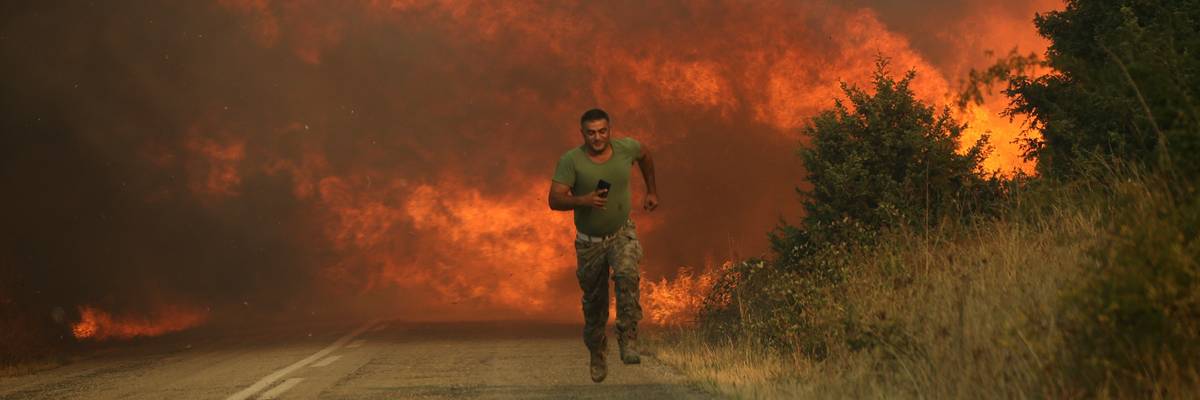
A firefighter runs as wildfire intensifies in the village of Sidiro and Yannuli in Evros, Greece on August 31, 2023.
“Fire management," said one researcher, "cannot replace climate mitigation.”
Wildfires raging across Europe this summer have burned through more than 1.4 million acres across France, Spain, Italy, and even countries with typically milder climates, including the United Kingdom and Belgium—and a study published Thursday warned that the continuation of high carbon emissions would nearly triple the amount of burnt land from wildfires by the end of the century.
Climate action that reduces emissions, including a transition away from fossil fuel extraction and toward solar, wind, and other renewable energy sources, would mean about 39% more land would be burned through during fire seasons across the European Union by 2100, according to the research by the Potsdam Institute for Climate Impact Research (PIK).
But if policymakers fail to take sufficient action, according to the researchers' models, an estimated 192% more land would be burned each year by the end of the century.
The massive increase in wildfire destruction would likely mean major upheaval across Europe; as wildfires tore through Spain and France last month, nearly 270,000 people were forced to evacuate.
Hundreds of people have been killed in European wildfires over the past decade, including at least 14 people in Spain's recent blazes, which grew rapidly amid soaring temperatures, and three firefighters in Greece.
The researchers at PIK compared the projected annual burnt area for 2070-2100 with a model of results for the period between 2000-2030. An increase in hot, dry weather, which scientists have linked to fossil fuel emissions, was the biggest driver of wildfire destruction in the model.
"If fires become really extreme, our ability to contain them might break down, and we do not know yet where this point is."
“Our results indicate there could be widespread increases in burned area even under comparatively low warming of around 1.8°C. But if we emit more, and global temperatures rise by roughly 3.6°C, we see fires become much more prevalent, especially around the Mediterranean and across much of Western and Central Europe, including areas that to date have not experienced many fires,” said Maik Billing, a researcher at PIK and lead author of the study, which was published Thursday in Global Change Biology.
A global temperature rise of 3.6°C would mean fire weather would intensify “virtually all of Europe” by 2100, the scientists said.
Currently, 2.6°C of global heating is expected by the end of the century under climate policies now in place.
The researchers also examined how human action to improve fire management, including training emergency crews and improving equipment and coordination, could mitigate some damage.
"Continued improvements in fire management have the potential to reduce burned area by 92% in a 1.8°C future and 72% at roughly 3.6°C," said PIK. "However, the authors cautioned that the results could be optimistic when it comes to the efficacy of fire management in a much warmer climate."
Thomas Hickler, a scientist at the Senckenberg Society for Nature Research and a co-author of the study, said: “We see fire conditions are increasing, so we need to invest more... Our projections show that this can make a significant difference."
"But if fires become really extreme, our ability to contain them might break down, and we do not know yet where this point is," said Hickler. "The recent record fires in France clearly show that we cannot simply extrapolate from the experiences of the past."
Billing emphasized that regardless of investments in firefighting, "if we go on a path of high emissions... we still see strong increases in burnt area."
“Fire management," said Billing, "cannot replace climate mitigation.”
Dear Common Dreams reader, It’s been nearly 30 years since I co-founded Common Dreams with my late wife, Lina Newhouser. We had the radical notion that journalism should serve the public good, not corporate profits. It was clear to us from the outset what it would take to build such a project. No paid advertisements. No corporate sponsors. No millionaire publisher telling us what to think or do. Many people said we wouldn't last a year, but we proved those doubters wrong. Together with a tremendous team of journalists and dedicated staff, we built an independent media outlet free from the constraints of profits and corporate control. Our mission has always been simple: To inform. To inspire. To ignite change for the common good. Building Common Dreams was not easy. Our survival was never guaranteed. When you take on the most powerful forces—Wall Street greed, fossil fuel industry destruction, Big Tech lobbyists, and uber-rich oligarchs who have spent billions upon billions rigging the economy and democracy in their favor—the only bulwark you have is supporters who believe in your work. But here’s the urgent message from me today. It's never been this bad out there. And it's never been this hard to keep us going. At the very moment Common Dreams is most needed, the threats we face are intensifying. We need your support now more than ever. We don't accept corporate advertising and never will. We don't have a paywall because we don't think people should be blocked from critical news based on their ability to pay. Everything we do is funded by the donations of readers like you. When everyone does the little they can afford, we are strong. But if that support retreats or dries up, so do we. Will you donate now to make sure Common Dreams not only survives but thrives? —Craig Brown, Co-founder |
Wildfires raging across Europe this summer have burned through more than 1.4 million acres across France, Spain, Italy, and even countries with typically milder climates, including the United Kingdom and Belgium—and a study published Thursday warned that the continuation of high carbon emissions would nearly triple the amount of burnt land from wildfires by the end of the century.
Climate action that reduces emissions, including a transition away from fossil fuel extraction and toward solar, wind, and other renewable energy sources, would mean about 39% more land would be burned through during fire seasons across the European Union by 2100, according to the research by the Potsdam Institute for Climate Impact Research (PIK).
But if policymakers fail to take sufficient action, according to the researchers' models, an estimated 192% more land would be burned each year by the end of the century.
The massive increase in wildfire destruction would likely mean major upheaval across Europe; as wildfires tore through Spain and France last month, nearly 270,000 people were forced to evacuate.
Hundreds of people have been killed in European wildfires over the past decade, including at least 14 people in Spain's recent blazes, which grew rapidly amid soaring temperatures, and three firefighters in Greece.
The researchers at PIK compared the projected annual burnt area for 2070-2100 with a model of results for the period between 2000-2030. An increase in hot, dry weather, which scientists have linked to fossil fuel emissions, was the biggest driver of wildfire destruction in the model.
"If fires become really extreme, our ability to contain them might break down, and we do not know yet where this point is."
“Our results indicate there could be widespread increases in burned area even under comparatively low warming of around 1.8°C. But if we emit more, and global temperatures rise by roughly 3.6°C, we see fires become much more prevalent, especially around the Mediterranean and across much of Western and Central Europe, including areas that to date have not experienced many fires,” said Maik Billing, a researcher at PIK and lead author of the study, which was published Thursday in Global Change Biology.
A global temperature rise of 3.6°C would mean fire weather would intensify “virtually all of Europe” by 2100, the scientists said.
Currently, 2.6°C of global heating is expected by the end of the century under climate policies now in place.
The researchers also examined how human action to improve fire management, including training emergency crews and improving equipment and coordination, could mitigate some damage.
"Continued improvements in fire management have the potential to reduce burned area by 92% in a 1.8°C future and 72% at roughly 3.6°C," said PIK. "However, the authors cautioned that the results could be optimistic when it comes to the efficacy of fire management in a much warmer climate."
Thomas Hickler, a scientist at the Senckenberg Society for Nature Research and a co-author of the study, said: “We see fire conditions are increasing, so we need to invest more... Our projections show that this can make a significant difference."
"But if fires become really extreme, our ability to contain them might break down, and we do not know yet where this point is," said Hickler. "The recent record fires in France clearly show that we cannot simply extrapolate from the experiences of the past."
Billing emphasized that regardless of investments in firefighting, "if we go on a path of high emissions... we still see strong increases in burnt area."
“Fire management," said Billing, "cannot replace climate mitigation.”
Wildfires raging across Europe this summer have burned through more than 1.4 million acres across France, Spain, Italy, and even countries with typically milder climates, including the United Kingdom and Belgium—and a study published Thursday warned that the continuation of high carbon emissions would nearly triple the amount of burnt land from wildfires by the end of the century.
Climate action that reduces emissions, including a transition away from fossil fuel extraction and toward solar, wind, and other renewable energy sources, would mean about 39% more land would be burned through during fire seasons across the European Union by 2100, according to the research by the Potsdam Institute for Climate Impact Research (PIK).
But if policymakers fail to take sufficient action, according to the researchers' models, an estimated 192% more land would be burned each year by the end of the century.
The massive increase in wildfire destruction would likely mean major upheaval across Europe; as wildfires tore through Spain and France last month, nearly 270,000 people were forced to evacuate.
Hundreds of people have been killed in European wildfires over the past decade, including at least 14 people in Spain's recent blazes, which grew rapidly amid soaring temperatures, and three firefighters in Greece.
The researchers at PIK compared the projected annual burnt area for 2070-2100 with a model of results for the period between 2000-2030. An increase in hot, dry weather, which scientists have linked to fossil fuel emissions, was the biggest driver of wildfire destruction in the model.
"If fires become really extreme, our ability to contain them might break down, and we do not know yet where this point is."
“Our results indicate there could be widespread increases in burned area even under comparatively low warming of around 1.8°C. But if we emit more, and global temperatures rise by roughly 3.6°C, we see fires become much more prevalent, especially around the Mediterranean and across much of Western and Central Europe, including areas that to date have not experienced many fires,” said Maik Billing, a researcher at PIK and lead author of the study, which was published Thursday in Global Change Biology.
A global temperature rise of 3.6°C would mean fire weather would intensify “virtually all of Europe” by 2100, the scientists said.
Currently, 2.6°C of global heating is expected by the end of the century under climate policies now in place.
The researchers also examined how human action to improve fire management, including training emergency crews and improving equipment and coordination, could mitigate some damage.
"Continued improvements in fire management have the potential to reduce burned area by 92% in a 1.8°C future and 72% at roughly 3.6°C," said PIK. "However, the authors cautioned that the results could be optimistic when it comes to the efficacy of fire management in a much warmer climate."
Thomas Hickler, a scientist at the Senckenberg Society for Nature Research and a co-author of the study, said: “We see fire conditions are increasing, so we need to invest more... Our projections show that this can make a significant difference."
"But if fires become really extreme, our ability to contain them might break down, and we do not know yet where this point is," said Hickler. "The recent record fires in France clearly show that we cannot simply extrapolate from the experiences of the past."
Billing emphasized that regardless of investments in firefighting, "if we go on a path of high emissions... we still see strong increases in burnt area."
“Fire management," said Billing, "cannot replace climate mitigation.”