SUBSCRIBE TO OUR FREE NEWSLETTER
Daily news & progressive opinion—funded by the people, not the corporations—delivered straight to your inbox.
5
#000000
#FFFFFF
To donate by check, phone, or other method, see our More Ways to Give page.
Daily news & progressive opinion—funded by the people, not the corporations—delivered straight to your inbox.
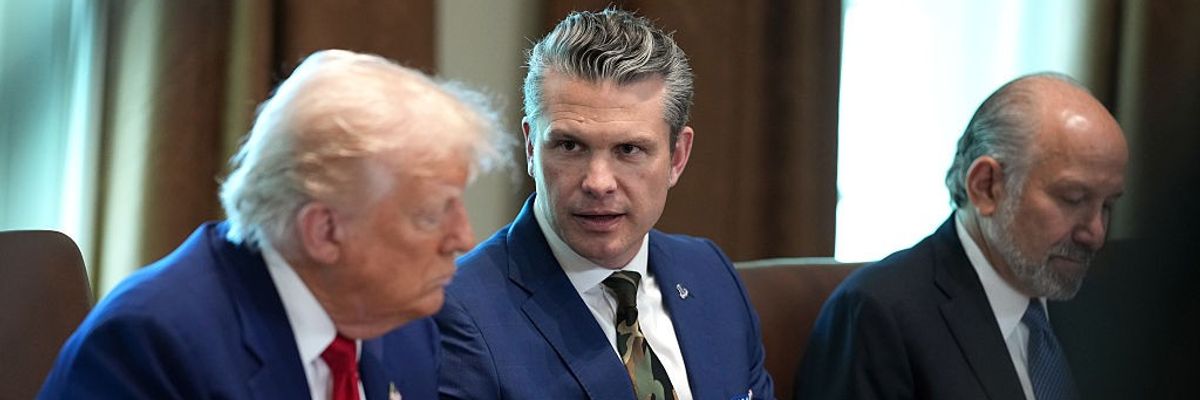
U.S. Defense Secretary Pete Hegseth and President Donald Trump attended a Cabinet meeting at the White House on April 30, 2025 in Washington, D.C.
"With sufficient will, the negotiations can reach the finish line and avert the risks of a disastrous war and Iranian weaponization of its nuclear program," said the National Iranian American Council's policy director.
Omani Foreign Minister Badr al-Busaidi announced on social media Thursday that a fourth round of U.S.-Iran nuclear talks planned for this coming weekend has been postponed—just hours after U.S. Defense Secretary Pete Hegseth publicly threatened Iran.
However, al-Busaidi, who has mediated the previous rounds of negotiations, did not address the U.S. threat. He claimed on social media that the delay was due to "logistical reasons" and "new dates will be announced when mutually agreed."
As The Associated Press reported:
Iran's Foreign Ministry spokesperson Esmail Baghaei issued a statement describing the talks as being "postponed at the request of Oman's foreign minister." He said Iran remains committed to reaching "a fair and lasting agreement."
Meanwhile, a person familiar with the U.S. negotiators said that America "had never confirmed its participation" in a fourth round of talks in Rome. However, the person said the U.S. expected the talks to occur "in the near future." The person spoke on condition of anonymity to discuss the closed-door negotiations.
During U.S. President Donald Trump's first term, he ditched the Iran nuclear deal negotiated under the Obama administration. After Trump returned to the Oval Office in January, Vice President JD Vance had to cast a tiebreaking vote to confirm Hegseth, whose tenure as Pentagon chief thus far has been marred by controversy and accusations of ineptitude.
Hegseth—a former Fox News host who faces mounting calls to resign after sharing U.S. plans to bomb Yemen in multiple chats on the commercial messaging application Signal—addressed Iran's support for the Houthis, a Yemeni group, in a late Wednesday social media post.
"Message to IRAN: We see your LETHAL support to the Houthis," he said. "We know exactly what you are doing. You know very well what the U.S. Military is capable of—and you were warned. You will pay the CONSEQUENCE at the time and place of our choosing."
Hegseth's initial post was from his Pentagon account. He also
shared it on his personal account with a screenshot of a mid-March Truth Social post in which Trump railed against Iran and the Houthis.
In response to Hegseth, journalist Ryan Grim asked, "This because our jet fell off our boat?"
A $60 million U.S. Navy F/A-18 Super Hornet fighter jet recently went overboard from the USS Harry S. Truman after the aircraft carrier turned to evade Houthi fire, according to a U.S. official.
Republican Congressman Thomas Massie (Ky.)—who has a history of joining with Democrats to criticize military action without a declaration of war, particularly in Yemen—responded: "I support this administration, but the secretary of defense doesn't have the constitutional authority to declare war on a sovereign country. A planned military attack on Iran is an act of war and requires a vote of Congress according to the U.S. Constitution."
Ryan Costello, policy director of the National Iranian American Council, said in a statement that "Trump entered office with a deficit of effective U.S. diplomacy in the Middle East, not a deficit of threats or bombing. Where the administration has led with diplomacy and sustained that focus, they've delivered some positive results. Where the administration has let bombs lead the way, like the Biden administration before them, we've seen security worsen and sustainable solutions move further from reach."
"If there was a military solution to security in Yemen, Saudi Arabia would have emerged victorious in its conflict a decade ago, and the Biden administration would have halted the Houthis' targeting of shipping in the Red Sea last year," he continued. "Of course, there isn’t a military solution in Yemen, which makes it all the more befuddling that the Trump administration thinks it can bomb the Houthis into submission when this approach has been tried and failed repeatedly."
"Secretary Hegseth tweeting at Iran and threatening 'CONSEQUENCE' for its ties with the Houthis won't alter these dynamics, and risks leading the U.S. into far more damaging blowback against a more capable adversary," Costello stressed. "The U.S. and Iran need to resolve security challenges through diplomacy, not threats and military escalation. This is true on the nuclear issue, where we encourage the U.S. and Iran to return to negotiations as soon as possible. The pace that they have set on negotiations has been difficult to sustain, but not impossible."
"With sufficient will, the negotiations can reach the finish line and avert the risks of a disastrous war and Iranian weaponization of its nuclear program," he added. "Likewise, the U.S. should halt its backfiring bombing campaign in Yemen and find a way to bring all the relevant actors to the negotiating table—simultaneous with efforts to restore a cease-fire in Gaza that frees the remaining hostages and ensures urgent aid for the devastating humanitarian crisis on the ground."
Dear Common Dreams reader, It’s been nearly 30 years since I co-founded Common Dreams with my late wife, Lina Newhouser. We had the radical notion that journalism should serve the public good, not corporate profits. It was clear to us from the outset what it would take to build such a project. No paid advertisements. No corporate sponsors. No millionaire publisher telling us what to think or do. Many people said we wouldn't last a year, but we proved those doubters wrong. Together with a tremendous team of journalists and dedicated staff, we built an independent media outlet free from the constraints of profits and corporate control. Our mission has always been simple: To inform. To inspire. To ignite change for the common good. Building Common Dreams was not easy. Our survival was never guaranteed. When you take on the most powerful forces—Wall Street greed, fossil fuel industry destruction, Big Tech lobbyists, and uber-rich oligarchs who have spent billions upon billions rigging the economy and democracy in their favor—the only bulwark you have is supporters who believe in your work. But here’s the urgent message from me today. It's never been this bad out there. And it's never been this hard to keep us going. At the very moment Common Dreams is most needed, the threats we face are intensifying. We need your support now more than ever. We don't accept corporate advertising and never will. We don't have a paywall because we don't think people should be blocked from critical news based on their ability to pay. Everything we do is funded by the donations of readers like you. When everyone does the little they can afford, we are strong. But if that support retreats or dries up, so do we. Will you donate now to make sure Common Dreams not only survives but thrives? —Craig Brown, Co-founder |
Omani Foreign Minister Badr al-Busaidi announced on social media Thursday that a fourth round of U.S.-Iran nuclear talks planned for this coming weekend has been postponed—just hours after U.S. Defense Secretary Pete Hegseth publicly threatened Iran.
However, al-Busaidi, who has mediated the previous rounds of negotiations, did not address the U.S. threat. He claimed on social media that the delay was due to "logistical reasons" and "new dates will be announced when mutually agreed."
As The Associated Press reported:
Iran's Foreign Ministry spokesperson Esmail Baghaei issued a statement describing the talks as being "postponed at the request of Oman's foreign minister." He said Iran remains committed to reaching "a fair and lasting agreement."
Meanwhile, a person familiar with the U.S. negotiators said that America "had never confirmed its participation" in a fourth round of talks in Rome. However, the person said the U.S. expected the talks to occur "in the near future." The person spoke on condition of anonymity to discuss the closed-door negotiations.
During U.S. President Donald Trump's first term, he ditched the Iran nuclear deal negotiated under the Obama administration. After Trump returned to the Oval Office in January, Vice President JD Vance had to cast a tiebreaking vote to confirm Hegseth, whose tenure as Pentagon chief thus far has been marred by controversy and accusations of ineptitude.
Hegseth—a former Fox News host who faces mounting calls to resign after sharing U.S. plans to bomb Yemen in multiple chats on the commercial messaging application Signal—addressed Iran's support for the Houthis, a Yemeni group, in a late Wednesday social media post.
"Message to IRAN: We see your LETHAL support to the Houthis," he said. "We know exactly what you are doing. You know very well what the U.S. Military is capable of—and you were warned. You will pay the CONSEQUENCE at the time and place of our choosing."
Hegseth's initial post was from his Pentagon account. He also
shared it on his personal account with a screenshot of a mid-March Truth Social post in which Trump railed against Iran and the Houthis.
In response to Hegseth, journalist Ryan Grim asked, "This because our jet fell off our boat?"
A $60 million U.S. Navy F/A-18 Super Hornet fighter jet recently went overboard from the USS Harry S. Truman after the aircraft carrier turned to evade Houthi fire, according to a U.S. official.
Republican Congressman Thomas Massie (Ky.)—who has a history of joining with Democrats to criticize military action without a declaration of war, particularly in Yemen—responded: "I support this administration, but the secretary of defense doesn't have the constitutional authority to declare war on a sovereign country. A planned military attack on Iran is an act of war and requires a vote of Congress according to the U.S. Constitution."
Ryan Costello, policy director of the National Iranian American Council, said in a statement that "Trump entered office with a deficit of effective U.S. diplomacy in the Middle East, not a deficit of threats or bombing. Where the administration has led with diplomacy and sustained that focus, they've delivered some positive results. Where the administration has let bombs lead the way, like the Biden administration before them, we've seen security worsen and sustainable solutions move further from reach."
"If there was a military solution to security in Yemen, Saudi Arabia would have emerged victorious in its conflict a decade ago, and the Biden administration would have halted the Houthis' targeting of shipping in the Red Sea last year," he continued. "Of course, there isn’t a military solution in Yemen, which makes it all the more befuddling that the Trump administration thinks it can bomb the Houthis into submission when this approach has been tried and failed repeatedly."
"Secretary Hegseth tweeting at Iran and threatening 'CONSEQUENCE' for its ties with the Houthis won't alter these dynamics, and risks leading the U.S. into far more damaging blowback against a more capable adversary," Costello stressed. "The U.S. and Iran need to resolve security challenges through diplomacy, not threats and military escalation. This is true on the nuclear issue, where we encourage the U.S. and Iran to return to negotiations as soon as possible. The pace that they have set on negotiations has been difficult to sustain, but not impossible."
"With sufficient will, the negotiations can reach the finish line and avert the risks of a disastrous war and Iranian weaponization of its nuclear program," he added. "Likewise, the U.S. should halt its backfiring bombing campaign in Yemen and find a way to bring all the relevant actors to the negotiating table—simultaneous with efforts to restore a cease-fire in Gaza that frees the remaining hostages and ensures urgent aid for the devastating humanitarian crisis on the ground."
Omani Foreign Minister Badr al-Busaidi announced on social media Thursday that a fourth round of U.S.-Iran nuclear talks planned for this coming weekend has been postponed—just hours after U.S. Defense Secretary Pete Hegseth publicly threatened Iran.
However, al-Busaidi, who has mediated the previous rounds of negotiations, did not address the U.S. threat. He claimed on social media that the delay was due to "logistical reasons" and "new dates will be announced when mutually agreed."
As The Associated Press reported:
Iran's Foreign Ministry spokesperson Esmail Baghaei issued a statement describing the talks as being "postponed at the request of Oman's foreign minister." He said Iran remains committed to reaching "a fair and lasting agreement."
Meanwhile, a person familiar with the U.S. negotiators said that America "had never confirmed its participation" in a fourth round of talks in Rome. However, the person said the U.S. expected the talks to occur "in the near future." The person spoke on condition of anonymity to discuss the closed-door negotiations.
During U.S. President Donald Trump's first term, he ditched the Iran nuclear deal negotiated under the Obama administration. After Trump returned to the Oval Office in January, Vice President JD Vance had to cast a tiebreaking vote to confirm Hegseth, whose tenure as Pentagon chief thus far has been marred by controversy and accusations of ineptitude.
Hegseth—a former Fox News host who faces mounting calls to resign after sharing U.S. plans to bomb Yemen in multiple chats on the commercial messaging application Signal—addressed Iran's support for the Houthis, a Yemeni group, in a late Wednesday social media post.
"Message to IRAN: We see your LETHAL support to the Houthis," he said. "We know exactly what you are doing. You know very well what the U.S. Military is capable of—and you were warned. You will pay the CONSEQUENCE at the time and place of our choosing."
Hegseth's initial post was from his Pentagon account. He also
shared it on his personal account with a screenshot of a mid-March Truth Social post in which Trump railed against Iran and the Houthis.
In response to Hegseth, journalist Ryan Grim asked, "This because our jet fell off our boat?"
A $60 million U.S. Navy F/A-18 Super Hornet fighter jet recently went overboard from the USS Harry S. Truman after the aircraft carrier turned to evade Houthi fire, according to a U.S. official.
Republican Congressman Thomas Massie (Ky.)—who has a history of joining with Democrats to criticize military action without a declaration of war, particularly in Yemen—responded: "I support this administration, but the secretary of defense doesn't have the constitutional authority to declare war on a sovereign country. A planned military attack on Iran is an act of war and requires a vote of Congress according to the U.S. Constitution."
Ryan Costello, policy director of the National Iranian American Council, said in a statement that "Trump entered office with a deficit of effective U.S. diplomacy in the Middle East, not a deficit of threats or bombing. Where the administration has led with diplomacy and sustained that focus, they've delivered some positive results. Where the administration has let bombs lead the way, like the Biden administration before them, we've seen security worsen and sustainable solutions move further from reach."
"If there was a military solution to security in Yemen, Saudi Arabia would have emerged victorious in its conflict a decade ago, and the Biden administration would have halted the Houthis' targeting of shipping in the Red Sea last year," he continued. "Of course, there isn’t a military solution in Yemen, which makes it all the more befuddling that the Trump administration thinks it can bomb the Houthis into submission when this approach has been tried and failed repeatedly."
"Secretary Hegseth tweeting at Iran and threatening 'CONSEQUENCE' for its ties with the Houthis won't alter these dynamics, and risks leading the U.S. into far more damaging blowback against a more capable adversary," Costello stressed. "The U.S. and Iran need to resolve security challenges through diplomacy, not threats and military escalation. This is true on the nuclear issue, where we encourage the U.S. and Iran to return to negotiations as soon as possible. The pace that they have set on negotiations has been difficult to sustain, but not impossible."
"With sufficient will, the negotiations can reach the finish line and avert the risks of a disastrous war and Iranian weaponization of its nuclear program," he added. "Likewise, the U.S. should halt its backfiring bombing campaign in Yemen and find a way to bring all the relevant actors to the negotiating table—simultaneous with efforts to restore a cease-fire in Gaza that frees the remaining hostages and ensures urgent aid for the devastating humanitarian crisis on the ground."