SUBSCRIBE TO OUR FREE NEWSLETTER
Daily news & progressive opinion—funded by the people, not the corporations—delivered straight to your inbox.
5
#000000
#FFFFFF
To donate by check, phone, or other method, see our More Ways to Give page.
Daily news & progressive opinion—funded by the people, not the corporations—delivered straight to your inbox.
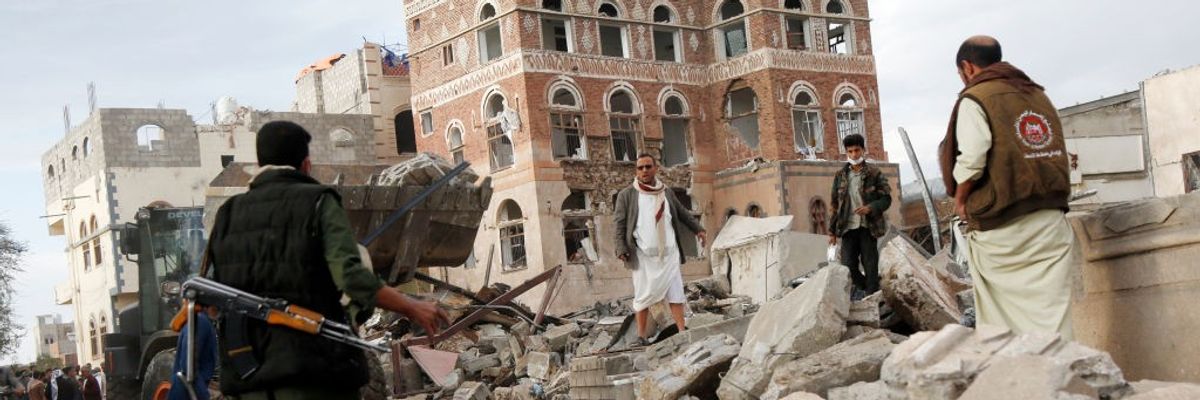
People inspect a building targeted by the United States aerial attacks on March 20, 2025, in Sana'a, Yemen.
The U.S. president appears to be heeding Saudi wishes ahead of a visit to Riyadh, with a potential eye on negotiations with Iran as well.
Middle East Eye reports that Saudi Arabia pressured the Trump administration to cease bombing Yemen in advance of his planned trip to the Kingdom next week because such raids would be an embarrassment for him and his host. U.S. President Donald Trump said Tuesday that he was convinced that the Houthis were sincere in their new pledge to cease targeting shipping in the Red Sea.
The subtext here is that people in the region believe the U.S. is bombing an Arab country on behalf of Israeli shipping in the Red Sea and to protect Israel from repercussions for its Gaza genocide. Attacking the Houthis, who are not otherwise popular, on these grounds while Trump is in Riyadh would make it look like Saudi Arabia is also running interference for the government of Israeli Prime Minister Benjamin Netanyahu. The Houthi strategy of hitting out at Israeli interests has helped rally the people around them and lends them some regional popularity.
Both the Biden administration and the Trump administration have bombed Yemen in reaction to the Houthi targeting of Red Sea shipping and attacks on Israel in sympathy with the people of Gaza, against whom Israel has conducted serial atrocities.
MEE says that the Saudis have requested that Trump not bring up normalization with Israel on this trip, since Riyadh is determined not to recognize Israel until there is a firm prospect of a Palestinian state. Unlike the UAE and Bahrain, which did recognize Israel, Saudi Arabia has a fairly large population of citizens, most of whom would be extremely upset to see their king reward the Israelis for their Gaza atrocities by establishing diplomatic relations.
The Houthis do not appear to have made any pledge to cease targeting Israel with missiles, and the Israeli government was reportedly blindsided by the Trump move. Trump kept them out of the loop, much to their dismay. On Tuesday, Israel itself bombed Sanaa in retaliation for the Houthi missile attack Sunday on Ben Gurion Airport.
Oman’s foreign minister, Badr Albusaidi, confirmed the White House announcement of the cessation of hostilities. Oman has been a go-to mediator for conflicts in the region, and is helping negotiate a Trump deal with Iran.
A senior Houthi official, Politburo member Muhammad Ali al-Houthi, expressed cautious optimism, saying that the American pledge to halt bombing the small country on the southwest edge of the Arabian Peninsula would be “field tested.”
Both the Biden administration and the Trump administration have bombed Yemen in reaction to the Houthi targeting of Red Sea shipping and attacks on Israel in sympathy with the people of Gaza, against whom Israel has conducted serial atrocities. Trump alone has ordered 800 bombing raids on the desperately poor country. Yemen is the only Arab country to have reacted against the Israeli genocide of Palestinians in Gaza. Its methods, however, have involved war crimes, since it has attacked civilian container ships, most of them not actually connected to Israel, and has attacked civilian targets in Israel—or has been unable to control its missiles, endangering civilian life—which is a war crime.
Former National Security adviser to the Iranian parliament, Heshmetollah Felahat, said Tuesday that the cessation of U.S. bombing of Yemen was connected to U.S.-Iran negotiations and was a way for Trump to block attempts of Netanyahu to draw the U.S. into war with Iran. He said that the chances of successful U.S.-Iran negotiations just went up.
This country and this world are at a monumental crossroads. US voters have an opportunity to beat back the forces of fascism and confront the billionaires who are rigging the economy, our media system, and our democracy, making it increasingly impossible for ordinary people to get by. We’re not just talking about the election. We’re talking about what must be done once these fascist elements are vanquished from power. We need a bolder set of solutions than what either major party has so far been willing to offer and a working-class movement ready to fight like hell for it. Trump didn't emerge from nowhere. The conditions that fueled MAGA authoritarianism were created by decades of radical neoliberal economic policies and a corrupt political system dominated by corporate interests. They slashed taxes on the super-rich, promising that the benefits would trickle down. They said giveaways to the corporate titans would make life more affordable for the rest of us. It was all bullshit. And when a bitter, betrayed populace searches for someone to blame, right-wing demagogues have little trouble finding scapegoats. People know when they're being lied to, but you won't hear any of this from the corporate media. Only independent journalism—powered and funded by people who believe in building a better world—can deliver truly trustworthy daily news. If you share our vision, please contribute whatever you can to sustain our work. |
Middle East Eye reports that Saudi Arabia pressured the Trump administration to cease bombing Yemen in advance of his planned trip to the Kingdom next week because such raids would be an embarrassment for him and his host. U.S. President Donald Trump said Tuesday that he was convinced that the Houthis were sincere in their new pledge to cease targeting shipping in the Red Sea.
The subtext here is that people in the region believe the U.S. is bombing an Arab country on behalf of Israeli shipping in the Red Sea and to protect Israel from repercussions for its Gaza genocide. Attacking the Houthis, who are not otherwise popular, on these grounds while Trump is in Riyadh would make it look like Saudi Arabia is also running interference for the government of Israeli Prime Minister Benjamin Netanyahu. The Houthi strategy of hitting out at Israeli interests has helped rally the people around them and lends them some regional popularity.
Both the Biden administration and the Trump administration have bombed Yemen in reaction to the Houthi targeting of Red Sea shipping and attacks on Israel in sympathy with the people of Gaza, against whom Israel has conducted serial atrocities.
MEE says that the Saudis have requested that Trump not bring up normalization with Israel on this trip, since Riyadh is determined not to recognize Israel until there is a firm prospect of a Palestinian state. Unlike the UAE and Bahrain, which did recognize Israel, Saudi Arabia has a fairly large population of citizens, most of whom would be extremely upset to see their king reward the Israelis for their Gaza atrocities by establishing diplomatic relations.
The Houthis do not appear to have made any pledge to cease targeting Israel with missiles, and the Israeli government was reportedly blindsided by the Trump move. Trump kept them out of the loop, much to their dismay. On Tuesday, Israel itself bombed Sanaa in retaliation for the Houthi missile attack Sunday on Ben Gurion Airport.
Oman’s foreign minister, Badr Albusaidi, confirmed the White House announcement of the cessation of hostilities. Oman has been a go-to mediator for conflicts in the region, and is helping negotiate a Trump deal with Iran.
A senior Houthi official, Politburo member Muhammad Ali al-Houthi, expressed cautious optimism, saying that the American pledge to halt bombing the small country on the southwest edge of the Arabian Peninsula would be “field tested.”
Both the Biden administration and the Trump administration have bombed Yemen in reaction to the Houthi targeting of Red Sea shipping and attacks on Israel in sympathy with the people of Gaza, against whom Israel has conducted serial atrocities. Trump alone has ordered 800 bombing raids on the desperately poor country. Yemen is the only Arab country to have reacted against the Israeli genocide of Palestinians in Gaza. Its methods, however, have involved war crimes, since it has attacked civilian container ships, most of them not actually connected to Israel, and has attacked civilian targets in Israel—or has been unable to control its missiles, endangering civilian life—which is a war crime.
Former National Security adviser to the Iranian parliament, Heshmetollah Felahat, said Tuesday that the cessation of U.S. bombing of Yemen was connected to U.S.-Iran negotiations and was a way for Trump to block attempts of Netanyahu to draw the U.S. into war with Iran. He said that the chances of successful U.S.-Iran negotiations just went up.