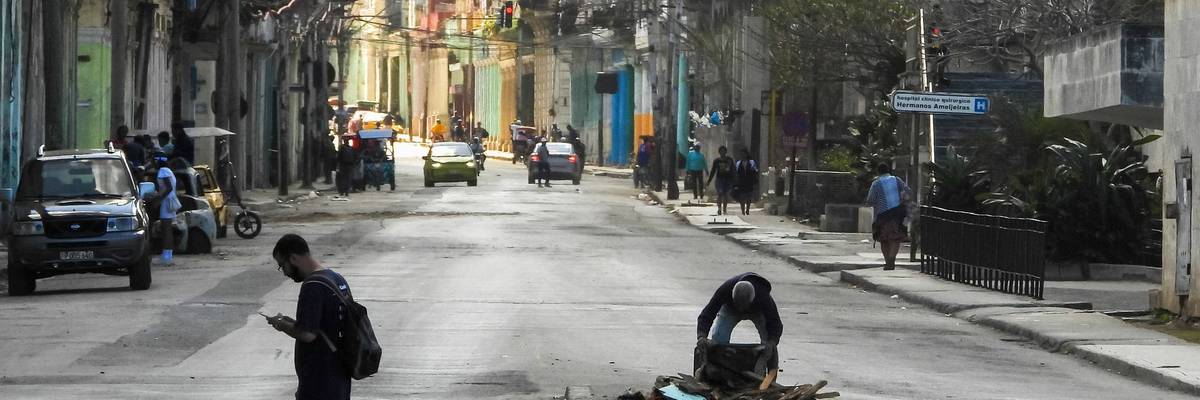
People walk along a quiet street in Havana, Cuba on February 8, 2026.
Trump Now 'Boasting of a War Crime' as Cuba Suffers Under Oil Blockade
"Cuba isn’t failing, it’s being suffocated," said one anti-war group.
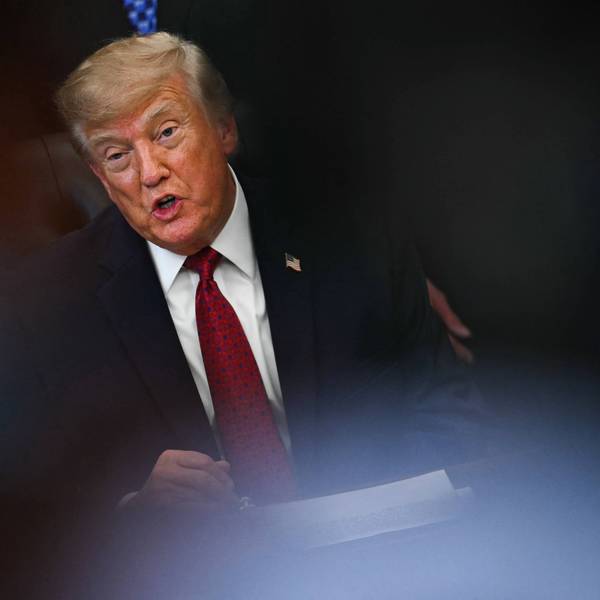
US President Donald Trump's latest comments on his government's blockade on Cuba Monday evening amounted to "boasting of a war crime," one journalist said after the president told the press that the Caribbean island is a "failed nation" weeks after Trump himself cut off Cuba's main source of energy and threatened countries with tariffs if they provided the government with oil.
Speaking to reporters on Air Force One, Trump listed some of the impacts of the blockade the White House imposed after invading Venezuela last month and pushing for control of its oil supply.
"They don't even have jet fuel to get their airplanes to take off. They're clogging up their runway. We're talking to Cuba right now... and they should absolutely make a deal, because it's really a humanitarian threat," said the president. "There's an embargo, there's no oil, there's no money, there's no anything."
Trump: Cuba and us are talking. In the meantime, there's an embargo. There's no oil. There's no money. There's no anything.
Reporter: If a deal isn't made, would you consider an operation like the one in Venezuela?
Trump: I don't want to answer that. pic.twitter.com/9bVhDtfqWV
— Acyn (@Acyn) February 17, 2026
Carlos F. de Cossio, Cuba's deputy minister of foreign affairs, pointed out that it has been "frequent for US officials and diplomats to claim that US aggression is not responsible for difficulties in Cuba," as the trade embargo maintained by the US for more than six decades has impeded medications, food, and other humanitarian assistance from reaching Cubans.
It seems those officials "don't listen to their president," said de Cossio.
Trump commented on the impact of his ramped-up blockade as Al Jazeera and Reuters reported that just 44 of Havana's 106 sanitation trucks have been able to operate in recent weeks due to the fuel shortage, leading waste to pile up on the Cuban capital's streets and raising fears of public health risks.
The lack of fuel has also caused blackouts in cities and rural areas, and one diplomat told The Guardian on Sunday that "it's a matter of weeks" before the blockade could cause extreme shortages of water and food.
While appearing to express concern for the Cuban public, Trump described how he and Secretary of State Marco Rubio "are overseeing a siege on Cuba... with no discernible foreign policy objective other than sadism," said Emma Vigeland of Majority Report.
"This is not an embargo. The US has had an embargo on Cuba for over 60 years, and it has failed" to force a regime change, said Vigeland.
The anti-war group Code Pink added: "If Cuba is a 'failed nation' then why has the U.S. spent 66 years trying and failing to destroy it?"
"Cuba isn’t failing, it’s being suffocated," said the group.
Trump repeated his demand that Cuban officials "make a deal," but Cuban officials have said they are open to coming to an agreement with the US. Meanwhile, Drop Site News reported last week that Rubio has been falsely claiming negotiations are taking place in an apparent bid to ultimately force regime change through other means.
One reporter asked the president Monday evening whether he would consider "an operation like the one in Venezuela," where US forces last month abducted President Nicolás Maduro and his wife and killed dozens of people, including many Cuban soldiers and guards.
Trump did not confirm or deny whether he would take military action in Cuba, but issued a veiled threat: "It wouldn't be a very tough operation, as you can figure."
Also on Monday, over 100 Cuban artists signed on to a call for "international solidarity" against the blockade.
"The empire says that Cuba represents a threat to its national security, which is ridiculous and implausible. It has imposed an oil blockade, resulting in the paralysis of hospitals, schools, industries, and transportation. They try to prevent our doctors from saving lives; they try to paralyze our free and universal education system, to plunge us into famine, into a lack of energy to guarantee access to drinking water and cooking food; in short, they aim to slowly and bloodily extinguish a country," reads the open letter.
"Cuba resists and will resist this inhumane aggression, but it counts on the active solidarity of all honest, humanist, and good-willed men and women of the world," it continues. "It is about preventing a genocidal act and saving a heroic people whose only 'crime and threat' has been to defend their sovereignty."
We are at a crossroads
This country and this world are at a monumental crossroads. In a few short weeks, US voters will have an opportunity to beat back the forces of fascism and confront the billionaires who are rigging the economy, our media system, and our democracy, making it increasingly impossible for ordinary people to get by. We’re not just talking about the election. We’re talking about what must be done once these fascist elements are vanquished from power. We need a bolder set of solutions than what either major party has so far been willing to offer and a working-class movement ready to fight like hell for it. Trump didn't emerge from nowhere. The conditions that fueled MAGA authoritarianism were created by decades of radical neoliberal economic policies and a corrupt political system dominated by corporate interests. They slashed taxes on the super-rich, promising that the benefits would trickle down. They said giveaways to the corporate titans would make life more affordable for the rest of us. It was all bullshit. And when a bitter, betrayed populace searches for someone to blame, right-wing demagogues have little trouble finding scapegoats. People know when they're being lied to, but you won't hear any of this from the corporate media. Only independent journalism—powered and funded by people who believe in building a better world—can deliver truly trustworthy daily news. Our Fall Campaign is underway, and we need your help. To power our newsroom through the rest of the year, we need to raise $125,000 by midnight on October 31. So if you share our vision, please contribute whatever you can to sustain our work. |
US President Donald Trump's latest comments on his government's blockade on Cuba Monday evening amounted to "boasting of a war crime," one journalist said after the president told the press that the Caribbean island is a "failed nation" weeks after Trump himself cut off Cuba's main source of energy and threatened countries with tariffs if they provided the government with oil.
Speaking to reporters on Air Force One, Trump listed some of the impacts of the blockade the White House imposed after invading Venezuela last month and pushing for control of its oil supply.
"They don't even have jet fuel to get their airplanes to take off. They're clogging up their runway. We're talking to Cuba right now... and they should absolutely make a deal, because it's really a humanitarian threat," said the president. "There's an embargo, there's no oil, there's no money, there's no anything."
Trump: Cuba and us are talking. In the meantime, there's an embargo. There's no oil. There's no money. There's no anything.
Reporter: If a deal isn't made, would you consider an operation like the one in Venezuela?
Trump: I don't want to answer that. pic.twitter.com/9bVhDtfqWV
— Acyn (@Acyn) February 17, 2026
Carlos F. de Cossio, Cuba's deputy minister of foreign affairs, pointed out that it has been "frequent for US officials and diplomats to claim that US aggression is not responsible for difficulties in Cuba," as the trade embargo maintained by the US for more than six decades has impeded medications, food, and other humanitarian assistance from reaching Cubans.
It seems those officials "don't listen to their president," said de Cossio.
Trump commented on the impact of his ramped-up blockade as Al Jazeera and Reuters reported that just 44 of Havana's 106 sanitation trucks have been able to operate in recent weeks due to the fuel shortage, leading waste to pile up on the Cuban capital's streets and raising fears of public health risks.
The lack of fuel has also caused blackouts in cities and rural areas, and one diplomat told The Guardian on Sunday that "it's a matter of weeks" before the blockade could cause extreme shortages of water and food.
While appearing to express concern for the Cuban public, Trump described how he and Secretary of State Marco Rubio "are overseeing a siege on Cuba... with no discernible foreign policy objective other than sadism," said Emma Vigeland of Majority Report.
"This is not an embargo. The US has had an embargo on Cuba for over 60 years, and it has failed" to force a regime change, said Vigeland.
The anti-war group Code Pink added: "If Cuba is a 'failed nation' then why has the U.S. spent 66 years trying and failing to destroy it?"
"Cuba isn’t failing, it’s being suffocated," said the group.
Trump repeated his demand that Cuban officials "make a deal," but Cuban officials have said they are open to coming to an agreement with the US. Meanwhile, Drop Site News reported last week that Rubio has been falsely claiming negotiations are taking place in an apparent bid to ultimately force regime change through other means.
One reporter asked the president Monday evening whether he would consider "an operation like the one in Venezuela," where US forces last month abducted President Nicolás Maduro and his wife and killed dozens of people, including many Cuban soldiers and guards.
Trump did not confirm or deny whether he would take military action in Cuba, but issued a veiled threat: "It wouldn't be a very tough operation, as you can figure."
Also on Monday, over 100 Cuban artists signed on to a call for "international solidarity" against the blockade.
"The empire says that Cuba represents a threat to its national security, which is ridiculous and implausible. It has imposed an oil blockade, resulting in the paralysis of hospitals, schools, industries, and transportation. They try to prevent our doctors from saving lives; they try to paralyze our free and universal education system, to plunge us into famine, into a lack of energy to guarantee access to drinking water and cooking food; in short, they aim to slowly and bloodily extinguish a country," reads the open letter.
"Cuba resists and will resist this inhumane aggression, but it counts on the active solidarity of all honest, humanist, and good-willed men and women of the world," it continues. "It is about preventing a genocidal act and saving a heroic people whose only 'crime and threat' has been to defend their sovereignty."
- Pushing for Regime Change, Trump Accused of 'Asphyxiating' Cuba With Fuel Embargo ›
- Reporting Says Rubio 'Deliberately' Lying to Trump About US-Cuba Talks ›
- After Venezuela Assault, Trump and Rubio Warn Cuba, Mexico, and Colombia Could Be Next ›
- Four People on a Florida Speedboat Killed in Shootout With Cuban Troops | Common Dreams ›
- 'Peace President' Trump Floats 'Friendly Takeover' of Cuba While Preparing to Attack Iran | Common Dreams ›
- Jayapal Rips 'Cruel and Failing' US Policy After Trump Says 'Cuba Is Gonna Fall' | Common Dreams ›
- Opinion | Ramadan Under the Blockade: The Women of Havana’s Only Mosque | Common Dreams ›
- Warning of Another 'Disaster' Like Iran, Senators Introduce War Powers Resolution on Cuba | Common Dreams ›
- 'Economic Warfare': Cuba Faces Island-Wide Blackout Amid Illegal Trump Blockade | Common Dreams ›
- As Trump Tightens US Chokehold on Cuba's Economy, Rubio Says Fix Requires 'New People in Chargen' | Common Dreams ›
- 'No Patient Deserves This': Doctors, Nurses Say Trump Blockade Is Killing Sick Cubans | Common Dreams ›
- Opinion | The US War on Cuba's Doctors | Common Dreams ›
- Cuba President Decries ‘Collective Punishment’ by US as ‘Act of Genocide’c | Common Dreams ›
US President Donald Trump's latest comments on his government's blockade on Cuba Monday evening amounted to "boasting of a war crime," one journalist said after the president told the press that the Caribbean island is a "failed nation" weeks after Trump himself cut off Cuba's main source of energy and threatened countries with tariffs if they provided the government with oil.
Speaking to reporters on Air Force One, Trump listed some of the impacts of the blockade the White House imposed after invading Venezuela last month and pushing for control of its oil supply.
"They don't even have jet fuel to get their airplanes to take off. They're clogging up their runway. We're talking to Cuba right now... and they should absolutely make a deal, because it's really a humanitarian threat," said the president. "There's an embargo, there's no oil, there's no money, there's no anything."
Trump: Cuba and us are talking. In the meantime, there's an embargo. There's no oil. There's no money. There's no anything.
Reporter: If a deal isn't made, would you consider an operation like the one in Venezuela?
Trump: I don't want to answer that. pic.twitter.com/9bVhDtfqWV
— Acyn (@Acyn) February 17, 2026
Carlos F. de Cossio, Cuba's deputy minister of foreign affairs, pointed out that it has been "frequent for US officials and diplomats to claim that US aggression is not responsible for difficulties in Cuba," as the trade embargo maintained by the US for more than six decades has impeded medications, food, and other humanitarian assistance from reaching Cubans.
It seems those officials "don't listen to their president," said de Cossio.
Trump commented on the impact of his ramped-up blockade as Al Jazeera and Reuters reported that just 44 of Havana's 106 sanitation trucks have been able to operate in recent weeks due to the fuel shortage, leading waste to pile up on the Cuban capital's streets and raising fears of public health risks.
The lack of fuel has also caused blackouts in cities and rural areas, and one diplomat told The Guardian on Sunday that "it's a matter of weeks" before the blockade could cause extreme shortages of water and food.
While appearing to express concern for the Cuban public, Trump described how he and Secretary of State Marco Rubio "are overseeing a siege on Cuba... with no discernible foreign policy objective other than sadism," said Emma Vigeland of Majority Report.
"This is not an embargo. The US has had an embargo on Cuba for over 60 years, and it has failed" to force a regime change, said Vigeland.
The anti-war group Code Pink added: "If Cuba is a 'failed nation' then why has the U.S. spent 66 years trying and failing to destroy it?"
"Cuba isn’t failing, it’s being suffocated," said the group.
Trump repeated his demand that Cuban officials "make a deal," but Cuban officials have said they are open to coming to an agreement with the US. Meanwhile, Drop Site News reported last week that Rubio has been falsely claiming negotiations are taking place in an apparent bid to ultimately force regime change through other means.
One reporter asked the president Monday evening whether he would consider "an operation like the one in Venezuela," where US forces last month abducted President Nicolás Maduro and his wife and killed dozens of people, including many Cuban soldiers and guards.
Trump did not confirm or deny whether he would take military action in Cuba, but issued a veiled threat: "It wouldn't be a very tough operation, as you can figure."
Also on Monday, over 100 Cuban artists signed on to a call for "international solidarity" against the blockade.
"The empire says that Cuba represents a threat to its national security, which is ridiculous and implausible. It has imposed an oil blockade, resulting in the paralysis of hospitals, schools, industries, and transportation. They try to prevent our doctors from saving lives; they try to paralyze our free and universal education system, to plunge us into famine, into a lack of energy to guarantee access to drinking water and cooking food; in short, they aim to slowly and bloodily extinguish a country," reads the open letter.
"Cuba resists and will resist this inhumane aggression, but it counts on the active solidarity of all honest, humanist, and good-willed men and women of the world," it continues. "It is about preventing a genocidal act and saving a heroic people whose only 'crime and threat' has been to defend their sovereignty."
- Pushing for Regime Change, Trump Accused of 'Asphyxiating' Cuba With Fuel Embargo ›
- Reporting Says Rubio 'Deliberately' Lying to Trump About US-Cuba Talks ›
- After Venezuela Assault, Trump and Rubio Warn Cuba, Mexico, and Colombia Could Be Next ›
- Four People on a Florida Speedboat Killed in Shootout With Cuban Troops | Common Dreams ›
- 'Peace President' Trump Floats 'Friendly Takeover' of Cuba While Preparing to Attack Iran | Common Dreams ›
- Jayapal Rips 'Cruel and Failing' US Policy After Trump Says 'Cuba Is Gonna Fall' | Common Dreams ›
- Opinion | Ramadan Under the Blockade: The Women of Havana’s Only Mosque | Common Dreams ›
- Warning of Another 'Disaster' Like Iran, Senators Introduce War Powers Resolution on Cuba | Common Dreams ›
- 'Economic Warfare': Cuba Faces Island-Wide Blackout Amid Illegal Trump Blockade | Common Dreams ›
- As Trump Tightens US Chokehold on Cuba's Economy, Rubio Says Fix Requires 'New People in Chargen' | Common Dreams ›
- 'No Patient Deserves This': Doctors, Nurses Say Trump Blockade Is Killing Sick Cubans | Common Dreams ›
- Opinion | The US War on Cuba's Doctors | Common Dreams ›
- Cuba President Decries ‘Collective Punishment’ by US as ‘Act of Genocide’c | Common Dreams ›