SUBSCRIBE TO OUR FREE NEWSLETTER
Daily news & progressive opinion—funded by the people, not the corporations—delivered straight to your inbox.
5
#000000
#FFFFFF
To donate by check, phone, or other method, see our More Ways to Give page.
Daily news & progressive opinion—funded by the people, not the corporations—delivered straight to your inbox.
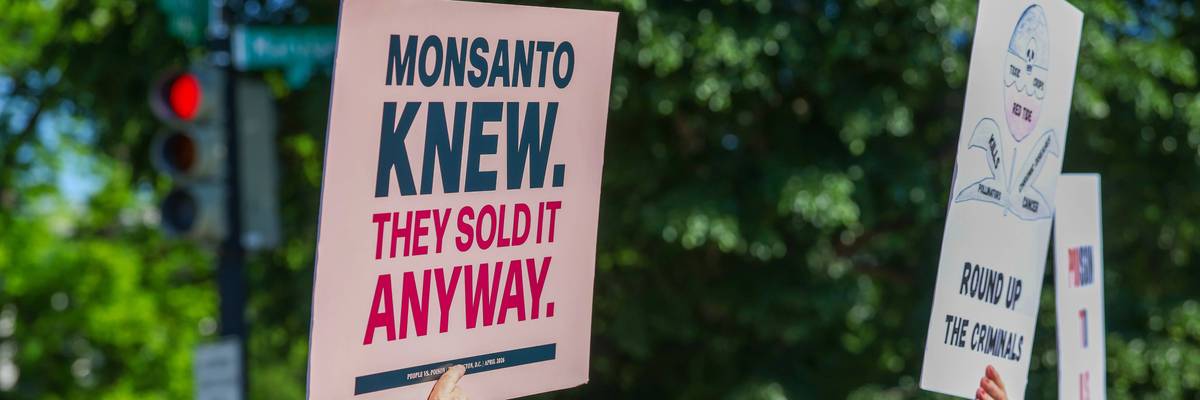
“The People v. Poison” protesters gather at the US Supreme Court on April 27, 2026 in Washington, DC.
"People who were exposed, workers who were never warned, consumers who trusted a label—they now have fewer tools to use to fight back. And the corporations responsible for that harm have more protection than ever."
Public health advocates, legal experts, and members of Congress were among those outraged on Thursday by the US Supreme Court's ruling in favor of Monsanto—and, effectively, against thousands of people who argue that its weedkiller Roundup caused their cancer.
Jay Feldman, executive director of the organization Beyond Pesticides, blasted the 7-2 decision as "a tragic setback for public and environmental health, allowing companies that produce toxic pesticides to evade the most basic of responsibilities, warning consumers that their products may cause cancer and other deadly diseases."
"In an age of deregulation, the ability of farmers, farmworkers, and consumers to hold chemical manufacturers accountable for hazard warnings is the keystone to minimum protection of public health, as demand in the market for the safest possible products grows daily," Feldman said in a statement.
The closely watched case stems from a state-level lawsuit and a resulting verdict in favor of John Durnell, a Missouri man who argued that Monsanto's glyphosate-based Roundup caused his non-Hodgkin lymphoma, a blood cancer, which is in remission after multiple rounds of chemotherapy. A jury agreed the herbicide's label should have had a cancer warning.
The World Health Organization's International Agency for Research on Cancer classified glyphosate as probably carcinogenic to humans over a decade ago, but the US Environmental Protection Agency and Bayer still insist it is safe. In a majority opinion penned by Justice Brett Kavanaugh, the country's high court agreed with the company's argument that the Federal Insecticide, Fungicide, and Rodenticide Act (FIFRA) preempts Durnell's failure-to-warn claim under state law.
In a dissent joined by Justice Neil Gorsuch, Justice Ketanji Brown Jackson wrote that "the majority reads into FIFRA a labeling requirement that does not exist, and it reads out of FIFRA the statute's ongoing prohibition on misbranding. This interpretation cannot be squared with the text of FIFRA or our precedents. Ultimately, the effect of the majority's interpretation is both remarkable and regrettable, for it unjustifiably closes the courthouse doors to state tort plaintiffs like Durnell."
Bayer—which bought Monsanto in 2018—similarly noted in a Thursday statement that the ruling "should help significantly contain the Roundup litigation after nearly a decade of legal battles," which the company also said that it will keep trying to resolve by seeking final approval of its proposed $7.25 billion class settlement.
"This case was never just about Bayer," Environmental Working Group president and co-founder Ken Cook emphasized Thursday. "It was about whether states retain the authority to provide stronger protections for their residents when federal regulations fall short, and whether ordinary Americans can hold powerful corporations accountable when their pesticides cause harm."
Despite returning to office with a promise to "Make America Healthy Again" alongside Health and Human Services Secretary Robert F. Kennedy Jr., President Donald Trump's administration "didn't sit on the sidelines—it lobbied the Supreme Court to strip Americans of their right to sue. And its tactics worked," Cook pointed out. "When a president uses the vast power of the federal government to protect a pesticide company from accountability—instead of the people he swore to serve—our system is no longer working for ordinary Americans."
"The ultimate losers are the American people," Cook concluded. "People who were exposed, workers who were never warned, consumers who trusted a label—they now have fewer tools to use to fight back. And the corporations responsible for that harm have more protection than ever."
Federal lawmakers who have fought against GOP efforts to pass a legislative "liability shield" for pesticide companies, including Sen. Cory Booker (D-NJ) and Congressman Thomas Massie (R-Ky.) joined Cook in ripping the ruling, as did Earthjustice senior attorney Patti Goldman, who said that it "allows Monsanto and other chemical companies to avoid responsibility when their labels leave people unprotected from serious harm."
As Farm Action president Angela Huffman also warned that the ruling "sets a dangerous precedent for other corporations seeking similar immunity," Sarah Starman, senior food and agriculture Campaigner at Friends of the Earth, took aim at the Supreme Court for issuing a decision that "sells out farmers, gardeners, and rural communities to multibillion-dollar pesticide corporations."
Food & Water Watch legal director Tarah Heinzen, also condemned the decision, declaring that "once again, the Supreme Court has sided with big business over people and the environment."
"Today's ruling is a disaster for public health—and it has Trump's name written all over it," said Heinzen. "If one needed any further proof that the president's feigned mission to 'Make America Healthy Again' was a farce, today's decision is all the evidence needed. Trump has been all too willing to endorse Bayer's crusade to pollute with impunity, while the administration doubles down on a failed pesticide regulatory scheme."
"Industrial agriculture is poisoning America," she stressed. "The fight against toxic pesticides does not end here. Congress must pass the Pesticide Injury Accountability Act to safeguard access to justice for all harmed by these toxic chemicals, and a Farm Bill that finally puts public health first. Until then, the Supreme Court has shut the courthouse doors to tens of thousands of sick and suffering Americans."
Kayla Hancock, director of Protect Our Care's Public Health Project, also called out Trump for dispatching US Solicitor General D. John Sauer to argue the case on the side of Bayer and its legal team.
"First Donald Trump signed an executive order plowing the field for increased glyphosate production despite the known health risks to help grow profits for his chemical industry donors," Hancock said. "Then Trump dispatched his [US Department of Justice] lawyers to help Big Chemical secure blanket immunity from at least 100,000 glyphosate-related liability claims."
"Sadly, the Supreme Court agreed to give glyphosate makers a free pass to poison Americans without warning," she added. "Donald Trump always has and always will prioritize big money corporate interests that benefit him, even if it means marginalizing the MAHA movement and concerned moms. And whenever Trump sells out public health to the highest industry bidder, there's no bigger apologist than his phony health secretary, RFK Jr."
Dear Common Dreams reader, It’s been nearly 30 years since I co-founded Common Dreams with my late wife, Lina Newhouser. We had the radical notion that journalism should serve the public good, not corporate profits. It was clear to us from the outset what it would take to build such a project. No paid advertisements. No corporate sponsors. No millionaire publisher telling us what to think or do. Many people said we wouldn't last a year, but we proved those doubters wrong. Together with a tremendous team of journalists and dedicated staff, we built an independent media outlet free from the constraints of profits and corporate control. Our mission has always been simple: To inform. To inspire. To ignite change for the common good. Building Common Dreams was not easy. Our survival was never guaranteed. When you take on the most powerful forces—Wall Street greed, fossil fuel industry destruction, Big Tech lobbyists, and uber-rich oligarchs who have spent billions upon billions rigging the economy and democracy in their favor—the only bulwark you have is supporters who believe in your work. But here’s the urgent message from me today. It's never been this bad out there. And it's never been this hard to keep us going. At the very moment Common Dreams is most needed, the threats we face are intensifying. We need your support now more than ever. We don't accept corporate advertising and never will. We don't have a paywall because we don't think people should be blocked from critical news based on their ability to pay. Everything we do is funded by the donations of readers like you. When everyone does the little they can afford, we are strong. But if that support retreats or dries up, so do we. Will you donate now to make sure Common Dreams not only survives but thrives? —Craig Brown, Co-founder |
Public health advocates, legal experts, and members of Congress were among those outraged on Thursday by the US Supreme Court's ruling in favor of Monsanto—and, effectively, against thousands of people who argue that its weedkiller Roundup caused their cancer.
Jay Feldman, executive director of the organization Beyond Pesticides, blasted the 7-2 decision as "a tragic setback for public and environmental health, allowing companies that produce toxic pesticides to evade the most basic of responsibilities, warning consumers that their products may cause cancer and other deadly diseases."
"In an age of deregulation, the ability of farmers, farmworkers, and consumers to hold chemical manufacturers accountable for hazard warnings is the keystone to minimum protection of public health, as demand in the market for the safest possible products grows daily," Feldman said in a statement.
The closely watched case stems from a state-level lawsuit and a resulting verdict in favor of John Durnell, a Missouri man who argued that Monsanto's glyphosate-based Roundup caused his non-Hodgkin lymphoma, a blood cancer, which is in remission after multiple rounds of chemotherapy. A jury agreed the herbicide's label should have had a cancer warning.
The World Health Organization's International Agency for Research on Cancer classified glyphosate as probably carcinogenic to humans over a decade ago, but the US Environmental Protection Agency and Bayer still insist it is safe. In a majority opinion penned by Justice Brett Kavanaugh, the country's high court agreed with the company's argument that the Federal Insecticide, Fungicide, and Rodenticide Act (FIFRA) preempts Durnell's failure-to-warn claim under state law.
In a dissent joined by Justice Neil Gorsuch, Justice Ketanji Brown Jackson wrote that "the majority reads into FIFRA a labeling requirement that does not exist, and it reads out of FIFRA the statute's ongoing prohibition on misbranding. This interpretation cannot be squared with the text of FIFRA or our precedents. Ultimately, the effect of the majority's interpretation is both remarkable and regrettable, for it unjustifiably closes the courthouse doors to state tort plaintiffs like Durnell."
Bayer—which bought Monsanto in 2018—similarly noted in a Thursday statement that the ruling "should help significantly contain the Roundup litigation after nearly a decade of legal battles," which the company also said that it will keep trying to resolve by seeking final approval of its proposed $7.25 billion class settlement.
"This case was never just about Bayer," Environmental Working Group president and co-founder Ken Cook emphasized Thursday. "It was about whether states retain the authority to provide stronger protections for their residents when federal regulations fall short, and whether ordinary Americans can hold powerful corporations accountable when their pesticides cause harm."
Despite returning to office with a promise to "Make America Healthy Again" alongside Health and Human Services Secretary Robert F. Kennedy Jr., President Donald Trump's administration "didn't sit on the sidelines—it lobbied the Supreme Court to strip Americans of their right to sue. And its tactics worked," Cook pointed out. "When a president uses the vast power of the federal government to protect a pesticide company from accountability—instead of the people he swore to serve—our system is no longer working for ordinary Americans."
"The ultimate losers are the American people," Cook concluded. "People who were exposed, workers who were never warned, consumers who trusted a label—they now have fewer tools to use to fight back. And the corporations responsible for that harm have more protection than ever."
Federal lawmakers who have fought against GOP efforts to pass a legislative "liability shield" for pesticide companies, including Sen. Cory Booker (D-NJ) and Congressman Thomas Massie (R-Ky.) joined Cook in ripping the ruling, as did Earthjustice senior attorney Patti Goldman, who said that it "allows Monsanto and other chemical companies to avoid responsibility when their labels leave people unprotected from serious harm."
As Farm Action president Angela Huffman also warned that the ruling "sets a dangerous precedent for other corporations seeking similar immunity," Sarah Starman, senior food and agriculture Campaigner at Friends of the Earth, took aim at the Supreme Court for issuing a decision that "sells out farmers, gardeners, and rural communities to multibillion-dollar pesticide corporations."
Food & Water Watch legal director Tarah Heinzen, also condemned the decision, declaring that "once again, the Supreme Court has sided with big business over people and the environment."
"Today's ruling is a disaster for public health—and it has Trump's name written all over it," said Heinzen. "If one needed any further proof that the president's feigned mission to 'Make America Healthy Again' was a farce, today's decision is all the evidence needed. Trump has been all too willing to endorse Bayer's crusade to pollute with impunity, while the administration doubles down on a failed pesticide regulatory scheme."
"Industrial agriculture is poisoning America," she stressed. "The fight against toxic pesticides does not end here. Congress must pass the Pesticide Injury Accountability Act to safeguard access to justice for all harmed by these toxic chemicals, and a Farm Bill that finally puts public health first. Until then, the Supreme Court has shut the courthouse doors to tens of thousands of sick and suffering Americans."
Kayla Hancock, director of Protect Our Care's Public Health Project, also called out Trump for dispatching US Solicitor General D. John Sauer to argue the case on the side of Bayer and its legal team.
"First Donald Trump signed an executive order plowing the field for increased glyphosate production despite the known health risks to help grow profits for his chemical industry donors," Hancock said. "Then Trump dispatched his [US Department of Justice] lawyers to help Big Chemical secure blanket immunity from at least 100,000 glyphosate-related liability claims."
"Sadly, the Supreme Court agreed to give glyphosate makers a free pass to poison Americans without warning," she added. "Donald Trump always has and always will prioritize big money corporate interests that benefit him, even if it means marginalizing the MAHA movement and concerned moms. And whenever Trump sells out public health to the highest industry bidder, there's no bigger apologist than his phony health secretary, RFK Jr."
Public health advocates, legal experts, and members of Congress were among those outraged on Thursday by the US Supreme Court's ruling in favor of Monsanto—and, effectively, against thousands of people who argue that its weedkiller Roundup caused their cancer.
Jay Feldman, executive director of the organization Beyond Pesticides, blasted the 7-2 decision as "a tragic setback for public and environmental health, allowing companies that produce toxic pesticides to evade the most basic of responsibilities, warning consumers that their products may cause cancer and other deadly diseases."
"In an age of deregulation, the ability of farmers, farmworkers, and consumers to hold chemical manufacturers accountable for hazard warnings is the keystone to minimum protection of public health, as demand in the market for the safest possible products grows daily," Feldman said in a statement.
The closely watched case stems from a state-level lawsuit and a resulting verdict in favor of John Durnell, a Missouri man who argued that Monsanto's glyphosate-based Roundup caused his non-Hodgkin lymphoma, a blood cancer, which is in remission after multiple rounds of chemotherapy. A jury agreed the herbicide's label should have had a cancer warning.
The World Health Organization's International Agency for Research on Cancer classified glyphosate as probably carcinogenic to humans over a decade ago, but the US Environmental Protection Agency and Bayer still insist it is safe. In a majority opinion penned by Justice Brett Kavanaugh, the country's high court agreed with the company's argument that the Federal Insecticide, Fungicide, and Rodenticide Act (FIFRA) preempts Durnell's failure-to-warn claim under state law.
In a dissent joined by Justice Neil Gorsuch, Justice Ketanji Brown Jackson wrote that "the majority reads into FIFRA a labeling requirement that does not exist, and it reads out of FIFRA the statute's ongoing prohibition on misbranding. This interpretation cannot be squared with the text of FIFRA or our precedents. Ultimately, the effect of the majority's interpretation is both remarkable and regrettable, for it unjustifiably closes the courthouse doors to state tort plaintiffs like Durnell."
Bayer—which bought Monsanto in 2018—similarly noted in a Thursday statement that the ruling "should help significantly contain the Roundup litigation after nearly a decade of legal battles," which the company also said that it will keep trying to resolve by seeking final approval of its proposed $7.25 billion class settlement.
"This case was never just about Bayer," Environmental Working Group president and co-founder Ken Cook emphasized Thursday. "It was about whether states retain the authority to provide stronger protections for their residents when federal regulations fall short, and whether ordinary Americans can hold powerful corporations accountable when their pesticides cause harm."
Despite returning to office with a promise to "Make America Healthy Again" alongside Health and Human Services Secretary Robert F. Kennedy Jr., President Donald Trump's administration "didn't sit on the sidelines—it lobbied the Supreme Court to strip Americans of their right to sue. And its tactics worked," Cook pointed out. "When a president uses the vast power of the federal government to protect a pesticide company from accountability—instead of the people he swore to serve—our system is no longer working for ordinary Americans."
"The ultimate losers are the American people," Cook concluded. "People who were exposed, workers who were never warned, consumers who trusted a label—they now have fewer tools to use to fight back. And the corporations responsible for that harm have more protection than ever."
Federal lawmakers who have fought against GOP efforts to pass a legislative "liability shield" for pesticide companies, including Sen. Cory Booker (D-NJ) and Congressman Thomas Massie (R-Ky.) joined Cook in ripping the ruling, as did Earthjustice senior attorney Patti Goldman, who said that it "allows Monsanto and other chemical companies to avoid responsibility when their labels leave people unprotected from serious harm."
As Farm Action president Angela Huffman also warned that the ruling "sets a dangerous precedent for other corporations seeking similar immunity," Sarah Starman, senior food and agriculture Campaigner at Friends of the Earth, took aim at the Supreme Court for issuing a decision that "sells out farmers, gardeners, and rural communities to multibillion-dollar pesticide corporations."
Food & Water Watch legal director Tarah Heinzen, also condemned the decision, declaring that "once again, the Supreme Court has sided with big business over people and the environment."
"Today's ruling is a disaster for public health—and it has Trump's name written all over it," said Heinzen. "If one needed any further proof that the president's feigned mission to 'Make America Healthy Again' was a farce, today's decision is all the evidence needed. Trump has been all too willing to endorse Bayer's crusade to pollute with impunity, while the administration doubles down on a failed pesticide regulatory scheme."
"Industrial agriculture is poisoning America," she stressed. "The fight against toxic pesticides does not end here. Congress must pass the Pesticide Injury Accountability Act to safeguard access to justice for all harmed by these toxic chemicals, and a Farm Bill that finally puts public health first. Until then, the Supreme Court has shut the courthouse doors to tens of thousands of sick and suffering Americans."
Kayla Hancock, director of Protect Our Care's Public Health Project, also called out Trump for dispatching US Solicitor General D. John Sauer to argue the case on the side of Bayer and its legal team.
"First Donald Trump signed an executive order plowing the field for increased glyphosate production despite the known health risks to help grow profits for his chemical industry donors," Hancock said. "Then Trump dispatched his [US Department of Justice] lawyers to help Big Chemical secure blanket immunity from at least 100,000 glyphosate-related liability claims."
"Sadly, the Supreme Court agreed to give glyphosate makers a free pass to poison Americans without warning," she added. "Donald Trump always has and always will prioritize big money corporate interests that benefit him, even if it means marginalizing the MAHA movement and concerned moms. And whenever Trump sells out public health to the highest industry bidder, there's no bigger apologist than his phony health secretary, RFK Jr."