

SUBSCRIBE TO OUR FREE NEWSLETTER
Daily news & progressive opinion—funded by the people, not the corporations—delivered straight to your inbox.
5
#000000
#FFFFFF
To donate by check, phone, or other method, see our More Ways to Give page.
Daily news & progressive opinion—funded by the people, not the corporations—delivered straight to your inbox.
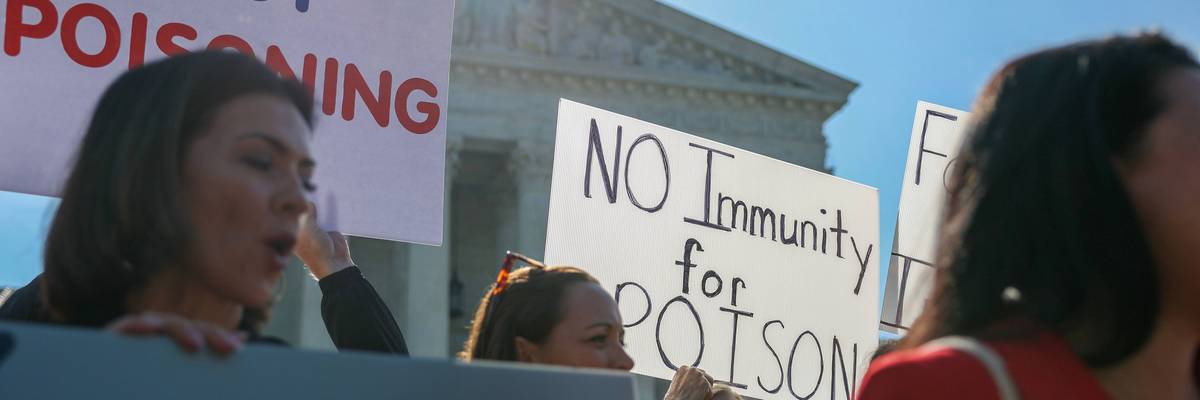
Protesters hold “The People v. the Poison” rally at the US Supreme Court in Washington, DC on April 27, 2026.
Support for stripping the pesticide provisions, said one advocate, "is proof that the Farm Bill should strengthen our food system, support farmers, and safeguard public health—not serve as a vehicle for corporate giveaways."
The diverse coalition opposed to a legislative "liability shield" for the pesticide industry celebrated on Thursday after the US House of Representatives stripped it out of the Farm, Food, and National Security Act of 2026—though progressive voices still sounded the alarm about the chamber's approval of the amended bill.
Dozens of Republicans and all but six Democrats backed Rep. Anna Paulina Luna's (R-Fla.) amendment targeting the protections for the pesticide industry. The 280-142 vote removed Sections 10205, 10206, and 10207 from the Farm Bill—which was later approved 224-200, with support from 14 Democrats and all but three Republicans.
"Major pesticide issues haven't been debated on the House floor in a very long time," said Jason Davidson, senior food and agriculture campaigner with Friends of the Earth US, in a statement. "For the people to win over the size, influence, and money of the pesticide industry is a remarkable display of grassroots power and a tremendous victory for Americans' ability to hold these companies accountable."
The House vote came just days after pesticide critics held "The People v. Poison" rally outside the US Supreme Court as the justices heard arguments in Monsanto Company v. Durnell, which is expected to have sweeping implications for cancer patients trying to take on the maker of the weedkiller Roundup, whose key active ingredient is glyphosate.
Bayer—which bought Monsanto in 2018—and the US Environmental Protection Agency insist glyphosate is safe, even though the World Health Organization’s International Agency for Research on Cancer classified it as a probable carcinogen to humans over a decade ago.
Despite President Donald Trump campaigning on a promise to "Make America Healthy Again," he has often served the pesticide industry, including by siding with Bayer in the case before the high court and signing a February executive order mandating production of glyphosate—a measure that also included a liability shield.
Sens. Martin Heinrich (D-NM) and Cory Booker (D-NJ) on Wednesday introduced the No Immunity for Glyphosate Act to reverse Trump's order. The bill's lead sponsors in the House, Reps. Thomas Massie (R-Ky.) and Chellie Pingree (D-Maine), were among those cheering the passage of Luna's amendment on Thursday.
"Industrial agriculture's pesticide addiction is poisoning America," declared Food and Water Watch senior food policy analyst Rebecca Wolf. "From the fields of Iowa to the halls of Congress, advocates have made our voices clear: Bayer's cruel Cancer Gag campaign has no place in our communities. US farm policy must support farmers and consumers, not the corporate overlords pulling the strings at our expense."
Wolf's group praised the defeat of the pesticide language but remains concerned about the EATS/Save Our Bacon Act, conservation cuts, and the Farm Bill's failure to reverse the so-called One Big Beautiful Bill Act's attack on the Supplemental Nutrition Assistance Program (SNAP).
"This Farm Bill has industry fingerprints all over it. By shrinking markets for high-welfare sustainable farmers, and doubling down on devastating cuts to federal food assistance, this pro-factory farm bill will do more harm than good," Wolf warned. "It's time to end the corporate power grab in Washington. This Farm Bill must be dead on arrival in the Senate."
Earthjustice Action legislative director of healthy communities Ranjani Prabhakar was also critical, arguing that "by passing this deeply flawed Farm Bill, House Republicans have doubled down on an approach that puts corporate polluters ahead of farmers, families, and our environment. This legislation weakens long-standing protections for endangered species and critical ecosystems and strips funding from conservation programs that help farmers combat climate change."
The "overwhelming support" for Luna's amendment, Prabhakar said, "is proof that the Farm Bill should strengthen our food system, support farmers, and safeguard public health—not serve as a vehicle for corporate giveaways. We urge the Senate to reject this harmful bill and work toward a solution that truly invests in resilient agriculture, healthy communities, and a sustainable future."
Progressive lawmakers also blasted the broader bill. Rep. Pramila Jayapal (D-Wash.) said that "the Farm Bill is a real opportunity to help farmers and Americans across this country. However, Republicans are using it as a shell to push through permanent cuts to food assistance, even as food prices continue to skyrocket."
"As we take food from hungry kids," she said, referring to SNAP cuts, "this bill also leaves American farmers without a lifeline after they have lost billions thanks to Trump's tariffs. At the end of the day, this bill will make more people hungry and does nothing to address the affordability crisis or struggling workers."
While welcoming that the legislation will no longer shield pesticide manufacturers from liability for their products, Jayapal charged that "today's Farm Bill is a further betrayal of the American people."
Dear Common Dreams reader, It’s been nearly 30 years since I co-founded Common Dreams with my late wife, Lina Newhouser. We had the radical notion that journalism should serve the public good, not corporate profits. It was clear to us from the outset what it would take to build such a project. No paid advertisements. No corporate sponsors. No millionaire publisher telling us what to think or do. Many people said we wouldn't last a year, but we proved those doubters wrong. Together with a tremendous team of journalists and dedicated staff, we built an independent media outlet free from the constraints of profits and corporate control. Our mission has always been simple: To inform. To inspire. To ignite change for the common good. Building Common Dreams was not easy. Our survival was never guaranteed. When you take on the most powerful forces—Wall Street greed, fossil fuel industry destruction, Big Tech lobbyists, and uber-rich oligarchs who have spent billions upon billions rigging the economy and democracy in their favor—the only bulwark you have is supporters who believe in your work. But here’s the urgent message from me today. It's never been this bad out there. And it's never been this hard to keep us going. At the very moment Common Dreams is most needed, the threats we face are intensifying. We need your support now more than ever. We don't accept corporate advertising and never will. We don't have a paywall because we don't think people should be blocked from critical news based on their ability to pay. Everything we do is funded by the donations of readers like you. When everyone does the little they can afford, we are strong. But if that support retreats or dries up, so do we. Will you donate now to make sure Common Dreams not only survives but thrives? —Craig Brown, Co-founder |
The diverse coalition opposed to a legislative "liability shield" for the pesticide industry celebrated on Thursday after the US House of Representatives stripped it out of the Farm, Food, and National Security Act of 2026—though progressive voices still sounded the alarm about the chamber's approval of the amended bill.
Dozens of Republicans and all but six Democrats backed Rep. Anna Paulina Luna's (R-Fla.) amendment targeting the protections for the pesticide industry. The 280-142 vote removed Sections 10205, 10206, and 10207 from the Farm Bill—which was later approved 224-200, with support from 14 Democrats and all but three Republicans.
"Major pesticide issues haven't been debated on the House floor in a very long time," said Jason Davidson, senior food and agriculture campaigner with Friends of the Earth US, in a statement. "For the people to win over the size, influence, and money of the pesticide industry is a remarkable display of grassroots power and a tremendous victory for Americans' ability to hold these companies accountable."
The House vote came just days after pesticide critics held "The People v. Poison" rally outside the US Supreme Court as the justices heard arguments in Monsanto Company v. Durnell, which is expected to have sweeping implications for cancer patients trying to take on the maker of the weedkiller Roundup, whose key active ingredient is glyphosate.
Bayer—which bought Monsanto in 2018—and the US Environmental Protection Agency insist glyphosate is safe, even though the World Health Organization’s International Agency for Research on Cancer classified it as a probable carcinogen to humans over a decade ago.
Despite President Donald Trump campaigning on a promise to "Make America Healthy Again," he has often served the pesticide industry, including by siding with Bayer in the case before the high court and signing a February executive order mandating production of glyphosate—a measure that also included a liability shield.
Sens. Martin Heinrich (D-NM) and Cory Booker (D-NJ) on Wednesday introduced the No Immunity for Glyphosate Act to reverse Trump's order. The bill's lead sponsors in the House, Reps. Thomas Massie (R-Ky.) and Chellie Pingree (D-Maine), were among those cheering the passage of Luna's amendment on Thursday.
"Industrial agriculture's pesticide addiction is poisoning America," declared Food and Water Watch senior food policy analyst Rebecca Wolf. "From the fields of Iowa to the halls of Congress, advocates have made our voices clear: Bayer's cruel Cancer Gag campaign has no place in our communities. US farm policy must support farmers and consumers, not the corporate overlords pulling the strings at our expense."
Wolf's group praised the defeat of the pesticide language but remains concerned about the EATS/Save Our Bacon Act, conservation cuts, and the Farm Bill's failure to reverse the so-called One Big Beautiful Bill Act's attack on the Supplemental Nutrition Assistance Program (SNAP).
"This Farm Bill has industry fingerprints all over it. By shrinking markets for high-welfare sustainable farmers, and doubling down on devastating cuts to federal food assistance, this pro-factory farm bill will do more harm than good," Wolf warned. "It's time to end the corporate power grab in Washington. This Farm Bill must be dead on arrival in the Senate."
Earthjustice Action legislative director of healthy communities Ranjani Prabhakar was also critical, arguing that "by passing this deeply flawed Farm Bill, House Republicans have doubled down on an approach that puts corporate polluters ahead of farmers, families, and our environment. This legislation weakens long-standing protections for endangered species and critical ecosystems and strips funding from conservation programs that help farmers combat climate change."
The "overwhelming support" for Luna's amendment, Prabhakar said, "is proof that the Farm Bill should strengthen our food system, support farmers, and safeguard public health—not serve as a vehicle for corporate giveaways. We urge the Senate to reject this harmful bill and work toward a solution that truly invests in resilient agriculture, healthy communities, and a sustainable future."
Progressive lawmakers also blasted the broader bill. Rep. Pramila Jayapal (D-Wash.) said that "the Farm Bill is a real opportunity to help farmers and Americans across this country. However, Republicans are using it as a shell to push through permanent cuts to food assistance, even as food prices continue to skyrocket."
"As we take food from hungry kids," she said, referring to SNAP cuts, "this bill also leaves American farmers without a lifeline after they have lost billions thanks to Trump's tariffs. At the end of the day, this bill will make more people hungry and does nothing to address the affordability crisis or struggling workers."
While welcoming that the legislation will no longer shield pesticide manufacturers from liability for their products, Jayapal charged that "today's Farm Bill is a further betrayal of the American people."
The diverse coalition opposed to a legislative "liability shield" for the pesticide industry celebrated on Thursday after the US House of Representatives stripped it out of the Farm, Food, and National Security Act of 2026—though progressive voices still sounded the alarm about the chamber's approval of the amended bill.
Dozens of Republicans and all but six Democrats backed Rep. Anna Paulina Luna's (R-Fla.) amendment targeting the protections for the pesticide industry. The 280-142 vote removed Sections 10205, 10206, and 10207 from the Farm Bill—which was later approved 224-200, with support from 14 Democrats and all but three Republicans.
"Major pesticide issues haven't been debated on the House floor in a very long time," said Jason Davidson, senior food and agriculture campaigner with Friends of the Earth US, in a statement. "For the people to win over the size, influence, and money of the pesticide industry is a remarkable display of grassroots power and a tremendous victory for Americans' ability to hold these companies accountable."
The House vote came just days after pesticide critics held "The People v. Poison" rally outside the US Supreme Court as the justices heard arguments in Monsanto Company v. Durnell, which is expected to have sweeping implications for cancer patients trying to take on the maker of the weedkiller Roundup, whose key active ingredient is glyphosate.
Bayer—which bought Monsanto in 2018—and the US Environmental Protection Agency insist glyphosate is safe, even though the World Health Organization’s International Agency for Research on Cancer classified it as a probable carcinogen to humans over a decade ago.
Despite President Donald Trump campaigning on a promise to "Make America Healthy Again," he has often served the pesticide industry, including by siding with Bayer in the case before the high court and signing a February executive order mandating production of glyphosate—a measure that also included a liability shield.
Sens. Martin Heinrich (D-NM) and Cory Booker (D-NJ) on Wednesday introduced the No Immunity for Glyphosate Act to reverse Trump's order. The bill's lead sponsors in the House, Reps. Thomas Massie (R-Ky.) and Chellie Pingree (D-Maine), were among those cheering the passage of Luna's amendment on Thursday.
"Industrial agriculture's pesticide addiction is poisoning America," declared Food and Water Watch senior food policy analyst Rebecca Wolf. "From the fields of Iowa to the halls of Congress, advocates have made our voices clear: Bayer's cruel Cancer Gag campaign has no place in our communities. US farm policy must support farmers and consumers, not the corporate overlords pulling the strings at our expense."
Wolf's group praised the defeat of the pesticide language but remains concerned about the EATS/Save Our Bacon Act, conservation cuts, and the Farm Bill's failure to reverse the so-called One Big Beautiful Bill Act's attack on the Supplemental Nutrition Assistance Program (SNAP).
"This Farm Bill has industry fingerprints all over it. By shrinking markets for high-welfare sustainable farmers, and doubling down on devastating cuts to federal food assistance, this pro-factory farm bill will do more harm than good," Wolf warned. "It's time to end the corporate power grab in Washington. This Farm Bill must be dead on arrival in the Senate."
Earthjustice Action legislative director of healthy communities Ranjani Prabhakar was also critical, arguing that "by passing this deeply flawed Farm Bill, House Republicans have doubled down on an approach that puts corporate polluters ahead of farmers, families, and our environment. This legislation weakens long-standing protections for endangered species and critical ecosystems and strips funding from conservation programs that help farmers combat climate change."
The "overwhelming support" for Luna's amendment, Prabhakar said, "is proof that the Farm Bill should strengthen our food system, support farmers, and safeguard public health—not serve as a vehicle for corporate giveaways. We urge the Senate to reject this harmful bill and work toward a solution that truly invests in resilient agriculture, healthy communities, and a sustainable future."
Progressive lawmakers also blasted the broader bill. Rep. Pramila Jayapal (D-Wash.) said that "the Farm Bill is a real opportunity to help farmers and Americans across this country. However, Republicans are using it as a shell to push through permanent cuts to food assistance, even as food prices continue to skyrocket."
"As we take food from hungry kids," she said, referring to SNAP cuts, "this bill also leaves American farmers without a lifeline after they have lost billions thanks to Trump's tariffs. At the end of the day, this bill will make more people hungry and does nothing to address the affordability crisis or struggling workers."
While welcoming that the legislation will no longer shield pesticide manufacturers from liability for their products, Jayapal charged that "today's Farm Bill is a further betrayal of the American people."

