SUBSCRIBE TO OUR FREE NEWSLETTER
Daily news & progressive opinion—funded by the people, not the corporations—delivered straight to your inbox.
5
#000000
#FFFFFF
To donate by check, phone, or other method, see our More Ways to Give page.
Daily news & progressive opinion—funded by the people, not the corporations—delivered straight to your inbox.
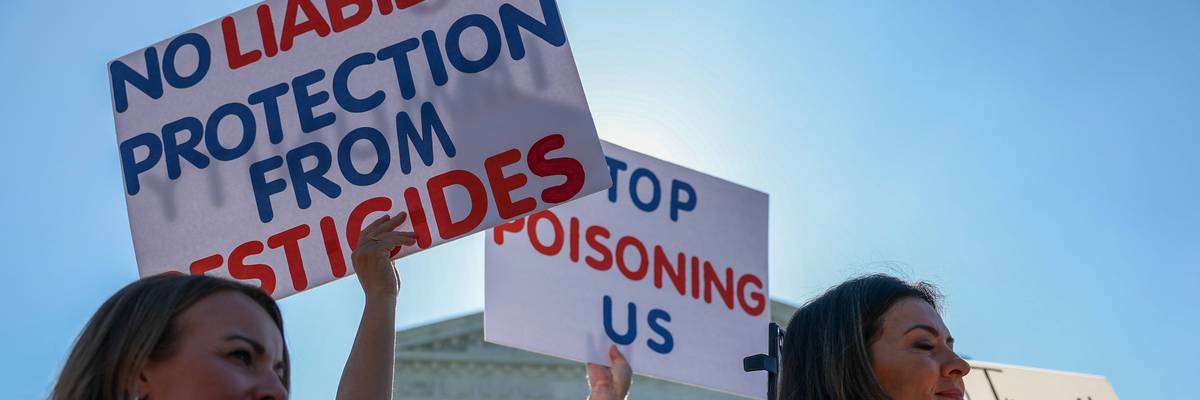
"The People vs the Poison" protesters gather at the US Supreme Court on April 27, 2026 in Washington, DC.
In a time with few points of consensus on the left and right, most Americans—a whopping 84% of adults—are worried about their exposure to harmful chemicals. Let's build on that for a safer country.
The Supreme Court recently ruled 7-2 that Monsanto, now owned by Bayer, could not be sued because the label of its product, the weed killer Roundup, didn’t mention that the herbicide could cause cancer. The ruling blocked thousands of lawsuits by cancer patients—protecting Bayer-Monsanto from liability for health consequences of exposure to agricultural chemicals—and led to headlines like “MAHA Rattled” and “MAHA Be Damned.”
After the Supreme Court decision and the Trump administration’s approval of two more “forever chemical” pesticides last month, it seems like the Make America Healthy Again agenda is being dropped. Despite what some on the left may think, this is not cause for celebration.
In a time with few points of consensus on the left and right, most Americans—a whopping 84% of adults—are worried about their exposure to harmful chemicals. Nearly as many want the government to do more to identify and regulate harmful chemicals. Regulating Roundup and other pesticides can bring together a new coalition of people across political lines. The left needs to be open to forming new alliances with people we don’t agree with on everything, including MAHA.
Reforming laws so that chemical manufacturers have to accept liability when their products cause harm is one space for bipartisan work. Most Americans don’t want companies like Monsanto-Bayer to be protected from lawsuits when they manufacture hazardous products that result in illnesses. Yet the Supreme Court’s decision does just that: It protects pesticide makers from bearing any consequences when people use their products, unaware of possible dangers of doing so, and later develop illnesses connected to pesticide use, like cancer.
Partnering on one topic while disagreeing on others is part of what politics is about.
Tobacco companies can be sued for the harms of lung cancer and addiction, an achievement after decades when companies were shielded from lawsuits. Pesticide companies should similarly be liable for the harms they knowingly create.
Corporate accountability should be something everyone can agree on. There are already moves toward collaboration in response to the Supreme Court decision. This spring, Democrats joined House Republicans Anna Paulina Luna (Fla.) and Thomas Massie (Ky.) in their push against pesticide liability shields. Then in June, two members of Congress from different political parties—Massie and Democrat Rep. Chellie Pingree (Maine)—proposed the People Over Poison Act, which restores the ability of consumers to hold pesticide makers accountable when they don’t warn us about the harms associated with their products, effectively undoing the Supreme Court decision.
Another possibility for collaboration is how chemicals like Roundup are assessed by the Environmental Protection Agency. When the EPA regulates pesticides, the approach requires scientific proof of harm in order to restrict a particular chemical. But we should shift the burden of proof onto chemical companies, as they do in Europe, by asking, “Has this chemical been proven safe?” instead of “has this chemical been proven harmful?”
In the EU, chemicals are regulated according to this approach, also known as the precautionary principle. Perhaps that explains why the US currently allows the use of 72 pesticides and herbicides banned in Europe (more than a quarter of all US pesticide use). A recent Newsweek poll found 89% of Americans (including 87% of Republicans) in favor of a ban on pesticides already banned in Europe. If Bayer-Monsanto wants to keep selling Roundup, they should have to meet this stronger burden of proof.
Those who want to limit Roundup face an uphill battle. Even in the EU, Glyphosate is licensed for use until 2033, and recent reporting shows how powerful lobbyists are putting pressure on the European Commission to delay EU targets to cut pesticide use. Just as in the US, a revolving door between industry and regulators, the influence of lobbyists, and ghostwritten and industry-funded science impact what chemicals get approved. Now, these same lobbyists—who also work for Bayer-Monsanto—want to dismantle Europe’s chemical license renewal process altogether, so new scientific evidence about health risks wouldn’t apply to these decisions. That similar dynamics keep glyphosate on the market in Europe is less a counterargument than another loophole that should be tightened.
Some are already seeing the usefulness of finding allies in unexpected places. For example, Indian eco-feminist Vandana Shiva does not align with MAHA moms in several respects, but she has been a longtime advocate of food sovereignty and a critic of chemical and seed companies that impact farmers in South Asia. Before the Supreme Court decision, Vandana Shiva protested alongside Robert F. Kennedy Jr. and MAHA activist “Glyphosate Girl.” She also co-founded a group called Mothers Across the World with Zen Honeycutt, a MAHA mom and fan of Turning Point USA. They might disagree about many things, but Shiva and Honeycutt have a shared cause in regulating chemicals like glyphosate.
Partnering on one topic while disagreeing on others is part of what politics is about. We would do well to embrace even strange bedfellows.
Dear Common Dreams reader, It’s been nearly 30 years since I co-founded Common Dreams with my late wife, Lina Newhouser. We had the radical notion that journalism should serve the public good, not corporate profits. It was clear to us from the outset what it would take to build such a project. No paid advertisements. No corporate sponsors. No millionaire publisher telling us what to think or do. Many people said we wouldn't last a year, but we proved those doubters wrong. Together with a tremendous team of journalists and dedicated staff, we built an independent media outlet free from the constraints of profits and corporate control. Our mission has always been simple: To inform. To inspire. To ignite change for the common good. Building Common Dreams was not easy. Our survival was never guaranteed. When you take on the most powerful forces—Wall Street greed, fossil fuel industry destruction, Big Tech lobbyists, and uber-rich oligarchs who have spent billions upon billions rigging the economy and democracy in their favor—the only bulwark you have is supporters who believe in your work. But here’s the urgent message from me today. It's never been this bad out there. And it's never been this hard to keep us going. At the very moment Common Dreams is most needed, the threats we face are intensifying. We need your support now more than ever. We don't accept corporate advertising and never will. We don't have a paywall because we don't think people should be blocked from critical news based on their ability to pay. Everything we do is funded by the donations of readers like you. When everyone does the little they can afford, we are strong. But if that support retreats or dries up, so do we. Will you donate now to make sure Common Dreams not only survives but thrives? —Craig Brown, Co-founder |
The Supreme Court recently ruled 7-2 that Monsanto, now owned by Bayer, could not be sued because the label of its product, the weed killer Roundup, didn’t mention that the herbicide could cause cancer. The ruling blocked thousands of lawsuits by cancer patients—protecting Bayer-Monsanto from liability for health consequences of exposure to agricultural chemicals—and led to headlines like “MAHA Rattled” and “MAHA Be Damned.”
After the Supreme Court decision and the Trump administration’s approval of two more “forever chemical” pesticides last month, it seems like the Make America Healthy Again agenda is being dropped. Despite what some on the left may think, this is not cause for celebration.
In a time with few points of consensus on the left and right, most Americans—a whopping 84% of adults—are worried about their exposure to harmful chemicals. Nearly as many want the government to do more to identify and regulate harmful chemicals. Regulating Roundup and other pesticides can bring together a new coalition of people across political lines. The left needs to be open to forming new alliances with people we don’t agree with on everything, including MAHA.
Reforming laws so that chemical manufacturers have to accept liability when their products cause harm is one space for bipartisan work. Most Americans don’t want companies like Monsanto-Bayer to be protected from lawsuits when they manufacture hazardous products that result in illnesses. Yet the Supreme Court’s decision does just that: It protects pesticide makers from bearing any consequences when people use their products, unaware of possible dangers of doing so, and later develop illnesses connected to pesticide use, like cancer.
Partnering on one topic while disagreeing on others is part of what politics is about.
Tobacco companies can be sued for the harms of lung cancer and addiction, an achievement after decades when companies were shielded from lawsuits. Pesticide companies should similarly be liable for the harms they knowingly create.
Corporate accountability should be something everyone can agree on. There are already moves toward collaboration in response to the Supreme Court decision. This spring, Democrats joined House Republicans Anna Paulina Luna (Fla.) and Thomas Massie (Ky.) in their push against pesticide liability shields. Then in June, two members of Congress from different political parties—Massie and Democrat Rep. Chellie Pingree (Maine)—proposed the People Over Poison Act, which restores the ability of consumers to hold pesticide makers accountable when they don’t warn us about the harms associated with their products, effectively undoing the Supreme Court decision.
Another possibility for collaboration is how chemicals like Roundup are assessed by the Environmental Protection Agency. When the EPA regulates pesticides, the approach requires scientific proof of harm in order to restrict a particular chemical. But we should shift the burden of proof onto chemical companies, as they do in Europe, by asking, “Has this chemical been proven safe?” instead of “has this chemical been proven harmful?”
In the EU, chemicals are regulated according to this approach, also known as the precautionary principle. Perhaps that explains why the US currently allows the use of 72 pesticides and herbicides banned in Europe (more than a quarter of all US pesticide use). A recent Newsweek poll found 89% of Americans (including 87% of Republicans) in favor of a ban on pesticides already banned in Europe. If Bayer-Monsanto wants to keep selling Roundup, they should have to meet this stronger burden of proof.
Those who want to limit Roundup face an uphill battle. Even in the EU, Glyphosate is licensed for use until 2033, and recent reporting shows how powerful lobbyists are putting pressure on the European Commission to delay EU targets to cut pesticide use. Just as in the US, a revolving door between industry and regulators, the influence of lobbyists, and ghostwritten and industry-funded science impact what chemicals get approved. Now, these same lobbyists—who also work for Bayer-Monsanto—want to dismantle Europe’s chemical license renewal process altogether, so new scientific evidence about health risks wouldn’t apply to these decisions. That similar dynamics keep glyphosate on the market in Europe is less a counterargument than another loophole that should be tightened.
Some are already seeing the usefulness of finding allies in unexpected places. For example, Indian eco-feminist Vandana Shiva does not align with MAHA moms in several respects, but she has been a longtime advocate of food sovereignty and a critic of chemical and seed companies that impact farmers in South Asia. Before the Supreme Court decision, Vandana Shiva protested alongside Robert F. Kennedy Jr. and MAHA activist “Glyphosate Girl.” She also co-founded a group called Mothers Across the World with Zen Honeycutt, a MAHA mom and fan of Turning Point USA. They might disagree about many things, but Shiva and Honeycutt have a shared cause in regulating chemicals like glyphosate.
Partnering on one topic while disagreeing on others is part of what politics is about. We would do well to embrace even strange bedfellows.
The Supreme Court recently ruled 7-2 that Monsanto, now owned by Bayer, could not be sued because the label of its product, the weed killer Roundup, didn’t mention that the herbicide could cause cancer. The ruling blocked thousands of lawsuits by cancer patients—protecting Bayer-Monsanto from liability for health consequences of exposure to agricultural chemicals—and led to headlines like “MAHA Rattled” and “MAHA Be Damned.”
After the Supreme Court decision and the Trump administration’s approval of two more “forever chemical” pesticides last month, it seems like the Make America Healthy Again agenda is being dropped. Despite what some on the left may think, this is not cause for celebration.
In a time with few points of consensus on the left and right, most Americans—a whopping 84% of adults—are worried about their exposure to harmful chemicals. Nearly as many want the government to do more to identify and regulate harmful chemicals. Regulating Roundup and other pesticides can bring together a new coalition of people across political lines. The left needs to be open to forming new alliances with people we don’t agree with on everything, including MAHA.
Reforming laws so that chemical manufacturers have to accept liability when their products cause harm is one space for bipartisan work. Most Americans don’t want companies like Monsanto-Bayer to be protected from lawsuits when they manufacture hazardous products that result in illnesses. Yet the Supreme Court’s decision does just that: It protects pesticide makers from bearing any consequences when people use their products, unaware of possible dangers of doing so, and later develop illnesses connected to pesticide use, like cancer.
Partnering on one topic while disagreeing on others is part of what politics is about.
Tobacco companies can be sued for the harms of lung cancer and addiction, an achievement after decades when companies were shielded from lawsuits. Pesticide companies should similarly be liable for the harms they knowingly create.
Corporate accountability should be something everyone can agree on. There are already moves toward collaboration in response to the Supreme Court decision. This spring, Democrats joined House Republicans Anna Paulina Luna (Fla.) and Thomas Massie (Ky.) in their push against pesticide liability shields. Then in June, two members of Congress from different political parties—Massie and Democrat Rep. Chellie Pingree (Maine)—proposed the People Over Poison Act, which restores the ability of consumers to hold pesticide makers accountable when they don’t warn us about the harms associated with their products, effectively undoing the Supreme Court decision.
Another possibility for collaboration is how chemicals like Roundup are assessed by the Environmental Protection Agency. When the EPA regulates pesticides, the approach requires scientific proof of harm in order to restrict a particular chemical. But we should shift the burden of proof onto chemical companies, as they do in Europe, by asking, “Has this chemical been proven safe?” instead of “has this chemical been proven harmful?”
In the EU, chemicals are regulated according to this approach, also known as the precautionary principle. Perhaps that explains why the US currently allows the use of 72 pesticides and herbicides banned in Europe (more than a quarter of all US pesticide use). A recent Newsweek poll found 89% of Americans (including 87% of Republicans) in favor of a ban on pesticides already banned in Europe. If Bayer-Monsanto wants to keep selling Roundup, they should have to meet this stronger burden of proof.
Those who want to limit Roundup face an uphill battle. Even in the EU, Glyphosate is licensed for use until 2033, and recent reporting shows how powerful lobbyists are putting pressure on the European Commission to delay EU targets to cut pesticide use. Just as in the US, a revolving door between industry and regulators, the influence of lobbyists, and ghostwritten and industry-funded science impact what chemicals get approved. Now, these same lobbyists—who also work for Bayer-Monsanto—want to dismantle Europe’s chemical license renewal process altogether, so new scientific evidence about health risks wouldn’t apply to these decisions. That similar dynamics keep glyphosate on the market in Europe is less a counterargument than another loophole that should be tightened.
Some are already seeing the usefulness of finding allies in unexpected places. For example, Indian eco-feminist Vandana Shiva does not align with MAHA moms in several respects, but she has been a longtime advocate of food sovereignty and a critic of chemical and seed companies that impact farmers in South Asia. Before the Supreme Court decision, Vandana Shiva protested alongside Robert F. Kennedy Jr. and MAHA activist “Glyphosate Girl.” She also co-founded a group called Mothers Across the World with Zen Honeycutt, a MAHA mom and fan of Turning Point USA. They might disagree about many things, but Shiva and Honeycutt have a shared cause in regulating chemicals like glyphosate.
Partnering on one topic while disagreeing on others is part of what politics is about. We would do well to embrace even strange bedfellows.