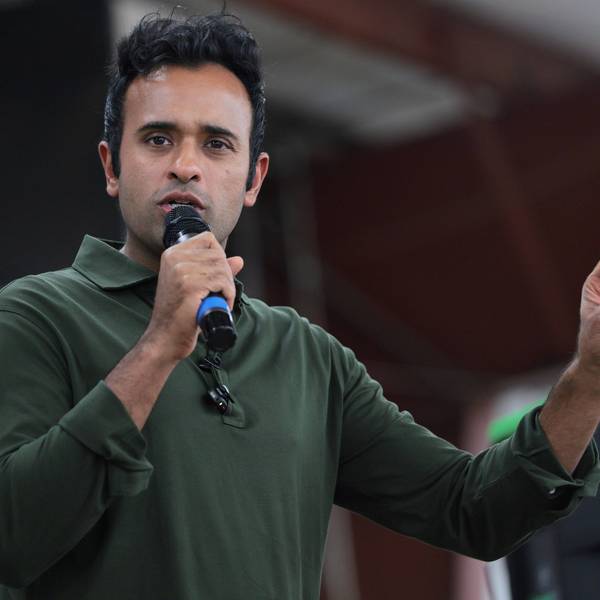

"The People v. Poison" protesters gather at the US Supreme Court on April 27, 2026 in Washington, DC.
Bayer Continues Push to 'Close the Door' on Glyphosate Victims at US Supreme Court
"Bayer is intent on preserving its right to harm at all costs—a pursuit the Trump administration is all too willing to endorse," said a Food and Water Watch campaigner.
As pesticide critics held a "The People v. Poison" rally outside the US Supreme Court on Monday, the justices heard arguments in Monsanto Company v. Durnell, a case whose conclusion is expected to have sweeping implications for cancer patients trying to take on the Roundup maker—now owned by Bayer—in the country's legal system.
The case stems from John Durnell's 2019 lawsuit against Monsanto in Missouri state court, alleging that exposure to the herbicide Roundup—whose active ingredient is glyphosate—caused his non-Hodgkin lymphoma, a type of blood cancer. A jury found that the company failed to warn users of the risks associated with the weedkiller, and awarded Durnell $1.25 million in damages.
Bayer argued before the Supreme Court on Monday that Durnell—and others like him—should not be able to bring such a suit because the Federal Insecticide, Fungicide, and Rodenticide Act preempts state rules for labeling pesticides when the Environmental Protection Agency doesn't require a cancer warning. Bayer and the EPA continue to insist that glyphosate is safe, despite the World Health Organization’s International Agency for Research on Cancer classifying it as probably carcinogenic to humans over a decade ago.
As The Associated Press and Reuters reported, the justices appeared "divided" on Monday, with the AP noting that several "seemed sympathetic to the company's argument that it can't be sued under state law because federal regulators have found Roundup likely doesn't cause cancer. Others, though, grilled attorneys about whether that wrongly stops states from responding to changing research."
Patti Goldman, senior attorney at Earthjustice—which filed an amicus brief in this case on behalf of farmworker organizations—said in a statement that "questions from the justices recognized that the Environmental Protection Agency approves pesticide labels based on the evidence before the agency at a single moment in time, but that evidence can become outdated as real-world exposure grows and scientific studies document resulting harms."
"Federal law requires the manufacturers to update their labels to provide sufficient warnings and directions to protect the public," Goldman stressed, "and state failure-to-warn claims reinforce that obligation—while ensuring children, families, and workers have a path to seek remedies for the harm they suffer."
Other groups that have submitted amicus briefs include Environmental Protection Network—which is made up of former EPA staffers—and the Center for Food Safety, one of the advocacy organizations that joined the rally outside the court. The event was also attended by members of Congress from both major political parties.
"This isn't left v. right—it's right v. wrong," said US Sen. Cory Booker (D-NJ). "Big corporations and their lobbyists have captured both parties, putting profits over our families' health. I've fought Monsanto and Bayer for years, and just filed an amicus brief to the Supreme Court to protect our right to sue them for illnesses caused by their products."
Despite President Donald Trump's campaign promise to "Make America Healthy Again," the Republican recently issued an executive order mandating the production of glyphosate, and the US Department of Justice has sided with Bayer in this case—part of a broader trend of his administration serving the pesticide industry's interests.
"Monsanto Company v. Durnell will have enormous consequences for environmental health litigation," Food and Water Watch legal director Tarah Heinzen said Monday. "Bayer is intent on preserving its right to harm at all costs—a pursuit the Trump administration is all too willing to endorse. This case threatens to close the courthouse doors to the many Americans harmed by pesticides."
Heinzen argued that "should the Supreme Court hold that the Environmental Protection Agency's failed pesticide regulatory scheme preempts state failure to warn lawsuits, leaving tens of thousands of sick Americans without legal recourse, Trump and his industry-dominated EPA will be to blame."
"This high stakes case should be a wake-up call for Congress to act," the campaigner added. "Industrial agriculture's pesticide addiction is poisoning America. Congress must pass the Pesticide Injury Accountability Act to safeguard access to justice for all harmed by toxic pesticides."
As The American Prospect noted Monday in its "three-part series on Bayer's crusade for immunity from Roundup-related cancer claims," the company "is now aggressively lobbying Congress to permanently close the door" on the weedkiller's victims, and managed to get an immunity provision included in the 2026 Farm Bill that advanced out of the US House Agriculture Committee last month.
After joining the rally at the Supreme Court on Monday, Friends of the Earth (FOE) US led a protest outside Bayer's headquarters in downtown Washington, DC, delivering hundreds of thousands of petition signatures are calling on the company to phase out the production of toxic pesticides, including glyphosate and neonicotinoids.
"People are sick and tired of being exposed to toxic pesticides while pesticide corporations shirk responsibility," said FOE senior campaigner Sarah Starman, who spoke at the rally. "Bayer and other pesticide companies should not be allowed to profit from chemicals that threaten our health, harm our environment, and undermine the future of our food system. The hundreds of people who rallied outside the Supreme Court and the 200,000 people who signed comments to Bayer are demanding change."
In the leadup to the arguments before the nation's top court, the Environmental Working Group last week sued the Trump administration at the US Court of Appeals for the District of Columbia Circuit, accusing the EPA of unlawfully delaying its response to an EWG petition seeking stronger restrictions on glyphosate.
"The EPA's silence leaves families in the dark and falls far short of its responsibility to protect public health," declared EWG president and co-founder Ken Cook. "It's time for the agency to stop stalling and do its job."We are at a crossroads
This country and this world are at a monumental crossroads. In a few short weeks, US voters will have an opportunity to beat back the forces of fascism and confront the billionaires who are rigging the economy, our media system, and our democracy, making it increasingly impossible for ordinary people to get by. We’re not just talking about the election. We’re talking about what must be done once these fascist elements are vanquished from power. We need a bolder set of solutions than what either major party has so far been willing to offer and a working-class movement ready to fight like hell for it. Trump didn't emerge from nowhere. The conditions that fueled MAGA authoritarianism were created by decades of radical neoliberal economic policies and a corrupt political system dominated by corporate interests. They slashed taxes on the super-rich, promising that the benefits would trickle down. They said giveaways to the corporate titans would make life more affordable for the rest of us. It was all bullshit. And when a bitter, betrayed populace searches for someone to blame, right-wing demagogues have little trouble finding scapegoats. People know when they're being lied to, but you won't hear any of this from the corporate media. Only independent journalism—powered and funded by people who believe in building a better world—can deliver truly trustworthy daily news. Our Fall Campaign is underway, and we need your help. To power our newsroom through the rest of the year, we need to raise $125,000 by midnight on October 31. So if you share our vision, please contribute whatever you can to sustain our work. |
As pesticide critics held a "The People v. Poison" rally outside the US Supreme Court on Monday, the justices heard arguments in Monsanto Company v. Durnell, a case whose conclusion is expected to have sweeping implications for cancer patients trying to take on the Roundup maker—now owned by Bayer—in the country's legal system.
The case stems from John Durnell's 2019 lawsuit against Monsanto in Missouri state court, alleging that exposure to the herbicide Roundup—whose active ingredient is glyphosate—caused his non-Hodgkin lymphoma, a type of blood cancer. A jury found that the company failed to warn users of the risks associated with the weedkiller, and awarded Durnell $1.25 million in damages.
Bayer argued before the Supreme Court on Monday that Durnell—and others like him—should not be able to bring such a suit because the Federal Insecticide, Fungicide, and Rodenticide Act preempts state rules for labeling pesticides when the Environmental Protection Agency doesn't require a cancer warning. Bayer and the EPA continue to insist that glyphosate is safe, despite the World Health Organization’s International Agency for Research on Cancer classifying it as probably carcinogenic to humans over a decade ago.
As The Associated Press and Reuters reported, the justices appeared "divided" on Monday, with the AP noting that several "seemed sympathetic to the company's argument that it can't be sued under state law because federal regulators have found Roundup likely doesn't cause cancer. Others, though, grilled attorneys about whether that wrongly stops states from responding to changing research."
Patti Goldman, senior attorney at Earthjustice—which filed an amicus brief in this case on behalf of farmworker organizations—said in a statement that "questions from the justices recognized that the Environmental Protection Agency approves pesticide labels based on the evidence before the agency at a single moment in time, but that evidence can become outdated as real-world exposure grows and scientific studies document resulting harms."
"Federal law requires the manufacturers to update their labels to provide sufficient warnings and directions to protect the public," Goldman stressed, "and state failure-to-warn claims reinforce that obligation—while ensuring children, families, and workers have a path to seek remedies for the harm they suffer."
Other groups that have submitted amicus briefs include Environmental Protection Network—which is made up of former EPA staffers—and the Center for Food Safety, one of the advocacy organizations that joined the rally outside the court. The event was also attended by members of Congress from both major political parties.
"This isn't left v. right—it's right v. wrong," said US Sen. Cory Booker (D-NJ). "Big corporations and their lobbyists have captured both parties, putting profits over our families' health. I've fought Monsanto and Bayer for years, and just filed an amicus brief to the Supreme Court to protect our right to sue them for illnesses caused by their products."
Despite President Donald Trump's campaign promise to "Make America Healthy Again," the Republican recently issued an executive order mandating the production of glyphosate, and the US Department of Justice has sided with Bayer in this case—part of a broader trend of his administration serving the pesticide industry's interests.
"Monsanto Company v. Durnell will have enormous consequences for environmental health litigation," Food and Water Watch legal director Tarah Heinzen said Monday. "Bayer is intent on preserving its right to harm at all costs—a pursuit the Trump administration is all too willing to endorse. This case threatens to close the courthouse doors to the many Americans harmed by pesticides."
Heinzen argued that "should the Supreme Court hold that the Environmental Protection Agency's failed pesticide regulatory scheme preempts state failure to warn lawsuits, leaving tens of thousands of sick Americans without legal recourse, Trump and his industry-dominated EPA will be to blame."
"This high stakes case should be a wake-up call for Congress to act," the campaigner added. "Industrial agriculture's pesticide addiction is poisoning America. Congress must pass the Pesticide Injury Accountability Act to safeguard access to justice for all harmed by toxic pesticides."
As The American Prospect noted Monday in its "three-part series on Bayer's crusade for immunity from Roundup-related cancer claims," the company "is now aggressively lobbying Congress to permanently close the door" on the weedkiller's victims, and managed to get an immunity provision included in the 2026 Farm Bill that advanced out of the US House Agriculture Committee last month.
After joining the rally at the Supreme Court on Monday, Friends of the Earth (FOE) US led a protest outside Bayer's headquarters in downtown Washington, DC, delivering hundreds of thousands of petition signatures are calling on the company to phase out the production of toxic pesticides, including glyphosate and neonicotinoids.
"People are sick and tired of being exposed to toxic pesticides while pesticide corporations shirk responsibility," said FOE senior campaigner Sarah Starman, who spoke at the rally. "Bayer and other pesticide companies should not be allowed to profit from chemicals that threaten our health, harm our environment, and undermine the future of our food system. The hundreds of people who rallied outside the Supreme Court and the 200,000 people who signed comments to Bayer are demanding change."
In the leadup to the arguments before the nation's top court, the Environmental Working Group last week sued the Trump administration at the US Court of Appeals for the District of Columbia Circuit, accusing the EPA of unlawfully delaying its response to an EWG petition seeking stronger restrictions on glyphosate.
"The EPA's silence leaves families in the dark and falls far short of its responsibility to protect public health," declared EWG president and co-founder Ken Cook. "It's time for the agency to stop stalling and do its job."- After Promising to 'Make America Healthy Again,' Trump Mandates Production of Cancer-Causing Glyphosate ›
- Citing Child Cancer Risk, Lawsuit Targets Trump EPA Over Glyphosate ›
- EPA Urged to Put Public Health Over Monsanto Profits by Banning Cancer-Linked Glyphosate ›
- Supreme Court Hearing Likely as 'Reckless' Bayer Loses Third Appeal Over Glyphosate Use ›
- Trump DOJ Sides With Roundup Manufacturer Over Cancer Victims in Supreme Court Case ›
- Heinrich, Booker Push 'No Immunity for Glyphosate' Bill as Supreme Court Weighs Monsanto Case | Common Dreams ›
- Despite Defeat of Pesticide Liability Shield, House Farm Bill Still 'Has Industry Fingerprints All Over It' | Common Dreams ›
- 'Trump's Name Written All Over It': Supreme Court Sides With Monsanto Over Roundup Cancer Victims | Common Dreams ›
- Opinion | Supreme Court's Monsanto Ruling Proves Trump Promise to 'Make America Healthy Again' Was a Farce | Common Dreams ›