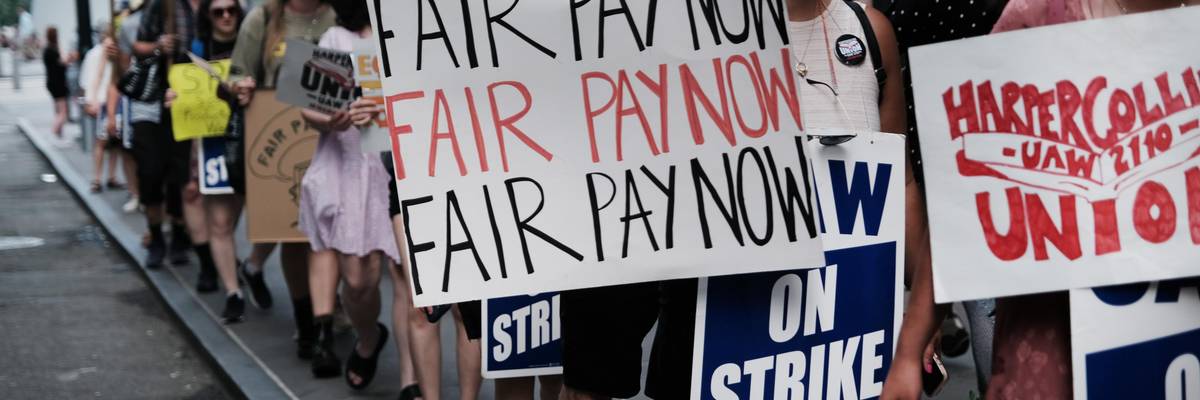
Employees of HarperCollins Publishers participate in a one-day strike outside the publishing houses offices in Manhattan on July 20, 2022 in New York City.
US Strike Activity Surged in 2022 as SCOTUS Workers' Rights Ruling Looms
"The right to strike is a critical source of worker power, but that right could be under further threat from the Supreme Court," warned one expert.
The number of U.S. workers who staged work stoppages in a wide array of industries in 2022 surged by nearly 50% from the previous year, new federal data shows—but the resolve among employees demanding fair pay after years without a raise, better working conditions, and paid sick leave may be under threat as the U.S. Supreme Court weighs a key labor case.
An analysis by three Economic Policy Institute (EPI) experts—Margaret Poydock, Jennifer Sherer, and Celine McNicholas—of data released Wednesday by the Bureau of Labor Statistics (BLS) showed that at least 120,600 U.S. workers were involved in major strikes in 2022, up from 80,700 in 2021.
EPI noted that a number of significant strikes went uncounted by the bureau, as the federal government does not track strikes involving fewer than 1,000 people, such as the three-month work stoppage staged by 250 union members at HarperCollins Publishers recently, which successfully secured bonuses and raises.
Between 2021 and 2022, union membership grew by 200,000 people, with 16 million workers represented by collective bargaining units, EPI's report showed. More Americans expressed approval of unions last year than they have in more than 50 years.
"Workers are turning to strikes to fight for better wages and working conditions, as well as union recognition," said Poydock. "This strike activity is occurring despite our broken labor law failing to adequately protect workers' fundamental right to strike."
As EPI noted, the internationally recognized human right to go on strike is guaranteed to most private sector workers in the U.S. under the National Labor Relations Act, but the law does not cover employees in the railway or airline industries, the public sector, agriculture, or in domestic work including home health aides and childcare workers.
Last month the Supreme Court heard oral arguments in Glacier Northwest, Inc. v. International Brotherhood of Teamsters—a case that could further weaken American workers' right to stage work stoppages to demand fair treatment from employers.
"Workers will face potential liability for any damages the employer deems to be related to the work stoppage. This would greatly limit workers ability to strike and would be a gross misinterpretation of the NLRA."
The case involves concrete company Glacier Northwest, which filed a lawsuit for damages after its truck drivers in Washington state, who are represented by the International Brotherhood of Teamsters Local 174, went on strike. The company claimed the work stoppage caused concrete to harden in trucks before it could be delivered, leaving Glacier Northwest with lost sales.
"The case centers on the question of whether an employer's suit for damages related to a strike is preempted by the NLRA, which governs the right to strike," Poydock, Sherer, and McNicholas in the EPI report, referring to the National Labor Relations Act. "In the Glacier case, the employer is arguing that, in spite of workers' attempts to protect the employer's property, the union is liable for damages related to the strike. If the Supreme Court is persuaded by this argument, it will upend decades of precedent surrounding the right to strike and leave workers with a significantly diminished ability to strike."
"Workers will face potential liability for any damages the employer deems to be related to the work stoppage. This would greatly limit workers ability to strike and would be a gross misinterpretation of the NLRA," they continued.
EPI said the case offers the latest reason for Congress to ensure that the right to unionize and strike is protected by passing the Protecting the Right to Organize (PRO) Act. The legislation would prohibit employers from permanently replacing workers who go on strike, eliminate a ban on secondary strikes, and allow intermittent strikes.
The group also called for the passage of the Striking Workers Healthcare Protection Act to prevent companies from retaliating against striking workers by cutting off their health coverage, as well as a number of state-level reforms.
Recent proposals in Massachusetts and Maine would extend the right to strike to public workers, and in Connecticut and Pennsylvania lawmakers have proposed allowing workers to collect unemployment benefits while on the picket line—"promising signs of growing state-level interest in shoring up workers' right to strike," EPI said.
We are at a crossroads
This country and this world are at a monumental crossroads. In a few short weeks, US voters will have an opportunity to beat back the forces of fascism and confront the billionaires who are rigging the economy, our media system, and our democracy, making it increasingly impossible for ordinary people to get by. We’re not just talking about the election. We’re talking about what must be done once these fascist elements are vanquished from power. We need a bolder set of solutions than what either major party has so far been willing to offer and a working-class movement ready to fight like hell for it. Trump didn't emerge from nowhere. The conditions that fueled MAGA authoritarianism were created by decades of radical neoliberal economic policies and a corrupt political system dominated by corporate interests. They slashed taxes on the super-rich, promising that the benefits would trickle down. They said giveaways to the corporate titans would make life more affordable for the rest of us. It was all bullshit. And when a bitter, betrayed populace searches for someone to blame, right-wing demagogues have little trouble finding scapegoats. People know when they're being lied to, but you won't hear any of this from the corporate media. Only independent journalism—powered and funded by people who believe in building a better world—can deliver truly trustworthy daily news. Our Fall Campaign is underway, and we need your help. To power our newsroom through the rest of the year, we need to raise $125,000 by midnight on October 31. So if you share our vision, please contribute whatever you can to sustain our work. |
The number of U.S. workers who staged work stoppages in a wide array of industries in 2022 surged by nearly 50% from the previous year, new federal data shows—but the resolve among employees demanding fair pay after years without a raise, better working conditions, and paid sick leave may be under threat as the U.S. Supreme Court weighs a key labor case.
An analysis by three Economic Policy Institute (EPI) experts—Margaret Poydock, Jennifer Sherer, and Celine McNicholas—of data released Wednesday by the Bureau of Labor Statistics (BLS) showed that at least 120,600 U.S. workers were involved in major strikes in 2022, up from 80,700 in 2021.
EPI noted that a number of significant strikes went uncounted by the bureau, as the federal government does not track strikes involving fewer than 1,000 people, such as the three-month work stoppage staged by 250 union members at HarperCollins Publishers recently, which successfully secured bonuses and raises.
Between 2021 and 2022, union membership grew by 200,000 people, with 16 million workers represented by collective bargaining units, EPI's report showed. More Americans expressed approval of unions last year than they have in more than 50 years.
"Workers are turning to strikes to fight for better wages and working conditions, as well as union recognition," said Poydock. "This strike activity is occurring despite our broken labor law failing to adequately protect workers' fundamental right to strike."
As EPI noted, the internationally recognized human right to go on strike is guaranteed to most private sector workers in the U.S. under the National Labor Relations Act, but the law does not cover employees in the railway or airline industries, the public sector, agriculture, or in domestic work including home health aides and childcare workers.
Last month the Supreme Court heard oral arguments in Glacier Northwest, Inc. v. International Brotherhood of Teamsters—a case that could further weaken American workers' right to stage work stoppages to demand fair treatment from employers.
"Workers will face potential liability for any damages the employer deems to be related to the work stoppage. This would greatly limit workers ability to strike and would be a gross misinterpretation of the NLRA."
The case involves concrete company Glacier Northwest, which filed a lawsuit for damages after its truck drivers in Washington state, who are represented by the International Brotherhood of Teamsters Local 174, went on strike. The company claimed the work stoppage caused concrete to harden in trucks before it could be delivered, leaving Glacier Northwest with lost sales.
"The case centers on the question of whether an employer's suit for damages related to a strike is preempted by the NLRA, which governs the right to strike," Poydock, Sherer, and McNicholas in the EPI report, referring to the National Labor Relations Act. "In the Glacier case, the employer is arguing that, in spite of workers' attempts to protect the employer's property, the union is liable for damages related to the strike. If the Supreme Court is persuaded by this argument, it will upend decades of precedent surrounding the right to strike and leave workers with a significantly diminished ability to strike."
"Workers will face potential liability for any damages the employer deems to be related to the work stoppage. This would greatly limit workers ability to strike and would be a gross misinterpretation of the NLRA," they continued.
EPI said the case offers the latest reason for Congress to ensure that the right to unionize and strike is protected by passing the Protecting the Right to Organize (PRO) Act. The legislation would prohibit employers from permanently replacing workers who go on strike, eliminate a ban on secondary strikes, and allow intermittent strikes.
The group also called for the passage of the Striking Workers Healthcare Protection Act to prevent companies from retaliating against striking workers by cutting off their health coverage, as well as a number of state-level reforms.
Recent proposals in Massachusetts and Maine would extend the right to strike to public workers, and in Connecticut and Pennsylvania lawmakers have proposed allowing workers to collect unemployment benefits while on the picket line—"promising signs of growing state-level interest in shoring up workers' right to strike," EPI said.
- These Supreme Court Cases Could Spell Final Doom for US Democracy ›
- Opinion | The Teamsters Show There’s (Still) Power in a Union | Common Dreams ›
- Opinion | Americans’ Approval of Unions Could Help Turn the Tide Against Inequality | Common Dreams ›
The number of U.S. workers who staged work stoppages in a wide array of industries in 2022 surged by nearly 50% from the previous year, new federal data shows—but the resolve among employees demanding fair pay after years without a raise, better working conditions, and paid sick leave may be under threat as the U.S. Supreme Court weighs a key labor case.
An analysis by three Economic Policy Institute (EPI) experts—Margaret Poydock, Jennifer Sherer, and Celine McNicholas—of data released Wednesday by the Bureau of Labor Statistics (BLS) showed that at least 120,600 U.S. workers were involved in major strikes in 2022, up from 80,700 in 2021.
EPI noted that a number of significant strikes went uncounted by the bureau, as the federal government does not track strikes involving fewer than 1,000 people, such as the three-month work stoppage staged by 250 union members at HarperCollins Publishers recently, which successfully secured bonuses and raises.
Between 2021 and 2022, union membership grew by 200,000 people, with 16 million workers represented by collective bargaining units, EPI's report showed. More Americans expressed approval of unions last year than they have in more than 50 years.
"Workers are turning to strikes to fight for better wages and working conditions, as well as union recognition," said Poydock. "This strike activity is occurring despite our broken labor law failing to adequately protect workers' fundamental right to strike."
As EPI noted, the internationally recognized human right to go on strike is guaranteed to most private sector workers in the U.S. under the National Labor Relations Act, but the law does not cover employees in the railway or airline industries, the public sector, agriculture, or in domestic work including home health aides and childcare workers.
Last month the Supreme Court heard oral arguments in Glacier Northwest, Inc. v. International Brotherhood of Teamsters—a case that could further weaken American workers' right to stage work stoppages to demand fair treatment from employers.
"Workers will face potential liability for any damages the employer deems to be related to the work stoppage. This would greatly limit workers ability to strike and would be a gross misinterpretation of the NLRA."
The case involves concrete company Glacier Northwest, which filed a lawsuit for damages after its truck drivers in Washington state, who are represented by the International Brotherhood of Teamsters Local 174, went on strike. The company claimed the work stoppage caused concrete to harden in trucks before it could be delivered, leaving Glacier Northwest with lost sales.
"The case centers on the question of whether an employer's suit for damages related to a strike is preempted by the NLRA, which governs the right to strike," Poydock, Sherer, and McNicholas in the EPI report, referring to the National Labor Relations Act. "In the Glacier case, the employer is arguing that, in spite of workers' attempts to protect the employer's property, the union is liable for damages related to the strike. If the Supreme Court is persuaded by this argument, it will upend decades of precedent surrounding the right to strike and leave workers with a significantly diminished ability to strike."
"Workers will face potential liability for any damages the employer deems to be related to the work stoppage. This would greatly limit workers ability to strike and would be a gross misinterpretation of the NLRA," they continued.
EPI said the case offers the latest reason for Congress to ensure that the right to unionize and strike is protected by passing the Protecting the Right to Organize (PRO) Act. The legislation would prohibit employers from permanently replacing workers who go on strike, eliminate a ban on secondary strikes, and allow intermittent strikes.
The group also called for the passage of the Striking Workers Healthcare Protection Act to prevent companies from retaliating against striking workers by cutting off their health coverage, as well as a number of state-level reforms.
Recent proposals in Massachusetts and Maine would extend the right to strike to public workers, and in Connecticut and Pennsylvania lawmakers have proposed allowing workers to collect unemployment benefits while on the picket line—"promising signs of growing state-level interest in shoring up workers' right to strike," EPI said.
- These Supreme Court Cases Could Spell Final Doom for US Democracy ›
- Opinion | The Teamsters Show There’s (Still) Power in a Union | Common Dreams ›
- Opinion | Americans’ Approval of Unions Could Help Turn the Tide Against Inequality | Common Dreams ›