

SUBSCRIBE TO OUR FREE NEWSLETTER
Daily news & progressive opinion—funded by the people, not the corporations—delivered straight to your inbox.
5
#000000
#FFFFFF
To donate by check, phone, or other method, see our More Ways to Give page.
Daily news & progressive opinion—funded by the people, not the corporations—delivered straight to your inbox.
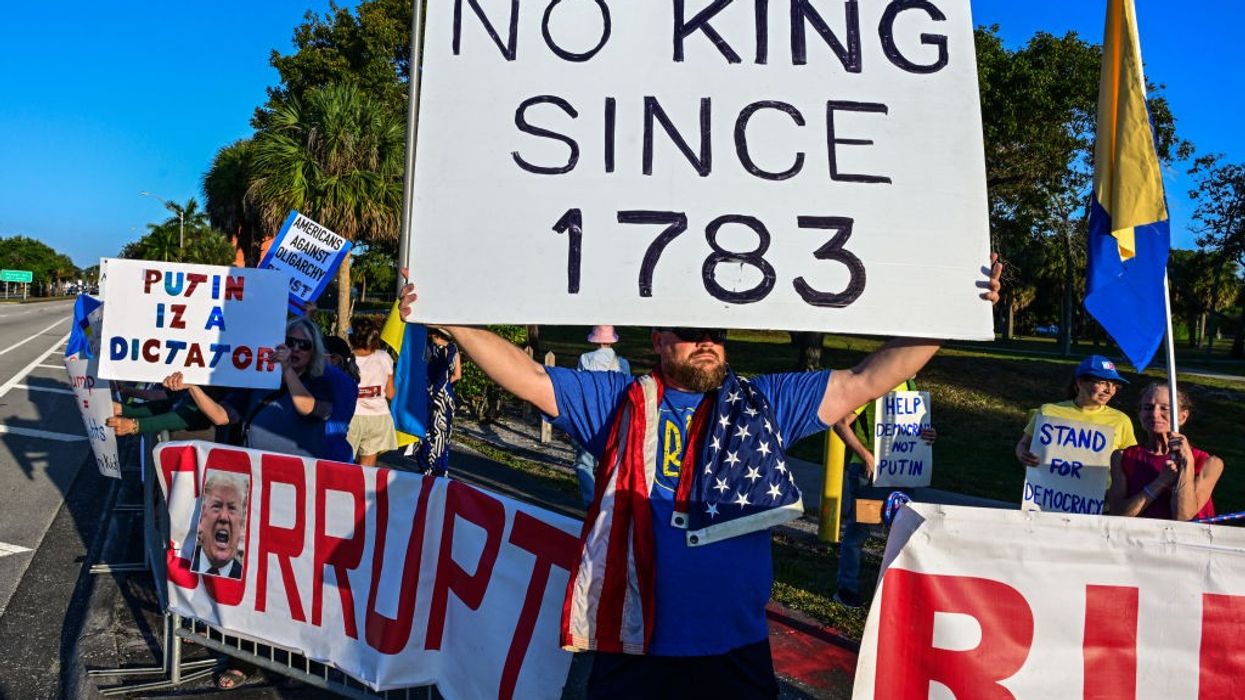
As we protest authoritarianism this Saturday—and legitimately condemn the many anti-democratic and unjust actions of Trump—let us also remember the tyranny of our corporate overlords who have been—perhaps more quietly but not less aggressively—eroding our democracy.
The “No Kings Day” mass rallies and marches this Saturday across the country will be, hopefully, a political and cultural affirmation of the democratic vision that we should be a self-governing people, a vision that has never been fully realized. The events must not only reject the reemergence and expansion of authoritarianism of Trump from his previous administration. They should also acknowledge the much longer tyranny and authoritarianism of corporate rule.
Speeches, signs, chants, and petitions will undoubtedly address the numerous authoritarian actions by the Trump administration since the election. These include pardons and immunities for loyalists, the use of federal agencies against political opponents, use of disinformation and threats against elected officials, mass deportations and family separation, executive orders that trump local and state governments, government loyalty purges, crackdown on the media and dissent, and militarized response to protests – such as the overreacting deployment of the Marines in response to the largely peaceful protests against ICE immigration raids in Los Angeles.
As we protest authoritarianism this Saturday—and legitimately condemn the many anti-democratic and unjust actions of Trump—let us also remember that tyranny has many symbols. One is a red hat. The other is a corporate logo.
The No Kings Day actions are just the latest and important public resistance to Trump’s tyrannical actions that have included other nationwide demonstrations and civil disobedience, legal challenges, whistleblowers and leaks, mutual aid, sanctuary networks, state and local government pushback, worker and union actions, and campus resistance.
Yet the reality is that Trump and his Project 2025 playbook represent one form of authoritarianism that, while distinct in some respects, intersects with another deeply entrenched form: corporate domination.
Unlike Trump’s style of blatant and unapologetic brute force, intimidation, and open defiance of the rule of law, corporate rule has been a slow, legalistic, never ending, and largely invisible seizure of power — not by individuals, but by artificial legal entities with little public accountability.
Corporations today define nearly every aspect of our lives:
How did this happen? The sword and shield of corporate rule is the U.S. Constitution. Despite corporate entities being originally created and defined by the government as a public tool to provide goods and services, the Supreme Court declared them to be private institutions, out of bounds to public definition and control. What had originally been the state providing mere “privileges” via the granting of charters or licences that could be withdrawn via the revoking of charters that violated the law became constitutional rights deemed beyond the reach of legislatures or individuals.
The Supremes have anointed corporations the constitutional rights of natural persons for more that a century, including:
Corporate “personhood” is an absurdity, yet humanly, environmentally, and democratically lethal.
While there have been frequent mass actions over single corporate abuses, we don’t see mass protests in the streets about the totality of corporate rule. Why does corporate tyranny go unchallenged?
Corporate rule has been normalized. It is:
Move to Amend exists to expose and abolish corporate constitutional rights and the doctrine of money as speech through the We the People Amendment (HJR54). This is not about regulating corporations better. It’s about breaking the illegitimate foundation of their power and declaring that we should have the power and right to define corporate actions.
As we protest authoritarianism this Saturday—and legitimately condemn the many anti-democratic and unjust actions of Trump—let us also remember that tyranny has many symbols. One is a red hat. The other is a corporate logo.
So let us all turn out on No Kings Day not only to oppose authoritarian rule, but also as an opportunity to oppose corporate rule, which will remain long after Trump is gone.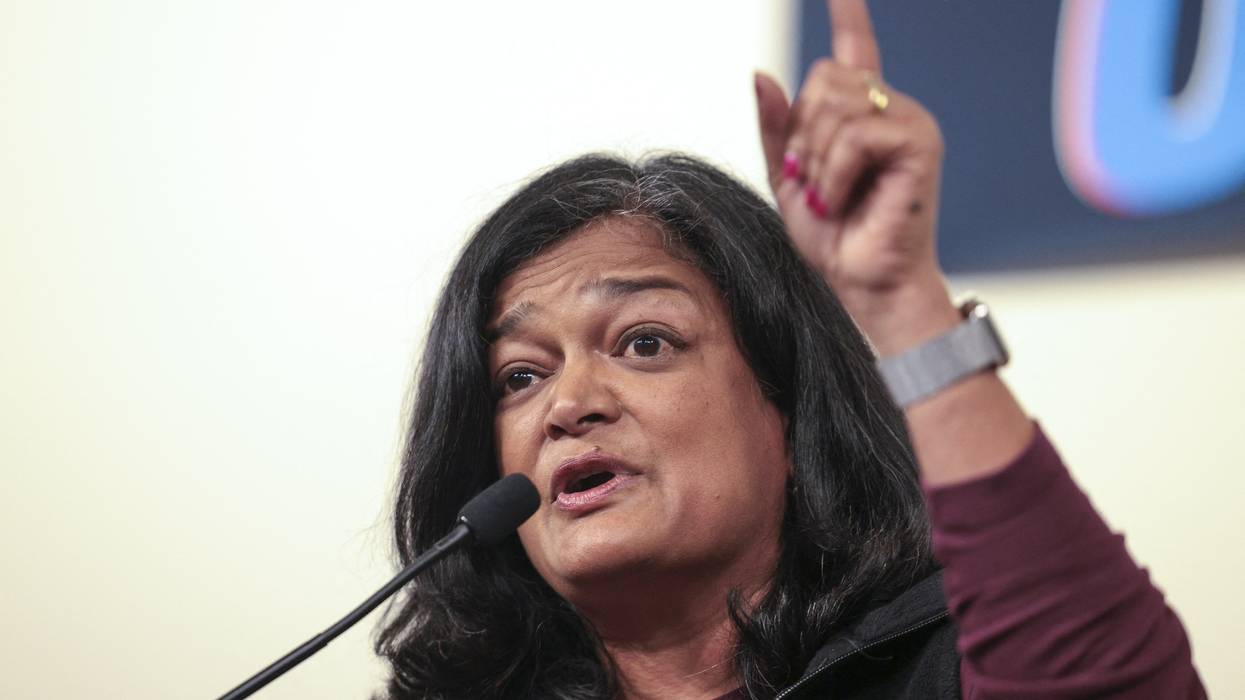
"In every election cycle since the disastrous Citizens United decision, we have seen more and more special interest dark money poured into campaigns across the country," said Rep. Pramila Jayapal.
With the impact of the 2010 U.S. Supreme Court decision in the Citizens United case becoming clearer by the day as billionaire megadonor Elon Musk spearheads the reshaping of the federal government, Congresswoman Pramila Jayapal on Thursday led more than two dozen Democratic lawmakers in introducing a constitutional amendment that would reverse the pivotal ruling.
The Washington Democrat has introduced the We the People Amendment in previous years, but she noted that this year she is proposing the measure after "a billionaire [paid] millions to buy a seat as Shadow President," referring to the more than $270 million Musk spent on President Donald Trump's campaign last year—an effort that promptly made him $170 billion richer and has resulted in new government contracts for his companies and his leadership of the so-called Department of Government Efficiency (DOGE).
"Corporations are not people and money is not speech," said Jayapal. "In every election cycle since the disastrous Citizens United decision, we have seen more and more special interest dark money poured into campaigns across the country... My We the People Amendment hands power back to the people by finally ending corporate constitutional rights, reversing Citizens United, and ensuring that our democracy is truly of the people, by the people, and for the people—not corporations."
The ruling in Citizens United v. Federal Election Commission struck down long-held rules on corporate "independent" spending that doesn't go directly to a candidate or political party, eliminating restrictions for money that flows to campaigns through super political action committees (PACs) which purport to be separate from candidates.
The We the People Amendment—which is not supported by any Republican lawmakers—would specify that constitutional rights apply to people, not corporations, "and that artificial entities have no constitutional rights," said Jayapal's office.
It would also mandate that federal, state, and local governments require public disclosure of all political contributions and expenditures.
As Brendan Fischer wrote at Rolling Stone last month, Musk's "astonishing influence over Trump and the Republican Party is not merely a function of his wealth, his celebrity, or his ownership of the social media platform X (formerly Twitter). It is attributable to his pouring of at least $277 million into super PACs last year, which purchased enormous influence."
Cole Bennett, legislative co-director of the advocacy group Move to Amend, applauded Jayapal's understanding "that the changes she and many of her colleagues support to advance healthcare, expand economic justice, ensure a livable world, and promote real democracy are incredibly difficult but necessary."
"This is especially true given the unjustifiable Supreme Court decisions declaring corporations as entities with many of the same constitutional rights as human persons and that money spent in elections is equivalent to First Amendment-protected free speech," said Bennett. "The exponential growth of corporate power and corrupting political influence from huge sums of money flooding elections can only be solved with a systemic solution that is equivalent in scale to these systemic problems—the We the People Amendment, which will end all corporate constitutional rights and money as free speech."
Most Americans don't realize it, but the United States didn't always have a President. From 1781 to 1789, the nation was governed by the Articles of Confederation, which due to fears about creating another king put all the power in the hands of the states. This quickly became unworkable, so the states called for the Philadelphia Convention, where they disposed of the Articles of Confederation and drafted the Constitution of the United States.
Yet the new document included a provision, Article V, stating that if two-thirds of the state legislatures agree, they can call another Constitutional Convention, where, like the original Philadelphia Convention, they can meet-up and create a new constitution.
That would be a hard sell to most Americans, but what if the convention was narrowly sold as a way to force those rascals in Washington, D.C., to live within their means and pass a Balanced Budget Amendment? Who's not concerned about the runaway national debt?
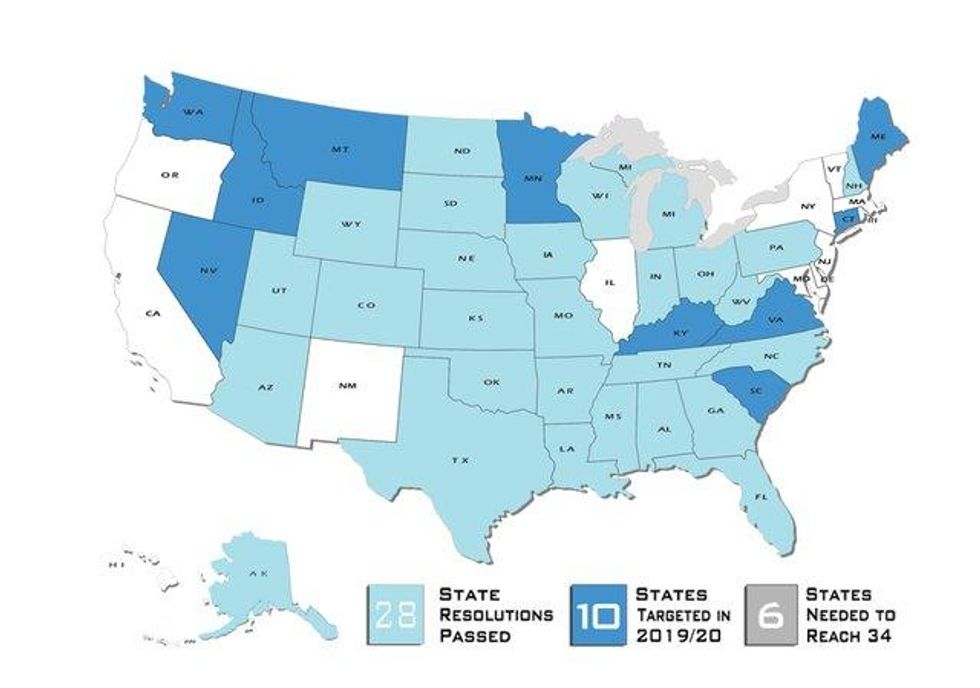
That's pretty much been the pitch of the awkwardly named Center for State-led National Debt Solutions (CSNDS), which in recent years, (thanks to some heavy lifting from the American Legislative Exchange Council), has quietly gotten twenty-eight of the thirty-four states necessary to sign-up under the auspices of passing a Balanced Budget Amendment (BBA).
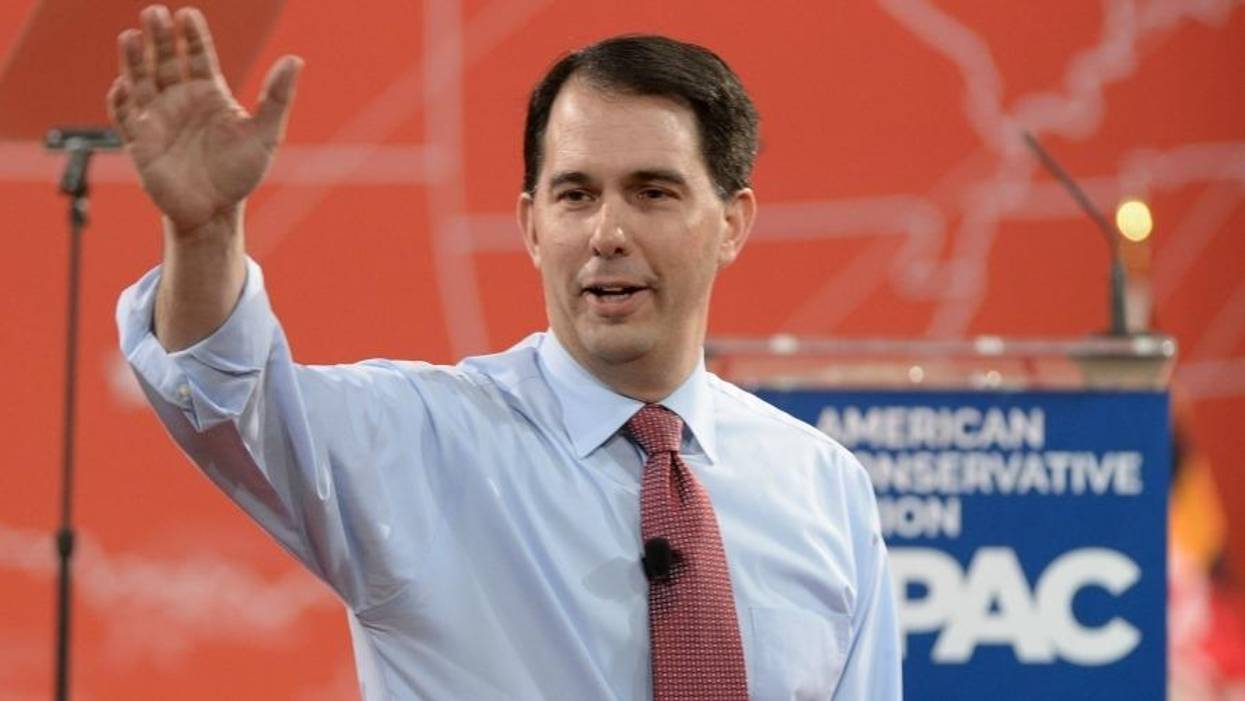
Last week, the group tapped former governor Scott Walker as its new leader.
Of the ten states that CSNDS, which in recent years has merged with the Balanced Budget Amendment Task Force, has targeted in 2019-20 (see map below), Republicans have full control of the state legislatures in five. In other words, the thirty-four-state threshold is very much in grasp.
Scott Rogers, who served as executive director for Task Force for a Balanced Budget Amendment for seven years, says his old organization is actually an elaborate bait-and-switch scheme that is hiding its true intentions, as its pick of Walker makes clear.
"The movement became less about reforming our nation's government, but a vehicle to limit and destroy the power of the federal government."
"Scott Walker isn't working for a balanced budget amendment and neither is the movement," Rogers tells The Progressive. "When I first became involved with the Article V movement, it was much more open to bipartisan efforts, and as a registered Democrat, I felt like I could work across the aisle to ensure a fiscally responsible government. However, as the years went on, the movement took a darker turn. It became less about reforming our nation's government, but a vehicle to limit and destroy the power of the federal government."
According to Rogers, "The movement is about using constitutional change to destroy the power of the federal government in the name of old-fashioned 'states rights.' This is nothing but a polished, media-friendly version of the 'states rights' advocated by southern racists in the 1960s."
Currently serving as the mayor of Charles Town, West Virginia, Rogers believes that once a convention commences, it will "enshrine the doctrines of the Koch Brothers, ALEC, and the religious right" and "endanger the civil rights we all hold dear. One could expect them to pass anti-LGBT amendments, amendments that would limit the ability of African-Americans to vote, the ability of woman to control their own reproductive health, and the list goes on and on."
Rogers says another part of the group's strategy to trigger a convention is to bring in people on the left with promises of a Constitutional amendment to overturn Citizens United and address other campaign-finance -reform concerns. Although campaign-finance-reform groups such as Common Cause and Democracy 21 are strongly opposed to a Constitutional Convention, other groups such as Move to Amend are open to a convention "with reservations," while Wolf PAC, the group founded by progressive activist Cenk Uygur, has voiced strong support.
"There has been a willingness by some of the conservative side to work together to get a Wolf PAC-Balanced Budget Amendment application passed in some states," Rogers said. "The idea is to appeal to liberals and conservatives, however, it disguises the true nature which is to get the BBA to thirty-four states, knowing that the Wolf Pack Citizens United Article V application has no chance to make it to thirty-four."
Wolf PAC, on its website, argues that the need for 75 percent state approval will ensure that only bipartisan and common-sense proposals get through. But Fred Wertheimer, former longtime head of Common Core and currently President of Democracy 21, calls that wishful thinking.
"Any Constitutional convention throws up for grabs all of the Constitutional rights and protections currently afforded to the American people," Wertheimer tells The Progressive. "We share the view of most legal scholars that once a Constitutional convention is called, you cannot limit the issues which the convention can consider."
"Once a Constitutional convention is called, you cannot limit the issues which the convention can consider."
Wertheimer adds that it is "unclear how ratification would work" in a convention setting. "Normally, you would need three-quarters of the states to ratify an amendment," he says. "But the convention could change the ratification rules by amendment and require, for example, a majority of states to ratify the amendments it adopts which, once approved, could supersede the three-quarters requirement."
These concerns echo those of the late Chief Justice Warren Berger, who said, "There is no way to effectively limit or muzzle the actions of a Constitutional Convention. The Convention could make its own rules and set its own agenda."
Here's the kicker: Just days after Scott Walker announced that he was the new head of CSNDS, he announced that he also would be working for a group whose primary focus is to defend Republican state legislatures that have gerrymandered their states.
In last fall's election in gerrymandered Wisconsin, under the contorted map Walker helped create, Republicans in the Assembly won 64 percent of the seats, despite winning only 46 percent of the votes for those seats.
And like many other gerrymandered states, these rigged legislatures would be the ones sending delegates to a Constitutional Convention. As Rogers aptly puts it, "This a slow-moving coup."
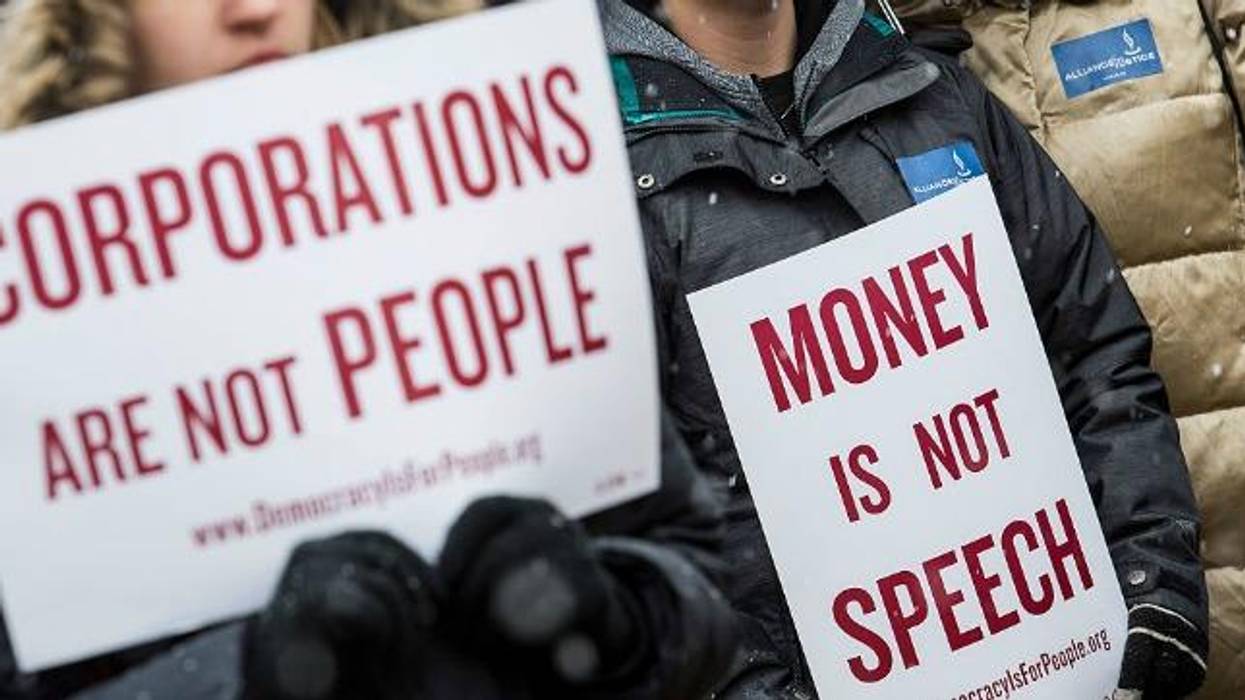
At first glance, the prominent political action committee End Citizens United (ECU) appears to be dedicated to channeling widespread grassroots anger at corporate money in politics into promoting candidates who reject cash from big business and support bold campaign finance reform.
But a closer look at the candidates ECU endorses and funds reveals that the organization frequently uses its vast resources to reinforce the poisonous status quo.
"A review of End Citizens United's campaign contributions shows a group that funds to the mainstream of the Democratic congressional caucus and is particularly supportive of the the more conservative and corporate-friendly members of the party."
--Donald Shaw, Sludge
In a detailed analysis of the ECU's recent endorsements, fundraising efforts, and campaign spending, Donald Shaw of Sludge--an outlet that covers political corruption--found that the group deploys "a large part of their campaign contributions to re-elect corporate-financed Democratic incumbents."
"Despite advocating for Democrats to reject corporate money, End Citizens United hasn't prioritized contributing to incumbents who make such pledges," Shaw writes. "A review of End Citizens United's campaign contributions shows a group that funds to the mainstream of the Democratic congressional caucus and is particularly supportive of the the more conservative and corporate-friendly members of the party."
An instructive example of ECU's preference for business-friendly Democrats was its decision to back 10-term incumbent and Wall Street favorite Rep. Joe Crowley (D-N.Y.) over democratic socialist Alexandria Ocasio-Cortez, who refused to take a dime of corporate money.
ECU--which was founded in 2015 by three former online fundraising specialists for the Democratic Congressional Campaign Committee (DCCC)--donated $5,000 to Crowley's campaign, joining the more than 250 corporate PAC's who gave to Crowley during the 2018 election cycle. The powerful House Democrat lost in a landslide to the 28-year-old progressive Ocasio-Cortez.
Additionally, Shaw notes, ECU "has helped to finance members of the Blue Dog Coalition, a conservative group of Democrats that prioritize working across the aisle with Republicans and often side with corporate interests on issues like financial deregulation, tax policy, and defense spending."
Since its inception, ECU has utilized aggressive fundraising tactics--renting email lists from media outlets like AlterNet and Mother Jones and sending up to seven fundraising pleas per day--to rake in millions in funds. Some of that money was then then given to corporate-friendly Democrats who are already flush with industry cash.
In an email to her group's supporters on Tuesday, Kaitlin Sopoci-Belknap, national director of Move to Amend--a grassroots organization that works to combat corporate influence in politics--wrote that ECU's tactics have harmed her organization's fundraising and outreach efforts, as the two organizations are frequently believed to be the same group.
"If their organization only supported candidates who firmly pledged no PAC money, their contributions could breathe much-needed life into grassroots campaigns. Instead it looks more like an intentional obfuscation."
--Cory Archibald, Brand New Congress
"Most of the time folks are frustrated about the onslaught, or confused about why we would suddenly back candidates instead of movement building, especially when those candidates are often not leaders in the movement to end Citizens United in Congress," Sopoci-Belknap noted. "So who exactly is this group anyway? How are they actually working to 'end' Citizens United?"
Citing Sludge's reporting, Sopoci-Belknap wrote "actions speak louder than words" and concluded that ECU is an "opportunistic organization that is raising big money on the promise of ending Citizens United, but is actually doing very little to support the broader movement for democracy."
Cory Archibald, a spokeswoman for the anti-corruption organization Brand New Congress, echoed Sopoci-Belknap's assessment in an interview with Sludge, arguing that ECU "looks like an attractive option" on the surface but utterly fails to live up to its promises in practice.
"If their organization only supported candidates who firmly pledged no PAC money, their contributions could breathe much-needed life into grassroots campaigns," Archibald concluded. "Instead it looks more like an intentional obfuscation."
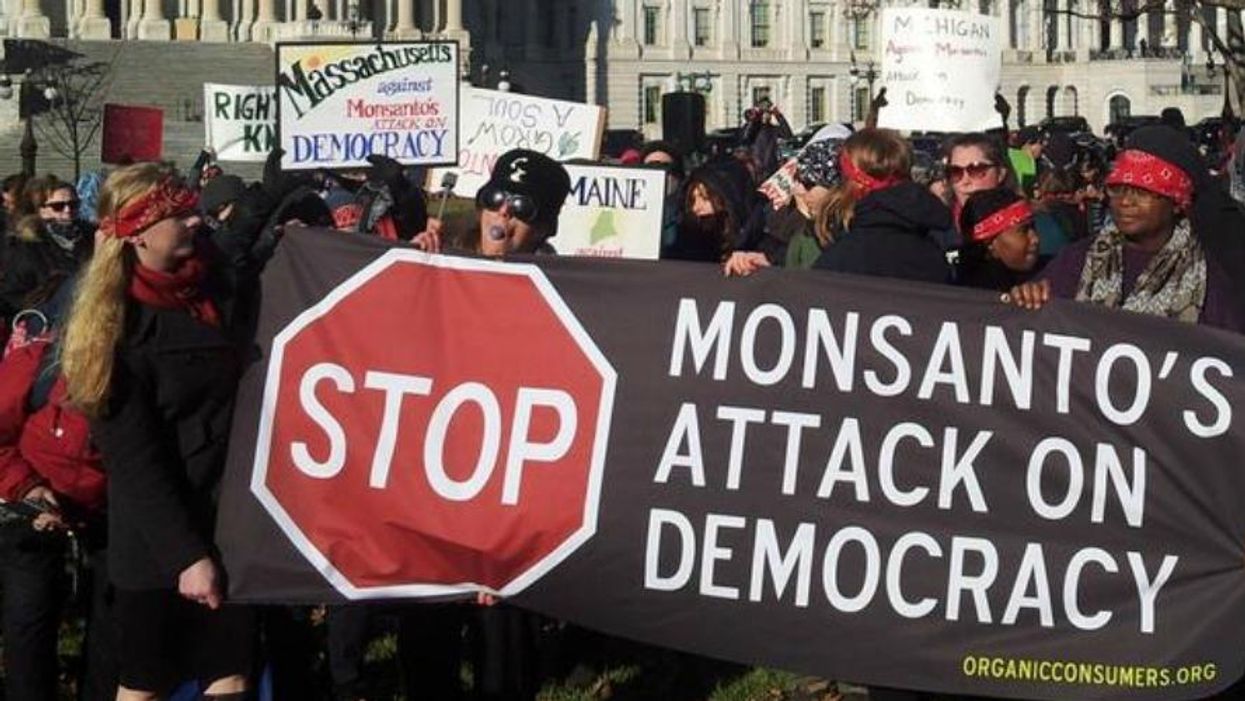
It's no secret that Monsanto Corporation's trademarked pesticide Ready Roundup has become one of the most widely used herbicides in agriculture since its introduction in the mid-1970s. What might be a surprise to most is that, according to the World Health Organization's (WHO) International Agency for Research on Cancer (IARC), glyphosate, the principal ingredient in the herbicide, is a "probable carcinogen." Acting to protect its public, as governments should do, the State of California required that food labels indicate the presence of glyphosate. Problem sorta solved... except for Monsanto's ill-gotten and ill-considered constitutional rights.
Obviously, Monsanto doesn't want the world to know that it is highly likely their product is a carcinogen, so Monsanto took California to court -- and won. Despite the IARC's findings, a U.S. District Judge has temporarily suspended the labeling of food products that contain traces of the herbicide, because it violates Monsanto's First Amendment "right not to speak".
"We are pleased Judge Shubb granted our request," said Chandler Goule, the chief executive officer for the National Assn. of Wheat Growers after the ruling. Goule went on to say that this is the first step in preventing California environmental officials "from forcing farmers, growers, and manufacturers to place false and misleading labels on agricultural products."
As long as we fail to fix the Constitution by establishing once and for all that human beings, not corporations like Monsanto, are entitled to constitutional rights, and that political money is not free speech, more corporate-funded shills will ascend to power to assert corporate interests over environmental sustainability and human wellbeing.
Back in 2015, when the WHO brought together 17 oncology experts from 11 countries to review the long-suspected link between glyphosate and kidney disease in farm workers, they concluded and published, that glyphosate is a "probable carcinogen." However, the WHO conclusion stirred an international controversy: European pesticide regulators and the U.S. Environmental Protection Agency alleged that contrary evidence was ignored or omitted.
It should come as no surprise that Monsanto also rejected the WHO's findings, which predicted the IARC would find carcinogens in its weed killer. Reminiscent of Big Tobacco and Big Oil companies' tactics, they set in motion a plan to discredit the international agency's study in order to continue selling their dangerous product. And thanks to its corporate constitutional rights and deep pockets, Monsanto found a willing shill in climate-change-denier and, ironically, the chairman of the House Science, Space, and Technology Committee: Rep. Lamar Smith (R-Texas).
Throughout his 32 years in Congress, Rep. Smith has received large monetary contributions from fossil fuel, automobile, and pharmaceutical/health industries, including Monsanto. Rep. Smith lashed out against the IARC during a hearing last February, accusing it of conducting "cherry-picked science" and even threatening retaliation by cutting off the U.S. contribution to the international agency. Such biased behavior has been a constant throughout his 5-year tenure as the science committee chairman, while Rep. Smith has made it his personal mission to relentlessly attack the integrity of individual scientists and the scientific community at large.
It is outrageous for an elected official to willingly jeopardize his constituents' health and safety to protect Monsanto's profits. Citizen backlash exploded; thousands expressed their anger online as a petition to tell Congress not to defund cancer research had reached over 42,800 signatures. After 16 terms of loyally supporting his campaign contributors, Smith announced last year that he won't seek re-election when his term ends in 2018.
The congressman's departure may be good riddance, but the root problem does not lie with any individual political figure or party. It lies with the Supreme Court's interpretation of constitutional "personhood." As long as we fail to fix the Constitution by establishing once and for all that human beings, not corporations like Monsanto, are entitled to constitutional rights, and that political money is not free speech, more corporate-funded shills will ascend to power to assert corporate interests over environmental sustainability and human wellbeing.
To prevent this cancerous process from metastasizing, take action now! Join the hundreds of organizations and over 450,000 individuals all across the nation working with the [Move to Amend to pass the We the People Amendment. It is the only amendment bill before Congress that will address both doctrines undermining democratic self-governance: money as speech and corporate constitutional rights. It's high time to demand government serves We the People, not corporate donors. Sign the petition at: MoveToAmend.org/motion.
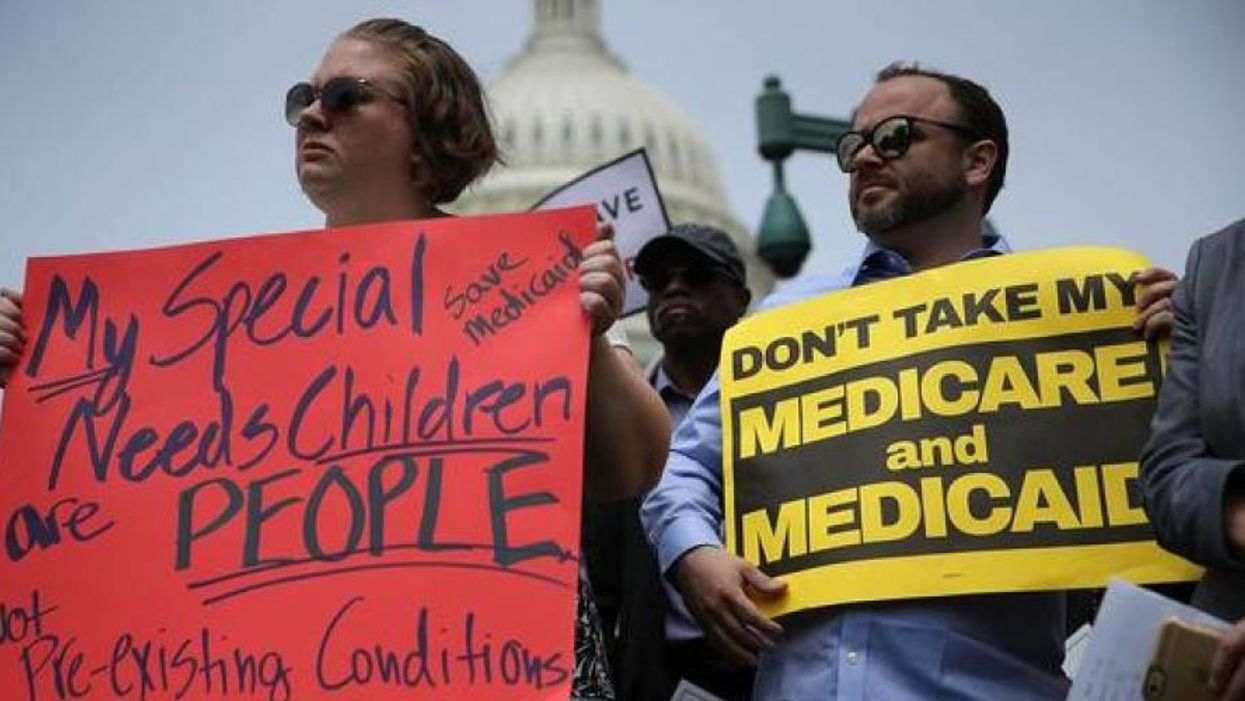
Every year at this time, US taxpayers (who bother to read news) are treated to a parade of stories about taxes and tax policy. We learn about the citizens who work multiple jobs and pay their taxes, while falling farther and farther behind in an economy that clearly exists to redistribute wealth upwards. We also learn about corporations, the real "welfare queens," which have used the courts and legislatures to legally avoid paying their fair share of taxes, while demanding subsidies, tax breaks, and the dismantling of labor unions.
Under the current administration, we are witnessing the deathblows to the economic and social policies of the New Deal, FDR's plan to save capitalism after the Crash of 29, which created the greatest economic expansion in the world, and with it the largest expansion of civil rights in US history. Tax policy was a core element of this transformation. After a false start or two, the New Deal became wildly successful. Besides the implementation of Social Security through a payroll tax structure, he raised taxes on the highest brackets and decreased or eliminated them on the lowest. He also adopted new monetary policy; FDR moved the US to fiat currency and running deficits. It worked for a long time.
The Korean War, the Vietnam War, and the Cold War had their effects and by the 70's a huge deficit combined with inflation, stagflation, and unemployment created an opening for new economic policy. Rather than build off the New Deals' successes, it was discarded in favor of neoliberalism--austerity and a quickened redistribution of wealth upwards--beginning with the 1980 election of Ronald Reagan. The deficit has exploded while federal tax percentages have fluctuated downward ever since; lack of tax revenue coupled with federal spending cuts have historically and meaningfully contributed to growing deficits.
Where has all that money gone? With the tech and mortgage crashes, hundreds of billions just evaporated into the thin air from which it was created, yet the vast majority of it landed in the pockets of the 1% and their corporations: the self-appointed, "deserving" beneficiaries of this nation's wealth--and the peoples labor. No benefit was recognized for most taxpayers as state and local governments either increased sales, income, property, gasoline, and/or energy taxes, along with a host of other fees, or cut spending on programs of social uplift (or a combination of the two) to offset federal funding cuts to education, and health and human services.
The biggest beneficiaries of tax cuts have always been the 1% and their corporations, and the latest tax reform is no different. It is expected to hit low-income people the hardest unless states take immediate action to protect their most vulnerable citizens. Not the 99%, not our communities, not even our states benefit more from the new reform than the 1% and their corporations. Charities are also expected to take a huge hit, which spells bad news for advocacy groups and the people they assist. We are witnessing an economic theory beyond neoliberalism, even capitalism itself, fascism American-style.
Some of the money our craven aforementioned beneficiaries save in taxes is spent to elect lackeys who will legislate more tax breaks and spending cuts, schmooze officials who will deregulate their industries, and exploit our airwaves to disseminate false news and information so the majority of voters will just get in line for fear of losing everything.
Logic, common sense, street smarts, whatever you want to call it, any thinking person can look around and tell you that corporations aren't people and that spending money buying media is a helluva lot different than free political speech. But our Constitution says different, thanks to decades of corporations and their owners chipping away at it through litigation and legislation, making legal--making real--the corporate person with human rights. Corporate First Amendment rights are just the tip of the blade the 1% are wielding to destroy our democracy and secure their wealth, for generations to come. The corporation, a "legal fiction," also has 4th, 5th, 7th and 14th Amendment rights along with a special rights carved out in the Commerce clause.
When a judge peers over the bench, he sees the corporate charter as a person with constitutional rights, pretty much the same as you or me. There is no distinction between flesh and paper, blood and ink, animation or object, mortality and immortality. The only way to correct his vision, and the vision of our elected officials, is to legally establish that corporations are not people with constitutional rights, and that money is not protected political speech and can be regulated in campaigns. Corporations can flourish governed by state sanctioned privileges, as they did before they got greedy and started rewriting our Constitution, over 130 years ago. Please join me as a signatory on the Motion to Amend and show your support for House Joint Resolution 48 in Congress, the We the People Amendment. (If you're really ready to roll your sleeves up, join me in person for the Move to Amend National Leadership Summit in June!)
As I sit here, trying to finish my tax returns, it is a gross understatement to say I am outraged. I was raised to believe that taxes are the price you pay to enjoy the benefits of being American. However, the benefits of being anything other than a rich, white, male member of the corporation-owning 1% are diminishing at an alarming rate. If we the people don't embrace our Revolutionary DNA, come together, stand up and demand what is rightfully ours--a government that works for all of us--then the American experiment in democracy will slowly die by a thousand tax cuts.
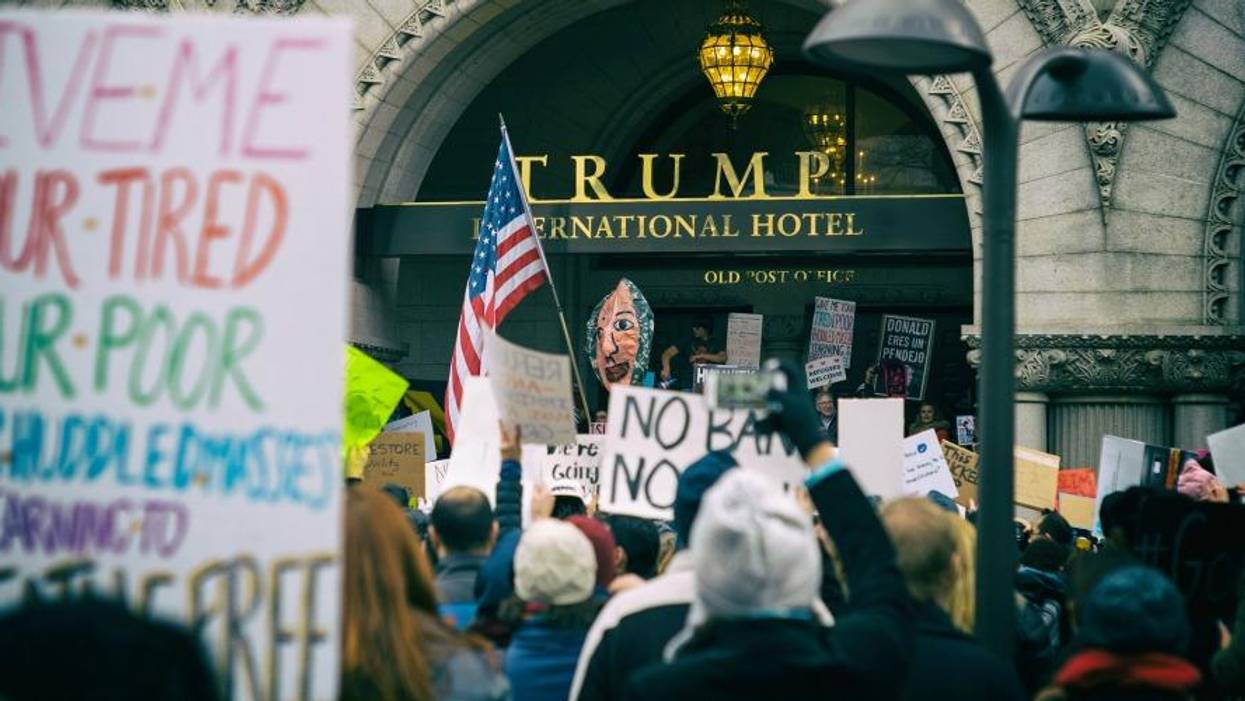
When the US Supreme Court decided in favor of the plaintiff in the Citizens United case on January 21, 2010, did the five justices who supported it know that their decision would open the door to a fascist state within six short years? In large part, Citizens United caused a minority of voters, aided by the Electoral College, to elect a real live major international corporation in the form of Donald Trump as President. The fusion of government and corporate rule is complete.
Chief Justice John G. Roberts, Justices Antonin G. Scalia, Samuel A. Alito, and Clarence Thomas joined Justice Anthony M. Kennedy, who wrote for the majority. They claimed there was no evidence that 'independent' money influences and corrupts the electoral process." In all their judicial wisdom, somehow they did not foresee at the time what the other four Justices and a large majority of Americans from both parties saw: the potential merger of our government with U.S. corporations.
Trump has gone on to appoint the most corporate administration ever. Nearly 70% of Trump's appointments have corporate ties, and his entire cabinet is mostly unqualified and unsuited for, or in opposition to, the department they head. Plainly put, these corporatists are in position to destroy the very departments that exist to protect We the People and the economy and environment on which our livelihoods depend.
We the People have been struggling under Corporate Rule for some time. Nowhere is it more apparent than in our electoral process, already corrupted before Citizens United, as CEO's, board members, and major shareholders flooded the process with direct and indirect donations, individual and bundled, to campaigns, parties, and PACs, far outspending what the ordinary citizen could afford. Citizens United put an end to the charade and lifted most corporate regulations governing the independent spending of money in elections. It lowered the bridge over the moat, and allowed the marauders unfettered access to the citadel of American democracy: our elections.
History will most definitely repeat itself when profit for a few outweighs economic wellbeing for the many. The U.S. is currently embroiled in another Gilded Age, where corporations, instead of bought-off politicians, are actually running the place. Mark Twain is credited for coining the term "Gilded Age," a truly ironic turn. Perhaps the most famous of American populists, Twain possessed an abiding love and faith in this country and his fellow Americans, while taking every opportunity to skewer government. He famously said these words: "Patriotism is supporting your country all the time, and your government when it deserves it." We the People are near the point where we must collectively decide to withdraw our consent to be governed, or allow the current fascist government to roll right over us and every last bit of our tattered democracy. We are exactly where our predecessors were during the first Gilded Age: the 1% playing us against ourselves, while robbing us blind.
The first Gilded Age produced Robber Barons and Rebels. Their "Robber Barons" are our 1%, and still include names like (J.P.) Morgan, Carnegie, Mellon, and Rockefeller, who got exceedingly rich by exploiting people and the rule of law. Practical and obvious solutions, like Medicare for All, a green sustainable economy, and a guaranteed annual income are impossible because they reduce profits for the same few, despite causing great expense, harm and death to the many, without their enactment.
Since the beginning of the Gilded Age, corporations have been using the courts to assume constitutional human rights, which enabled their dominance then and a modern fascist state now. The 1886 Santa Clara County V Southern Pacific Railroad case gave corporations their first human right: equal protection under the law. (Women would fight and shed blood to obtain that right for the next 34 years.) From that point forward, corporations have been rewriting sections of the U.S. and state constitutions to gain constitutional rights meant for human beings, and other rights -- like immortality -- which no human being could possibly assert.
It's important to recognize that the affirmation of "corporate personhood" in Citizens United is far more damaging than granting them the single right to speak in elections. Since that ruling, the Hobby Lobby case imbued for-profit corporations with an additional, although narrow, First Amendment right to religious belief, undermining the separation of church and state. A clear pattern exists: corporations and their lawyers chipping away at the Constitution, bit by little bit, gaining more rights and undermining those of actual living, breathing individual people.
The recent tax reform package signed into law by a president purporting to make America great again and opposed by a huge majority of voters, is a prime example of what happens when corporations rule. The reform package provides a little temporary tax relief to some working Americans. The bulk of benefits go to corporations and their major shareholders (the 1%) in the form of permanent tax cuts, purposely driving the nation into astronomical debt. Cuts to public assistance programs and earned benefits like Social Security and Medicare cannot be far behind when it comes time to reconcile the budget. The inequality gap widens.
Many organizations and certain Democrats are calling to overturn Citizens United, which will only take us back in time to 2009, when corporations already possessed other First, Fourth, and Fifth Amendment rights along with the Holy Grail of human rights, the aforementioned 14th Amendment - the right to equal protection under the law.
As long as corporations don't die and are recognized as people with 14th amendment rights, addressing campaign spending will not fix the problem in the long run. The only constitutional remedy is to abolish corporate constitutional rights all together and replace them with a set of clearly articulated privileges, which enable them to conduct business in a secure and stable environment while protecting the public welfare.
The We the People Amendment, now before Congress, does exactly that, and it is the only amendment to completely overturn Citizens United and all rulings imbuing corporations with constitutional human rights.
It's difficult to compare current conditions in the country to conditions one hundred years ago, and not ask ourselves, "What are We the People going to do about this, and what specifically am I going to do?" Our predecessors were already fully engaged in the struggle and reaching millions of Americans (without the Internet). We have technology they never dreamed of to help us organize, but do we have the will, resilience, and presence of mind and body to take what is rightfully ours: our own government? Alice Walker had it right when she said, "We are the ones we have been waiting for."
The "Rebels" of the Gilded Age were progressive populists, who self organized and built power. The Progressive Era is characterized by solidarity organizing across the producing class (those who labor to produce) through direct assistance, action, and electoral organizing, resulting in the formation of the People's Party. Although co-opted by the Democratic Party, a wave of legislation embracing the Peoples' Party platform passed, positively impacting the lives of most workers (overwhelmingly white) and opened the door to the creation of the middle class (overwhelmingly white). We may be living in a fascist state, but we still have many tools of democracy at our disposal. Like our progressive predecessors, it's time to pick them up, start organizing for power, pass the We the People Amendment, and build a real transformative democracy where every single person is a recognized person under the Constitution with full voice, equal rights and a real chance at equity.
There are many fronts of resistance happening right now, which are all elements of a burgeoning democracy movement. From Occupy and the North Dakota Water Protectors to Black Lives Matter and The Dreamers, single issue movements are ebbing and flowing. The Trump Presidency has caused economic, environmental, and social justice advocates to organize more frantically than ever. Organizations like Liberty Tree, Move to Amend, and the US Social Forum, to name only a few, are building the democracy movement from the ground up by providing tools, educational materials, actions, and resources to practice and create solidarity, equality, and eventually a real democracy. Resistance is important, but it must include an alternative to the status quo.
If We the People are truly going to carry on with the great American experiment in democracy and self-governance, we must learn from the Populists, who failed to find common ground with communities of color. Corporate rule is the common feature of almost all issues of concern to We the People, no matter what demographic we may fall in. By joining those on the frontlines of oppression to fight corporate rule as it plays out in both urban and rural areas -- in common cause -- we can achieve what the populists couldn't: solidarity and a chance at authentic democracy that works for the benefit of We the People, not Robber Barons and the 1%.
It's no mistake that most Americans are at a loss as to what they should do next. Far too many of us have been taught that casting a ballot is the only necessary participation in a democracy. Even if that were true, consider how the political parties have maneuvered to protect themselves and their donors; there is absolutely no way in the current moment to vote ourselves out of this mess. Corporations have been intentionally changing the rules of the game for the last fourteen decades, so that no matter who wins, the people lose. The fix is in; citizens/patriots need to be creative and intentional in the way we move forward.
Just as it was for the American Revolutionaries, the Abolitionists, the Populists, and the Suffragists before us, the moment for We the People to non-violently rise up is upon us. This, too, is a war for the heart and soul of this nation - -an ideological showdown of immense proportions. Will we unite to fulfill the promise of American democracy or will we allow corporate rule to keep us divided? Will every sacrifice to protect our freedoms, made by those patriots before us, become meaningless under a fascist state and continued corporate rule?
What should you do next? If abolishing corporate rule isn't your first issue, please make it your second. Sign the petition, then volunteer with the Campaign to Legalize Democracy!
The House and Senate Republican tax bills help corporations and the super rich, but hurts or "taxes" most people in our nation over the long term, as well as what's left of democracy itself.
One or both bills permanently slashes corporate tax rates, doubles the estate tax exemption for the exceedingly wealthy and lowers the tax rate for an increasing number of very rich taxpayers -- among other tax break goodies.
Trump's claim that "[w]e are giving them a big, beautiful Christmas present in the form of a tremendous tax cut" is spot on when applied to corporations and the super rich.
Corporations would benefit by $1 trillion over 10 years by cutting their tax rates from 35 to 20 percent. Few companies ever paid 35% in taxes as a variety of special deductions reduced their actual rate to about half that -- 18.6%. The same would hold true if the lower rate becomes law with corporations paying just 9% in taxes.
Congressional corporatists argue that cutting corporate taxes will dramatically boost economic growth, job creation and wages. This "trickle down" regurgitated claim of more money in corporate coffers will result in greater investments in their businesses was yet again debunked within days after both bill were introduced by of all people -- large corporate CEOs.
When Trump's top economic advisor Gary Cohen asked CEOs at a Wall Street Journal CEO Council meeting this month to raise their hands if their company plans to invest more if the tax reform bill passes, most sat on theirs. More corporate tax breaks simply means more corporate profits, which are already booming. Huge corporations, however, benefit disproportionately, which is why the National Federation of Independent Businesses said it would oppose the bills, saying the legislation "leaves too many small businesses behind."
Gains by super rich under the tax bills would be no less gluttonous. Tax rates for many of the very rich would be reduced. Additionally, the doubling and eventual elimination of the estate tax, which only applied to a mere 5,500 estates to begin with out of 3 million in total, will add tens of billions in additional wealth to a crowd that's seen their wealth soar as the stock market has rocketed upward. So much for dedication to rock solid conservative principles that people should pick themselves up by their bootstraps. The continued but now expanded standard is to let the kiddos of the super rich born on third base claim they are huge success stories that can be emulated by anyone in only they worked hard enough.
The vast majority of people in our nation will be harmed over the short or long term by these bills. Tax cuts for the majority of taxpayers will be small and temporary. Scrapping tax breaks for mortgage interest deduction, state and local tax payments, medical expenses, moving expenses, graduate student tuition, alimony payments, among others, to pay for the corporate and super rich tax breaks will be devastating to millions who are economically teetering. Eliminating the Affordable Care Act mandates will drive insurance costs upward -- making insurance unaffordable to millions.
Nevertheless, the bill would add up to $1.5 trillion over 10 years to the national deficit -- with long term consequences for further cuts to social programs, if not Social Security, Medicare and Medicaid, down the road.
With polls showing voters want corporations and the rich to pay higher, not lower, taxes and disbelieving that corporate rate cuts will translate into more jobs and higher wages, how could such bills be even proposed? The answer is a simple but chilling one -- the capture of government by corporations and the super rich via lobbying and political campaign investments.
Anchoring the interconnection between economic and political power in our society are constitutional rights provided to corporate entities and wealth that for over a century have hijacked the ability of We the People to authentically govern ourselves.
Activist Supreme Courts have anointed corporations with never intended constitutional 1st Amendment free speech "rights," 4th Amendment search and seizure "rights," 5th Amendment takings "rights," and 14th Amendment due process and equal protection "rights," as well as application of the constitutional Contracts and Commerce Clauses to corporations. The Supremes for good measure also defined money as 1st Amendment protected "free speech."
The cumulative effect of these judge-made decisions, beyond the direct reach of the public and our elected representatives, has been massive economic and political inequality with devastating harm to the majority of the public and the natural world.
The current tax bills are merely the latest examples of not so much a tax system as they are political and legal systems in need of fundamental change. Changing elected officials, laws and regulations, while important, are less so than changing or amending our constitution to end all corporate constitutional rights ("corporate personhood") and the doctrine that "money is speech."
Move to Amend's We the People Amendment addresses both the urgent need for fundamental change through a constitutional amendment and including in that amendment the need to end all forms of corporations having the same Bill of Rights and other constitutional protections as human beings. Simply reversing the 2010 Citizens United decision or only ending money as free speech is insufficient in the face of a century-long legacy of corporations preempting democratically enacted laws protecting workers, consumers and communities by a variety of constitutionally claimed "rights."
Until and unless all corporate constitutional rights end, We the People will forever and ever be on the defensive side of proposed bills that are taxing not just to our pocketbooks and livelihoods, but to whatever amount of democracy exists or ever existed in our nation.
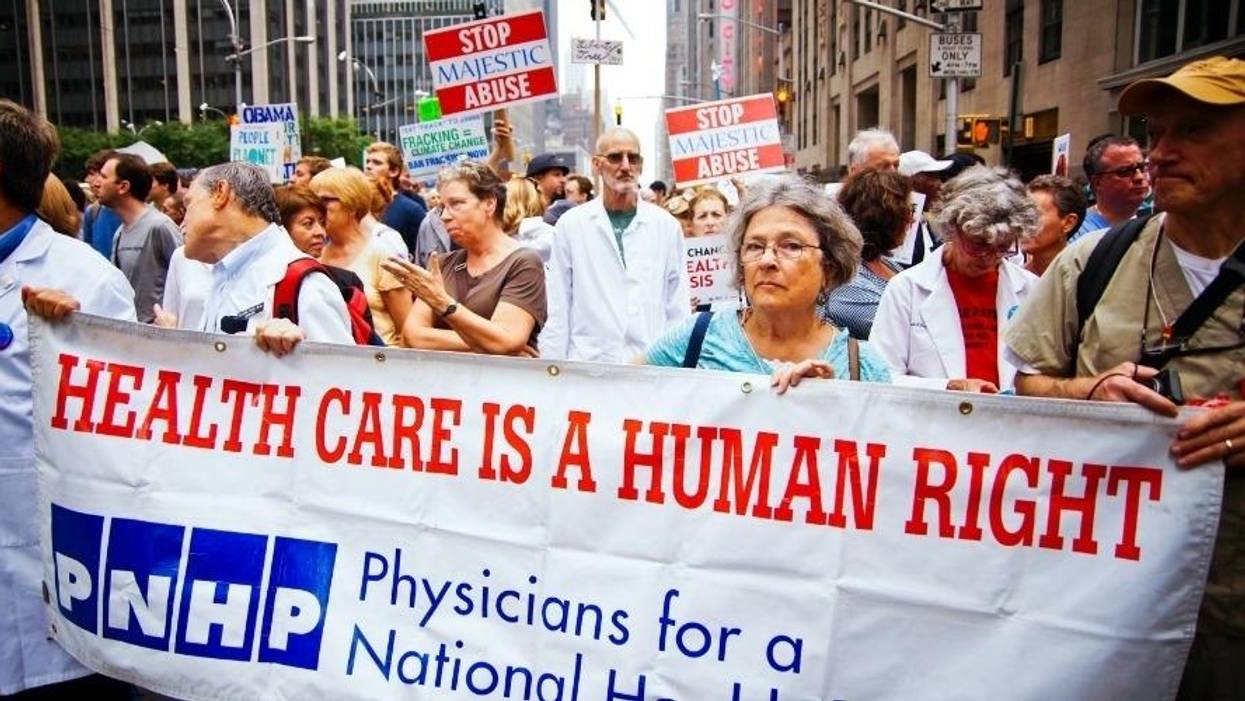
The promotion of human health in all its dimensions (i.e. physical, mental, emotional) is among the most important single indicators of a just society. The availability and affordability of comprehensive health care to every person, regardless of income or other factors, is defined by many nations as a basic human right. This is the foundational principal of the Medicare for All Act introduced this week by Sen. Bernie Sanders.
"Ending corporate constitutional rights is the ultimate cure to our critically ill health care system and democracy."
Article 25 of the 1948 United Nations' Universal Declaration of Human Rights asserts, "[e]veryone has the right to a standard of living adequate for the health and well-being of himself and of his family, including food, clothing, housing and medical care and necessary social services." President Franklin Delano Roosevelt called for a Second Bill of Rights in 1944 that identified the "right to adequate medical care and the opportunity to achieve and enjoy good health" as one of several fundamental conditions to achieve human happiness and well being.
Recent polls indicate Americans feel health care is one of the nation's biggest problems. The US spends the most per person on health care than any other nation, has the worst health care system among high-income nations, and has overall poor population health. Nearly 26 million Americans remain uninsured.
3 ways corporations have captured health care:
1. Framing health care as a commodity, not as a right
The U.S. health care industry defines health care within the domain of the private (i.e. corporate), not public realm. It's created a mindset, if not culture, that that "the market" is the most efficient and affordable means to provide the highest quality health care in the world. It's asserted that the prospect of mammoth profits from being the first to develop and patent drugs, procedures or devices are what drive corporations to new discoveries that the public sector would never achieve.
Health care is currently less a basic "right" than a commodity, less a public good than a corporate opportunity to peddle drugs, tests, equipment and procedures focused less on prevention (which isn't profitable) and more on treatment (which is highly profitable, regardless of payer). The business model of so-called "health care" corporations is to minimize coverage and treatment while maximizing premiums, deductibles and co-pays - all of which maximize profits. Despite the rhetoric, insurance agents, not doctors or patients, largely determine basic health care decisions.
2. Investments in lobbying and political campaigns to gain political influence
The so-called "health care" sector was #1 in political spending in 2016, according to OpenSecrets.org. More than $500 million was raised to employ 2700 lobbyists to influence legislation. The money came from corporations representing pharmaceuticals/health products ($245,812,399), hospitals/nursing homes ($94,875,553), and health services/HMOs ($77,966,304). Health professionals chipped in another $84,829,148.
Campaign political "contributions" (more like investments) was a separate category. Health Care Political Action Committees (PACs) invested $55.7 million in federal candidate campaigns (60% to Republicans, 40% to Democrats) in 2016. An additional $53.8 million in "outside" political spending (e.g. largely for advertising) was invested, led by health care-related insurance corporations ($19 million) and pharmaceuticals/health products ($15.8 million).
What have these contributions/investments bought? We've seen laws promoting "tort reform," limits on class action medical lawsuits, patent protection, and massive federal subsidies (i.e. government research) to the medical industrial complex. What we've not seen is neither a single payer system nor any form of "claw back" of excessive compensation of Big Pharma or insurance CEOs.
3. Misuse/abuse of corporate constitutional rights
Corporate constitutional rights have been used to promote corporate interests over human health and safety and/or to deny health coverage. Examples
The Supreme Court in its Burwell v. Hobby Lobby decision prohibited the Department of Health and Human Services from requiring closely held, for-profit secular corporations to provide contraceptive coverage as part of their employer-sponsored health insurance plans under the Affordable Care Act if it violated the corporation's 1st Amendment "religious rights and beliefs." To extend and pretend that private, personal religious rights apply to entities such as business corporations is a breach of a constitutional firewall with potential widespread discriminatory implications.
Tens of thousands of deaths annually are attributed to occupational disease while several million people report work-related injuries and tens of thousands of work place fatalities. Corporate 4th Amendment search and seizure rights, affirmed in cases like Marshall v. Barlow which prevented inspectors from the Occupational Safety & Health Administration onto corporate property, threatens worker health and safety.
From 1905 until the mid 1930s the Court invalidated Approximately 200 regulations protecting the health and safety of workers, consumers and children were invalidated from 1905 until the 1930's alone under various Supreme Court cases affirming corporate rights under the due process clause of the 14th Amendment
Current health care debate
The current "mainstream" political and media debate on health care place takes place within a narrow space - the entirety of which falls within the corporate sphere. Both the Affordable Care Act/"Obamacare" and various Republican Congressional proposals are all private, corporate-dominated systems that enrich all parts of the medical industrial complex - from hospitals, to drug corporations to insurance corporations.
Limiting the range of information, discussion and debate has been corporate "mainstream" media. Single payer health care is not on the table. Corporate agents have made this decision. Yet the public owns the airwaves. TV and media stations lease these public "commons" from us.
It's in this political and media environment that the Medicare for All Act has been introduced. Pharmaceutical and insurance corporations will surely double down, if not quadruple down, on their political lobbying and political contributions/investments to protect their massively profitable sick-care industry.
"Corporations won't give up their massive influence and profit without a massive fight."
The corporate media will do its part by disproportionately providing airtime to politicians, pundits and sick-care industry shills fear mongering about supposedly excessive taxes, inadequate treatment and government sticking its nose in between you and your doctor. The corporate media will also gladly accept the throngs of paid ads from the sick-care industry distorting, distracting and discombobulating the reality of the Canadian and other Western European health care systems - all of which provide much more universal, comprehensive and affordable health care to its residents. By contrast, the voices of advocates for the Medicare for All Act will be marginalized and drowned out.
Move to Amend and We the People Amendment
Healthy individuals and a healthy democracy are inextricable connected. Removing the corporate cancer from our health care system is possible without killing our body politic. Eliminating corporate influence and the incredible profits and human toll from private doctor-patient decisions, workplace safety decisions and all public policy decisions is the prescription. Ending corporate constitutional rights is the ultimate cure to our critically ill health care system and democracy. This requires much more than simply (un)elected public officials. It requires a constitutional amendment.
Move to Amend's We the People Amendment to the U.S Constitution will make clear that only human beings have constitutional rights and end constitutional "personhood" rights of corporations as well as end the spending of money in elections as constitutionally protected "free speech." It's a fundamental elixir to achieving the basic public right to decide.
The powerful grassroots social movement directed at Congress in the spring/summer of 2017 to prevent the repeal of the ACA demonstrated both the universal concern of health care and the political power of organized people for a common cause. A larger social movement will be required to humanize and democratize our health care system in the direction of single payer, including the Medicare for All Act, which Senator Sanders acknowledged in calling for a "political revolution" to enact his bill. Corporations won't give up their massive influence and profit without a massive fight. The same it true of the massive "corporatization" of education, transportation, energy, criminal justice, food and other basic spheres of our lives. Working against each of these single-issue examples of corporatization and for passage of the We the People Amendment reinforces and legitimizes one another.
The implication is clear: the need to join together to build and sustain a powerful and authentically diverse democracy movement that by eliminating corporate constitutional rights and money as speech, as well as other measures such as guaranteeing the right to vote, will guarantee just and peaceful policies and programs - including a universal, affordable, accessible and comprehensive health care system for every person.
"Give me your tired, your poor,
Your huddled masses yearning to breathe free,
The wretched refuse of your teeming shore.
Send these, the homeless, tempest-tost to me,
I lift my lamp beside the golden door!"
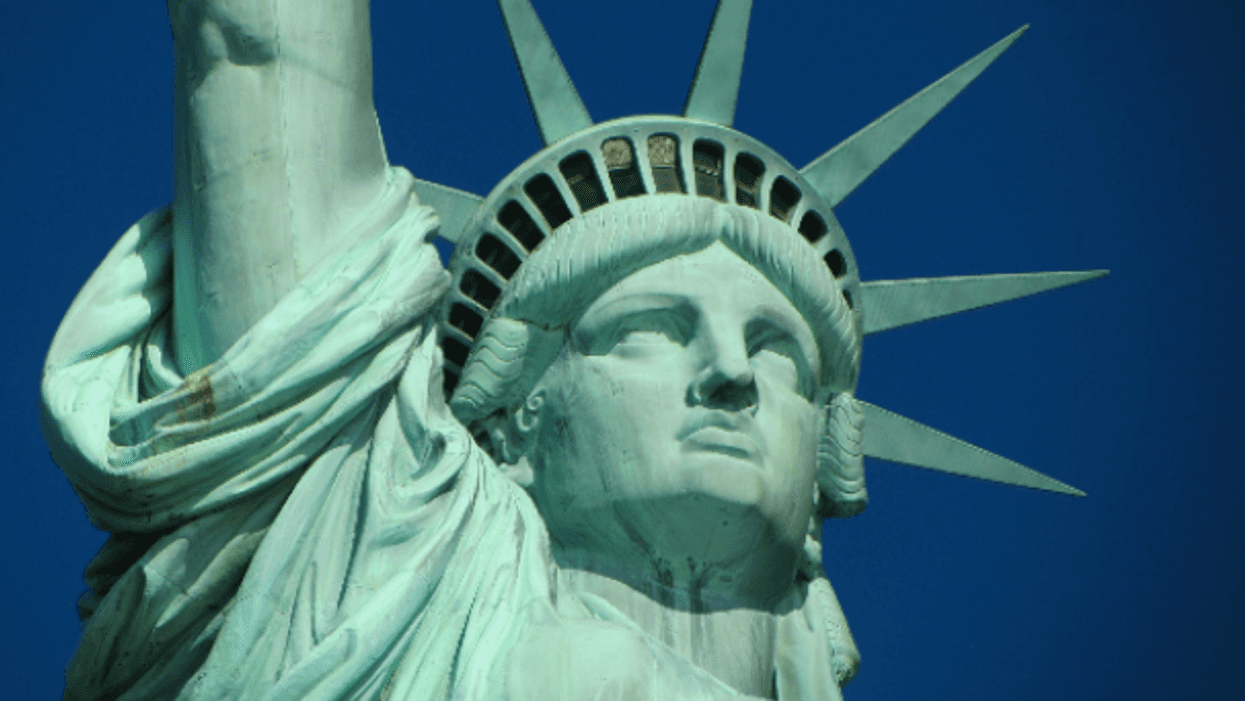
The Statue of Liberty is one very big American icon, adorned with some poetry of equally iconic proportion. Those famous words welcoming immigrants to the U.S. were penned by poet Emma Lazarus. Both the statue and Lazarus's words are recognized globally and are uniquely feminine. Both are being attacked as the war on women continues. In undermining Lazarus and Lady Liberty, the bonds Americans hold with the values the statue and Lazarus's sonnet represent are more easily broken, and in doing so the fascists in power prevent the nation as a whole from embracing the feminist quality of inclusiveness, preached by Lazarus, and its benefits to the entire nation.
Trump's apocalyptic horseman Stephen Miller recently attempted to claw back the meaning of the Statue of Liberty by implying the plaque containing Emma Lazarus's famous lines of verse bore no meaning to the "original" purpose of the statue, which was to be a beacon for American Liberty "enlightening the world." In today's parlance, that's alt-right code for revising history in order to legitimize the ongoing corporate colonization of the rest of the world, by force if necessary.
According to the U.S. Park Service, the monument was originally "built as a gift from France to the United States in order to commemorate the perseverance of freedom and democracy in the United States and to honor the work of the late president Abraham Lincoln." Unfortunately there was no budget to build the base on which to mount the monument, so a fundraising campaign was initiated. Lazarus wrote The New Colossus in 1883 to help raise the money for the base on which the "Mother of Exiles" (aka Lady Liberty) has stood in full glory since 1886. Considering the statue's proximity to Ellis Island, the poem simply struck a chord with the public, and the original intent became the foundation for its current meaning. To honor her work, the famous sonnet was inscribed on a plaque and affixed to the base 13 years after the statue's completion. To say that the Mother of Exiles is not a beacon to immigrants seeking freedom is simply an unadulterated lie meant to distort history and diminish the role of women and immigrants in American history and culture.
Why attempt to desecrate Lady Liberty and Emma Lazarus instead of Uncle Sam and Benjamin Franklin? The fascist agenda is all about division, and it includes forcing women, especially those in low-income communities and in those of color, into second-class citizenship. There are at least a few who would prefer to see the 19th Amendment abolished all together. (Remember a week ago, when many Americans thought the alt-right were just a few loonies?) These female icons symbolize strength, courage, compassion, and conviction along with the call for inclusiveness. Undermining female icons like Lady Liberty and Lazarus undermines all women. Who's next? Lady Justice and Mother Theresa?
The irony is that 1886 was also the year in which the Supreme Court granted corporations their first human right. Women would wait another 34 years and endure much suffering before ratification of the 19th Amendment on August 18, 1920, a major democratic moment for women and the nation. As the struggle to extend human rights to all people regardless of sex, gender, skin color, religion, age, and ability continues, many lessons from the suffrage movement can be learned. Among these is to remember Lazarus's plea for inclusion.
While Lazarus had no significant ties to the Suffrage movement, she most definitely embodied a success too few women experienced then or now. On the other hand, the Suffrage movement embodies many of the strategies, tactics and pitfalls most movements experience. Split by racism and united again under the banner of inclusiveness, suffragists eventually forced a woman's right to vote into the Constitution, and left us with many insights into how we can pass an amendment to abolish corporate constitutional rights.
Sniping at the Statue of Liberty and Emma Lazarus is so 19th century. It is, however, serving a purpose: the destruction of democracy. Consider the connections between the conflagration in Charlottesville this past week and Miller's statement two weeks ago, along with the original intent behind Lady Liberty and what she quickly came to symbolize. It's looking more and more like an attempted unraveling of every civil rights gain since the Bill of Rights passed. Even those rights are on shaky ground: your right to assemble, right to protest, right to a fair trial, right to vote are all under attack. The 13th Amendment still allows for legal slavery. How's your pursuit of happiness going? Make no mistake, our constitutional rights are being undermined and diminished day in and day out by courts and legislatures corrupted by corporate rule, and it's been going on since the very year Lady Liberty was completed.
More importantly, the overall lack of democracy in the U.S. has helped to create not one, but two global catastrophes just waiting to happen: nuclear annihilation and devastating climate change. A lack of democracy has created huge inequities in the economy, education, housing, and healthcare as well. Our democratic republic has always been undemocratic, and is now clearly anti-democratic despite We the People being identified as the legal sovereigns of this nation. Our Constitution, written by rich white men--in secret--works against the 99% and must be amended to clearly articulate that only natural persons have constitutionally protected rights (corporations are not people), and money is not a form of protected political speech (money isn't speech). Only then will We the People be free to prioritize human rights and other American values over corporate profits.
This time around, people who identify as women, womanist and feminist will play a significant role in the passage of the 28th Amendment, H.J.R. 48 The We the People Amendment and the transformation of our democracy, as should all others whose voice has been silenced by institutionalized oppression, fear and hatred.
As we observe the 97th anniversary of the 19th Amendment today and the establishment of women's rights in the U.S., it is worth taking notice of the ongoing war on women in all its forms happening simultaneously with wars on people of color, poor folk, undocumented immigrants, non-cis-gendered folks, Muslims, indigenous people, the environment, science, and the multiple fronts on which the U.S. military is currently engaged. If We the People do not come together in the light of inclusiveness, corporate forces and their institutional operatives will keep on laying waste to our economy, landscapes, human rights, the animal kingdom, and the sovereignty of other nations.
It's the 21st century, and it's high time We the People unite in a movement to abolish corporate constitutional rights and money as protected political speech. It's time to level the playing field, codify human rights, and create a democracy where We the People rule, not corporations. A dystopian fascist future is emerging and it is encouraging our society to repeat past mistakes and recreate those injustices already settled; the time has never been more right to join the Campaign to Legalize Democracy.