SUBSCRIBE TO OUR FREE NEWSLETTER
Daily news & progressive opinion—funded by the people, not the corporations—delivered straight to your inbox.
5
#000000
#FFFFFF
To donate by check, phone, or other method, see our More Ways to Give page.
Daily news & progressive opinion—funded by the people, not the corporations—delivered straight to your inbox.
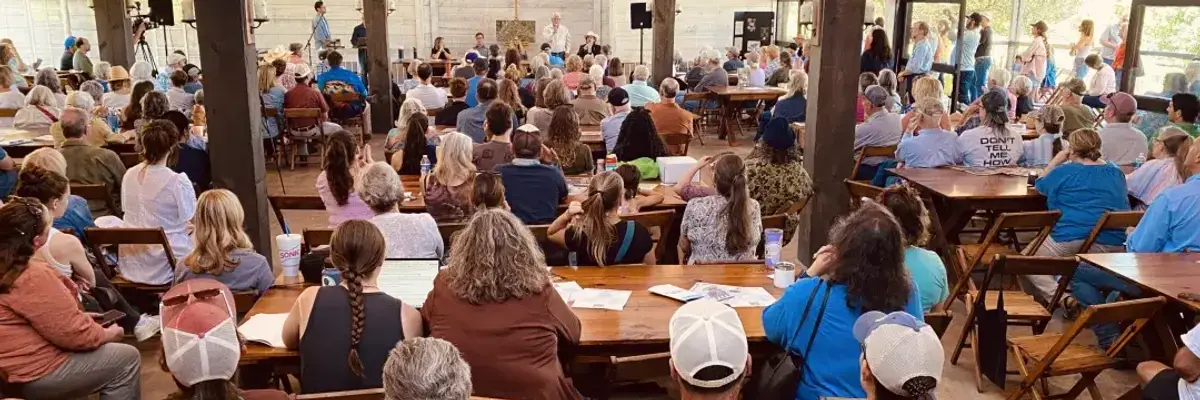
Residents discuss their opposition to a proposed data center in Lockart, Texas.
When ordinary people organize, mobilize, and refuse to accept the dictates of an elite few, America moves forward.
Two hundred fifty years ago, Americans rejected monarchy. They rejected the idea that power should rest in the hands of one person, one family, or a distant ruling class. Instead, they enshrined an American promise: Legitimate power comes from the people.
Our Constitution opens with three words: “We the People.” As the country marks its 250th anniversary, that promise is worth remembering: In America, the people are supposed to be in charge.
Indeed, every day we see neighbors working together to improve their lives, their communities, and the country.
Earlier this year, hundreds of residents of San Marcos, Texas, packed into public meetings with concerns about a new data center. The Caldwell/Hays Examiner, a local paper, summarized the sentiment: “Electricity bills may soon spike while access to clean water diminishes drastically, given the unfathomably giant data center on its way.”
Do “We the People” govern ourselves, or are we ruled by concentrated power?
The local government rejected the unpopular project, and similar efforts are taking place across the country. In every place the message is clear: The people who live there, not a distant tech company, should be in charge of the community’s resources.
Rural communities are also taking on Big Ag. For example, Grassroots Organizing of Western Wisconsin brought residents together and passed local safeguards that limit threats from factory farms and support family farmers, clean water, and local infrastructure.
Iowans won a big victory against a global pesticide manufacturer. Knowing their state’s unusually high cancer rates, Iowa Farmers Union mobilized from the bottom up and blocked a law that would have shielded a billion-dollar corporation from accountability.
These patriotic efforts help fulfill the promise of “We the People.” They also show what’s possible when people come together to shape the decisions that affect our lives.
Unfortunately, few Americans feel in control right now. We face an unpredictable economy, cuts to healthcare, cruel and reckless Immigration and Customs Enforcement raids, and attacks on mail-in ballots. Even that recent win in Iowa is in jeopardy—the Supreme Court just shielded the pesticide company from thousands of lawsuits brought by farmers and families who blame Roundup for their cancer.
These are all symptoms of a single disease: a nation where too much power rests with an elite few rather than with ordinary Americans. That’s exactly what researchers at Topos Partnership found. After listening to nearly 5,000 Americans, we heard one idea emerge: The people are supposed to be in charge.
The real story isn’t Democrats versus Republicans, or newcomers versus citizens, or some fabricated clash of civilizations. The real story—the one that unifies and energizes—is about who decides. Do “We the People” govern ourselves, or are we ruled by concentrated power?
Most Americans in our research recognize that the answer to that question is complicated, but also that being reminded of our defining story could help heal a fractured nation. As one moderate Colorado man expressed: “When everyday people don’t feel in charge, it creates anger, frustration, bitterness. But when everyday people feel like they’re having an impact, it creates a sense of belonging.”
When ordinary people organize, mobilize, and refuse to accept the dictates of an elite few, America moves forward. We’ve seen it in workers establishing safer workplaces and the civil rights movement expanding “who counts” in our country. We decided our nation belonged to us—and acted like it.
Let America’s history and recent successes be the inspiration. This July 4, the most patriotic thing we can do is remember whose hands this country is supposed to be in: ours. When we come together, the people are in charge.
Dear Common Dreams reader, It’s been nearly 30 years since I co-founded Common Dreams with my late wife, Lina Newhouser. We had the radical notion that journalism should serve the public good, not corporate profits. It was clear to us from the outset what it would take to build such a project. No paid advertisements. No corporate sponsors. No millionaire publisher telling us what to think or do. Many people said we wouldn't last a year, but we proved those doubters wrong. Together with a tremendous team of journalists and dedicated staff, we built an independent media outlet free from the constraints of profits and corporate control. Our mission has always been simple: To inform. To inspire. To ignite change for the common good. Building Common Dreams was not easy. Our survival was never guaranteed. When you take on the most powerful forces—Wall Street greed, fossil fuel industry destruction, Big Tech lobbyists, and uber-rich oligarchs who have spent billions upon billions rigging the economy and democracy in their favor—the only bulwark you have is supporters who believe in your work. But here’s the urgent message from me today. It's never been this bad out there. And it's never been this hard to keep us going. At the very moment Common Dreams is most needed, the threats we face are intensifying. We need your support now more than ever. We don't accept corporate advertising and never will. We don't have a paywall because we don't think people should be blocked from critical news based on their ability to pay. Everything we do is funded by the donations of readers like you. When everyone does the little they can afford, we are strong. But if that support retreats or dries up, so do we. Will you donate now to make sure Common Dreams not only survives but thrives? —Craig Brown, Co-founder |
Two hundred fifty years ago, Americans rejected monarchy. They rejected the idea that power should rest in the hands of one person, one family, or a distant ruling class. Instead, they enshrined an American promise: Legitimate power comes from the people.
Our Constitution opens with three words: “We the People.” As the country marks its 250th anniversary, that promise is worth remembering: In America, the people are supposed to be in charge.
Indeed, every day we see neighbors working together to improve their lives, their communities, and the country.
Earlier this year, hundreds of residents of San Marcos, Texas, packed into public meetings with concerns about a new data center. The Caldwell/Hays Examiner, a local paper, summarized the sentiment: “Electricity bills may soon spike while access to clean water diminishes drastically, given the unfathomably giant data center on its way.”
Do “We the People” govern ourselves, or are we ruled by concentrated power?
The local government rejected the unpopular project, and similar efforts are taking place across the country. In every place the message is clear: The people who live there, not a distant tech company, should be in charge of the community’s resources.
Rural communities are also taking on Big Ag. For example, Grassroots Organizing of Western Wisconsin brought residents together and passed local safeguards that limit threats from factory farms and support family farmers, clean water, and local infrastructure.
Iowans won a big victory against a global pesticide manufacturer. Knowing their state’s unusually high cancer rates, Iowa Farmers Union mobilized from the bottom up and blocked a law that would have shielded a billion-dollar corporation from accountability.
These patriotic efforts help fulfill the promise of “We the People.” They also show what’s possible when people come together to shape the decisions that affect our lives.
Unfortunately, few Americans feel in control right now. We face an unpredictable economy, cuts to healthcare, cruel and reckless Immigration and Customs Enforcement raids, and attacks on mail-in ballots. Even that recent win in Iowa is in jeopardy—the Supreme Court just shielded the pesticide company from thousands of lawsuits brought by farmers and families who blame Roundup for their cancer.
These are all symptoms of a single disease: a nation where too much power rests with an elite few rather than with ordinary Americans. That’s exactly what researchers at Topos Partnership found. After listening to nearly 5,000 Americans, we heard one idea emerge: The people are supposed to be in charge.
The real story isn’t Democrats versus Republicans, or newcomers versus citizens, or some fabricated clash of civilizations. The real story—the one that unifies and energizes—is about who decides. Do “We the People” govern ourselves, or are we ruled by concentrated power?
Most Americans in our research recognize that the answer to that question is complicated, but also that being reminded of our defining story could help heal a fractured nation. As one moderate Colorado man expressed: “When everyday people don’t feel in charge, it creates anger, frustration, bitterness. But when everyday people feel like they’re having an impact, it creates a sense of belonging.”
When ordinary people organize, mobilize, and refuse to accept the dictates of an elite few, America moves forward. We’ve seen it in workers establishing safer workplaces and the civil rights movement expanding “who counts” in our country. We decided our nation belonged to us—and acted like it.
Let America’s history and recent successes be the inspiration. This July 4, the most patriotic thing we can do is remember whose hands this country is supposed to be in: ours. When we come together, the people are in charge.
Two hundred fifty years ago, Americans rejected monarchy. They rejected the idea that power should rest in the hands of one person, one family, or a distant ruling class. Instead, they enshrined an American promise: Legitimate power comes from the people.
Our Constitution opens with three words: “We the People.” As the country marks its 250th anniversary, that promise is worth remembering: In America, the people are supposed to be in charge.
Indeed, every day we see neighbors working together to improve their lives, their communities, and the country.
Earlier this year, hundreds of residents of San Marcos, Texas, packed into public meetings with concerns about a new data center. The Caldwell/Hays Examiner, a local paper, summarized the sentiment: “Electricity bills may soon spike while access to clean water diminishes drastically, given the unfathomably giant data center on its way.”
Do “We the People” govern ourselves, or are we ruled by concentrated power?
The local government rejected the unpopular project, and similar efforts are taking place across the country. In every place the message is clear: The people who live there, not a distant tech company, should be in charge of the community’s resources.
Rural communities are also taking on Big Ag. For example, Grassroots Organizing of Western Wisconsin brought residents together and passed local safeguards that limit threats from factory farms and support family farmers, clean water, and local infrastructure.
Iowans won a big victory against a global pesticide manufacturer. Knowing their state’s unusually high cancer rates, Iowa Farmers Union mobilized from the bottom up and blocked a law that would have shielded a billion-dollar corporation from accountability.
These patriotic efforts help fulfill the promise of “We the People.” They also show what’s possible when people come together to shape the decisions that affect our lives.
Unfortunately, few Americans feel in control right now. We face an unpredictable economy, cuts to healthcare, cruel and reckless Immigration and Customs Enforcement raids, and attacks on mail-in ballots. Even that recent win in Iowa is in jeopardy—the Supreme Court just shielded the pesticide company from thousands of lawsuits brought by farmers and families who blame Roundup for their cancer.
These are all symptoms of a single disease: a nation where too much power rests with an elite few rather than with ordinary Americans. That’s exactly what researchers at Topos Partnership found. After listening to nearly 5,000 Americans, we heard one idea emerge: The people are supposed to be in charge.
The real story isn’t Democrats versus Republicans, or newcomers versus citizens, or some fabricated clash of civilizations. The real story—the one that unifies and energizes—is about who decides. Do “We the People” govern ourselves, or are we ruled by concentrated power?
Most Americans in our research recognize that the answer to that question is complicated, but also that being reminded of our defining story could help heal a fractured nation. As one moderate Colorado man expressed: “When everyday people don’t feel in charge, it creates anger, frustration, bitterness. But when everyday people feel like they’re having an impact, it creates a sense of belonging.”
When ordinary people organize, mobilize, and refuse to accept the dictates of an elite few, America moves forward. We’ve seen it in workers establishing safer workplaces and the civil rights movement expanding “who counts” in our country. We decided our nation belonged to us—and acted like it.
Let America’s history and recent successes be the inspiration. This July 4, the most patriotic thing we can do is remember whose hands this country is supposed to be in: ours. When we come together, the people are in charge.