

SUBSCRIBE TO OUR FREE NEWSLETTER
Daily news & progressive opinion—funded by the people, not the corporations—delivered straight to your inbox.
5
#000000
#FFFFFF
To donate by check, phone, or other method, see our More Ways to Give page.
Daily news & progressive opinion—funded by the people, not the corporations—delivered straight to your inbox.
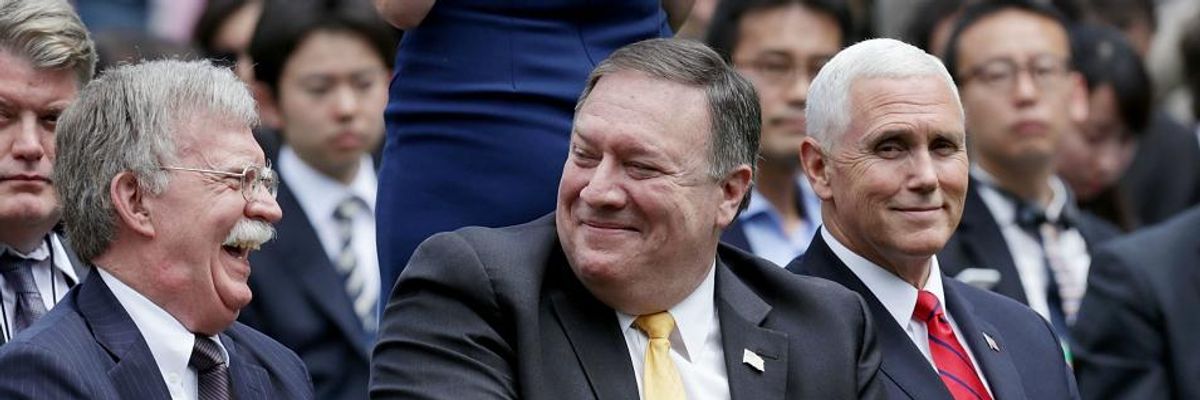
National security adviser John Bolton, Secretary of State Mike Pompeo and Vice President Mike Pence before the start of a joint news conference in the Rose Garden at the White House June 7, 2018 in Washington, D.C. (Photo: Chip Somodevilla/Getty Images)
After President Donald Trump's national security adviser John Bolton openly threatened Venezuela's elected government on Twitter and White House officials continued to warn that U.S. military intervention remains "on the table," Rep. Ilhan Omar (D-Minn.) on Sunday acknowledged the ongoing political and economic crises in Venezuela but argued that American military action must be entirely ruled out as a possible solution.
"We must rule out military action in Venezuela."
--Rep. Ilhan Omar (D-Minn.)
"We must rule out military action in Venezuela," Omar wrote. "We have to wonder, if Trump and [Secretary of State Mike] Pompeo are so worried about human rights and democracy in Venezuela, Cuba, and Nicaragua, why do they actively support horrible regimes in Brazil, Guatemala, and Honduras?"
"Of course there is suffering in Venezuela and I strongly stand with the people," the Minnesota congresswoman continued. "There [are] many ways we can assist that I would support but will always caution us against intervention."
Rep. Pramila Jayapal (D-Wash.), co-chair of the Congressional Progressive Caucus, echoed Omar's opposition to military action on Sunday, declaring, "The administration should be helping to de-escalate tensions and encouraging a peaceful resolution to this conflict, not fueling more violence, chaos, and instability in the region."
" U.S. military intervention in Venezuela is not the answer here."
--Rep. Pramila Jayapal
"U.S. military intervention in Venezuela is not the answer here," Jayapal added.
While Sen. Bernie Sanders (I-Vt.) openly criticized the record and policies of the Maduro government last week, he also took a firm stand against U.S. intervention by the Trump administration.
"The United States has a long history of inappropriately intervening in Latin American countries," said the senator. "We must not go down that road again."
Omar and Jayapal's clear stand on Sunday against U.S. military intervention came just hours after Bolton--who played a central role in orchestrating what has been denounced as an attempted coup d'etat--took to Twitter to warn Venezuela's government of a "significant response" if American diplomats, members of the Venezuelan National Assembly, or U.S.-backed opposition leader and self-declared "Interim President" Juan Guaido are intimidated or attacked.
"Any violence and intimidation against U.S. diplomatic personnel, Venezuela's democratic leader, Juan Guiado [sic], or the National Assembly itself would represent a grave assault on the rule of law and will be met with a significant response," Bolton warned in a tweet on Sunday.
Bolton also claimed, without citing any evidence, that Cuba has "control" over Venezuela's armed forces. Experts have said links between Cuba and Venezuela, which are allies, are frequently overblown.
As the Wall Street Journal reported on Friday, Bolton, Pompeo, and Vice President Mike Pence were all key players in talks with the Venezuelan opposition that culminated in Guaido's decision last week to declare himself "interim president." According to the Journal, Pence called Guaido to pledge U.S. support for the move. Immediately after Guaido's announcement, Trump recognized him as Venezuela's rightful leader and declared Maduro's government illegitimate.
Prompting horror and dismay, Pompeo announced on Friday that notorious neoconservative Elliot Abrams is joining the Trump administration as U.S. special envoy for Venezuela.
"Welcome back to the fight," Bolton declared.
Further fueling concerns that the Trump administration is considering military action, Sen. Lindsey Graham (R-S.C.) told Axios on Sunday that the president is "really hawkish" on Venezuela and has openly floated the possibility of military intervention.
"What do you think about using military force?" Trump reportedly asked Graham as recently as a few weeks ago.
The Trump administration's quick recognition of Guaido was quickly met with alarm by progressive anti-war advocates and commentators, who denounced the move as the beginnings of a coup and warned that U.S. intervention in Venezuela's internal affairs will only make the country's economic and political crises worse.
"The U.S. and its allies must cease encouraging violence by pushing for violent, extralegal regime change," over 70 academics and Latin America experts wrote in an open letter published by Common Dreams last week. "If the Trump administration and its allies continue to pursue their reckless course in Venezuela, the most likely result will be bloodshed, chaos, and instability."
Dear Common Dreams reader, It’s been nearly 30 years since I co-founded Common Dreams with my late wife, Lina Newhouser. We had the radical notion that journalism should serve the public good, not corporate profits. It was clear to us from the outset what it would take to build such a project. No paid advertisements. No corporate sponsors. No millionaire publisher telling us what to think or do. Many people said we wouldn't last a year, but we proved those doubters wrong. Together with a tremendous team of journalists and dedicated staff, we built an independent media outlet free from the constraints of profits and corporate control. Our mission has always been simple: To inform. To inspire. To ignite change for the common good. Building Common Dreams was not easy. Our survival was never guaranteed. When you take on the most powerful forces—Wall Street greed, fossil fuel industry destruction, Big Tech lobbyists, and uber-rich oligarchs who have spent billions upon billions rigging the economy and democracy in their favor—the only bulwark you have is supporters who believe in your work. But here’s the urgent message from me today. It's never been this bad out there. And it's never been this hard to keep us going. At the very moment Common Dreams is most needed, the threats we face are intensifying. We need your support now more than ever. We don't accept corporate advertising and never will. We don't have a paywall because we don't think people should be blocked from critical news based on their ability to pay. Everything we do is funded by the donations of readers like you. When everyone does the little they can afford, we are strong. But if that support retreats or dries up, so do we. Will you donate now to make sure Common Dreams not only survives but thrives? —Craig Brown, Co-founder |
After President Donald Trump's national security adviser John Bolton openly threatened Venezuela's elected government on Twitter and White House officials continued to warn that U.S. military intervention remains "on the table," Rep. Ilhan Omar (D-Minn.) on Sunday acknowledged the ongoing political and economic crises in Venezuela but argued that American military action must be entirely ruled out as a possible solution.
"We must rule out military action in Venezuela."
--Rep. Ilhan Omar (D-Minn.)
"We must rule out military action in Venezuela," Omar wrote. "We have to wonder, if Trump and [Secretary of State Mike] Pompeo are so worried about human rights and democracy in Venezuela, Cuba, and Nicaragua, why do they actively support horrible regimes in Brazil, Guatemala, and Honduras?"
"Of course there is suffering in Venezuela and I strongly stand with the people," the Minnesota congresswoman continued. "There [are] many ways we can assist that I would support but will always caution us against intervention."
Rep. Pramila Jayapal (D-Wash.), co-chair of the Congressional Progressive Caucus, echoed Omar's opposition to military action on Sunday, declaring, "The administration should be helping to de-escalate tensions and encouraging a peaceful resolution to this conflict, not fueling more violence, chaos, and instability in the region."
" U.S. military intervention in Venezuela is not the answer here."
--Rep. Pramila Jayapal
"U.S. military intervention in Venezuela is not the answer here," Jayapal added.
While Sen. Bernie Sanders (I-Vt.) openly criticized the record and policies of the Maduro government last week, he also took a firm stand against U.S. intervention by the Trump administration.
"The United States has a long history of inappropriately intervening in Latin American countries," said the senator. "We must not go down that road again."
Omar and Jayapal's clear stand on Sunday against U.S. military intervention came just hours after Bolton--who played a central role in orchestrating what has been denounced as an attempted coup d'etat--took to Twitter to warn Venezuela's government of a "significant response" if American diplomats, members of the Venezuelan National Assembly, or U.S.-backed opposition leader and self-declared "Interim President" Juan Guaido are intimidated or attacked.
"Any violence and intimidation against U.S. diplomatic personnel, Venezuela's democratic leader, Juan Guiado [sic], or the National Assembly itself would represent a grave assault on the rule of law and will be met with a significant response," Bolton warned in a tweet on Sunday.
Bolton also claimed, without citing any evidence, that Cuba has "control" over Venezuela's armed forces. Experts have said links between Cuba and Venezuela, which are allies, are frequently overblown.
As the Wall Street Journal reported on Friday, Bolton, Pompeo, and Vice President Mike Pence were all key players in talks with the Venezuelan opposition that culminated in Guaido's decision last week to declare himself "interim president." According to the Journal, Pence called Guaido to pledge U.S. support for the move. Immediately after Guaido's announcement, Trump recognized him as Venezuela's rightful leader and declared Maduro's government illegitimate.
Prompting horror and dismay, Pompeo announced on Friday that notorious neoconservative Elliot Abrams is joining the Trump administration as U.S. special envoy for Venezuela.
"Welcome back to the fight," Bolton declared.
Further fueling concerns that the Trump administration is considering military action, Sen. Lindsey Graham (R-S.C.) told Axios on Sunday that the president is "really hawkish" on Venezuela and has openly floated the possibility of military intervention.
"What do you think about using military force?" Trump reportedly asked Graham as recently as a few weeks ago.
The Trump administration's quick recognition of Guaido was quickly met with alarm by progressive anti-war advocates and commentators, who denounced the move as the beginnings of a coup and warned that U.S. intervention in Venezuela's internal affairs will only make the country's economic and political crises worse.
"The U.S. and its allies must cease encouraging violence by pushing for violent, extralegal regime change," over 70 academics and Latin America experts wrote in an open letter published by Common Dreams last week. "If the Trump administration and its allies continue to pursue their reckless course in Venezuela, the most likely result will be bloodshed, chaos, and instability."
After President Donald Trump's national security adviser John Bolton openly threatened Venezuela's elected government on Twitter and White House officials continued to warn that U.S. military intervention remains "on the table," Rep. Ilhan Omar (D-Minn.) on Sunday acknowledged the ongoing political and economic crises in Venezuela but argued that American military action must be entirely ruled out as a possible solution.
"We must rule out military action in Venezuela."
--Rep. Ilhan Omar (D-Minn.)
"We must rule out military action in Venezuela," Omar wrote. "We have to wonder, if Trump and [Secretary of State Mike] Pompeo are so worried about human rights and democracy in Venezuela, Cuba, and Nicaragua, why do they actively support horrible regimes in Brazil, Guatemala, and Honduras?"
"Of course there is suffering in Venezuela and I strongly stand with the people," the Minnesota congresswoman continued. "There [are] many ways we can assist that I would support but will always caution us against intervention."
Rep. Pramila Jayapal (D-Wash.), co-chair of the Congressional Progressive Caucus, echoed Omar's opposition to military action on Sunday, declaring, "The administration should be helping to de-escalate tensions and encouraging a peaceful resolution to this conflict, not fueling more violence, chaos, and instability in the region."
" U.S. military intervention in Venezuela is not the answer here."
--Rep. Pramila Jayapal
"U.S. military intervention in Venezuela is not the answer here," Jayapal added.
While Sen. Bernie Sanders (I-Vt.) openly criticized the record and policies of the Maduro government last week, he also took a firm stand against U.S. intervention by the Trump administration.
"The United States has a long history of inappropriately intervening in Latin American countries," said the senator. "We must not go down that road again."
Omar and Jayapal's clear stand on Sunday against U.S. military intervention came just hours after Bolton--who played a central role in orchestrating what has been denounced as an attempted coup d'etat--took to Twitter to warn Venezuela's government of a "significant response" if American diplomats, members of the Venezuelan National Assembly, or U.S.-backed opposition leader and self-declared "Interim President" Juan Guaido are intimidated or attacked.
"Any violence and intimidation against U.S. diplomatic personnel, Venezuela's democratic leader, Juan Guiado [sic], or the National Assembly itself would represent a grave assault on the rule of law and will be met with a significant response," Bolton warned in a tweet on Sunday.
Bolton also claimed, without citing any evidence, that Cuba has "control" over Venezuela's armed forces. Experts have said links between Cuba and Venezuela, which are allies, are frequently overblown.
As the Wall Street Journal reported on Friday, Bolton, Pompeo, and Vice President Mike Pence were all key players in talks with the Venezuelan opposition that culminated in Guaido's decision last week to declare himself "interim president." According to the Journal, Pence called Guaido to pledge U.S. support for the move. Immediately after Guaido's announcement, Trump recognized him as Venezuela's rightful leader and declared Maduro's government illegitimate.
Prompting horror and dismay, Pompeo announced on Friday that notorious neoconservative Elliot Abrams is joining the Trump administration as U.S. special envoy for Venezuela.
"Welcome back to the fight," Bolton declared.
Further fueling concerns that the Trump administration is considering military action, Sen. Lindsey Graham (R-S.C.) told Axios on Sunday that the president is "really hawkish" on Venezuela and has openly floated the possibility of military intervention.
"What do you think about using military force?" Trump reportedly asked Graham as recently as a few weeks ago.
The Trump administration's quick recognition of Guaido was quickly met with alarm by progressive anti-war advocates and commentators, who denounced the move as the beginnings of a coup and warned that U.S. intervention in Venezuela's internal affairs will only make the country's economic and political crises worse.
"The U.S. and its allies must cease encouraging violence by pushing for violent, extralegal regime change," over 70 academics and Latin America experts wrote in an open letter published by Common Dreams last week. "If the Trump administration and its allies continue to pursue their reckless course in Venezuela, the most likely result will be bloodshed, chaos, and instability."

