

SUBSCRIBE TO OUR FREE NEWSLETTER
Daily news & progressive opinion—funded by the people, not the corporations—delivered straight to your inbox.
5
#000000
#FFFFFF
To donate by check, phone, or other method, see our More Ways to Give page.
Daily news & progressive opinion—funded by the people, not the corporations—delivered straight to your inbox.
The NAACP will be with thousands of people who will converge on Washington, D.C., this spring as part of an unprecedented movement to demand a democracy that works for all Americans, one in which everyone has an equal voice and elected officials are accountable to the people, not the wealthy.
The landmark three-day mobilization, called "Democracy Awakening" and scheduled for April 16-18, brings together two advocacy communities in one movement. Together, they will press for reform proposals focused both on restoring and expanding voting rights protections, and curbing the influence of wealthy interests and corporations on elections. Polls show that the public overwhelmingly agrees on the need for reforms in both arenas, but this will mark the first mass demonstration calling for change on both these fronts.
More than 100 groups representing a diverse array of issues are organizing Democracy Awakening. Lead organizations include the American Postal Workers Union, Common Cause, Communications Workers of America, Democracy Initiative, Every Voice Center, Food & Water Watch, Franciscan Action Network, Greenpeace, NAACP, People For the American Way, Public Citizen, Student Debt Crisis and U.S. PIRG. A list of all endorsing organizations is available at https://democracyawakening.org/who-we-are/.
"We're not talking about the nostalgic disenfranchisement of 1965. Once again, states with the worst histories of discrimination are pushing for new barriers to block the young, the poor, the elderly and minority voters from the ballot in 2016," said Cornell William Brooks, president and CEO of the NAACP. "We must answer the call for action."
Democracy Awakening will feature a rally and march on Sunday, April 17, as well as targeted actions at the "Congress of Conscience" on Monday, April 18, that will call for voting rights protections, measures to curb the influence of money in politics and more. Democracy Awakening will include teach-ins and cultural events throughout the weekend.
For both money in politics and voting rights, the U.S. Supreme Court has eviscerated laws that once protected the voices and votes of everyday Americans. Congress has solutions in front of it, but has failed to pass them into law or even hold a hearing in the U.S. House of Representatives.
"That's why it's time for us to fight back on a scale that's never been done before," announces a video about Democracy Awakening created by Brave New Films.
City by city and state by state, a national movement is growing to ensure voters are fully heard. In communities throughout the country, voters have turned back efforts to impose discriminatory barriers to voting, won measures for public financing of local and state elections, and passed resolutions calling for a constitutional amendment to overturn the Supreme Court's Citizens United decision and other rulings.
Solutions being sought as part of Democracy Awakening include legislation to restore the protections against voting discrimination that were struck down by the Supreme Court's ruling in Shelby Vs,. Holder, modernize voter registration, prevent deceptive practices that keep people from the ballot box and ensure equal access to voting for all.
Activists also will call for a constitutional amendment to overturn Citizens United and allow elected representatives to set commonsense limits on money in elections. They will press for increased disclosure of the source of election spending and public financing of elections.
Democracy Awakening will follow a march and demonstrations organized by 99Rise and Avaaz as part of a separate event called "Democracy Spring." which will travel from the Liberty Bell in Philadelphia to the U.S. Capitol in Washington, D.C., in early April.
Why It Matters
Representatives of some of the organizations participating in Democracy Awakening explain why they are involved:
"Americans' frustration - and despair - is reflected in countless polls that show staggering majorities of our citizens believe the system is rigged to favor the rich and powerful," said Robert Weissman, president of Public Citizen. "These views transcend party, region, race and gender. The American people know the system is not working for them, and that a broken system is blocking us from addressing our great challenges."
"Protecting voting rights and pushing for money in politics reform are two sides of the same coin," said Marge Baker, executive vice president of People For the American Way. "When people face barriers to casting a ballot, and when wealthy special interests can overpower the voices and priorities of everyday Americans, our democracy simply isn't working."
"A handful of wealthy and corporate donors are hijacking our political system through mega-contributions and a systematic assault on voting rights that can only result in a breakdown in democracy and the belief by the average person that her or his vote doesn't matter," said Christopher Shelton, president of Communications Workers of America. "This spring, CWA members are ready to join the millions of others in this movement and to do what it takes to win back our democracy."
"Americans across the country are demanding a democracy where everyone has an equal voice and our elected officials are held accountable to the voters," said Marissa Brown, executive director of the Democracy Initiative."Thousands of people will join together in Washington, D.C., for a Democracy Awakening - a call to conscience for our elected officials."
"People are fed up with a political system that too often works for big donors at the expense of everyone else," said Nick Nyhart, president and CEO of Every Voice Center. "And at the Democracy Awakening this spring, in Maine, in Seattle, and in cities and states across the country Americans are coming together to demand a democracy in which one's influence isn't determined by the size of their wallet."
"As long as our government is controlled by corporate interests, we'll never be able to protect our food, ban fracking, or prevent disasters like we've seen in Flint," said Wenonah Hauter, executive director of Food & Water Watch. "Our democracy is broken, and for the sake of our food, water, and climate, it's time for us to fix it."
"The Democracy Awakening mobilization will galvanize the emerging movement that's challenging America to live up to its promise of government of, by, and for the people," said Annie Leonard, executive director at Greenpeace USA. "That promise means politicians putting people first by supporting voting rights and rejecting the campaign contributions from fossil fuel companies which manipulate our political system."
" Student Debt Crisis wholeheartedly believe that borrowers, students and young people are facing an uphill battle when it comes to higher education reform due to the influence of billionaires and corporations on our political system," said Natalia Abrams, executive director of Student Debt Crisis. "Until we get money out of politics and restore voting rights, our voices will not have the power that we, the people, deserve. It is our hope that once we get rid of the corporate stronghold on our democracy we will see reforms such as free college and some form of student loan forgiveness."
"As Franciscans and people of faith, we're working to remove the road block of unchecked money in politics as issues such as immigration, care for creation, and gun safety are not moving on Capitol Hill," said Patrick Carolan, executive director of the Franciscan Action Network. "As we continue to advocate for these core issues, we must also work to alleviate the root of the problem in order to see real progress."
"Voters want to be heard in our elections - they want a government that works for them instead of mega-donors," said Andre Delattre, executive director of U.S. PIRG. "As an independent voice for American consumers, U.S. PIRG has made voter empowerment a top priority. Democracy Awakening is a chance for us to push lawmakers for real election reforms."
"Democracy Awakening is the American Postal Workers Union's chance to become bigger than ourselves," said Debby Szeredy, executive vice president of the APWU. "We are a union representing our members and all of America as we fight to provide a Postal Service that is prompt efficient, affordable, with decent living wage jobs and benefits that communities have valued for years. Democracy Awakening connects us to the political revolution that has become crucial."
"Our democracy faces serious threats. Everyday Americans know our system is out of balance, and what's worse, our constitutional right to free speech has been reduced to a whisper as a few wealthy special interests spend billions so their voices are heard over everyone else," said Miles Rapport, president of Common Cause. "This spring, Common Cause's 400,000 members join with Americans from all walks of life to lift our voices and demand change through a series of important actions during two weeks in April, highlighting the importance of voting rights and reducing money's influence so together we create a 21st century democracy that works for every American."
Founded Feb. 12. 1909, the NAACP is the nation's oldest, largest and most widely recognized grassroots-based civil rights organization. Its more than half-million members and supporters throughout the United States and the world are the premier advocates for civil rights in their communities, conducting voter mobilization and monitoring equal opportunity in the public and private sectors.

"The Supreme Court’s attacks on voting rights are about rigging elections for Republicans," said Rep. Greg Casar, the chair of the Congressional Progressive Caucus.
US President Donald Trump on Sunday attacked a pro-democracy resolution recently introduced by key House caucus leaders, warning that the measure's adoption would strike a fatal blow to the Republican Party.
"They do this, and the Republican Party is DEAD!" Trump wrote in a social media post, citing a Politico story on the resolution. The proposal, unveiled last month by the heads of the Congressional Progressive Caucus (CPC), Congressional Black Caucus, Congressional Hispanic Caucus, and Congressional Asian Pacific American Caucus, calls for the restoration and strengthening of voter protections gutted by the US Supreme Court as well as court reforms—including possible expansion of the number of justices and term limits.
Rep. Greg Casar (D-Texas), chair of the CPC, wrote Sunday that Trump's post amounted to an acknowledgment that "the Supreme Court’s attacks on voting rights are about rigging elections for Republicans."
"At least he admits it," the progressive leader wrote on social media.
This is what Trump says about my resolution with @RepYvetteClarke, @RepEspaillat, and @RepGraceMeng to restore voting rights, end the filibuster, and reform the Supreme Court.
At least he admits it: the Supreme Court’s attacks on voting rights are about rigging elections for Rs. pic.twitter.com/GgQzhlwo4Q
— Congressman Greg Casar (@RepCasar) July 5, 2026
Politico reported that while the resolution "stands virtually no chance of adoption" in the current GOP-controlled Congress, "it is the latest indicator of how the Congressional Black Caucus and other key Democrats want to respond to the April decision that cleared the way for Republican states to redraw their congressional maps and eliminate majority-minority districts"—a reference to the Supreme Court's 6-3 ruling in Louisiana v. Callais.
Trump seized on the ruling to push state-level Republicans to aggressively gerrymander their maps ahead of the critical 2026 midterm elections. The president is also pressuring congressional Republicans to force through legislation known as the SAVE America Act, which would impose strict voter ID and documentation requirements nationwide, potentially blocking millions of American citizens from casting ballots under the pretext of cracking down on noncitizen voting—something that is already illegal and rare.
Trump is currently holding a bipartisan housing affordability bill hostage in a bid to get the stalled SAVE America Act through Congress.
House Speaker Mike Johnson (R-La.) affirmed on Sunday that Republicans intend to attach the assault on voting rights to a filibuster-proof budget reconciliation package in a last-ditch effort to get the measure through the Senate, where it has not received enough support to clear the upper chamber's 60-vote threshold. Trump has called for elimination of the filibuster to pass the SAVE America Act, but Senate Republicans have thus far declined to remove the barrier.
The progressive resolution that Trump attacked on Sunday also proposes "the elimination of the 60-vote threshold in the Senate"—but it specifies that the action should only be taken "under the next pro-democracy governing moment."
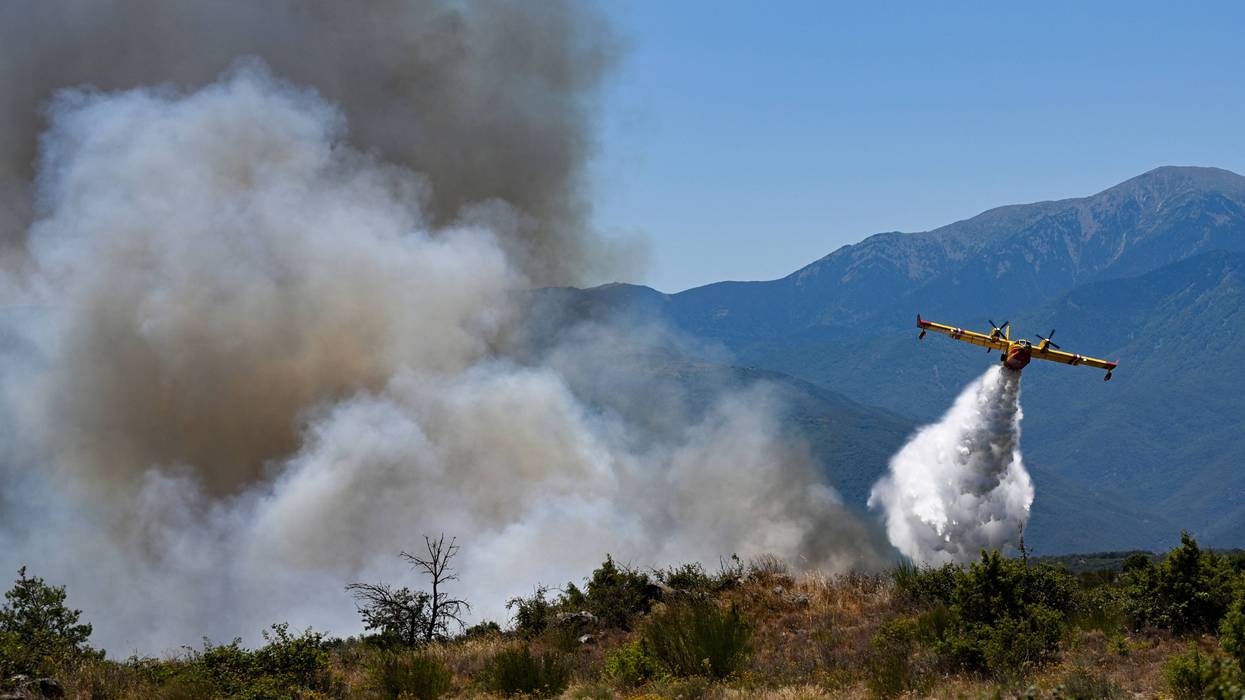
Blazes mobilized hundreds of firefighters over the weekend and scorched a total of 42,000 acres in Spain, France, and Portugal alone—an area two times the size of Manhattan.
On the heels of a deadly European heatwave, fierce fires erupted in Greece, Spain, Portugal, and France over the weekend, raising fears for a summer of extremes as the effects of the climate emergency become ever more apparent.
The blazes mobilized hundreds of firefighters and scorched a total of 42,000 acres as of Sunday in Spain, France, and Portugal alone—an area two times the size of Manhattan.
" Climate change is here, we are living the consequences and it is only the start of July," French fire service Colonel Eric Belgioino told the public, as Agence France-Presse reported.
Multiplication des #wildfire🔥(feux de forêt) ce dimanche en France.
Quatre foyers, dont trois hors de contrôle, sont désormais visibles simultanément depuis les satellites. À eux seuls, ils ont déjà parcouru l'équivalent d'environ 3.500 terrains de football. @zoom_earth pic.twitter.com/qpdrct7AmA
— Guillaume Jauseau (@GJauseau) July 5, 2026
One of the fires raging in the South of France forced organizers of the Tour de France to close the third stage of the race to the public on Monday, as Reuters reported.
The fire has consumed 6.18 square miles in Southern France and put two people in critical condition.
"An exceptional fire calls for exceptional measures for the tour," race director Christian Prudhomme said, according to Reuters.
As of Sunday, seven departments in France faced "very high risk” for fires, as temperatures were expected to reach highs of 100-104°F across the south, as Anadolu Agency reported.
🇪🇸 🔥 Firefighters tackle wildfires menacing Spanish tourist hotspot
Wildfires in Catalonia have burned over 2000 hectares of forest, prompting regional authorities to ask residents of 10 municipalities to stay at home, including in popular tourist hotspots such as the Platja… pic.twitter.com/Dal7mlAJlu
— AFP News Agency (@AFP) July 5, 2026
Across the border in Spain, a fire in Costa Brava burned through over 5,400 acres in a 48-hour period, according to AFP. The flames led to shelter-in-place or evacuation orders for nearly 50,000 people.
The Catalunya fire service said on Sunday that firefighters "worked tirelessly throughout the night to consolidate the perimeter of the La Bisbal d'Empordà forest fire, which is now stabilized."
A large wildfire near Vouzela in central Portugal spread overnight across three municipalities, burning over 2,400 hectares, injuring six people and forcing village evacuations, with nearly 1,000 firefighters and eight aircraft deployed to tackle the blaze https://t.co/GzfxgDSGiq pic.twitter.com/v5KgKj9IPt
— Reuters (@Reuters) July 3, 2026
Another blaze ignited in Portugal's central Vouzela area on Thursday.
It burned through 30,000 acres and required the work of 1,200 firefighters before it was partially contained as of Sunday.
🇬🇷🔥 Not only are Europeans dealing with deadly heat, there is also a fire threat.
Check out this video from an overnight fire in the Oreokastro area of northern Greece.
So far, 2 factories have been destroyed, and evacuations have been ordered near Thessaloniki.
Writer:…
— Mario Nawfal (@MarioNawfal) July 5, 2026
In Greece, two fires erupted on Saturday and Sunday.
The first, in the Oraiokastro suburb of the country's second-largest city of Thessaloniki, compelled evacuations and shelter-in-place orders when it overtook a recycling plant and released dangerous smoke into the air, The Associated Press reported.
“The smoke contains volatile organic compounds that irritate the eyes and throat, as well as carcinogenic substances such as benzene, dioxins, and furans,” Dimosthenis Sarigiannis, professor of environmental engineering at the Aristotle University of Thessaloniki, told ekathimerini.com.
The inferno also damaged multiple homes and businesses, Oraiokastro Mayor Pandelis Tsakiris told the country's state broadcaster.
The second blaze ignited on Sunday west of Athens, according to AP, and 210 firefighters worked hard to control it before the sun set and firefighting planes would be grounded.
The European fires follow a heatwave that scientists said would have been "virtually impossible" without climate change caused by the burning of fossil fuels, and spark concerns that the continent could see a devastating summer for fires.
French Interior Minister Laurent Nunez noted that the fire season had started one month early, according to AFP.
As fire Colonel Belgioino said: "The season is going to be long for the soldiers fighting fires. You have to help us."
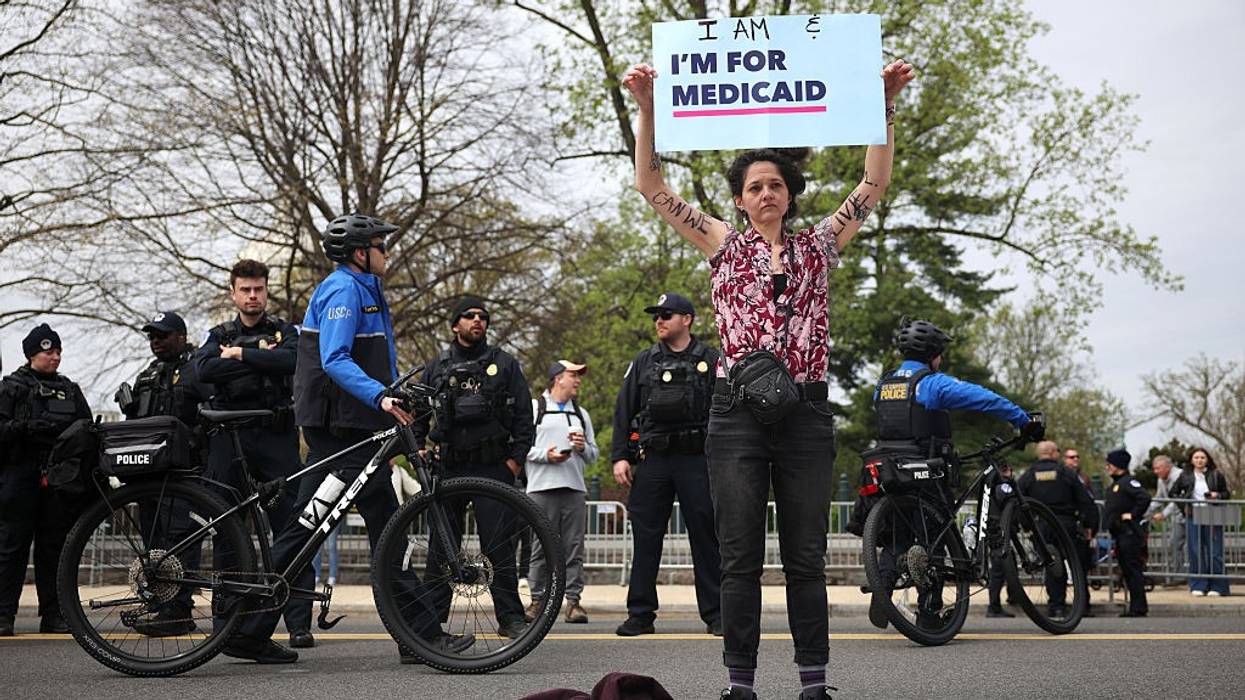
Reproductive healthcare advocates vowed to keep up the fight as conservative activists pressure Congress to make the funding ban permanent.
Planned Parenthood and other reproductive health clinics regained access to Medicaid funding on Saturday after a provision in the One Big Beautiful Bill Act defunding the organizations expired.
The provision depriving Planned Parenthood was touted as a major victory for the anti-abortion movement when the bill was signed on July 4, 2025, but, due to Senate rules, the defunding only lasted for one year, and Congress failed to renew it before their summer recess.
While this means that Planned Parenthood, Health Imperatives in Massachusetts, and Maine Family Planning can once again bill Medicaid for non-abortion related healthcare, it doesn't reverse the damage caused by a year-long lack of access to funds totaling more than $800 million per year for Planned Parenthood alone.
“Tens of thousands of patients have been denied access to services like cancer screenings and birth control and STI testing and treatment. These are things that just can’t be undone,” Nora Walsh-DeVries, vice president of political and legislative affairs at Planned Parenthood Action Fund, told The Hill.
"Patients have totally borne the cost of this politically motivated attack on care."
In a report published July 1, Planned Parenthood and Planned Parenthood Action Fund said that the defunding had led to the closure of almost 30 health centers, two-thirds of which were in rural areas, or locations that had a shortage of medical services or healthcare professionals. In addition, all of the closed centers were in "contraceptive deserts." Overall, the number of Medicaid visits to the organization decreased by 25% compared with the year before.
“By deliberately targeting Planned Parenthood, President [Donald] Trump and his allies in Congress worsened a public health crisis, making it harder for people to get the essential and lifesaving care they needed at their trusted provider," Alexis McGill Johnson, president and CEO of Planned Parenthood Federation of America and Planned Parenthood Action Fund, said in a statement.
Olivia Pennington, a spokesperson for Maine Family Planning, told NPR, "It's been devastating to see this defund and to see the impacts that it's had across the nation."
As Walsh-DeVries further told The Hill, “I think it’s just really clear that patients have totally borne the cost of this politically motivated attack on care."
Despite the restoration of funding, uncertainty lingers. Walsh-DeVries said that it wasn't clear how clinics could obtain the restored funds, and states can now block Medicaid funds to Planned Parenthood on their own, thanks to a Supreme Court ruling last year. To date, 13 states have blocked or tried to block funds.
What's more, conservative and anti-abortion advocates have expressed outrage at Congress' failure to extend the funding ban, and are determined to pressure it do so via a reconciliation bill.
"This failure must be corrected immediately. President Trump and Congress must act as fast as possible to restore and extend the defunding of Planned Parenthood and every organization that commits abortion," Lila Rose, founder and president of anti-abortion group Live Action, said in a statement.
However, 65% of Americans oppose congressional efforts to defund Planned Parenthood, according to polling by the organization, and it is unclear if Republicans as a whole have the political will to renew the ban ahead of the midterm elections. Planned Parenthood Action Fund is currently mobilizing to unseat House republicans who voted for the ban last year.
“We have to really continue to do the work that we’re doing to make this as politically toxic as possible,” Walsh-DeVries told Politico.
McGill Johnson affirmed: "Anti-abortion lawmakers are trying to make ‘defund’ permanent because Planned Parenthood health centers provide abortion care where it’s legal. They are willing to sacrifice the lives and health of people across the country if it gets them closer to their goal of banning abortion everywhere and shutting down Planned Parenthood."
She continued: "We’re in a fight for survival—not just for Planned Parenthood health centers, but for everyone to get high-quality, affordable healthcare from their trusted provider. And know this: Planned Parenthood will never stop fighting to ensure everyone can get the care they need.”