SUBSCRIBE TO OUR FREE NEWSLETTER
Daily news & progressive opinion—funded by the people, not the corporations—delivered straight to your inbox.
5
#000000
#FFFFFF
To donate by check, phone, or other method, see our More Ways to Give page.
Daily news & progressive opinion—funded by the people, not the corporations—delivered straight to your inbox.
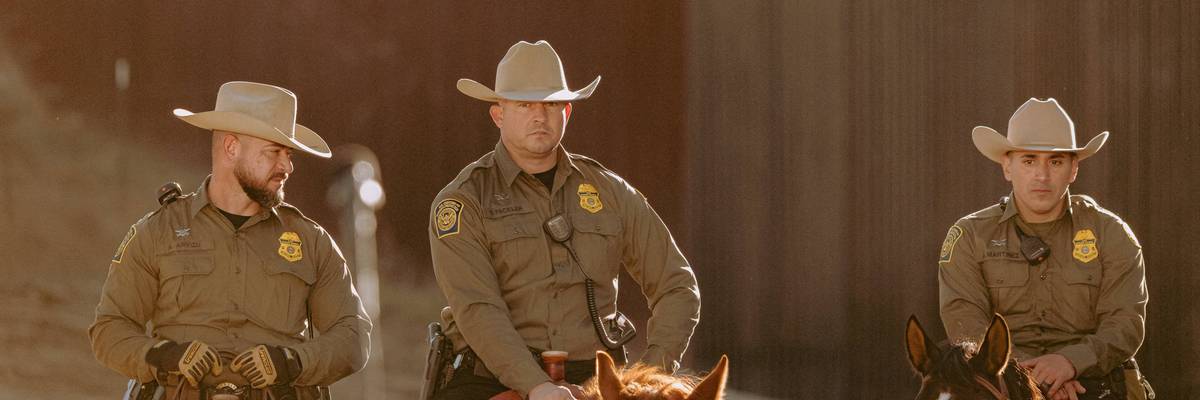
US Border Patrol agents ride horses before US Homeland Security Secretary Kristi Noem meets agents by the wall at the US-Mexico border in Nogales, Arizona, on February 4, 2026.
“This settlement confirms what we already knew: What happened to us was wrong,” said an award-winning photographer detained at the US-Mexico border as part of a secret program to target journalists in 2019.
In what the ACLU called a "win for freedom of the press," a pair of federal immigration agencies announced on Wednesday that they settled a lawsuit with five photojournalists who claimed to have been unconstitutionally detained and questioned while reporting at the US-Mexico border.
The five journalists—Bing Guan, Go Nakamura, Mark Abramson, Kitra Cahana, and Ariana Drehsler—are all citizens of the United States who traveled to the border in 2018 and 2019 to report on the journeys of people traveling from Central America as part of migrant caravans.
The journalists said that after reporting on conditions at the border, they were detained by US border officers and questioned about their sources and observations while reporting, which they said was a violation of their First Amendment right in a lawsuit.
"It’s clear the government’s actions were meant to instill fear in journalists like me, to cow us into standing down from reporting what is happening on the ground," said Guan, a freelance photographer who has contributed to Reuters, Bloomberg, the New York Times, and the Wall Street Journal, among other publications.
Shortly after these five journalists were detained, NBC News reported that they were targeted as part of a broader operation by US Customs and Border Protection's (CBP) San Diego sector to detain and interrogate a list of dozens of journalists, lawyers, and activists labeled as "instigators."
Others on this list who were detained, including US citizens, reported being aggressively interrogated about their political views and opinions about the Trump administration.
Tactics have only grown more aggressive during President Donald Trump's second term: Federal immigration agents have hauled off journalists in unmarked vans for recording them, and the administration has repeatedly asserted, incorrectly, that it is illegal to film ICE agents on duty or reveal their identities.
Homeland Security Secretary Kristi Noem has claimed that recording ICE agents in public constitutes “violence” or a “threat” to agents' safety, and a DHS bulletin issued last year has classified recording at protests as “unlawful civil unrest."
However, several federal courts have overwhelmingly held that the First Amendment protects the right to film law enforcement, including ICE and Customs and Border Protection.
Esha Bhandari, director of the ACLU Speech, Privacy, and Technology project, said the settlement, reached in January, affirms that "the First Amendment applies at the border to protect freedom of the press."
As part of the settlement, CBP will be required to issue guidance to certain border units on First Amendment and Privacy Act protections that apply when questioning journalists at the border.
While the scope of the settlement is limited and does little to protect journalists under threat nationwide, Kitra Cahana, an award-winning photographer and another plaintiff, said it still serves as an important affirmation of press freedom.
“This settlement confirms what we already knew: what happened to us was wrong,” Cahana said. “Government officials should never put journalists on secret lists, interfere with our ability to work and travel, or pressure us for information at border crossings."
"My biggest fear is that other journalists may have avoided important stories out of fear of being targeted themselves," she added. "Press freedom is not a partisan issue. Everyone should be alarmed when journalists are targeted.”
Dear Common Dreams reader, It’s been nearly 30 years since I co-founded Common Dreams with my late wife, Lina Newhouser. We had the radical notion that journalism should serve the public good, not corporate profits. It was clear to us from the outset what it would take to build such a project. No paid advertisements. No corporate sponsors. No millionaire publisher telling us what to think or do. Many people said we wouldn't last a year, but we proved those doubters wrong. Together with a tremendous team of journalists and dedicated staff, we built an independent media outlet free from the constraints of profits and corporate control. Our mission has always been simple: To inform. To inspire. To ignite change for the common good. Building Common Dreams was not easy. Our survival was never guaranteed. When you take on the most powerful forces—Wall Street greed, fossil fuel industry destruction, Big Tech lobbyists, and uber-rich oligarchs who have spent billions upon billions rigging the economy and democracy in their favor—the only bulwark you have is supporters who believe in your work. But here’s the urgent message from me today. It's never been this bad out there. And it's never been this hard to keep us going. At the very moment Common Dreams is most needed, the threats we face are intensifying. We need your support now more than ever. We don't accept corporate advertising and never will. We don't have a paywall because we don't think people should be blocked from critical news based on their ability to pay. Everything we do is funded by the donations of readers like you. When everyone does the little they can afford, we are strong. But if that support retreats or dries up, so do we. Will you donate now to make sure Common Dreams not only survives but thrives? —Craig Brown, Co-founder |
In what the ACLU called a "win for freedom of the press," a pair of federal immigration agencies announced on Wednesday that they settled a lawsuit with five photojournalists who claimed to have been unconstitutionally detained and questioned while reporting at the US-Mexico border.
The five journalists—Bing Guan, Go Nakamura, Mark Abramson, Kitra Cahana, and Ariana Drehsler—are all citizens of the United States who traveled to the border in 2018 and 2019 to report on the journeys of people traveling from Central America as part of migrant caravans.
The journalists said that after reporting on conditions at the border, they were detained by US border officers and questioned about their sources and observations while reporting, which they said was a violation of their First Amendment right in a lawsuit.
"It’s clear the government’s actions were meant to instill fear in journalists like me, to cow us into standing down from reporting what is happening on the ground," said Guan, a freelance photographer who has contributed to Reuters, Bloomberg, the New York Times, and the Wall Street Journal, among other publications.
Shortly after these five journalists were detained, NBC News reported that they were targeted as part of a broader operation by US Customs and Border Protection's (CBP) San Diego sector to detain and interrogate a list of dozens of journalists, lawyers, and activists labeled as "instigators."
Others on this list who were detained, including US citizens, reported being aggressively interrogated about their political views and opinions about the Trump administration.
Tactics have only grown more aggressive during President Donald Trump's second term: Federal immigration agents have hauled off journalists in unmarked vans for recording them, and the administration has repeatedly asserted, incorrectly, that it is illegal to film ICE agents on duty or reveal their identities.
Homeland Security Secretary Kristi Noem has claimed that recording ICE agents in public constitutes “violence” or a “threat” to agents' safety, and a DHS bulletin issued last year has classified recording at protests as “unlawful civil unrest."
However, several federal courts have overwhelmingly held that the First Amendment protects the right to film law enforcement, including ICE and Customs and Border Protection.
Esha Bhandari, director of the ACLU Speech, Privacy, and Technology project, said the settlement, reached in January, affirms that "the First Amendment applies at the border to protect freedom of the press."
As part of the settlement, CBP will be required to issue guidance to certain border units on First Amendment and Privacy Act protections that apply when questioning journalists at the border.
While the scope of the settlement is limited and does little to protect journalists under threat nationwide, Kitra Cahana, an award-winning photographer and another plaintiff, said it still serves as an important affirmation of press freedom.
“This settlement confirms what we already knew: what happened to us was wrong,” Cahana said. “Government officials should never put journalists on secret lists, interfere with our ability to work and travel, or pressure us for information at border crossings."
"My biggest fear is that other journalists may have avoided important stories out of fear of being targeted themselves," she added. "Press freedom is not a partisan issue. Everyone should be alarmed when journalists are targeted.”
In what the ACLU called a "win for freedom of the press," a pair of federal immigration agencies announced on Wednesday that they settled a lawsuit with five photojournalists who claimed to have been unconstitutionally detained and questioned while reporting at the US-Mexico border.
The five journalists—Bing Guan, Go Nakamura, Mark Abramson, Kitra Cahana, and Ariana Drehsler—are all citizens of the United States who traveled to the border in 2018 and 2019 to report on the journeys of people traveling from Central America as part of migrant caravans.
The journalists said that after reporting on conditions at the border, they were detained by US border officers and questioned about their sources and observations while reporting, which they said was a violation of their First Amendment right in a lawsuit.
"It’s clear the government’s actions were meant to instill fear in journalists like me, to cow us into standing down from reporting what is happening on the ground," said Guan, a freelance photographer who has contributed to Reuters, Bloomberg, the New York Times, and the Wall Street Journal, among other publications.
Shortly after these five journalists were detained, NBC News reported that they were targeted as part of a broader operation by US Customs and Border Protection's (CBP) San Diego sector to detain and interrogate a list of dozens of journalists, lawyers, and activists labeled as "instigators."
Others on this list who were detained, including US citizens, reported being aggressively interrogated about their political views and opinions about the Trump administration.
Tactics have only grown more aggressive during President Donald Trump's second term: Federal immigration agents have hauled off journalists in unmarked vans for recording them, and the administration has repeatedly asserted, incorrectly, that it is illegal to film ICE agents on duty or reveal their identities.
Homeland Security Secretary Kristi Noem has claimed that recording ICE agents in public constitutes “violence” or a “threat” to agents' safety, and a DHS bulletin issued last year has classified recording at protests as “unlawful civil unrest."
However, several federal courts have overwhelmingly held that the First Amendment protects the right to film law enforcement, including ICE and Customs and Border Protection.
Esha Bhandari, director of the ACLU Speech, Privacy, and Technology project, said the settlement, reached in January, affirms that "the First Amendment applies at the border to protect freedom of the press."
As part of the settlement, CBP will be required to issue guidance to certain border units on First Amendment and Privacy Act protections that apply when questioning journalists at the border.
While the scope of the settlement is limited and does little to protect journalists under threat nationwide, Kitra Cahana, an award-winning photographer and another plaintiff, said it still serves as an important affirmation of press freedom.
“This settlement confirms what we already knew: what happened to us was wrong,” Cahana said. “Government officials should never put journalists on secret lists, interfere with our ability to work and travel, or pressure us for information at border crossings."
"My biggest fear is that other journalists may have avoided important stories out of fear of being targeted themselves," she added. "Press freedom is not a partisan issue. Everyone should be alarmed when journalists are targeted.”