

SUBSCRIBE TO OUR FREE NEWSLETTER
Daily news & progressive opinion—funded by the people, not the corporations—delivered straight to your inbox.
5
#000000
#FFFFFF
To donate by check, phone, or other method, see our More Ways to Give page.
Daily news & progressive opinion—funded by the people, not the corporations—delivered straight to your inbox.

Expert contact: Tiffany Finck-Haynes, Friends of the Earth, (202) 222-0715, tfinckhaynes@foe.org
Communications contact: Kate Colwell, Friends of the Earth, (202) 222-0744, kcolwell@foe.org
Today the Bee Informed Partnership, in collaboration with the Apiary Inspectors of America and the United States Department of Agriculture, released its annual report on honey bee losses in the United States based on a national survey of beekeepers. Most significantly, beekeepers reported losing 42.1 percent of the total number of colonies managed over the last year (total annual loss, between April 2014 and April 2015). This represents the second highest annual loss recorded to date.
Preliminary results indicate that during the winter of 2014-2015 U.S. beekeepers lost 23.1 percent of their hives on average, which is lower than average losses in recent years, but considered too high to be sustainable. U.S. beekeepers lost an average of 27.4 percent of their hives in the summer of 2014 (April-October), which is higher than 2013 summer losses.
A large and growing body of science has attributed alarming bee declines in recent years to several key factors, including exposure to the world's most widely used class of insecticides, neonicotinoids. In 2013, the European Union banned the three most widely used neonicotinoids based on the weight of scientific evidence indicating that these pesticides can kill bees outright and make them more vulnerable to pests, pathogens and other stressors. However, these pesticides are still widely used in the U.S. despite massive bee losses that threaten vital food crops, from almonds in California to apples in Washington.
Tiffany Finck-Haynes, food futures campaigner with Friends of the Earth, said "These dire honey bee numbers add to the consistent pattern of unsustainable bee losses in recent years that threatens our food system. The science is clear -- we must take action now to protect these essential pollinators from bee-toxic pesticides."
More than 4 million Americans have signed petitions to the Obama administration demanding immediate restrictions on systemic neonicotinoid pesticides linked to bee declines. The White House Task Force on Pollinator Health is expected to release a plan for bee protection in the near future. This plan is required by a Presidential Memorandum, issued by President Obama in June 2014, which called for a federal strategy to protect pollinators and called on the EPA to assess the effect of pesticides, including neonicotinoids, on bees and other pollinators within 180 days.
On April 2, the EPA announced a moratorium on new or expanded uses of neonicotinoids while it evaluates the risks posed to pollinators. In October, 2014, the Council on Environmental Quality issued guidance for federal facilities and federal lands which included acquiring seeds and plants from nurseries that do not treat these items with systemic insecticides.
In response to a campaign by Friends of the Earth and allies, more than twenty garden stores, nurseries, and landscaping companies, including Lowe's (NYSE: LOW) and Home Depot (NYSE: HD), the two largest home improvement retailers in the world, BJ's Wholesale Club and Whole Foods (NASDAQ: WFM) have taken steps to restrict neonicotinoids in their stores.
Last April, Friends of the Earth released a report, "Follow the Honey: 7 ways pesticide companies are spinning the bee crisis to protect profits," which documents the deceptive PR tactics used by agrochemical companies including Germany-based Bayer (DE: BAYN), Switzerland-based Syngenta (NYSE: SYT) and U.S.-based Monsanto (NYSE: MON), to deflect blame from their products' contributions to bee declines and delay regulatory action on neonicotinoid pesticides.
"Bayer, Syngenta and Monsanto make billions from bee-killing pesticide products while masquerading as champions of bee health," Finck-Haynes said. "Are their profits more important than our food supply? Are they more important than the livelihoods of America's farmers? The Obama administration must act now to restrict neonicotinoid pesticides that threaten America's bees, farmers and food security."
A recent study by Newcastle University recommends that reducing pesticide use "may be the only certain" way to halt bee and pollinator decline. A study by Oxford University researchers came to a similar conclusion, documenting that organic agriculture supports 50 percent more pollinator and bee species compared with conventional, pesticide heavy agriculture.
"The solution to the bee crisis is to shift to sustainable agriculture systems that are not dependent on monoculture crops saturated in pesticides. It's time to reimagine the way we farm in the United States and incentivize organic agriculture practices that are better for bees and for all of us," Finck-Haynes said.
Friends of the Earth fights for a more healthy and just world. Together we speak truth to power and expose those who endanger the health of people and the planet for corporate profit. We organize to build long-term political power and campaign to change the rules of our economic and political systems that create injustice and destroy nature.
(202) 783-7400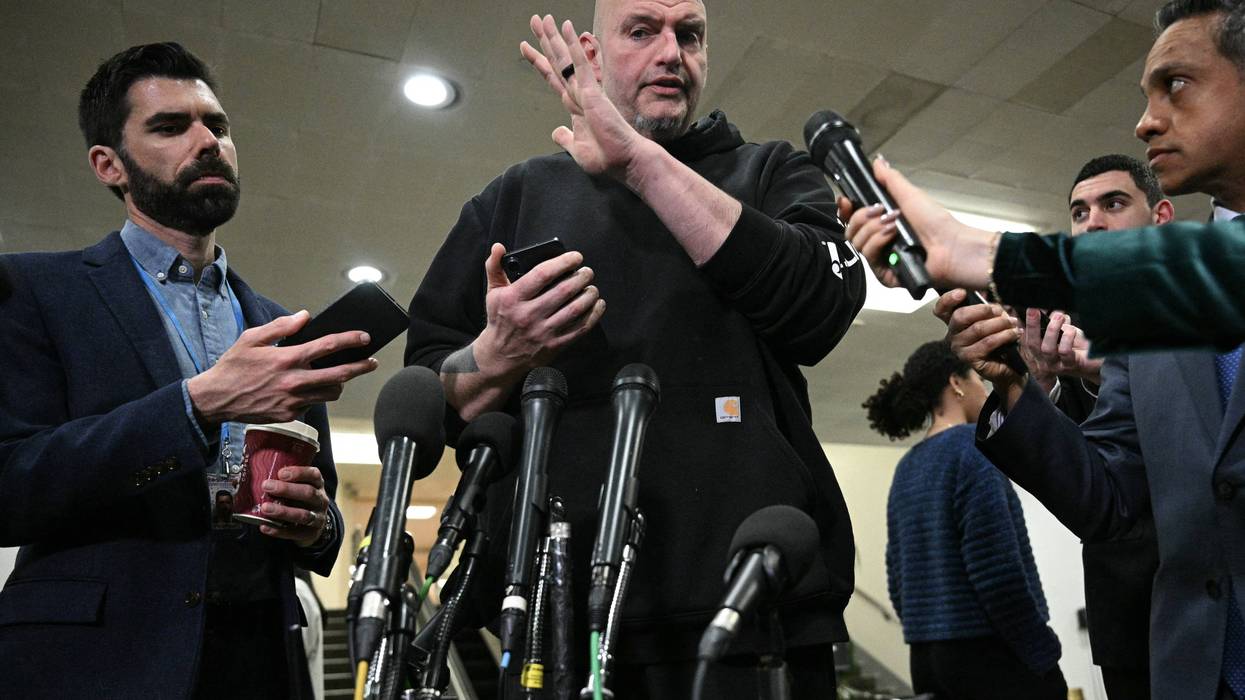
Fetterman's vote comes as recent polling has shown the Iran war has grown more unpopular over time.
The US Senate on Wednesday once again voted down a resolution that would have restricted President Donald Trump's ability to use military force against Iran, and this time a Democratic senator was the deciding vote.
The resolution failed after Sen. John Fetterman (D-Pa.) voted with the majority of Republican senators against a war powers resolution introduced by Sen. Jeff Merkley (D-Ore.).
The resolution would would have passed had Fetterman supported it because Sens. Rand Paul (R-Ky.), Susan Collins (R-Maine), Lisa Murkowski (R-Alaska) all voted in favor.
This is now the seventh time the Senate has blocked a war powers resolution on Iran since Trump illegally began the conflict in late February.
As noted by Zeteo reporter Prem Thakker, a poll taken two months ago found that Pennsylvania voters disapproved of the Iran war by 16 percentage points, and more recent national polling shows that the war has grown more unpopular over time.
"Nonetheless," Thakker commented, "John Fetterman was just a deciding vote to keep it going."
Fetterman has frequently been at odds with his party on a number of issues, including the war with Iran and building Trump's proposed luxury ballroom at the White House.
Despite the motion's failure, Ryan Costello, policy director of the National Iranian American Council, optimistically pointed out that this war powers resolution came closer to passing than any others, with Murkowski crossing the aisle for the first time to register her support.
"Sen. Murkowski moved in line with the vast majority of Americans who want this war to end," said Costello, "and did so right after hearing Secretary of War Pete Hegseth claim that the Trump administration did not need authorization from Congress to resume the war, and as gas prices in Alaska hit $5.26."
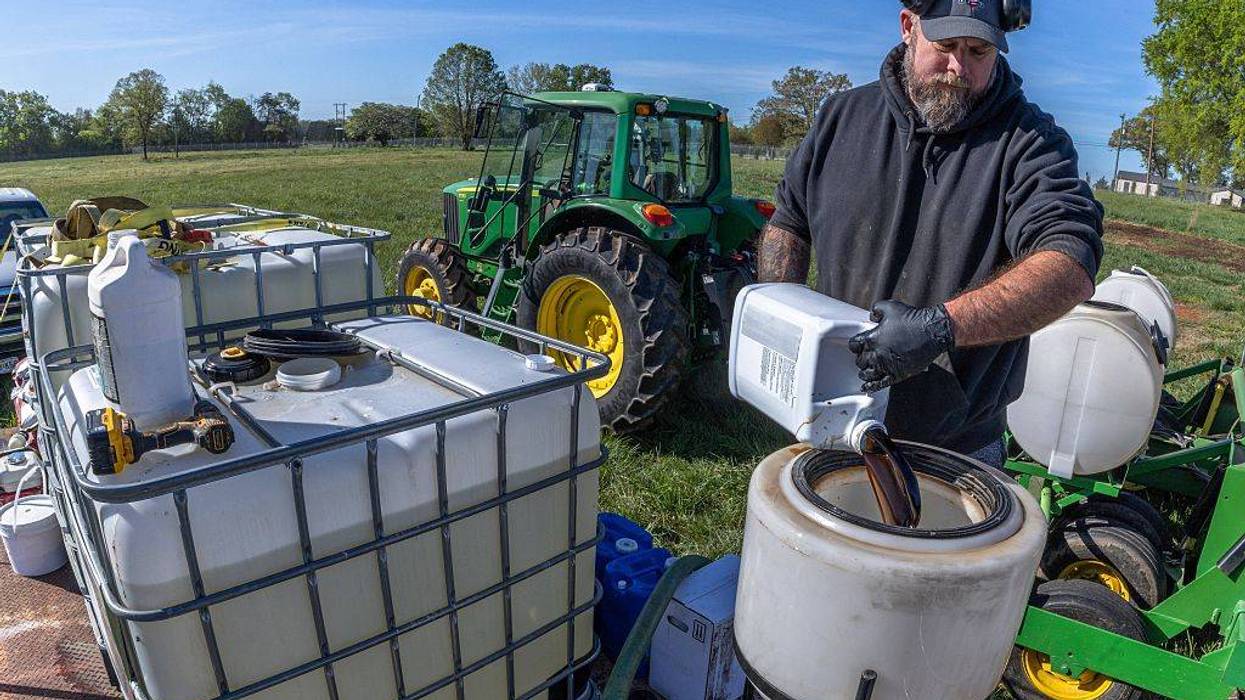
"While a few agrochemical giants shamelessly reap bumper profits, farmers are watching their livelihoods wither on the vine," said one Greenpeace campaigner.
Democratic lawmakers on Wednesday underscored how the US-Israeli war on Iran and Trump administration trade policies are hurting farmers and consumers while Big Ag profits from fast-rising fertilizer and food prices.
President Donald Trump's illegal war of choice has resulted in the closure of the Strait of Hormuz, through which around 30% of the world's fertilizer and 20% of its oil previously passed. In addition to increasing the risk of a global food crisis, the strait's closure has sent fuel and fertilizer prices soaring, with US farm diesel costing nearly 50% more than it did on the war's eve in February and nitrogen fertilizer rising by a similar percentage.
Meanwhile, Trump's erratic tariff war has further squeezed farmers and consumers. Tariffs have increased short-term prices, market volatility, and farmer costs while temporarily reducing import flows.
Vermont farmers "are footing the bill for Trump's reckless war in Iran," Rep. Becca Balint (D-Vt.) said Wednesday on social media. "Fuel and fertilizer costs are surging right amid planting season, hitting family farms that are already stretched thin. This needs to end."
Rep. Shri Thanedar (D-Mich.) said on X that "food prices are skyrocketing because 70% of farmers can't afford fertilizer, due to Trump's reckless Iran War," adding that "perhaps Trump should help them out by lending some, given that he's full of crap."
Rep. Betty McCollum (D-Minn.) noted Tuesday on Bluesky that "Minnesota’s farmers are dealing with tariffs, high fertilizer costs, expensive feed, and exorbitant fuel prices," while Trump is "planning to lay off dozens" of US Department of Agriculture workers "who help farmers protect their land and water."
The lawmakers' posts followed Tuesday's US Senate Agriculture Committee hearing on fertilizer market challenges, during which members of the Republican majority spoke vaguely of "trade disputes" and the "recent conflict in the Middle East" without naming names.
When it was her turn to speak, Ranking Member Amy Klobuchar (D-Minn.) noted the "direct link" between the soaring price of nitrogen fertilizer components and Trump's actions.
"In the months since the president started the war, with no consultation or authorization from Congress... urea has spiked more than 40%, the cost of diesel has hit near record highs in Midwest states," she said. "Now, why? Well, nearly half of the global urea goes through the Strait of Hormuz. Thirty percent of ammonia goes through the Strait of Hormuz."
Farmers are facing fertilizer prices that are through the roof because of the across-the-board tariffs, market consolidation, and uncertainties stemming from a war in Iran that was started with no consultation or authorization from Congress.
[image or embed]
— Senator Amy Klobuchar (@klobuchar.senate.gov) May 12, 2026 at 5:51 PM
"Yet, even before the war, farmers were walloped by the presence of across-the-board tariffs," Klobuchar continued. "An analysis by North Dakota State University... found that [International Emergency Economic Powers Act] tariffs added nearly $1 billion in costs to critical inputs like fertilizer, seed, machinery, and chemicals from February through October of last year."
"Acting now will ultimately help stabilize prices and give farmers the certainty they need," the senator added. "But it is going to have to be a combination of things: ending the tariffs, or reducing them, or making them much more targeted; ending this war; finding a way to resolve it, so the Strait of Hormuz is open again; and then going at this long-term systemic problem about the lack of competition in this area."
According to the advocacy group Farm Action, a handful of companies—primarily Nutrien, Mosaic, and CF Industries—dominate the North American fertilizer market, operating as an oligopoly that controls over 90% of nitrogen and potash production. Saskatchewan-based Nutrien, the world's leading potash producer, last week reported net first-quarter earnings of $139 million, up from $19 million one year ago.
"Fertilizer companies raise their prices because they can, and that's the market power that they have," Sen. Tina Smith (D-Minn.) said during Tuesday's hearing.
Noting record gains reaped amid the tumult of Russia's ongoing invasion of Ukraine, Smith said that during 2021-22, "the nine largest fertilizer companies made an estimated $84 billion in profits."
"In 2022, major fertilizer companies saw profits increase somewhere between 100 and 200%," she continued. "Their input costs did not go up by that much... How much do you think the profits of the average farmer in South Dakota [went] up during that time period?"
Pointing to new reports of robust fertilizer industry profits, South Dakota Corn Farmers president Trent Kubik replied, "during these last 75 days, a lot of money was being made, but it wasn't by farmers."
Addressing the question of "what can we do to change the behavior of companies that are in a position where they can charge such high prices and get such exorbitant profits," Smith suggested considering a "windfall profits tax" to "make the market more fair, particularly for folks that are doing the work."
The Trump administration's plan to counter high fertilizer prices includes reopening the Biden-era Fertilizer Production Expansion Program, which provides grants and financing to build or expand domestic manufacturing capacity. Some critics have slammed the program as a form of corporate welfare.
The administration is also considering further expanding a multibillion-dollar bailout program, which critics say has mainly benefited large-scale, export-oriented commodity farms.
Responding to recent reports of strong profits for nitrogen fertilizer producers, Greenpeace Aotearoa (New Zealand) Big Ag project lead Amanda Larsson said Tuesday that “the illegal US-Israeli attack on Iran has sent global fertilizer prices soaring, and while a few agrochemical giants shamelessly reap bumper profits, farmers are watching their livelihoods wither on the vine."
"This is war profiteering facilitated by a broken, fossil fuel-dependent food system—with farmers and consumers paying the price," she continued.
“Synthetic nitrogen fertilizer causes water and climate pollution, while propping up a system of industrial over-production, particularly to produce monoculture feed crops for livestock," Larsson said. "We are sacrificing our rivers, our climate, and our financial security to prop up a system that serves billionaires, not communities."
“We cannot buy food security on a volatile global chemical market," she added. "The only path to true food sovereignty and resilience is through a transition to ecological farming. By moving away from synthetic fertilizers and toward diverse, nature-based practices, we can break the cycle of chemical dependence, protect our water, and ensure that the price of food is no longer dictated by the whims of war and corporate greed.”
“The dichotomy between the contractors’ profits and the detainees’ pay is outrageous."
As President Donald Trump continues his mass detention and deportation agenda and expands the use of privately owned immigrant prisons, with more than 60,000 people detained across the country, the profits of private contractors like the GEO Group and CoreCivic are skyrocketing—and a new report by a government watchdog reveals one method the multibillion-dollar firms have of extracting profits from detainees.
Public Citizen researcher Douglas Pasternak wrote in a report released Wednesday that approximately 50% of immigrants who are detained for more than a few days end up in the government's so-called Voluntary Work Program (VWP), earning just $1 per day—12.5 cents per hour—while they keep the detention centers running.
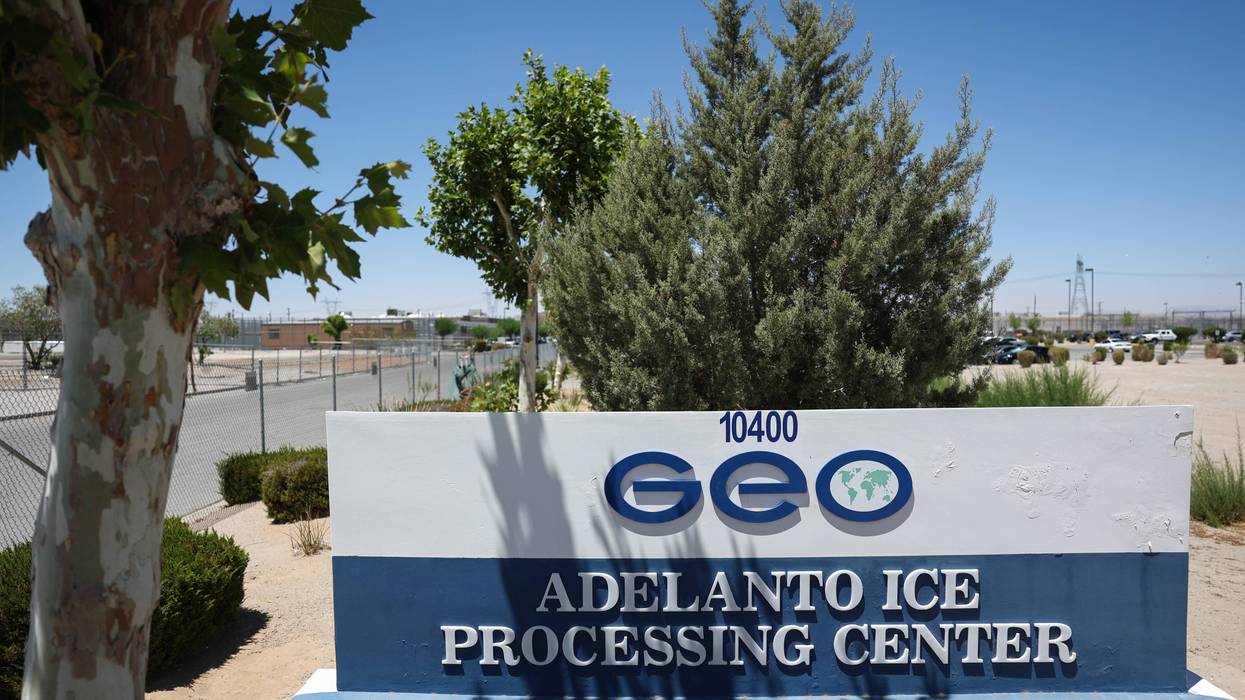
At facilities like Adelanto Detention Center in Adelanto, California, run by the GEO Group, and CoreCivic's Stewart Detention Center in Lumpkin, Georgia, detainees work as many as 14 hours in a day for just $1—cooking, cleaning, performing maintenance work, and completing other labor essential to the facilities' operations—and in many cases are forced to use their meager wages only at commissaries also run by the corporations.
"This entire $1-a-day pay scheme is economically unjustifiable, fundamentally unfair, and morally reprehensible," said Pasternak in a statement.
The companies are notorious for price gouging, forcing the so-called "voluntary worker" to work full-time for 11 days to afford a tube of Sensodyne toothpaste—priced at $11.02 at Stewart Detention Center, compared to just $5.20 on Amazon.
"At these rates, it may take a detainee more than three days of work to purchase a can of tuna fish or more than two days of work to purchase a bar of soap," said Public Citizen.
The business model has saved the contractors millions of dollars and allowed them to reap massive profits.
Former CoreCivic CEO Damon Hininger made $7.2 million in compensation last year before retiring, and the company's profits grew from $68.9 million in 2024 to $116.5 million last year. Both CoreCivic and the GEO Group reported well over $2 billion in revenue in 2025.
“The private contractors running immigrant detention centers are pocketing millions of dollars in profits as tens of thousands of detainees struggle to afford to purchase a bar of soap or a tube of toothpaste."
When it was sued over its use of the VWP in Washington State, the GEO Group testified that it would have had to pay 85 full-time employees at the state's minimum wage—$17.13 per hour—if it hadn't used the labor of detainees. Hiring workers would have cost the company over $3 million per year, but instead the GEO Group spent just over $22,000 paying imprisoned immigrants $1 per hour.
“The private contractors running immigrant detention centers are pocketing millions of dollars in profits as tens of thousands of detainees struggle to afford to purchase a bar of soap or a tube of toothpaste,” said Pasternak. “The dichotomy between the contractors’ profits and the detainees’ pay is outrageous."
In the case in Washington state, a court found that the GEO Group owed $17 million in back pay to thousands of detainees and owed nearly $6 million to the state for "unjust enrichment." The company has appealed to the Supreme Court. There are at least six other federal court cases challenging private companies for paying immigrant detainees $1 per day.
The report also describes a nine-bedroom, 11-bathroom, 18,523-square-foot home owned by GEO Group co-founder George Zoley in Boca Raton, Florida—estimated to be worth more than $22.5 million.
"The disparity between Zoley’s wealth and the $1 per day pay to detained immigrants is striking," reads the report. "The tens of thousands of immigrants detained by the US government deserve better than being paid $1 per day, and the federal contractors building an extensive network of detention camps across the country should not be making excessive profits at their expense."