SUBSCRIBE TO OUR FREE NEWSLETTER
Daily news & progressive opinion—funded by the people, not the corporations—delivered straight to your inbox.
5
#000000
#FFFFFF
To donate by check, phone, or other method, see our More Ways to Give page.
Daily news & progressive opinion—funded by the people, not the corporations—delivered straight to your inbox.
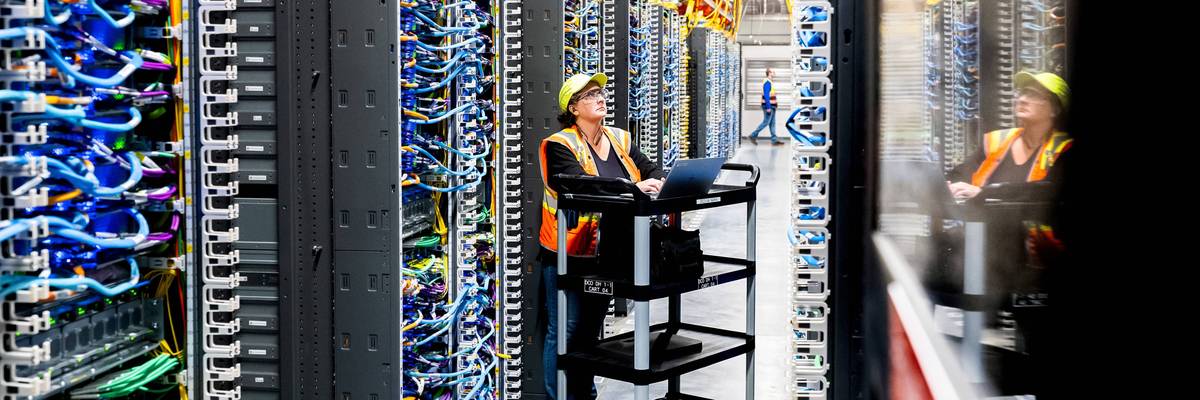
In this handout provided by Amazon, a technician works at an Amazon Web Services artificial intelligence data center in New Carlisle, Indiana on October 2, 2025.
"Maryland customers have neither caused the need for these billions in new transmission projects, nor will they meaningfully benefit from them," said Maryland People’s Counsel David S. Lapp.
A top state utilities regulator is calling foul on an effort to shift the power cost of out-of-state artificial intelligence data centers onto Maryland residents.
Maryland's Office of People's Counsel on Thursday filed a complaint with the Federal Energy Regulatory Commission (FERC) against electric grid operator PJM Interconnection objecting to plans that it said would force residents in the state to pay $1.6 billion in data center-driven transmission costs over the next decade.
The complaint states that the transmission cost allocation methodology PJM is using "broadly socializes" the cost of increased power demands that is being driven by AI data centers.
"That result is unjust and unreasonable and violates the cost causation principles that have long governed transmission cost allocation and that this commission has repeatedly affirmed," the complaint says. "PJM’s tariff imposes these costs on Maryland electric customers even though Maryland customers do not meaningfully cause nor benefit from those investments."
The Office of People's Counsel pointed to the massive number of data centers built in neighboring Virginia as a primary culprit for added strain on the electric grid.
"Amidst national data center growth, Virginia stands as the epicenter," the complaint says. "Virginia is the largest data center market in the world... As of December 2024, data centers represented 3.6 GW of demand... reflecting, since 2013, a 660% increase in megawatt-hour consumption."
This explosive growth in energy demand is only expected to intensify over the next several years, the complaint continues, noting that "PJM projects 32 GW of peak load growth across its territory by 2030, of which approximately 30 GW is attributable to data centers."
As a remedy, the complaint asks FERC to "require PJM to take immediate action to assign data center-driven transmission costs to the PJM zones where the data center customers are located" instead of shifting the cost to Marylanders.
Commenting on his office's complaint, Maryland People’s Counsel David S. Lapp said that the attempt to saddle Maryland consumers with a $1.6 billion bill for facilities outside the state's borders shows "PJM’s cost allocation rules are broken."
"Maryland customers have neither caused the need for these billions in new transmission projects," Lapp added, "nor will they meaningfully benefit from them."
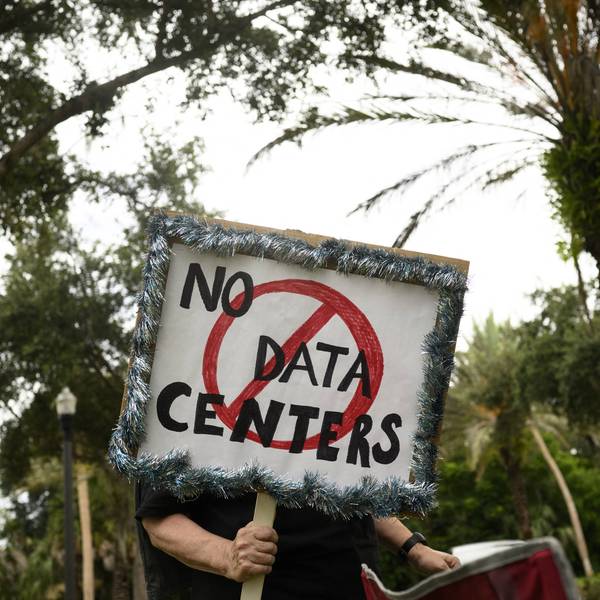
Data centers have become political lightning rods in recent months, as residents from across the country object to their mass resource consumption, which is leading to a major spike in utilities bills, as well as the noise pollution they generate.
As CNBC reported earlier this year, PJM currently projects that it will be a 6 GW short of its reliability requirements in 2027 thanks to the added demand from data centers.
Sen. Bernie Sanders (I-Vt.) and Rep. Alexandria Ocasio-Cortez (D-NY) earlier this year introduced a bill that would impose a nationwide moratorium on AI data center construction “until strong national safeguards are in place to protect workers, consumers, and communities, defend privacy and civil rights, and ensure these technologies do not harm our environment.”
Dear Common Dreams reader, It’s been nearly 30 years since I co-founded Common Dreams with my late wife, Lina Newhouser. We had the radical notion that journalism should serve the public good, not corporate profits. It was clear to us from the outset what it would take to build such a project. No paid advertisements. No corporate sponsors. No millionaire publisher telling us what to think or do. Many people said we wouldn't last a year, but we proved those doubters wrong. Together with a tremendous team of journalists and dedicated staff, we built an independent media outlet free from the constraints of profits and corporate control. Our mission has always been simple: To inform. To inspire. To ignite change for the common good. Building Common Dreams was not easy. Our survival was never guaranteed. When you take on the most powerful forces—Wall Street greed, fossil fuel industry destruction, Big Tech lobbyists, and uber-rich oligarchs who have spent billions upon billions rigging the economy and democracy in their favor—the only bulwark you have is supporters who believe in your work. But here’s the urgent message from me today. It's never been this bad out there. And it's never been this hard to keep us going. At the very moment Common Dreams is most needed, the threats we face are intensifying. We need your support now more than ever. We don't accept corporate advertising and never will. We don't have a paywall because we don't think people should be blocked from critical news based on their ability to pay. Everything we do is funded by the donations of readers like you. When everyone does the little they can afford, we are strong. But if that support retreats or dries up, so do we. Will you donate now to make sure Common Dreams not only survives but thrives? —Craig Brown, Co-founder |
A top state utilities regulator is calling foul on an effort to shift the power cost of out-of-state artificial intelligence data centers onto Maryland residents.
Maryland's Office of People's Counsel on Thursday filed a complaint with the Federal Energy Regulatory Commission (FERC) against electric grid operator PJM Interconnection objecting to plans that it said would force residents in the state to pay $1.6 billion in data center-driven transmission costs over the next decade.
The complaint states that the transmission cost allocation methodology PJM is using "broadly socializes" the cost of increased power demands that is being driven by AI data centers.
"That result is unjust and unreasonable and violates the cost causation principles that have long governed transmission cost allocation and that this commission has repeatedly affirmed," the complaint says. "PJM’s tariff imposes these costs on Maryland electric customers even though Maryland customers do not meaningfully cause nor benefit from those investments."
The Office of People's Counsel pointed to the massive number of data centers built in neighboring Virginia as a primary culprit for added strain on the electric grid.
"Amidst national data center growth, Virginia stands as the epicenter," the complaint says. "Virginia is the largest data center market in the world... As of December 2024, data centers represented 3.6 GW of demand... reflecting, since 2013, a 660% increase in megawatt-hour consumption."
This explosive growth in energy demand is only expected to intensify over the next several years, the complaint continues, noting that "PJM projects 32 GW of peak load growth across its territory by 2030, of which approximately 30 GW is attributable to data centers."
As a remedy, the complaint asks FERC to "require PJM to take immediate action to assign data center-driven transmission costs to the PJM zones where the data center customers are located" instead of shifting the cost to Marylanders.
Commenting on his office's complaint, Maryland People’s Counsel David S. Lapp said that the attempt to saddle Maryland consumers with a $1.6 billion bill for facilities outside the state's borders shows "PJM’s cost allocation rules are broken."
"Maryland customers have neither caused the need for these billions in new transmission projects," Lapp added, "nor will they meaningfully benefit from them."
Data centers have become political lightning rods in recent months, as residents from across the country object to their mass resource consumption, which is leading to a major spike in utilities bills, as well as the noise pollution they generate.
As CNBC reported earlier this year, PJM currently projects that it will be a 6 GW short of its reliability requirements in 2027 thanks to the added demand from data centers.
Sen. Bernie Sanders (I-Vt.) and Rep. Alexandria Ocasio-Cortez (D-NY) earlier this year introduced a bill that would impose a nationwide moratorium on AI data center construction “until strong national safeguards are in place to protect workers, consumers, and communities, defend privacy and civil rights, and ensure these technologies do not harm our environment.”
A top state utilities regulator is calling foul on an effort to shift the power cost of out-of-state artificial intelligence data centers onto Maryland residents.
Maryland's Office of People's Counsel on Thursday filed a complaint with the Federal Energy Regulatory Commission (FERC) against electric grid operator PJM Interconnection objecting to plans that it said would force residents in the state to pay $1.6 billion in data center-driven transmission costs over the next decade.
The complaint states that the transmission cost allocation methodology PJM is using "broadly socializes" the cost of increased power demands that is being driven by AI data centers.
"That result is unjust and unreasonable and violates the cost causation principles that have long governed transmission cost allocation and that this commission has repeatedly affirmed," the complaint says. "PJM’s tariff imposes these costs on Maryland electric customers even though Maryland customers do not meaningfully cause nor benefit from those investments."
The Office of People's Counsel pointed to the massive number of data centers built in neighboring Virginia as a primary culprit for added strain on the electric grid.
"Amidst national data center growth, Virginia stands as the epicenter," the complaint says. "Virginia is the largest data center market in the world... As of December 2024, data centers represented 3.6 GW of demand... reflecting, since 2013, a 660% increase in megawatt-hour consumption."
This explosive growth in energy demand is only expected to intensify over the next several years, the complaint continues, noting that "PJM projects 32 GW of peak load growth across its territory by 2030, of which approximately 30 GW is attributable to data centers."
As a remedy, the complaint asks FERC to "require PJM to take immediate action to assign data center-driven transmission costs to the PJM zones where the data center customers are located" instead of shifting the cost to Marylanders.
Commenting on his office's complaint, Maryland People’s Counsel David S. Lapp said that the attempt to saddle Maryland consumers with a $1.6 billion bill for facilities outside the state's borders shows "PJM’s cost allocation rules are broken."
"Maryland customers have neither caused the need for these billions in new transmission projects," Lapp added, "nor will they meaningfully benefit from them."
Data centers have become political lightning rods in recent months, as residents from across the country object to their mass resource consumption, which is leading to a major spike in utilities bills, as well as the noise pollution they generate.
As CNBC reported earlier this year, PJM currently projects that it will be a 6 GW short of its reliability requirements in 2027 thanks to the added demand from data centers.
Sen. Bernie Sanders (I-Vt.) and Rep. Alexandria Ocasio-Cortez (D-NY) earlier this year introduced a bill that would impose a nationwide moratorium on AI data center construction “until strong national safeguards are in place to protect workers, consumers, and communities, defend privacy and civil rights, and ensure these technologies do not harm our environment.”