
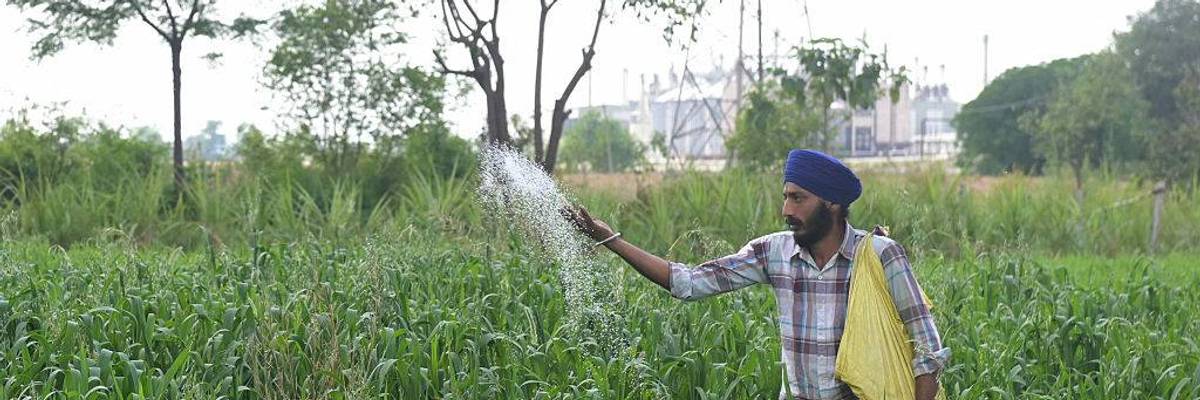
A farmer sprinkles fertilizer on crops in a field on the outskirts of Amritsar on April 9, 2026.
Risk of 'Significant and Severe' Food Crisis If Strait of Hormuz Remains Shut, Says Top UN Official
Trump's Iran War has caused "a massive disruption in the supply chain of fertilizers," and "clearly we are seeing a crisis emerging" in the agricultural industry, said one UN expert.
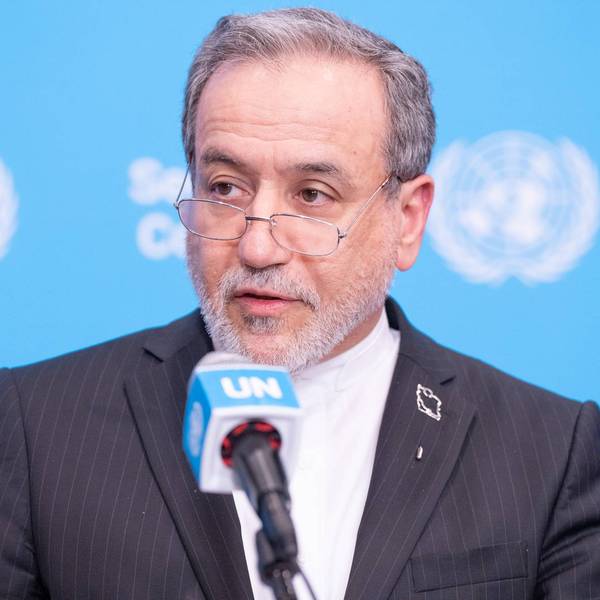
A top United Nations official on Tuesday warned that there is a real risk of a global food crisis if the Strait of Hormuz remains closed to shipments of fertilizer.
Jorge Moreira da Silva, executive director of the UN Office for Project Services (UNOPS), said in an interview with UN News that roughly one-third of global fertilizer shipments flow through the Strait of Hormuz, and its closure has caused "a massive disruption in the supply chain of fertilizers," and "clearly we are seeing a crisis emerging" in the agricultural industry.
The UN official also emphasized the need for a fast resolution to the crisis to prevent catastrophic food shortages as tensions continued to escalate in the strait in recent days, with both the US and Iran seizing vessels in the area.
"We can’t wait until everything is fixed to at least get something fixed in time for the planting season," he emphasized. "The planting season has already started, and in most countries in Africa it will end in May. So, if we don’t get some solution immediately, the crisis will be very significant and severe, particularly for the poorest countries and for the poorest citizens."
While poorer nations are most vulnerable to fertilizer supply shocks, wealthy nations like the US are taking a hit as well.
A survey released last week by the American Farm Bureau Federation (AFBF) found that 70% of US farmers say the price of fertilizer has grown so high that they will not be able to afford all they need for the 2026 planting season.
Analysis conducted by AFBF found that, since President Donald Trump illegally launched his war with Iran in late February without any congressional approval, "nitrogen fertilizer prices have risen more than 30%, while combined fuel and fertilizer costs have increased roughly 20% to 40%."
AFBF also found that the cost of widely used urea fertilizers "have increased by 47% since the end of February, marking the largest month-to-month percentage increase" ever.
Zippy Duvall, president of AFBF, warned that "without the necessary fertilizers, we’ll face lower yields and some farmers will reduce acres altogether, which will impact food and feed supplies."
An analysis published by Bloomberg's Tracy Alloway on Wednesday found that "all the signs are already pointing to higher prices" for food in the coming weeks thanks to Trump's Iran War.
"Bank of America’s Commodity Inflation Trendspotter for food and beverage companies shows March input costs up a whopping 373 basis points to 7.9% year-on-year," explained Alloway. "That jump was driven mostly by diesel and heating oil, meaning we haven’t even seen much impact from things like higher plastics prices or fertilizer just yet."
Alloway pointed to the skyrocketing price of urea as particularly worrisome for food prices, as once Midwestern farmers start paying more for the fertilizer, "you start seeing higher prices for everything from actual grains to beef, chicken, eggs, ethanol," and more.
The bottom line, Alloway wrote, is "rising fertilizer prices are now hitting farmers, and eventually those will translate into higher wholesale food prices which will (assuming higher costs are passed onto consumers) eventually land at grocery stores too."
"The inflationary impulse doesn’t arrive all at once," she added, "it builds."
We are at a crossroads
This country and this world are at a monumental crossroads. In a few short weeks, US voters will have an opportunity to beat back the forces of fascism and confront the billionaires who are rigging the economy, our media system, and our democracy, making it increasingly impossible for ordinary people to get by. We’re not just talking about the election. We’re talking about what must be done once these fascist elements are vanquished from power. We need a bolder set of solutions than what either major party has so far been willing to offer and a working-class movement ready to fight like hell for it. Trump didn't emerge from nowhere. The conditions that fueled MAGA authoritarianism were created by decades of radical neoliberal economic policies and a corrupt political system dominated by corporate interests. They slashed taxes on the super-rich, promising that the benefits would trickle down. They said giveaways to the corporate titans would make life more affordable for the rest of us. It was all bullshit. And when a bitter, betrayed populace searches for someone to blame, right-wing demagogues have little trouble finding scapegoats. People know when they're being lied to, but you won't hear any of this from the corporate media. Only independent journalism—powered and funded by people who believe in building a better world—can deliver truly trustworthy daily news. Our Fall Campaign is underway, and we need your help. To power our newsroom through the rest of the year, we need to raise $125,000 by midnight on October 31. So if you share our vision, please contribute whatever you can to sustain our work. |
A top United Nations official on Tuesday warned that there is a real risk of a global food crisis if the Strait of Hormuz remains closed to shipments of fertilizer.
Jorge Moreira da Silva, executive director of the UN Office for Project Services (UNOPS), said in an interview with UN News that roughly one-third of global fertilizer shipments flow through the Strait of Hormuz, and its closure has caused "a massive disruption in the supply chain of fertilizers," and "clearly we are seeing a crisis emerging" in the agricultural industry.
The UN official also emphasized the need for a fast resolution to the crisis to prevent catastrophic food shortages as tensions continued to escalate in the strait in recent days, with both the US and Iran seizing vessels in the area.
"We can’t wait until everything is fixed to at least get something fixed in time for the planting season," he emphasized. "The planting season has already started, and in most countries in Africa it will end in May. So, if we don’t get some solution immediately, the crisis will be very significant and severe, particularly for the poorest countries and for the poorest citizens."
While poorer nations are most vulnerable to fertilizer supply shocks, wealthy nations like the US are taking a hit as well.
A survey released last week by the American Farm Bureau Federation (AFBF) found that 70% of US farmers say the price of fertilizer has grown so high that they will not be able to afford all they need for the 2026 planting season.
Analysis conducted by AFBF found that, since President Donald Trump illegally launched his war with Iran in late February without any congressional approval, "nitrogen fertilizer prices have risen more than 30%, while combined fuel and fertilizer costs have increased roughly 20% to 40%."
AFBF also found that the cost of widely used urea fertilizers "have increased by 47% since the end of February, marking the largest month-to-month percentage increase" ever.
Zippy Duvall, president of AFBF, warned that "without the necessary fertilizers, we’ll face lower yields and some farmers will reduce acres altogether, which will impact food and feed supplies."
An analysis published by Bloomberg's Tracy Alloway on Wednesday found that "all the signs are already pointing to higher prices" for food in the coming weeks thanks to Trump's Iran War.
"Bank of America’s Commodity Inflation Trendspotter for food and beverage companies shows March input costs up a whopping 373 basis points to 7.9% year-on-year," explained Alloway. "That jump was driven mostly by diesel and heating oil, meaning we haven’t even seen much impact from things like higher plastics prices or fertilizer just yet."
Alloway pointed to the skyrocketing price of urea as particularly worrisome for food prices, as once Midwestern farmers start paying more for the fertilizer, "you start seeing higher prices for everything from actual grains to beef, chicken, eggs, ethanol," and more.
The bottom line, Alloway wrote, is "rising fertilizer prices are now hitting farmers, and eventually those will translate into higher wholesale food prices which will (assuming higher costs are passed onto consumers) eventually land at grocery stores too."
"The inflationary impulse doesn’t arrive all at once," she added, "it builds."
- Our Global Food System Is on the Brink of Collapse ›
- US-Israeli War on Iran Fuels Higher Global Food Prices, Mideast Poverty: UN Agencies ›
- Trump's Iran War to Spike US Grocery Costs, Threaten Global Food Crisis ›
- 'This Is War Profiteering': Fertilizer Giants See Fortunes Boom as Trump Militarism, Tariffs Hurt Farmers | Common Dreams ›
- 'Misled' and 'Strung Along' by Trump, Financial Pain of Farmers Grows as Costs Continue to Skyrocket | Common Dreams ›
A top United Nations official on Tuesday warned that there is a real risk of a global food crisis if the Strait of Hormuz remains closed to shipments of fertilizer.
Jorge Moreira da Silva, executive director of the UN Office for Project Services (UNOPS), said in an interview with UN News that roughly one-third of global fertilizer shipments flow through the Strait of Hormuz, and its closure has caused "a massive disruption in the supply chain of fertilizers," and "clearly we are seeing a crisis emerging" in the agricultural industry.
The UN official also emphasized the need for a fast resolution to the crisis to prevent catastrophic food shortages as tensions continued to escalate in the strait in recent days, with both the US and Iran seizing vessels in the area.
"We can’t wait until everything is fixed to at least get something fixed in time for the planting season," he emphasized. "The planting season has already started, and in most countries in Africa it will end in May. So, if we don’t get some solution immediately, the crisis will be very significant and severe, particularly for the poorest countries and for the poorest citizens."
While poorer nations are most vulnerable to fertilizer supply shocks, wealthy nations like the US are taking a hit as well.
A survey released last week by the American Farm Bureau Federation (AFBF) found that 70% of US farmers say the price of fertilizer has grown so high that they will not be able to afford all they need for the 2026 planting season.
Analysis conducted by AFBF found that, since President Donald Trump illegally launched his war with Iran in late February without any congressional approval, "nitrogen fertilizer prices have risen more than 30%, while combined fuel and fertilizer costs have increased roughly 20% to 40%."
AFBF also found that the cost of widely used urea fertilizers "have increased by 47% since the end of February, marking the largest month-to-month percentage increase" ever.
Zippy Duvall, president of AFBF, warned that "without the necessary fertilizers, we’ll face lower yields and some farmers will reduce acres altogether, which will impact food and feed supplies."
An analysis published by Bloomberg's Tracy Alloway on Wednesday found that "all the signs are already pointing to higher prices" for food in the coming weeks thanks to Trump's Iran War.
"Bank of America’s Commodity Inflation Trendspotter for food and beverage companies shows March input costs up a whopping 373 basis points to 7.9% year-on-year," explained Alloway. "That jump was driven mostly by diesel and heating oil, meaning we haven’t even seen much impact from things like higher plastics prices or fertilizer just yet."
Alloway pointed to the skyrocketing price of urea as particularly worrisome for food prices, as once Midwestern farmers start paying more for the fertilizer, "you start seeing higher prices for everything from actual grains to beef, chicken, eggs, ethanol," and more.
The bottom line, Alloway wrote, is "rising fertilizer prices are now hitting farmers, and eventually those will translate into higher wholesale food prices which will (assuming higher costs are passed onto consumers) eventually land at grocery stores too."
"The inflationary impulse doesn’t arrive all at once," she added, "it builds."
- Our Global Food System Is on the Brink of Collapse ›
- US-Israeli War on Iran Fuels Higher Global Food Prices, Mideast Poverty: UN Agencies ›
- Trump's Iran War to Spike US Grocery Costs, Threaten Global Food Crisis ›
- 'This Is War Profiteering': Fertilizer Giants See Fortunes Boom as Trump Militarism, Tariffs Hurt Farmers | Common Dreams ›
- 'Misled' and 'Strung Along' by Trump, Financial Pain of Farmers Grows as Costs Continue to Skyrocket | Common Dreams ›