5
#000000
#FFFFFF
To donate by check, phone, or other method, see our More Ways to Give page.
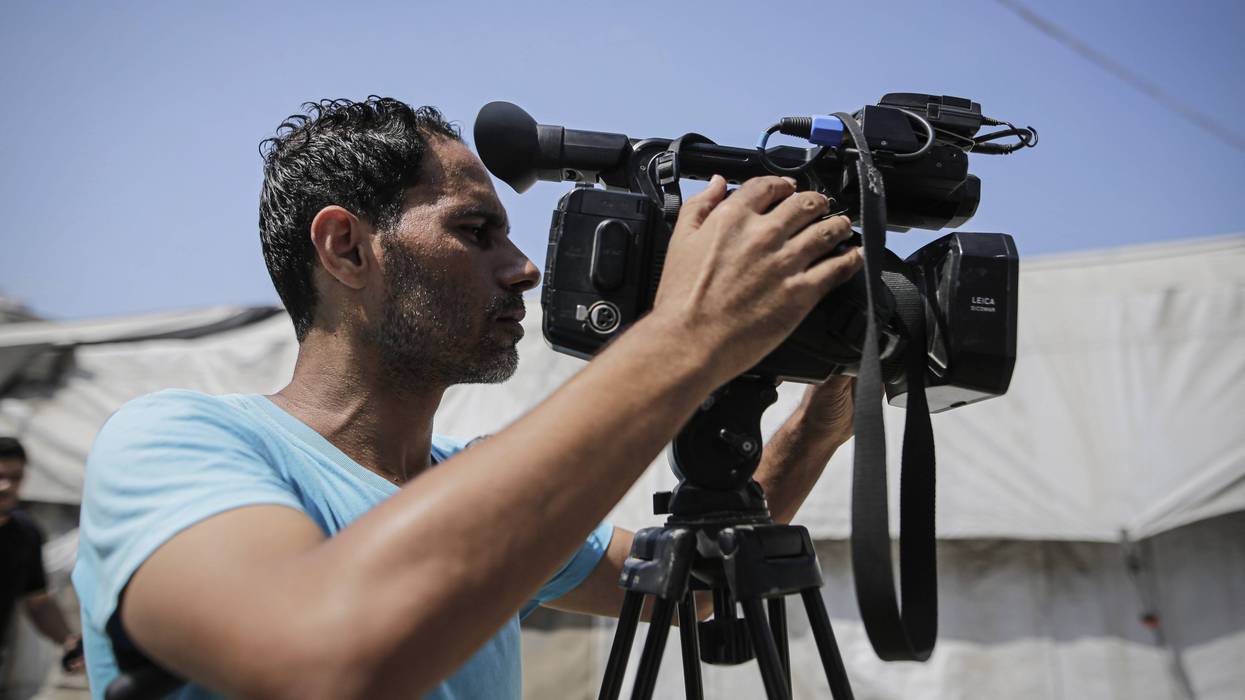
Israeli officials and Western supporters have trumpeted the IDF's list as a counter to findings by groups like International Federation of Journalists, which has described Israel's nearly-three-year-old-war in Gaza as “the deadliest period in the history of journalism" and cataloged at least 240 journalists and media workers killed.
Reporters Without Borders (RSF) has found dozens of cases in which it concluded journalists were targeted deliberately because of their reporting and filed multiple complaints with the International Criminal Court (ICC) alleging war crimes against the press.
The database, which the IDF refers to as the "Press Files," says "that claim does not tell the full story" and states that "individuals presented as innocent journalists were, in fact, militants in the military wings of Hamas, Palestinian Islamic Jihad (PIJ) and other terrorist organizations."
The IDF claims the list was the product of an “in-depth investigation” consisting of open-source information, documents recovered by Israeli forces in Gaza, interrogations of alleged Palestinian militants, and intelligence gathered during military operations.
But as Shehada explained in a thread posted to social media on Sunday, "In the overwhelming majority of those listed, the IDF presents ZERO credible evidence. In most of them, their pages are literally blank."
In 59 cases, Shehada found that the IDF did not provide any evidence for its claim that a journalist was a member of Hamas or PIJ other than that the claim was "based on multiple intelligence sources."
Shehada said this amounted to essentially saying "trust me, bro," which is especially insufficient given the numerous instances in which the IDF has been found to have misled the public about its responsibility for certain attacks, like the killing of 5-year-old Hind Rajab in 2024.
In another 42 cases, Shehada found, the IDF provided only decontextualized "snippets" of files, which were "undated and unspecified." Without more information, Shehada said, this is "not... evidence of anything."
"Those snippets could be taken from random files; they could be outdated or fabricated," Shehada said, pointing to previous cases in which purported Hamas intelligence circulated by Israeli sources was later revealed to be misleadingly presented as fabricated.
Shehada pointed to specific cases in which Israel's allegations against specific journalists have been undermined by the underlying evidence.
Israel claimed that Al Jazeera reporter Ismail al-Ghoul, whom the IDF killed in July 2024, was an operative with Hamas' elite Nukhba wing and released a supposed Hamas personnel document as proof.
But as Reporters Without Borders has previously explained, the document says al-Ghoul, born in 1997, received a military rank in 2007, when he was 10, while elsewhere saying he joined in 2014. It also identifies him as an engineer, contradicting the IDF’s description of him as a Nukhba fighter. Israeli troops also detained al-Ghoul at al-Shifa hospital months before he was killed but released him after 12 hours.
The case of Anas al-Sharif, another Al Jazeera journalist killed in 2025, is similar. As Shehada documented for +972 magazine last year, al-Sharif was seriously injured in 2017, listed in a military context in 2019, but described as “suspended” and “unassigned” by 2023—while another document nevertheless portrays him as an elite Nukhba fighter. He was also reportedly detained and released by Israeli forces during the 2024 al-Shifa raid.
In other cases, the IDF's evidence outright debunks the military's own claims. For instance, Israel labeled photojournalist Hassan Aslih—killed by an airstrike at Nasser Hospital in Khan Yunis in May 2025—as a "military operative." But the 2019 Hamas document provided as evidence for this lists him as a "photographer" involved with "media services."
While the document, if authentic, does establish a relationship between Aslih and Hamas' Qassam Brigades at least six years before his death, this does not make him a legitimate target under international humanitarian law, which distinguishes between those who have a “continuous combat function" and those who provide political or other indirect forms of support, like media coverage.
Shehada found at least seven cases in which the only evidence provided by the IDF was photos of slain journalists holding guns. In another 12 cases, the IDF provided undated photos of journalists allegedly taking part in Hamas or PIJ military activities.
Shehada noted that many prominent Israeli journalists also have past military service, such as Axios correspondent Barak Ravid, who was an IDF reservist until 2023. "Does that make him a 'legitimate target'? or a non-civilian forever?" Shehada asked.
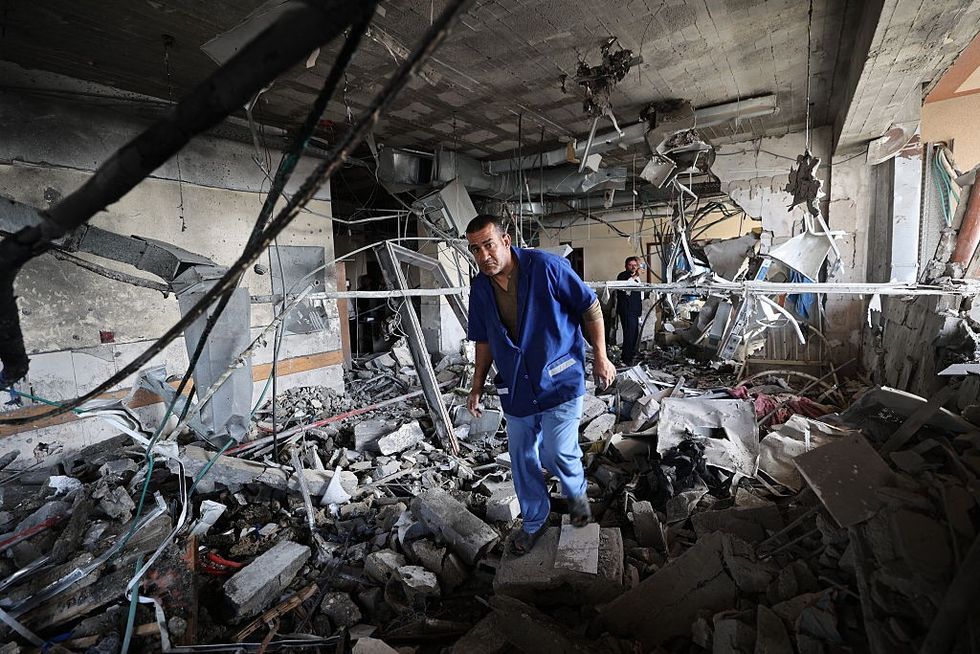 Palestinian hospital staff inspect the destruction inside Nasser hospital in Khan Yunis in the southern Gaza Strip, following an Israeli strike early on May 13, 2025 in which Palestinian journalist Hassan Aslih was killed along with several others. (Photo by Eyad Baba/AFP)
The distinction between past military affiliation and active combatant status has been a repeated source of dispute for press freedom groups that have attempted to tally the number of journalists killed.
Last month, the Committee to Protect Journalists (CPJ) completed a sweeping review of 229 deaths after Hamas and PIJ published obituaries identifying some people listed as journalists as members of armed groups.
CPJ ultimately removed 22 people from its list, including some it found had participated in combat—but retained others despite militant obituaries, gun photos, or past organizational ties when the evidence did not establish active combatant status.
The "Press Files" database contains 49 cases in which the main piece of evidence is one of these obituaries. Among them are people who CPJ examined and concluded were not active combatants, such as photojournalist Amr Abu Odeh—a 26-year-old freelance photographer for the Anadolu Agency and Reuters—whom the IDF database labels a Hamas "squad commander."
CPJ examined photos of Odeh wearing a military uniform, which came from a 2021 military training course with Gaza's Ministry of the Interior. The group noted that "No armed factions in Gaza have claimed Abu Odeh as being affiliated with them, and the IDF has not alleged he was involved in combat."
"In multiple cases, despite obituaries by Hamas/PIJ, the Committee to Protect Journalists investigated thoroughly and concluded those journalists were NOT engaged in any militant activity during the genocide," Shehada wrote. "They may have in the past. That doesn't make them combatants forever."
He added that the flimsiness of the IDF's evidence was more striking given the sophistication of the intelligence unit it uses to "dig up dirt" on journalists to provide post hoc justification for their killings, which has been referred to internally as the "Legitimization Cell," which was revealed in a +972 investigation.
"If that's all they can provide as "evidence" (e.g. blank pages, random snippets, outdated docs) despite having formidable resources," Shehada wrote, "then it's a vindication of Gaza's journalists!"


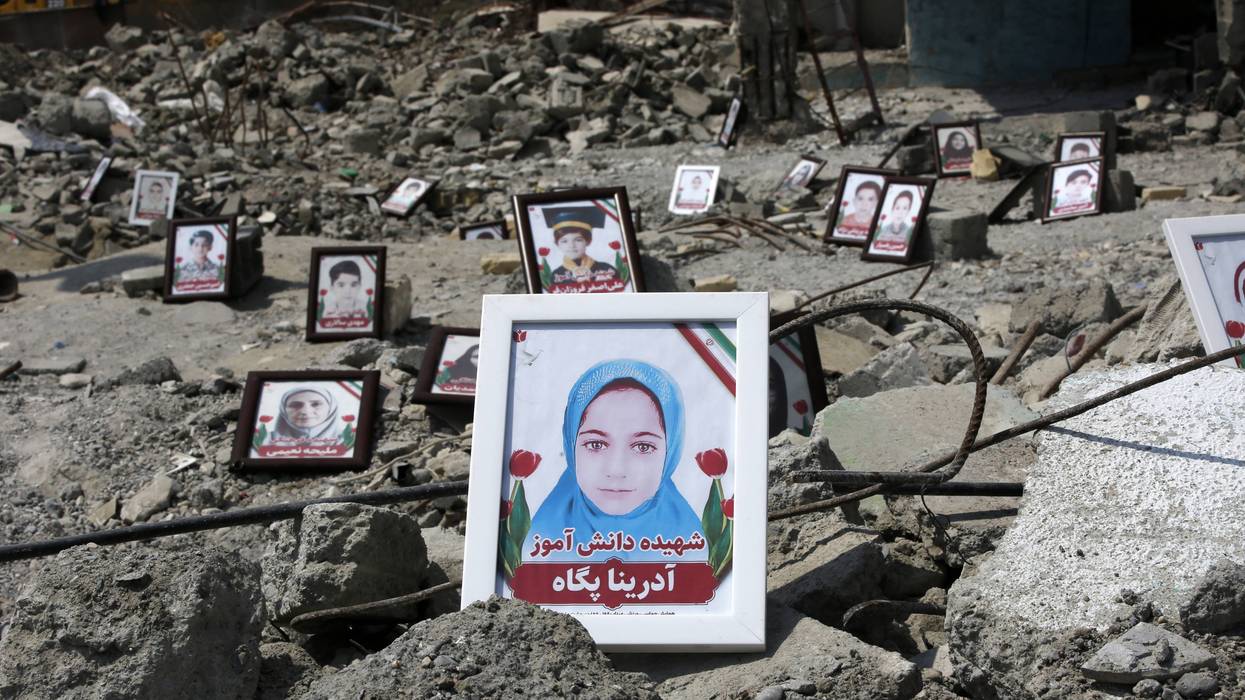
“The children were five years old and all they did was yell, ‘Miss! Miss!’ and were crying. I ran to the children. I just said, ‘Get under the table!” recalled preschool teacher Hossniyeh Salem. “I didn’t think they were going to strike the school. I just thought that some place had been hit. I said, ‘Don’t be afraid, sit down.’”
“Two simultaneous sounds. They’re still in my ear. My son even describes them—‘Wooosh, boom! Woosh, boom!’—and then the explosion very close by,” Salem said. “Plaster was falling, the ground was shaking, and at that moment I just looked at my preschool girls and my son, and I said to myself, ‘It’s over. Now is the time when we go under the rubble, it’s going to fall now,’” she continued. “Then there were no more sounds. The class was full of smoke and dust."
Yaghoub Yazdanpanah, a literature teacher at another school about eight miles from Minab, described the moment he learned that the school his 6-year-old daughter, Fatemeh, attended had been bombed.
“I left my classroom, ran home, took my car, and sped to Minab. When I arrived, I said, ‘Oh no!’ The unimaginable had happened," he said. “There was no school left. Two-thirds of the school, maybe more, had been destroyed. Smoke was rising from all over the school. It had turned into rubble. For a moment, I thought I was asleep and having a nightmare."
Yazdanpanah said he already knew the worst had happened well before he received his daughter’s body at an overwhelmed hospital that night.
“We knew our children had been martyred; we knew our children were no longer with us," he said. “When they brought Fatemeh, she was in one piece because she had been in her teacher’s arms [when she died].”
“There was no school left."
The US has still not accepted responsibility for the Minab attack, even though an internal Pentagon investigation has concluded that US forces struck the school using two Tomahawk missiles. In the initial days after the attack, President Donald Trump claimed that Iran had been responsible before backing off the claim, stating, “I just don’t know enough about it.”
Drop Site obtained images of the missile fragments from the site, which an independent weapons inspector said “all appear to be remnants of Tomahawk missiles." Iran is not known to possess Tomahawks. A UN fact-finding mission report released earlier this month determined that the school had been “the intended point of impact" rather than collateral damage.
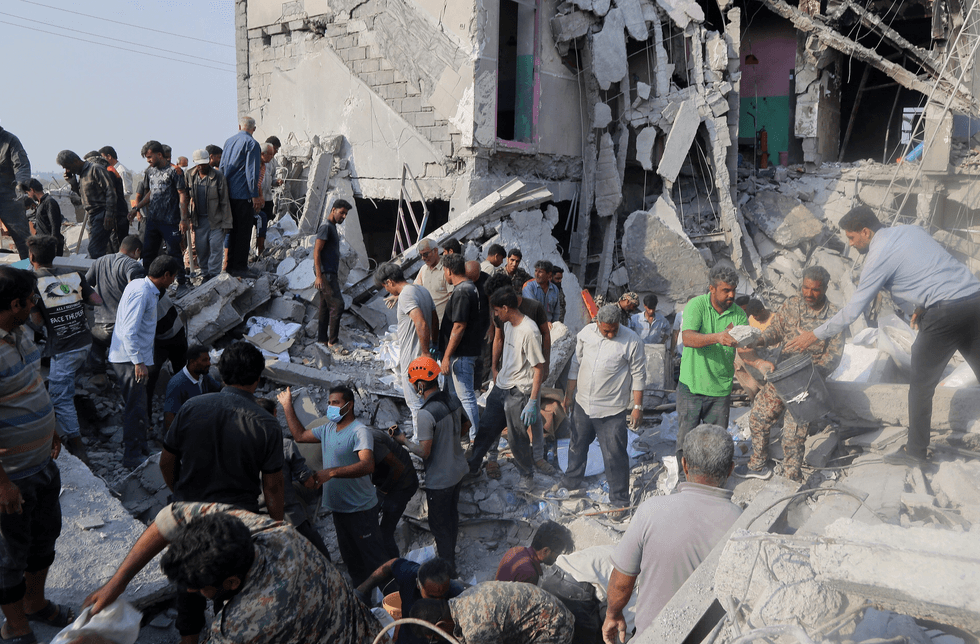 People are seen scouring the wreckage at the site of the February 28, 2026 bombing of the Shajareh Tayyebeh girls’ elementary school in Minab, Iran. (Photo by Mehr News Agency/Wikimedia Commons)
Adm. Brad Cooper, the commander of US Central Command (CENTCOM) told Congress in May that the school was "located on an active [Islamic Revolutionary Guard Corps] cruise missile base."
Wes Bryant, a former senior targeting adviser at the Pentagon, told Drop Site he'd never seen any indication that the school was on an active missile site and explained that even if it was, "it doesn’t matter."
“Those children, all those civilians, are still non-combatants and protected, so it’s really disgusting to hear that," he said. "This wasn’t even fragmentation that hit a school next to another target. This was deliberately targeted very, very clearly and obviously. So at the very least, [it was a] complete mischaracterization of the target.”
There was abundant evidence of the school's civilian use that would have been available to those who conducted the strike. The school was part of a compound that included barracks for the elite IRGC but was redeveloped for civilian use beginning in 2014. It had publicly and officially operated as a school since 2015.
The school had a very active online presence with a website that prominently displayed classroom activities and school events. Meanwhile, satellite imagery captured just two months before the attack showed children standing in the schoolyard outside the building.
An investigation from Bloomberg found that the school had been placed on a list of targets for the war's opening salvo that was assembled in part using the Maven artificial intelligence system developed by Palantir, which reportedly did not classify it as a school.
The UN report emphasized that even if the attack can be boiled down to an intelligence failure, it still likely amounted to a war crime because the US attacked despite readily available evidence that the building was a school, a failure investigators said went “beyond mere negligence” and amounted to recklessness toward the risk of striking civilians.
 US President Donald Trump and Secretary of Defense Pete Hegseth attend a dignified transfer event for US service members killed during operations in the Middle East, at Dover Air Force Base in Dover, Delaware, on July 22, 2026. (Photo by Saul Loeb/AFP via Getty Images)
Hala Rharrit, a career former US Foreign Service officer who spent 17 years at the State Department before resigning in 2024, remains unsatisfied by the government's efforts to downplay the attack as a "mistake."
“There’s no way to say that this was some type of error,” Rharrit told Drop Site. “You’re either saying that our US Military is completely incompetent, that despite the multiple layers of review, everybody messed up—or there was something very, very sinister about this strike.”
According to data from the Human Rights Activists News Agency, the vast majority of US-Israeli strikes during the first 40 days of the war did harm to civilians or civilian infrastructure, contradicting repeated claims that the US “never targets civilians.” At minimum, the data shows at least 1,701 civilians have been killed, but HRANA has stressed that the true death toll is likely substantially higher.
Defense Secretary Pete Hegseth has spent his tenure dissolving guardrails meant to prevent civilian casualties, denouncing "stupid rules of engagement," and saying the military should pursue “lethality” over “legality.” Trump, meanwhile, has repeatedly threatened mass destruction upon Iran, including that the "entire civilization" would "die."
“The administration and Hegseth have made it quite clear that they don’t really care about civilian casualties. That may also have been true of previous bombing campaigns that predate the Trump administration, but it is even more the case than in the past, and they have made it clear that troops do not need to be concerned about consequences,” said Harrison Mann, a former US Army major and intelligence analyst for the Defense Intelligence Agency (DIA).
“There is no mystery about what coordinates those missiles hit, and that question would have been answerable on the day of the strikes," he told Drop Site. "The only way that CENTCOM would not know is that they are choosing to be willfully ignorant.”