SUBSCRIBE TO OUR FREE NEWSLETTER
Daily news & progressive opinion—funded by the people, not the corporations—delivered straight to your inbox.
5
#000000
#FFFFFF
To donate by check, phone, or other method, see our More Ways to Give page.
Daily news & progressive opinion—funded by the people, not the corporations—delivered straight to your inbox.
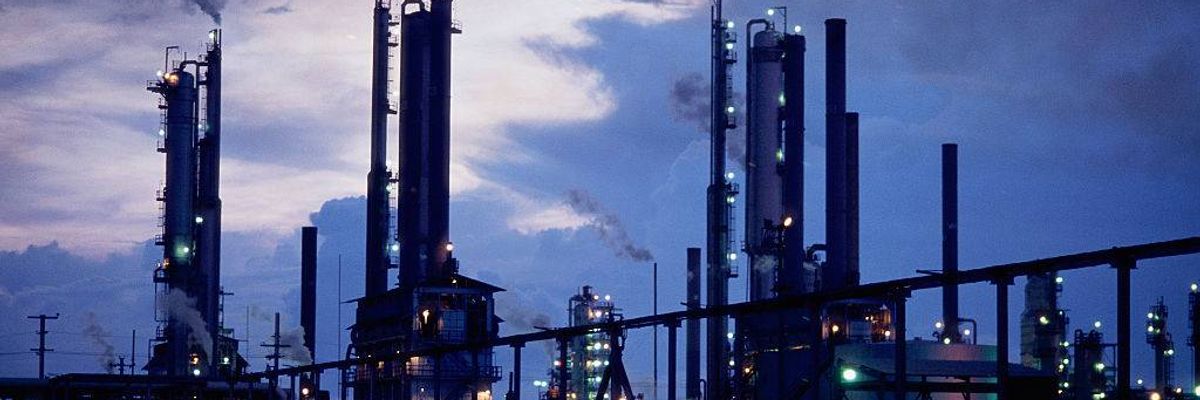
Dark clouds drift over Amuay Oil Refinery in Venezuela. Amuay is one of the world's largest oil refineries.
"The appetite for jumping into Venezuela right now is pretty low," one industry source explained to CNN.
While President Donald Trump has openly stated that the US will seize Venezuela's oil in the wake of the US military's abduction of Venezuelan President Nicolás Maduro, there are questions about just how much interest big oil companies have in the president's desire for plunder.
In a Monday interview with NBC News, Trump insisted that US oil companies would invest the billions of dollars needed to rebuild Venezuela's oil extraction infrastructure, and he even floated having US taxpayers reimburse them for their efforts.
"A tremendous amount of money will have to be spent, and the oil companies will spend it, and then they’ll get reimbursed by us or through revenue," Trump explained.
However, other recent reporting indicates that oil companies are not gung-ho about the president's plans.
According to a Monday report from CNN, US oil companies have several reasons to be wary of making significant investments in Venezuela, including political instability in the wake of Maduro's ouster, degradation of the country's oil infrastructure, and the fact that the current low price of oil would make such investments unprofitable.
"The appetite for jumping into Venezuela right now is pretty low," one industry source explained to CNN. "We have no idea what the government there will look like. The president’s desire is different than the industry’s. And the White House would have known that if they had communicated with the industry prior to the operation on Saturday."
Another industry source told CNN that the president doesn't appear to understand the complexities of setting up major petroleum extraction operations, especially in politically unstable countries.
"Just because there are oil reserves—even the largest in the world—doesn’t mean you’re necessarily going to produce there,” they said. "This isn’t like standing up a food truck operation."
The American Prospect's Ryan Cooper added some more context to oil companies' reluctance to go all-in on Trump's looting scheme, noting in an analysis published Tuesday that US fracking companies could feel real financial pain if Trump floods the market with even cheaper Venezuelan oil.
"The price of oil, about $58 at time of writing, is already dangerously low for American fracking companies, whose investments typically pencil out with prices at $60 per barrel or above," Cooper explained. "More oil on global markets means those prices would drop even lower, crushing the economics of drilling even further. The US oil industry needs Trump to swoop in and add another few million barrels a day of production like it needs a hole in the head."
Cooper added that while Venezuela has a large quantity of oil, its quality is very low, which could also hinder oil companies' ability to produce a profit from extracting it.
"The product is so gloopy that you have to cut it with some kind of solvent to get it to flow in a pipe," he wrote. "In short, it’s expensive to drill, transport, and refine, just like the fracked oil that is barely turning a profit right now."
Reuters reported on Tuesday that Exxon, ConocoPhillips, and Chevron are set to have a meeting at the White House this week to discuss the prospects of extracting oil from Venezuela.
An industry source told Reuters that "nobody in those three companies has had conversations with the White House about operating in Venezuela, pre-removal or post-removal to this point."
Dear Common Dreams reader, It’s been nearly 30 years since I co-founded Common Dreams with my late wife, Lina Newhouser. We had the radical notion that journalism should serve the public good, not corporate profits. It was clear to us from the outset what it would take to build such a project. No paid advertisements. No corporate sponsors. No millionaire publisher telling us what to think or do. Many people said we wouldn't last a year, but we proved those doubters wrong. Together with a tremendous team of journalists and dedicated staff, we built an independent media outlet free from the constraints of profits and corporate control. Our mission has always been simple: To inform. To inspire. To ignite change for the common good. Building Common Dreams was not easy. Our survival was never guaranteed. When you take on the most powerful forces—Wall Street greed, fossil fuel industry destruction, Big Tech lobbyists, and uber-rich oligarchs who have spent billions upon billions rigging the economy and democracy in their favor—the only bulwark you have is supporters who believe in your work. But here’s the urgent message from me today. It's never been this bad out there. And it's never been this hard to keep us going. At the very moment Common Dreams is most needed, the threats we face are intensifying. We need your support now more than ever. We don't accept corporate advertising and never will. We don't have a paywall because we don't think people should be blocked from critical news based on their ability to pay. Everything we do is funded by the donations of readers like you. When everyone does the little they can afford, we are strong. But if that support retreats or dries up, so do we. Will you donate now to make sure Common Dreams not only survives but thrives? —Craig Brown, Co-founder |
While President Donald Trump has openly stated that the US will seize Venezuela's oil in the wake of the US military's abduction of Venezuelan President Nicolás Maduro, there are questions about just how much interest big oil companies have in the president's desire for plunder.
In a Monday interview with NBC News, Trump insisted that US oil companies would invest the billions of dollars needed to rebuild Venezuela's oil extraction infrastructure, and he even floated having US taxpayers reimburse them for their efforts.
"A tremendous amount of money will have to be spent, and the oil companies will spend it, and then they’ll get reimbursed by us or through revenue," Trump explained.
However, other recent reporting indicates that oil companies are not gung-ho about the president's plans.
According to a Monday report from CNN, US oil companies have several reasons to be wary of making significant investments in Venezuela, including political instability in the wake of Maduro's ouster, degradation of the country's oil infrastructure, and the fact that the current low price of oil would make such investments unprofitable.
"The appetite for jumping into Venezuela right now is pretty low," one industry source explained to CNN. "We have no idea what the government there will look like. The president’s desire is different than the industry’s. And the White House would have known that if they had communicated with the industry prior to the operation on Saturday."
Another industry source told CNN that the president doesn't appear to understand the complexities of setting up major petroleum extraction operations, especially in politically unstable countries.
"Just because there are oil reserves—even the largest in the world—doesn’t mean you’re necessarily going to produce there,” they said. "This isn’t like standing up a food truck operation."
The American Prospect's Ryan Cooper added some more context to oil companies' reluctance to go all-in on Trump's looting scheme, noting in an analysis published Tuesday that US fracking companies could feel real financial pain if Trump floods the market with even cheaper Venezuelan oil.
"The price of oil, about $58 at time of writing, is already dangerously low for American fracking companies, whose investments typically pencil out with prices at $60 per barrel or above," Cooper explained. "More oil on global markets means those prices would drop even lower, crushing the economics of drilling even further. The US oil industry needs Trump to swoop in and add another few million barrels a day of production like it needs a hole in the head."
Cooper added that while Venezuela has a large quantity of oil, its quality is very low, which could also hinder oil companies' ability to produce a profit from extracting it.
"The product is so gloopy that you have to cut it with some kind of solvent to get it to flow in a pipe," he wrote. "In short, it’s expensive to drill, transport, and refine, just like the fracked oil that is barely turning a profit right now."
Reuters reported on Tuesday that Exxon, ConocoPhillips, and Chevron are set to have a meeting at the White House this week to discuss the prospects of extracting oil from Venezuela.
An industry source told Reuters that "nobody in those three companies has had conversations with the White House about operating in Venezuela, pre-removal or post-removal to this point."
While President Donald Trump has openly stated that the US will seize Venezuela's oil in the wake of the US military's abduction of Venezuelan President Nicolás Maduro, there are questions about just how much interest big oil companies have in the president's desire for plunder.
In a Monday interview with NBC News, Trump insisted that US oil companies would invest the billions of dollars needed to rebuild Venezuela's oil extraction infrastructure, and he even floated having US taxpayers reimburse them for their efforts.
"A tremendous amount of money will have to be spent, and the oil companies will spend it, and then they’ll get reimbursed by us or through revenue," Trump explained.
However, other recent reporting indicates that oil companies are not gung-ho about the president's plans.
According to a Monday report from CNN, US oil companies have several reasons to be wary of making significant investments in Venezuela, including political instability in the wake of Maduro's ouster, degradation of the country's oil infrastructure, and the fact that the current low price of oil would make such investments unprofitable.
"The appetite for jumping into Venezuela right now is pretty low," one industry source explained to CNN. "We have no idea what the government there will look like. The president’s desire is different than the industry’s. And the White House would have known that if they had communicated with the industry prior to the operation on Saturday."
Another industry source told CNN that the president doesn't appear to understand the complexities of setting up major petroleum extraction operations, especially in politically unstable countries.
"Just because there are oil reserves—even the largest in the world—doesn’t mean you’re necessarily going to produce there,” they said. "This isn’t like standing up a food truck operation."
The American Prospect's Ryan Cooper added some more context to oil companies' reluctance to go all-in on Trump's looting scheme, noting in an analysis published Tuesday that US fracking companies could feel real financial pain if Trump floods the market with even cheaper Venezuelan oil.
"The price of oil, about $58 at time of writing, is already dangerously low for American fracking companies, whose investments typically pencil out with prices at $60 per barrel or above," Cooper explained. "More oil on global markets means those prices would drop even lower, crushing the economics of drilling even further. The US oil industry needs Trump to swoop in and add another few million barrels a day of production like it needs a hole in the head."
Cooper added that while Venezuela has a large quantity of oil, its quality is very low, which could also hinder oil companies' ability to produce a profit from extracting it.
"The product is so gloopy that you have to cut it with some kind of solvent to get it to flow in a pipe," he wrote. "In short, it’s expensive to drill, transport, and refine, just like the fracked oil that is barely turning a profit right now."
Reuters reported on Tuesday that Exxon, ConocoPhillips, and Chevron are set to have a meeting at the White House this week to discuss the prospects of extracting oil from Venezuela.
An industry source told Reuters that "nobody in those three companies has had conversations with the White House about operating in Venezuela, pre-removal or post-removal to this point."