SUBSCRIBE TO OUR FREE NEWSLETTER
Daily news & progressive opinion—funded by the people, not the corporations—delivered straight to your inbox.
5
#000000
#FFFFFF
To donate by check, phone, or other method, see our More Ways to Give page.
Daily news & progressive opinion—funded by the people, not the corporations—delivered straight to your inbox.
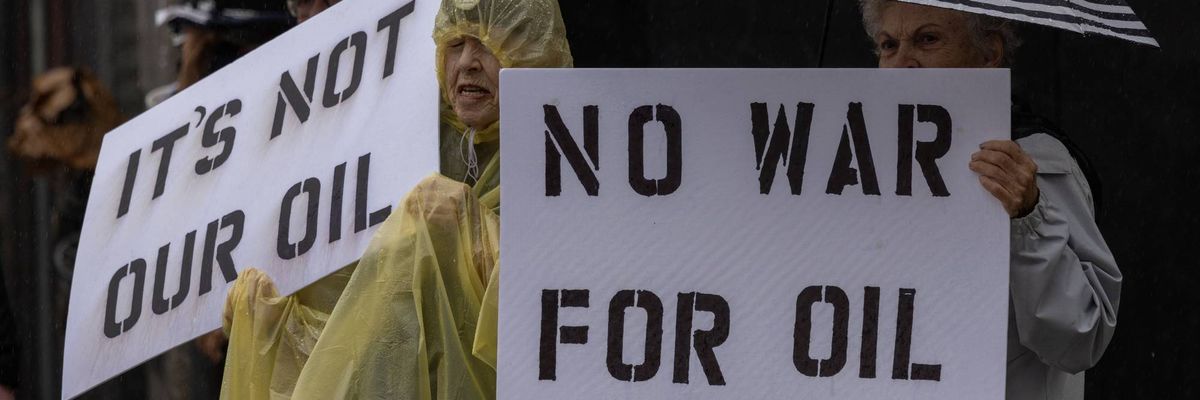
People participate in a "No War on Venezuela" protest on January 3, 2026 in Los Angeles, California.
"They have spoken openly about controlling Venezuela’s oil reserves, the largest in the world," said US Sen. Bernie Sanders. "It recalls the darkest chapters of US interventions in Latin America."
US President Donald Trump left no doubt on Saturday that a—or perhaps the—primary driver of his decision to illegally attack Venezuela, abduct its president, and pledge to indefinitely run its government was his desire to control and exploit the country's oil reserves, which are believed to be the largest in the world.
Over the course of Trump's lengthy press conference following Saturday's assault, the word "oil" was mentioned dozens of times as the president vowed to unleash powerful fossil fuel giants on the South American nation and begin "taking a tremendous amount of wealth out of the ground"—with a healthy cut of it going to the US "in the form of reimbursement" for the supposed "damages caused us" by Venezuela.
"We're going to have our very large United States oil companies, the biggest anywhere in the world, go in, spend billions of dollars, fix the badly broken infrastructure, and start making money for the country," Trump said, suggesting American troops could be deployed, without congressional authorization, to bolster such efforts.
"We're going to get the oil flowing the way it should be," he added.
Currently, Chevron is the only US-based oil giant operating in Venezuela, whose oil industry and broader economy have been badly hampered by US sanctions. In a statement on Saturday, a Chevron spokesperson said the company is "prepared to work constructively with the US government during this period, leveraging our experience and presence to strengthen US energy security."
Other oil behemoths, some of which helped bankroll Trump's presidential campaign, are likely licking their chops—even if they've been mostly quiet in the wake of the US attack, which was widely condemned as unlawful and potentially catastrophic for the region. Amnesty International said Saturday that "the stated US intention to run Venezuela and control its oil resources" likely "constitutes a violation of international law."
"The most powerful multinational fossil fuel corporations stand to benefit from these aggressions, and US oil and gas companies are poised to exploit the chaos."
Thomas O'Donnell, an energy and geopolitical strategist, told Reuters that "the company that probably will be very interested in going back [to Venezuela] is Conoco," noting that an international arbitration tribunal has ordered Caracas to pay the company around $10 billion for alleged "unlawful expropriation" of oil investments.
The Houston Chronicle reported that "Exxon, America’s largest oil company, which has for years grown its presence in South America, would be among the most likely US oil companies to tap Venezuela’s deep oil reserves. The company, along with fellow Houston giant ConocoPhillips, had a number of failed contract attempts with Venezuela under Maduro and former President Hugo Chavez."
Elizabeth Bast, executive director of the advocacy group Oil Change International, said in a statement Saturday that the Trump administration's escalation in Venezuela "follows a historic playbook: undermine leftist governments, create instability, and clear the path for extractive companies to profit."
"The most powerful multinational fossil fuel corporations stand to benefit from these aggressions, and US oil and gas companies are poised to exploit the chaos and carve up one of the world's most oil-rich territories," said Bast. "The US must stop treating Latin America as a resource colony. The Venezuelan people, not US oil executives, must shape their country’s future."
US Sen. Chris Van Hollen (D-Md.) said that the president's own words make plain that his attack on Venezuela and attempt to impose his will there are "about trying to grab Venezuela's oil for Trump's billionaire buddies."
In a statement, US Sen. Bernie Sanders (I-Vt.) echoed that sentiment, calling Trump's assault on Venezuela "rank imperialism."
"They have spoken openly about controlling Venezuela’s oil reserves, the largest in the world," said Sanders. "It recalls the darkest chapters of US interventions in Latin America, which have left a terrible legacy. It will and should be condemned by the democratic world."
Dear Common Dreams reader, It’s been nearly 30 years since I co-founded Common Dreams with my late wife, Lina Newhouser. We had the radical notion that journalism should serve the public good, not corporate profits. It was clear to us from the outset what it would take to build such a project. No paid advertisements. No corporate sponsors. No millionaire publisher telling us what to think or do. Many people said we wouldn't last a year, but we proved those doubters wrong. Together with a tremendous team of journalists and dedicated staff, we built an independent media outlet free from the constraints of profits and corporate control. Our mission has always been simple: To inform. To inspire. To ignite change for the common good. Building Common Dreams was not easy. Our survival was never guaranteed. When you take on the most powerful forces—Wall Street greed, fossil fuel industry destruction, Big Tech lobbyists, and uber-rich oligarchs who have spent billions upon billions rigging the economy and democracy in their favor—the only bulwark you have is supporters who believe in your work. But here’s the urgent message from me today. It's never been this bad out there. And it's never been this hard to keep us going. At the very moment Common Dreams is most needed, the threats we face are intensifying. We need your support now more than ever. We don't accept corporate advertising and never will. We don't have a paywall because we don't think people should be blocked from critical news based on their ability to pay. Everything we do is funded by the donations of readers like you. When everyone does the little they can afford, we are strong. But if that support retreats or dries up, so do we. Will you donate now to make sure Common Dreams not only survives but thrives? —Craig Brown, Co-founder |
US President Donald Trump left no doubt on Saturday that a—or perhaps the—primary driver of his decision to illegally attack Venezuela, abduct its president, and pledge to indefinitely run its government was his desire to control and exploit the country's oil reserves, which are believed to be the largest in the world.
Over the course of Trump's lengthy press conference following Saturday's assault, the word "oil" was mentioned dozens of times as the president vowed to unleash powerful fossil fuel giants on the South American nation and begin "taking a tremendous amount of wealth out of the ground"—with a healthy cut of it going to the US "in the form of reimbursement" for the supposed "damages caused us" by Venezuela.
"We're going to have our very large United States oil companies, the biggest anywhere in the world, go in, spend billions of dollars, fix the badly broken infrastructure, and start making money for the country," Trump said, suggesting American troops could be deployed, without congressional authorization, to bolster such efforts.
"We're going to get the oil flowing the way it should be," he added.
Currently, Chevron is the only US-based oil giant operating in Venezuela, whose oil industry and broader economy have been badly hampered by US sanctions. In a statement on Saturday, a Chevron spokesperson said the company is "prepared to work constructively with the US government during this period, leveraging our experience and presence to strengthen US energy security."
Other oil behemoths, some of which helped bankroll Trump's presidential campaign, are likely licking their chops—even if they've been mostly quiet in the wake of the US attack, which was widely condemned as unlawful and potentially catastrophic for the region. Amnesty International said Saturday that "the stated US intention to run Venezuela and control its oil resources" likely "constitutes a violation of international law."
"The most powerful multinational fossil fuel corporations stand to benefit from these aggressions, and US oil and gas companies are poised to exploit the chaos."
Thomas O'Donnell, an energy and geopolitical strategist, told Reuters that "the company that probably will be very interested in going back [to Venezuela] is Conoco," noting that an international arbitration tribunal has ordered Caracas to pay the company around $10 billion for alleged "unlawful expropriation" of oil investments.
The Houston Chronicle reported that "Exxon, America’s largest oil company, which has for years grown its presence in South America, would be among the most likely US oil companies to tap Venezuela’s deep oil reserves. The company, along with fellow Houston giant ConocoPhillips, had a number of failed contract attempts with Venezuela under Maduro and former President Hugo Chavez."
Elizabeth Bast, executive director of the advocacy group Oil Change International, said in a statement Saturday that the Trump administration's escalation in Venezuela "follows a historic playbook: undermine leftist governments, create instability, and clear the path for extractive companies to profit."
"The most powerful multinational fossil fuel corporations stand to benefit from these aggressions, and US oil and gas companies are poised to exploit the chaos and carve up one of the world's most oil-rich territories," said Bast. "The US must stop treating Latin America as a resource colony. The Venezuelan people, not US oil executives, must shape their country’s future."
US Sen. Chris Van Hollen (D-Md.) said that the president's own words make plain that his attack on Venezuela and attempt to impose his will there are "about trying to grab Venezuela's oil for Trump's billionaire buddies."
In a statement, US Sen. Bernie Sanders (I-Vt.) echoed that sentiment, calling Trump's assault on Venezuela "rank imperialism."
"They have spoken openly about controlling Venezuela’s oil reserves, the largest in the world," said Sanders. "It recalls the darkest chapters of US interventions in Latin America, which have left a terrible legacy. It will and should be condemned by the democratic world."
US President Donald Trump left no doubt on Saturday that a—or perhaps the—primary driver of his decision to illegally attack Venezuela, abduct its president, and pledge to indefinitely run its government was his desire to control and exploit the country's oil reserves, which are believed to be the largest in the world.
Over the course of Trump's lengthy press conference following Saturday's assault, the word "oil" was mentioned dozens of times as the president vowed to unleash powerful fossil fuel giants on the South American nation and begin "taking a tremendous amount of wealth out of the ground"—with a healthy cut of it going to the US "in the form of reimbursement" for the supposed "damages caused us" by Venezuela.
"We're going to have our very large United States oil companies, the biggest anywhere in the world, go in, spend billions of dollars, fix the badly broken infrastructure, and start making money for the country," Trump said, suggesting American troops could be deployed, without congressional authorization, to bolster such efforts.
"We're going to get the oil flowing the way it should be," he added.
Currently, Chevron is the only US-based oil giant operating in Venezuela, whose oil industry and broader economy have been badly hampered by US sanctions. In a statement on Saturday, a Chevron spokesperson said the company is "prepared to work constructively with the US government during this period, leveraging our experience and presence to strengthen US energy security."
Other oil behemoths, some of which helped bankroll Trump's presidential campaign, are likely licking their chops—even if they've been mostly quiet in the wake of the US attack, which was widely condemned as unlawful and potentially catastrophic for the region. Amnesty International said Saturday that "the stated US intention to run Venezuela and control its oil resources" likely "constitutes a violation of international law."
"The most powerful multinational fossil fuel corporations stand to benefit from these aggressions, and US oil and gas companies are poised to exploit the chaos."
Thomas O'Donnell, an energy and geopolitical strategist, told Reuters that "the company that probably will be very interested in going back [to Venezuela] is Conoco," noting that an international arbitration tribunal has ordered Caracas to pay the company around $10 billion for alleged "unlawful expropriation" of oil investments.
The Houston Chronicle reported that "Exxon, America’s largest oil company, which has for years grown its presence in South America, would be among the most likely US oil companies to tap Venezuela’s deep oil reserves. The company, along with fellow Houston giant ConocoPhillips, had a number of failed contract attempts with Venezuela under Maduro and former President Hugo Chavez."
Elizabeth Bast, executive director of the advocacy group Oil Change International, said in a statement Saturday that the Trump administration's escalation in Venezuela "follows a historic playbook: undermine leftist governments, create instability, and clear the path for extractive companies to profit."
"The most powerful multinational fossil fuel corporations stand to benefit from these aggressions, and US oil and gas companies are poised to exploit the chaos and carve up one of the world's most oil-rich territories," said Bast. "The US must stop treating Latin America as a resource colony. The Venezuelan people, not US oil executives, must shape their country’s future."
US Sen. Chris Van Hollen (D-Md.) said that the president's own words make plain that his attack on Venezuela and attempt to impose his will there are "about trying to grab Venezuela's oil for Trump's billionaire buddies."
In a statement, US Sen. Bernie Sanders (I-Vt.) echoed that sentiment, calling Trump's assault on Venezuela "rank imperialism."
"They have spoken openly about controlling Venezuela’s oil reserves, the largest in the world," said Sanders. "It recalls the darkest chapters of US interventions in Latin America, which have left a terrible legacy. It will and should be condemned by the democratic world."