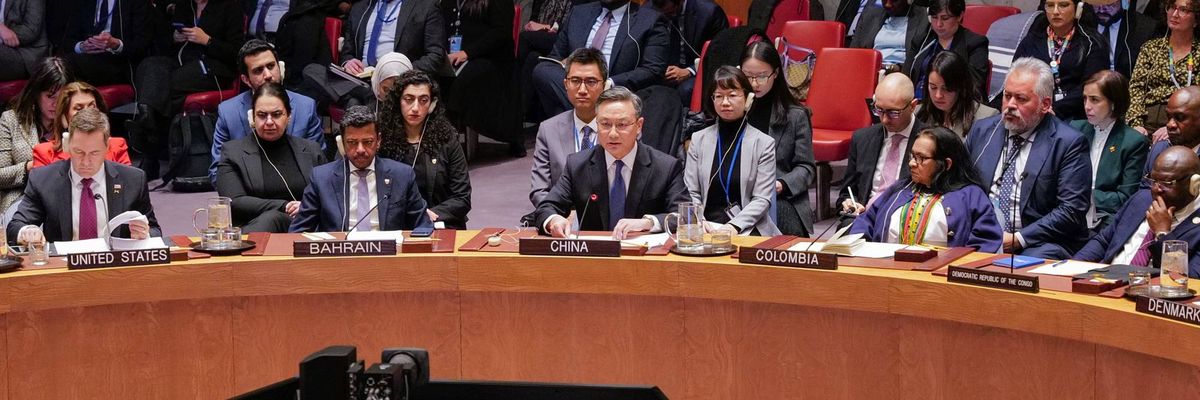
China's deputy permanent representative to the United Nations, Sun Lei, addresses a UN Security Council meeting on Venezuela on January 5, 2026 in New York City.
China's Foreign Ministry Demands Maduro's Immediate Release, Rips 'So-Called' Trial
Lin Jian, a spokesperson for the Chinese Foreign Ministry, said the US abduction of Nicolás Maduro "seriously violates Venezuela’s national sovereignty and destabilizes international relations."
A spokesperson for China's Foreign Ministry on Tuesday demanded the immediate release of Venezuelan President Nicolás Maduro and his wife from US custody and condemned the Trump administration's trampling of international law.
"The US disregards President Maduro’s status as head of state, blatantly prosecutes him, and puts him on a so-called 'trial' in a domestic court," Lin Jian wrote in a social media post. "This seriously violates Venezuela’s national sovereignty and destabilizes international relations."
"No country should put its domestic rules above international law," Lin added. "China calls on the US to release President Maduro and his wife at once and ensure their personal safety."
The U.S. disregards President Maduro’s status as head of state, blatantly prosecutes him and puts him on a so-called “trial” in a domestic court. This seriously violates Venezuela’s national sovereignty and destabilizes international relations.
No country should put its… pic.twitter.com/v1xQqE4Cqo
— Lin Jian 林剑 (@SpoxCHN_LinJian) January 6, 2026
The Chinese official's remarks came a day after Maduro said Monday during his first appearance before a federal court in New York City that he is "still president" of Venezuela—a sentiment echoed by the country's interim leader—and considers himself a "prisoner of war." Maduro pleaded not guilty to narcoterrorism conspiracy and other charges pursued by the Trump Justice Department.
During a press conference on Monday, Lin called the US abduction of Maduro a "clear violation of international law, basic norms in international relations, and the purposes and principles of the UN Charter," expressing a view widely held by legal experts.
"China calls on the US to ensure the personal safety of President Nicolás Maduro and his wife, release them at once, stop toppling the government of Venezuela, and resolve issues through dialogue and negotiation," said Lin.
Under international law, sitting heads of state are immune from prosecution in other countries' courts. The Trump administration argues Maduro's leadership was illegitimate. But President Donald Trump, in his social media post announcing the weekend attack on Venezuela, described Maduro as president of the South American country.
"If the Justice Department plans to argue that Nicolás Maduro is not protected by head of state immunity," asked Francisco Rodríguez, a senior fellow at the Center for Economic and Policy Research, "then why did President Trump announce his capture referring to him as 'President Maduro'—a designation that the US government had stopped using in 2019?"
An unsealed US indictment against Maduro characterizes him as "previously the president of Venezuela."
Chimène Keitner, a professor at the University of California, Davis School of Law, wrote Tuesday that the Trump administration "appears to feel that its military and economic superiority allow it to act unilaterally in violation of international law, and that cooperation and alliances are overrated."
"That might seem appealing in the short term, but the world has already seen where unchecked expansionism and claimed spheres of influence lead," wrote Keitner. "The benefits of following agreed-upon rules have often been recognized only after significant harm caused by their disregard."
We are at a crossroads
This country and this world are at a monumental crossroads. In a few short weeks, US voters will have an opportunity to beat back the forces of fascism and confront the billionaires who are rigging the economy, our media system, and our democracy, making it increasingly impossible for ordinary people to get by. We’re not just talking about the election. We’re talking about what must be done once these fascist elements are vanquished from power. We need a bolder set of solutions than what either major party has so far been willing to offer and a working-class movement ready to fight like hell for it. Trump didn't emerge from nowhere. The conditions that fueled MAGA authoritarianism were created by decades of radical neoliberal economic policies and a corrupt political system dominated by corporate interests. They slashed taxes on the super-rich, promising that the benefits would trickle down. They said giveaways to the corporate titans would make life more affordable for the rest of us. It was all bullshit. And when a bitter, betrayed populace searches for someone to blame, right-wing demagogues have little trouble finding scapegoats. People know when they're being lied to, but you won't hear any of this from the corporate media. Only independent journalism—powered and funded by people who believe in building a better world—can deliver truly trustworthy daily news. Our Fall Campaign is underway, and we need your help. To power our newsroom through the rest of the year, we need to raise $125,000 by midnight on October 31. So if you share our vision, please contribute whatever you can to sustain our work. |
A spokesperson for China's Foreign Ministry on Tuesday demanded the immediate release of Venezuelan President Nicolás Maduro and his wife from US custody and condemned the Trump administration's trampling of international law.
"The US disregards President Maduro’s status as head of state, blatantly prosecutes him, and puts him on a so-called 'trial' in a domestic court," Lin Jian wrote in a social media post. "This seriously violates Venezuela’s national sovereignty and destabilizes international relations."
"No country should put its domestic rules above international law," Lin added. "China calls on the US to release President Maduro and his wife at once and ensure their personal safety."
The U.S. disregards President Maduro’s status as head of state, blatantly prosecutes him and puts him on a so-called “trial” in a domestic court. This seriously violates Venezuela’s national sovereignty and destabilizes international relations.
No country should put its… pic.twitter.com/v1xQqE4Cqo
— Lin Jian 林剑 (@SpoxCHN_LinJian) January 6, 2026
The Chinese official's remarks came a day after Maduro said Monday during his first appearance before a federal court in New York City that he is "still president" of Venezuela—a sentiment echoed by the country's interim leader—and considers himself a "prisoner of war." Maduro pleaded not guilty to narcoterrorism conspiracy and other charges pursued by the Trump Justice Department.
During a press conference on Monday, Lin called the US abduction of Maduro a "clear violation of international law, basic norms in international relations, and the purposes and principles of the UN Charter," expressing a view widely held by legal experts.
"China calls on the US to ensure the personal safety of President Nicolás Maduro and his wife, release them at once, stop toppling the government of Venezuela, and resolve issues through dialogue and negotiation," said Lin.
Under international law, sitting heads of state are immune from prosecution in other countries' courts. The Trump administration argues Maduro's leadership was illegitimate. But President Donald Trump, in his social media post announcing the weekend attack on Venezuela, described Maduro as president of the South American country.
"If the Justice Department plans to argue that Nicolás Maduro is not protected by head of state immunity," asked Francisco Rodríguez, a senior fellow at the Center for Economic and Policy Research, "then why did President Trump announce his capture referring to him as 'President Maduro'—a designation that the US government had stopped using in 2019?"
An unsealed US indictment against Maduro characterizes him as "previously the president of Venezuela."
Chimène Keitner, a professor at the University of California, Davis School of Law, wrote Tuesday that the Trump administration "appears to feel that its military and economic superiority allow it to act unilaterally in violation of international law, and that cooperation and alliances are overrated."
"That might seem appealing in the short term, but the world has already seen where unchecked expansionism and claimed spheres of influence lead," wrote Keitner. "The benefits of following agreed-upon rules have often been recognized only after significant harm caused by their disregard."
A spokesperson for China's Foreign Ministry on Tuesday demanded the immediate release of Venezuelan President Nicolás Maduro and his wife from US custody and condemned the Trump administration's trampling of international law.
"The US disregards President Maduro’s status as head of state, blatantly prosecutes him, and puts him on a so-called 'trial' in a domestic court," Lin Jian wrote in a social media post. "This seriously violates Venezuela’s national sovereignty and destabilizes international relations."
"No country should put its domestic rules above international law," Lin added. "China calls on the US to release President Maduro and his wife at once and ensure their personal safety."
The U.S. disregards President Maduro’s status as head of state, blatantly prosecutes him and puts him on a so-called “trial” in a domestic court. This seriously violates Venezuela’s national sovereignty and destabilizes international relations.
No country should put its… pic.twitter.com/v1xQqE4Cqo
— Lin Jian 林剑 (@SpoxCHN_LinJian) January 6, 2026
The Chinese official's remarks came a day after Maduro said Monday during his first appearance before a federal court in New York City that he is "still president" of Venezuela—a sentiment echoed by the country's interim leader—and considers himself a "prisoner of war." Maduro pleaded not guilty to narcoterrorism conspiracy and other charges pursued by the Trump Justice Department.
During a press conference on Monday, Lin called the US abduction of Maduro a "clear violation of international law, basic norms in international relations, and the purposes and principles of the UN Charter," expressing a view widely held by legal experts.
"China calls on the US to ensure the personal safety of President Nicolás Maduro and his wife, release them at once, stop toppling the government of Venezuela, and resolve issues through dialogue and negotiation," said Lin.
Under international law, sitting heads of state are immune from prosecution in other countries' courts. The Trump administration argues Maduro's leadership was illegitimate. But President Donald Trump, in his social media post announcing the weekend attack on Venezuela, described Maduro as president of the South American country.
"If the Justice Department plans to argue that Nicolás Maduro is not protected by head of state immunity," asked Francisco Rodríguez, a senior fellow at the Center for Economic and Policy Research, "then why did President Trump announce his capture referring to him as 'President Maduro'—a designation that the US government had stopped using in 2019?"
An unsealed US indictment against Maduro characterizes him as "previously the president of Venezuela."
Chimène Keitner, a professor at the University of California, Davis School of Law, wrote Tuesday that the Trump administration "appears to feel that its military and economic superiority allow it to act unilaterally in violation of international law, and that cooperation and alliances are overrated."
"That might seem appealing in the short term, but the world has already seen where unchecked expansionism and claimed spheres of influence lead," wrote Keitner. "The benefits of following agreed-upon rules have often been recognized only after significant harm caused by their disregard."