SUBSCRIBE TO OUR FREE NEWSLETTER
Daily news & progressive opinion—funded by the people, not the corporations—delivered straight to your inbox.
5
#000000
#FFFFFF
To donate by check, phone, or other method, see our More Ways to Give page.
Daily news & progressive opinion—funded by the people, not the corporations—delivered straight to your inbox.
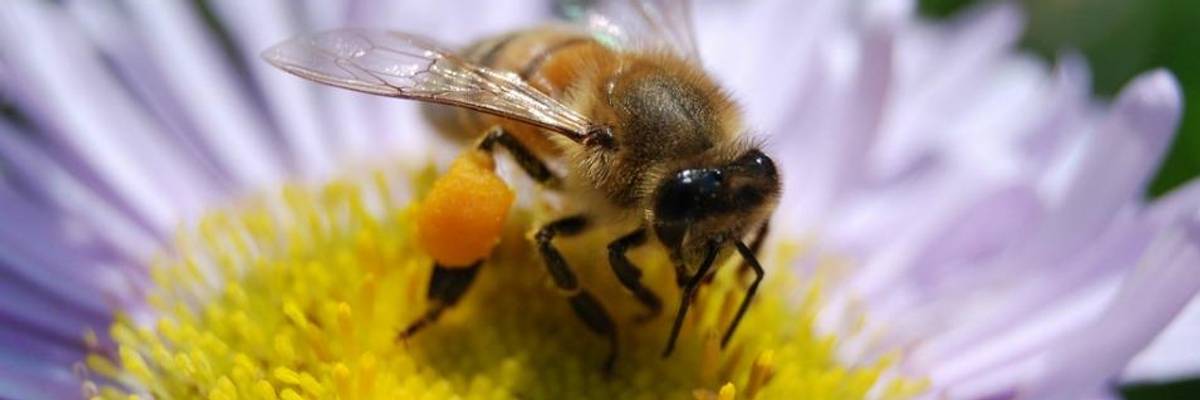
For the third straight year, the U.K. announced on January 23, 2023 that it will permit the use of sugar beet seeds coated with a banned neonicotinoid pesticide lethal to bees.
"The real 'emergency' here is our declining biodiversity," said one campaigner. "It's time farmers got support for alternatives, not a green light for using toxic chemicals."
Biodiversity defenders have sounded the alarm about the United Kingdom government's Monday decision to provide another so-called "emergency" exception for the use of an outlawed neonicotinoid pesticide lethal to bees.
"Bad news again for bees as the U.K. government allows banned neonicotinoids in our fields against the advice of its own experts," Friends of the Earth campaigner Sandra Bell tweeted. "The real 'emergency' here is our declining biodiversity—it's time farmers got support for alternatives, not a green light for using toxic chemicals."
Despite U.K. guidance affirming that emergency applications should not be granted more than once, the Department for Environment, Food, and Rural Affairs (DEFRA) announced for the third straight year that it will permit the use of sugar beet seeds coated with thiamethoxam under certain conditions in England.
"If the government is serious about halting biodiversity loss by 2030, they must support farmers to explore long-term, agroecological solutions that don't threaten our endangered bee population."
Against the recommendation of an independent panel of pesticide experts, the agency approved the use of thiamethoxam just four days after the European Union's highest court ruled that providing emergency derogations for prohibited neonicotinoid-treated seeds is inconsistent with the bloc's laws. The U.K. withdrew from the E.U. in 2020.
DEFRA's emergency authorization for thiamethoxam-coated sugar beet seeds also comes one month after the U.K. government advocated for a stronger global pesticide reduction target at the United Nations COP15 biodiversity summit.
Calling the authorization "yet another shameful episode in a long list of failures to protect the U.K. environment," the British chapter of the Pesticide Action Network (PAN) said that "putting bees and other insects at risk shows just how seriously this government takes the biodiversity crisis."
"It's incredibly brazen to allow a banned bee-harming pesticide back into U.K. fields mere weeks after the government talked up the need for global ambition on reducing pesticides at the U.N. biodiversity talks in Montreal," Bell said in a statement issued by the Pesticide Collaboration, a progressive coalition of 83 health and environmental organizations, trade unions, farmer and consumer groups, and academics.
"This is the third consecutive year that the government has gone directly against the advice of its own scientific advisers with potentially devastating consequences for bees and other vital pollinators," said Bell. "The health of us all and the planet depends on their survival. The government must fulfill its duty to protect wildlife and keep pesticides off our crops for good—that means supporting farmers to find nature-friendly ways to control pests."
University of Sussex biology professor Dave Goulson has estimated that a single teaspoon of thiamethoxam—one of three neonicotinoids produced by Bayer, the German biotech corporation that merged with agrochemical giant Monsanto in 2018—is toxic enough to wipe out 1.25 billion bees.
A Greenpeace U.K. petition imploring Thérèse Coffey, a Conservative Party lawmaker serving as secretary of state for environment, food, and rural affairs, to "enforce a total ban on bee-killing pesticides" has garnered nearly one million signatures.
Describing DEFRA's move as "a huge disappointment," the Stand By Bees campaign on Tuesday urged supporters to "continue pushing" and "write to your local MP."
In 2013, the European Commission banned the use of thiamethoxam and two other hazardous neonicotinoids produced by Monsanto—clothianidin and imidacloprid—on bee-attractive crops including maize, rapeseed, and some cereals. This was followed by a prohibition on all outdoor uses in 2018, which the European Court of Justice upheld in 2021, rejecting an appeal by Bayer.
The Pesticide Collaboration warned Monday that DEFRA's latest authorization for thiamethoxam-coated sugar beet seeds "raises wider concerns over whether the government will maintain existing restrictions on neonicotinoids and other harmful pesticides, or whether they may be overturned as part of a forthcoming bonfire of regulations that protect nature, wildlife, and communities."
At issue is the Retained E.U. Law Bill, which threatens to rescind E.U.-era environmental standards and other measures enacted prior to Brexit.
"It is inexcusable to see England falling so far behind the E.U. on regulations in place to prevent such a detrimental impact on biodiversity," Soil Association, a U.K.-based research and advocacy group, tweeted Tuesday. "It's not credible to claim an exemption is 'temporary' or 'emergency' when it is used year after year. How many more years will it happen?"
According to Amy Heley of the Pesticide Collaboration: "In previous years, DEFRA insisted that the sugar industry must make progress in finding alternatives, but we are yet to see any outcomes of this. The Pesticide Collaboration is deeply concerned that this emergency derogation is simply another example of the government failing to follow through on their own pledges to improve the environment and protect human health."
As Joan Edwards, director of policy & public affairs at the Wildlife Trusts, noted Monday: "Just last month, the Secretary of State Thérèse Coffey committed the U.K. to halving the environmental impact of damaging pesticides by 2030. However, today she has incompatibly authorized the use of a banned neonicotinoid, one of the world's most environmentally damaging pesticides."
“Only a few days ago, the E.U.'s highest court ruled that E.U. countries should no longer be allowed temporary exemptions for banned, bee-toxic neonicotinoid pesticides," said Edwards. "Yet this government deems it acceptable to allow the use of a toxic pesticide that is extremely harmful to bees and other insects, at a time when populations of our precious pollinators are already in freefall. This is unacceptable."
The Soil Association, meanwhile, argued that "if the government is serious about halting biodiversity loss by 2030, they must support farmers to explore long-term, agroecological solutions that don't threaten our endangered bee population."
"Neonicotinoids simply have no place in a sustainable farming system," the group added.
Dear Common Dreams reader, It’s been nearly 30 years since I co-founded Common Dreams with my late wife, Lina Newhouser. We had the radical notion that journalism should serve the public good, not corporate profits. It was clear to us from the outset what it would take to build such a project. No paid advertisements. No corporate sponsors. No millionaire publisher telling us what to think or do. Many people said we wouldn't last a year, but we proved those doubters wrong. Together with a tremendous team of journalists and dedicated staff, we built an independent media outlet free from the constraints of profits and corporate control. Our mission has always been simple: To inform. To inspire. To ignite change for the common good. Building Common Dreams was not easy. Our survival was never guaranteed. When you take on the most powerful forces—Wall Street greed, fossil fuel industry destruction, Big Tech lobbyists, and uber-rich oligarchs who have spent billions upon billions rigging the economy and democracy in their favor—the only bulwark you have is supporters who believe in your work. But here’s the urgent message from me today. It's never been this bad out there. And it's never been this hard to keep us going. At the very moment Common Dreams is most needed, the threats we face are intensifying. We need your support now more than ever. We don't accept corporate advertising and never will. We don't have a paywall because we don't think people should be blocked from critical news based on their ability to pay. Everything we do is funded by the donations of readers like you. When everyone does the little they can afford, we are strong. But if that support retreats or dries up, so do we. Will you donate now to make sure Common Dreams not only survives but thrives? —Craig Brown, Co-founder |
Biodiversity defenders have sounded the alarm about the United Kingdom government's Monday decision to provide another so-called "emergency" exception for the use of an outlawed neonicotinoid pesticide lethal to bees.
"Bad news again for bees as the U.K. government allows banned neonicotinoids in our fields against the advice of its own experts," Friends of the Earth campaigner Sandra Bell tweeted. "The real 'emergency' here is our declining biodiversity—it's time farmers got support for alternatives, not a green light for using toxic chemicals."
Despite U.K. guidance affirming that emergency applications should not be granted more than once, the Department for Environment, Food, and Rural Affairs (DEFRA) announced for the third straight year that it will permit the use of sugar beet seeds coated with thiamethoxam under certain conditions in England.
"If the government is serious about halting biodiversity loss by 2030, they must support farmers to explore long-term, agroecological solutions that don't threaten our endangered bee population."
Against the recommendation of an independent panel of pesticide experts, the agency approved the use of thiamethoxam just four days after the European Union's highest court ruled that providing emergency derogations for prohibited neonicotinoid-treated seeds is inconsistent with the bloc's laws. The U.K. withdrew from the E.U. in 2020.
DEFRA's emergency authorization for thiamethoxam-coated sugar beet seeds also comes one month after the U.K. government advocated for a stronger global pesticide reduction target at the United Nations COP15 biodiversity summit.
Calling the authorization "yet another shameful episode in a long list of failures to protect the U.K. environment," the British chapter of the Pesticide Action Network (PAN) said that "putting bees and other insects at risk shows just how seriously this government takes the biodiversity crisis."
"It's incredibly brazen to allow a banned bee-harming pesticide back into U.K. fields mere weeks after the government talked up the need for global ambition on reducing pesticides at the U.N. biodiversity talks in Montreal," Bell said in a statement issued by the Pesticide Collaboration, a progressive coalition of 83 health and environmental organizations, trade unions, farmer and consumer groups, and academics.
"This is the third consecutive year that the government has gone directly against the advice of its own scientific advisers with potentially devastating consequences for bees and other vital pollinators," said Bell. "The health of us all and the planet depends on their survival. The government must fulfill its duty to protect wildlife and keep pesticides off our crops for good—that means supporting farmers to find nature-friendly ways to control pests."
University of Sussex biology professor Dave Goulson has estimated that a single teaspoon of thiamethoxam—one of three neonicotinoids produced by Bayer, the German biotech corporation that merged with agrochemical giant Monsanto in 2018—is toxic enough to wipe out 1.25 billion bees.
A Greenpeace U.K. petition imploring Thérèse Coffey, a Conservative Party lawmaker serving as secretary of state for environment, food, and rural affairs, to "enforce a total ban on bee-killing pesticides" has garnered nearly one million signatures.
Describing DEFRA's move as "a huge disappointment," the Stand By Bees campaign on Tuesday urged supporters to "continue pushing" and "write to your local MP."
In 2013, the European Commission banned the use of thiamethoxam and two other hazardous neonicotinoids produced by Monsanto—clothianidin and imidacloprid—on bee-attractive crops including maize, rapeseed, and some cereals. This was followed by a prohibition on all outdoor uses in 2018, which the European Court of Justice upheld in 2021, rejecting an appeal by Bayer.
The Pesticide Collaboration warned Monday that DEFRA's latest authorization for thiamethoxam-coated sugar beet seeds "raises wider concerns over whether the government will maintain existing restrictions on neonicotinoids and other harmful pesticides, or whether they may be overturned as part of a forthcoming bonfire of regulations that protect nature, wildlife, and communities."
At issue is the Retained E.U. Law Bill, which threatens to rescind E.U.-era environmental standards and other measures enacted prior to Brexit.
"It is inexcusable to see England falling so far behind the E.U. on regulations in place to prevent such a detrimental impact on biodiversity," Soil Association, a U.K.-based research and advocacy group, tweeted Tuesday. "It's not credible to claim an exemption is 'temporary' or 'emergency' when it is used year after year. How many more years will it happen?"
According to Amy Heley of the Pesticide Collaboration: "In previous years, DEFRA insisted that the sugar industry must make progress in finding alternatives, but we are yet to see any outcomes of this. The Pesticide Collaboration is deeply concerned that this emergency derogation is simply another example of the government failing to follow through on their own pledges to improve the environment and protect human health."
As Joan Edwards, director of policy & public affairs at the Wildlife Trusts, noted Monday: "Just last month, the Secretary of State Thérèse Coffey committed the U.K. to halving the environmental impact of damaging pesticides by 2030. However, today she has incompatibly authorized the use of a banned neonicotinoid, one of the world's most environmentally damaging pesticides."
“Only a few days ago, the E.U.'s highest court ruled that E.U. countries should no longer be allowed temporary exemptions for banned, bee-toxic neonicotinoid pesticides," said Edwards. "Yet this government deems it acceptable to allow the use of a toxic pesticide that is extremely harmful to bees and other insects, at a time when populations of our precious pollinators are already in freefall. This is unacceptable."
The Soil Association, meanwhile, argued that "if the government is serious about halting biodiversity loss by 2030, they must support farmers to explore long-term, agroecological solutions that don't threaten our endangered bee population."
"Neonicotinoids simply have no place in a sustainable farming system," the group added.
Biodiversity defenders have sounded the alarm about the United Kingdom government's Monday decision to provide another so-called "emergency" exception for the use of an outlawed neonicotinoid pesticide lethal to bees.
"Bad news again for bees as the U.K. government allows banned neonicotinoids in our fields against the advice of its own experts," Friends of the Earth campaigner Sandra Bell tweeted. "The real 'emergency' here is our declining biodiversity—it's time farmers got support for alternatives, not a green light for using toxic chemicals."
Despite U.K. guidance affirming that emergency applications should not be granted more than once, the Department for Environment, Food, and Rural Affairs (DEFRA) announced for the third straight year that it will permit the use of sugar beet seeds coated with thiamethoxam under certain conditions in England.
"If the government is serious about halting biodiversity loss by 2030, they must support farmers to explore long-term, agroecological solutions that don't threaten our endangered bee population."
Against the recommendation of an independent panel of pesticide experts, the agency approved the use of thiamethoxam just four days after the European Union's highest court ruled that providing emergency derogations for prohibited neonicotinoid-treated seeds is inconsistent with the bloc's laws. The U.K. withdrew from the E.U. in 2020.
DEFRA's emergency authorization for thiamethoxam-coated sugar beet seeds also comes one month after the U.K. government advocated for a stronger global pesticide reduction target at the United Nations COP15 biodiversity summit.
Calling the authorization "yet another shameful episode in a long list of failures to protect the U.K. environment," the British chapter of the Pesticide Action Network (PAN) said that "putting bees and other insects at risk shows just how seriously this government takes the biodiversity crisis."
"It's incredibly brazen to allow a banned bee-harming pesticide back into U.K. fields mere weeks after the government talked up the need for global ambition on reducing pesticides at the U.N. biodiversity talks in Montreal," Bell said in a statement issued by the Pesticide Collaboration, a progressive coalition of 83 health and environmental organizations, trade unions, farmer and consumer groups, and academics.
"This is the third consecutive year that the government has gone directly against the advice of its own scientific advisers with potentially devastating consequences for bees and other vital pollinators," said Bell. "The health of us all and the planet depends on their survival. The government must fulfill its duty to protect wildlife and keep pesticides off our crops for good—that means supporting farmers to find nature-friendly ways to control pests."
University of Sussex biology professor Dave Goulson has estimated that a single teaspoon of thiamethoxam—one of three neonicotinoids produced by Bayer, the German biotech corporation that merged with agrochemical giant Monsanto in 2018—is toxic enough to wipe out 1.25 billion bees.
A Greenpeace U.K. petition imploring Thérèse Coffey, a Conservative Party lawmaker serving as secretary of state for environment, food, and rural affairs, to "enforce a total ban on bee-killing pesticides" has garnered nearly one million signatures.
Describing DEFRA's move as "a huge disappointment," the Stand By Bees campaign on Tuesday urged supporters to "continue pushing" and "write to your local MP."
In 2013, the European Commission banned the use of thiamethoxam and two other hazardous neonicotinoids produced by Monsanto—clothianidin and imidacloprid—on bee-attractive crops including maize, rapeseed, and some cereals. This was followed by a prohibition on all outdoor uses in 2018, which the European Court of Justice upheld in 2021, rejecting an appeal by Bayer.
The Pesticide Collaboration warned Monday that DEFRA's latest authorization for thiamethoxam-coated sugar beet seeds "raises wider concerns over whether the government will maintain existing restrictions on neonicotinoids and other harmful pesticides, or whether they may be overturned as part of a forthcoming bonfire of regulations that protect nature, wildlife, and communities."
At issue is the Retained E.U. Law Bill, which threatens to rescind E.U.-era environmental standards and other measures enacted prior to Brexit.
"It is inexcusable to see England falling so far behind the E.U. on regulations in place to prevent such a detrimental impact on biodiversity," Soil Association, a U.K.-based research and advocacy group, tweeted Tuesday. "It's not credible to claim an exemption is 'temporary' or 'emergency' when it is used year after year. How many more years will it happen?"
According to Amy Heley of the Pesticide Collaboration: "In previous years, DEFRA insisted that the sugar industry must make progress in finding alternatives, but we are yet to see any outcomes of this. The Pesticide Collaboration is deeply concerned that this emergency derogation is simply another example of the government failing to follow through on their own pledges to improve the environment and protect human health."
As Joan Edwards, director of policy & public affairs at the Wildlife Trusts, noted Monday: "Just last month, the Secretary of State Thérèse Coffey committed the U.K. to halving the environmental impact of damaging pesticides by 2030. However, today she has incompatibly authorized the use of a banned neonicotinoid, one of the world's most environmentally damaging pesticides."
“Only a few days ago, the E.U.'s highest court ruled that E.U. countries should no longer be allowed temporary exemptions for banned, bee-toxic neonicotinoid pesticides," said Edwards. "Yet this government deems it acceptable to allow the use of a toxic pesticide that is extremely harmful to bees and other insects, at a time when populations of our precious pollinators are already in freefall. This is unacceptable."
The Soil Association, meanwhile, argued that "if the government is serious about halting biodiversity loss by 2030, they must support farmers to explore long-term, agroecological solutions that don't threaten our endangered bee population."
"Neonicotinoids simply have no place in a sustainable farming system," the group added.