
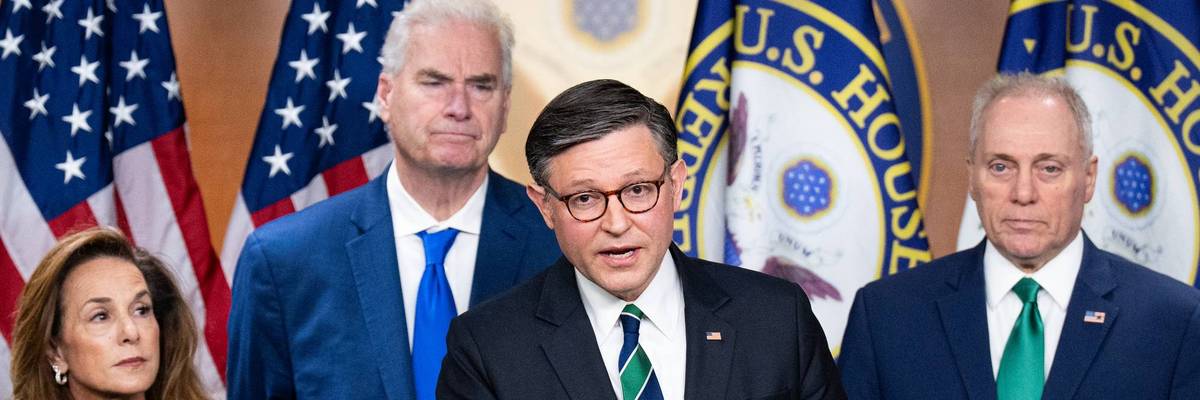
Speaker of the House Mike Johnson, R-La., speaks during the House Republican Conference news conference in the US Capitol on Tuesday, March 17, 2026.
Congress Must End Warrantless Spying Program
Trump is more than willing to risk your rights and privileges for the sake of the America he desires. For a petty narcissist obsessed with revenge, section 702 of FISA is another dangerous and powerful tool for furthering his authoritarian agenda.
On April 17, Congress voted to pass a brief 10-day extension of section 702 of the Foreign Intelligence Surveillance Act, or FISA. This sets the new expiration date for April 30, 2026.
Section 702 was added to FISA in 2008 with a provision that requires Congress to periodically reauthorize it. The measure allows national security agencies like the National Security Agency (NSA), Federal Bureau of Investigation (FBI), and Central Intelligence Agency (CIA) to collect and monitor—without a warrant—any electronic communications sent to and from non-US persons “reasonably believed to be located” outside the US. Notably, Americans who send messages to people abroad may likewise have their data surveilled.
Law enforcement agencies have consistently abused this loophole to spy on US citizens in clear violation of their Fourth Amendment rights. The Brennan Center for Justice reports that, in recent years, the government has conducted warrantless “searches for the communications of 141 Black Lives Matter protesters; 19,000 donors to a congressional campaign; members of Congress; multiple US government officials, political commentators, and journalists; and tens of thousands of Americans engaged in ‘civil unrest.’”
Even President Donald Trump alleges being a victim of these “backdoor searches.” Ahead of the last renewal vote in April 2024, Trump posted on Truth Social, “KILL FISA, IT WAS ILLEGALLY USED AGAINST ME, AND MANY OTHERS. THEY SPIED ON MY CAMPAIGN!!! DJT.”
The Trump administration perfectly encapsulates the dangers that section 702 presents to the American public and the wider international community. Far from preventing terrorism, section 702 enables it.
Since returning to the White House, however, his tone has notably shifted. On April 15, Trump posted that Republicans must “UNIFY” to pass a “clean extension of FISA 702.” He continues, “While parts of FISA were illegally and unfortunately used against me in the Democrats’ disgraceful Witch Hunt and Attack in the RUSSIA, RUSSIA, RUSSIA Hoax, and perhaps would be used against me in the future, I am willing to risk the giving up of my Rights and Privileges as a Citizen for our Great Military and Country!”
Trump’s strong endorsement of section 702 is unsurprising. His administration has actively worked to undermine the rights and protections the Constitution guarantees. This includes: (i) subpoenaing social media sites to turn over the personal data of users who have criticized Immigration and Customs Enforcement; (ii) actively exploring a proposal to detain US citizens and deport them to prisons in El Salvador; (iii) violating states’ rights by threatening to cut funding to sanctuary cities as well as commandeering state and local officials to do the federal government’s bidding; (iv) working to disenfranchise voters via the election-rigging SAVE America Act; and (v) his administration’s efforts to restrict birthright citizenship, among many other examples.
Trump is more than willing to risk your rights and privileges for the sake of the America he desires. For a petty narcissist obsessed with revenge, section 702 is another dangerous and powerful tool for furthering his authoritarian agenda.
Already, Trump is actively exploiting section 702 to advance his illegal wars. On April 14, he posted, “Our Military desperately needs FISA 702, and it is one of the reasons we have had such tremendous SUCCESS on the battlefield, both in Venezuela and Iran.” These ‘successes’—or more accurately, war crimes and violations of international law—include kidnapping Venezuelan President Nicolás Maduro; assassinating Iran’s Ayatollah Ali Khamenei; and inciting a reckless war of choice that has seen the US and Israel deliberately target schools, hospitals, and residential buildings.
The Trump administration perfectly encapsulates the dangers that section 702 presents to the American public and the wider international community. Far from preventing terrorism, section 702 enables it.
To be clear, however, the reasons for ending section 702 go beyond the Trump administration. First, the measure undermines the very rationale for FISA. FISA was enacted in 1978 following the revelations of widespread warrantless surveillance under the Nixon administration. This included not only the infamous Watergate scandal, but also spying on anti-war protesters and civil rights activists under the guise that they were linked to foreign communist groups. FISA requires intelligence agencies to obtain authorization for electronic surveillance and other investigative actions. It also establishes the FISA court to oversee requests for surveillance warrants.
Section 702 bypasses these safeguards. Once the government collects a target’s data, the FBI and other agencies can search through it to find Americans’ phone calls, text messages, and emails without a warrant or approval from the FISA court. Section 702 allows the government to engage in the very kinds of Nixonian abuses FISA was designed to prevent.
Keeping in line with Trump’s interests, Johnson’s proposal would permit the federal government to continue its assault against the American public and the global community unimpeded.
In fact, section 702 originally grew out of a secret warrantless surveillance program authorized by the Bush administration following the 9/11 attacks. The New York Times exposed the Terrorism Surveillance Program (TSP) to the public in 2005, triggering a wave of lawsuits. In 2006, Judge Anna Diggs Taylor ruled that TSP violated FISA and the Constitution. Despite this, as the American Civil Liberties Union notes, “Congress weakened FISA in 2007 and then again in 2008 to permit the warrantless wiretapping that the law had previously prohibited.” Instead of shutting down Bush’s unconstitutional program, Congress effectively codified it.
Second, and relatedly, section 702 cannot be meaningfully reformed precisely because the measure is antithetical to FISA itself. In 2023, amid another FISA renewal debate, then-FBI director Christopher Wray told Congress that he was “especially concerned” about a proposal that would require the government to obtain a warrant or court order before accessing information obtained using section 702. He remarked that, “A warrant requirement would amount to a de facto ban, because query applications either would not meet the legal standard to win court approval; or because, when the standard could be met, it would be so only after the expenditure of scarce resources, the submission and review of a lengthy legal filing, and the passage of significant time.”
This makes sense. After all, the entire point of section 702 is to authorize a warrantless surveillance program. A warrant requirement would effectively render it useless.
More modest attempts at reform have been proposed and even implemented. The 2024 Reforming Intelligence and Securing America Act (RISAA), for instance, introduced a few provisions aimed at restricting backdoor searches. Yet, within a few months, the FBI was already violating those new requirements. While the Office of the Director of National Intelligence (ODNI) contends that RISAA has led to a steep decline in backdoor searches, the reality is that the FBI failed to track all such queries in 2024 and 2025. Whether RISAA has had any real impact is thus unknown. That said, even if a decline occurred, RISAA—and similar proposals—would still have failed at solving the fundamental problem: prohibiting warrantless government surveillance and mass data collection.
This is the dilemma reformists face: A warrant requirement is a “de facto ban,” but any other form of restrictions will, at best, only lessen the number of people whose constitutional rights are violated.
The proposed three-year extension unveiled by Speaker of the House Mike Johnson (R-La.) on April 23 is no better. It includes minimal new oversight and penalties for abusing the spy program, but no warrant requirements. As Senator Ron Wyden (D-Ore.) remarked: “Instead of ending warrantless surveillance or creating more transparency about government spying, this bill only requires a few more Trump administration officials to check a box. That always leads to more abuses, not less.” Keeping in line with Trump’s interests, Johnson’s proposal would permit the federal government to continue its assault against the American public and the global community unimpeded.
Third, while Trump and the CIA make sweeping claims about the terror attacks that section 702 has prevented, there is little publicly available evidence to support this. According to the Cato Institute, there is only one well-documented, independently corroborated case of section 702 preventing a terrorist attack on American soil: the 2009 New York subway bombing plot. In that case, section 702 was used by the NSA to track an exchange between an al-Qaeda courier and Najibullah Zazi, who was living in the US. The NSA passed this information to the FBI, which identified Zazi and disrupted the attack before it took place. Importantly, however, the NSA allegedly received the courier’s foreign email address from the government’s British Intelligence partners. At best then, this success was a byproduct of productive intelligence sharing between allies. Rather than proving the necessity of section 702, this incident underscores how Trump’s inane attacks against key US allies undermine our national security.
Congress should end section 702 and shift their focus to implementing more meaningful guardrails and oversight to FISA. At a time when constitutional rights are under unprecedented threat, Congress must act in the best interest of the public. While there’s still time, I urge everyone to contact their representatives and express their opposition to extending section 702.
We are at a crossroads
This country and this world are at a monumental crossroads. In a few short weeks, US voters will have an opportunity to beat back the forces of fascism and confront the billionaires who are rigging the economy, our media system, and our democracy, making it increasingly impossible for ordinary people to get by. We’re not just talking about the election. We’re talking about what must be done once these fascist elements are vanquished from power. We need a bolder set of solutions than what either major party has so far been willing to offer and a working-class movement ready to fight like hell for it. Trump didn't emerge from nowhere. The conditions that fueled MAGA authoritarianism were created by decades of radical neoliberal economic policies and a corrupt political system dominated by corporate interests. They slashed taxes on the super-rich, promising that the benefits would trickle down. They said giveaways to the corporate titans would make life more affordable for the rest of us. It was all bullshit. And when a bitter, betrayed populace searches for someone to blame, right-wing demagogues have little trouble finding scapegoats. People know when they're being lied to, but you won't hear any of this from the corporate media. Only independent journalism—powered and funded by people who believe in building a better world—can deliver truly trustworthy daily news. Our Fall Campaign is underway, and we need your help. To power our newsroom through the rest of the year, we need to raise $125,000 by midnight on October 31. So if you share our vision, please contribute whatever you can to sustain our work. |
On April 17, Congress voted to pass a brief 10-day extension of section 702 of the Foreign Intelligence Surveillance Act, or FISA. This sets the new expiration date for April 30, 2026.
Section 702 was added to FISA in 2008 with a provision that requires Congress to periodically reauthorize it. The measure allows national security agencies like the National Security Agency (NSA), Federal Bureau of Investigation (FBI), and Central Intelligence Agency (CIA) to collect and monitor—without a warrant—any electronic communications sent to and from non-US persons “reasonably believed to be located” outside the US. Notably, Americans who send messages to people abroad may likewise have their data surveilled.
Law enforcement agencies have consistently abused this loophole to spy on US citizens in clear violation of their Fourth Amendment rights. The Brennan Center for Justice reports that, in recent years, the government has conducted warrantless “searches for the communications of 141 Black Lives Matter protesters; 19,000 donors to a congressional campaign; members of Congress; multiple US government officials, political commentators, and journalists; and tens of thousands of Americans engaged in ‘civil unrest.’”
Even President Donald Trump alleges being a victim of these “backdoor searches.” Ahead of the last renewal vote in April 2024, Trump posted on Truth Social, “KILL FISA, IT WAS ILLEGALLY USED AGAINST ME, AND MANY OTHERS. THEY SPIED ON MY CAMPAIGN!!! DJT.”
The Trump administration perfectly encapsulates the dangers that section 702 presents to the American public and the wider international community. Far from preventing terrorism, section 702 enables it.
Since returning to the White House, however, his tone has notably shifted. On April 15, Trump posted that Republicans must “UNIFY” to pass a “clean extension of FISA 702.” He continues, “While parts of FISA were illegally and unfortunately used against me in the Democrats’ disgraceful Witch Hunt and Attack in the RUSSIA, RUSSIA, RUSSIA Hoax, and perhaps would be used against me in the future, I am willing to risk the giving up of my Rights and Privileges as a Citizen for our Great Military and Country!”
Trump’s strong endorsement of section 702 is unsurprising. His administration has actively worked to undermine the rights and protections the Constitution guarantees. This includes: (i) subpoenaing social media sites to turn over the personal data of users who have criticized Immigration and Customs Enforcement; (ii) actively exploring a proposal to detain US citizens and deport them to prisons in El Salvador; (iii) violating states’ rights by threatening to cut funding to sanctuary cities as well as commandeering state and local officials to do the federal government’s bidding; (iv) working to disenfranchise voters via the election-rigging SAVE America Act; and (v) his administration’s efforts to restrict birthright citizenship, among many other examples.
Trump is more than willing to risk your rights and privileges for the sake of the America he desires. For a petty narcissist obsessed with revenge, section 702 is another dangerous and powerful tool for furthering his authoritarian agenda.
Already, Trump is actively exploiting section 702 to advance his illegal wars. On April 14, he posted, “Our Military desperately needs FISA 702, and it is one of the reasons we have had such tremendous SUCCESS on the battlefield, both in Venezuela and Iran.” These ‘successes’—or more accurately, war crimes and violations of international law—include kidnapping Venezuelan President Nicolás Maduro; assassinating Iran’s Ayatollah Ali Khamenei; and inciting a reckless war of choice that has seen the US and Israel deliberately target schools, hospitals, and residential buildings.
The Trump administration perfectly encapsulates the dangers that section 702 presents to the American public and the wider international community. Far from preventing terrorism, section 702 enables it.
To be clear, however, the reasons for ending section 702 go beyond the Trump administration. First, the measure undermines the very rationale for FISA. FISA was enacted in 1978 following the revelations of widespread warrantless surveillance under the Nixon administration. This included not only the infamous Watergate scandal, but also spying on anti-war protesters and civil rights activists under the guise that they were linked to foreign communist groups. FISA requires intelligence agencies to obtain authorization for electronic surveillance and other investigative actions. It also establishes the FISA court to oversee requests for surveillance warrants.
Section 702 bypasses these safeguards. Once the government collects a target’s data, the FBI and other agencies can search through it to find Americans’ phone calls, text messages, and emails without a warrant or approval from the FISA court. Section 702 allows the government to engage in the very kinds of Nixonian abuses FISA was designed to prevent.
Keeping in line with Trump’s interests, Johnson’s proposal would permit the federal government to continue its assault against the American public and the global community unimpeded.
In fact, section 702 originally grew out of a secret warrantless surveillance program authorized by the Bush administration following the 9/11 attacks. The New York Times exposed the Terrorism Surveillance Program (TSP) to the public in 2005, triggering a wave of lawsuits. In 2006, Judge Anna Diggs Taylor ruled that TSP violated FISA and the Constitution. Despite this, as the American Civil Liberties Union notes, “Congress weakened FISA in 2007 and then again in 2008 to permit the warrantless wiretapping that the law had previously prohibited.” Instead of shutting down Bush’s unconstitutional program, Congress effectively codified it.
Second, and relatedly, section 702 cannot be meaningfully reformed precisely because the measure is antithetical to FISA itself. In 2023, amid another FISA renewal debate, then-FBI director Christopher Wray told Congress that he was “especially concerned” about a proposal that would require the government to obtain a warrant or court order before accessing information obtained using section 702. He remarked that, “A warrant requirement would amount to a de facto ban, because query applications either would not meet the legal standard to win court approval; or because, when the standard could be met, it would be so only after the expenditure of scarce resources, the submission and review of a lengthy legal filing, and the passage of significant time.”
This makes sense. After all, the entire point of section 702 is to authorize a warrantless surveillance program. A warrant requirement would effectively render it useless.
More modest attempts at reform have been proposed and even implemented. The 2024 Reforming Intelligence and Securing America Act (RISAA), for instance, introduced a few provisions aimed at restricting backdoor searches. Yet, within a few months, the FBI was already violating those new requirements. While the Office of the Director of National Intelligence (ODNI) contends that RISAA has led to a steep decline in backdoor searches, the reality is that the FBI failed to track all such queries in 2024 and 2025. Whether RISAA has had any real impact is thus unknown. That said, even if a decline occurred, RISAA—and similar proposals—would still have failed at solving the fundamental problem: prohibiting warrantless government surveillance and mass data collection.
This is the dilemma reformists face: A warrant requirement is a “de facto ban,” but any other form of restrictions will, at best, only lessen the number of people whose constitutional rights are violated.
The proposed three-year extension unveiled by Speaker of the House Mike Johnson (R-La.) on April 23 is no better. It includes minimal new oversight and penalties for abusing the spy program, but no warrant requirements. As Senator Ron Wyden (D-Ore.) remarked: “Instead of ending warrantless surveillance or creating more transparency about government spying, this bill only requires a few more Trump administration officials to check a box. That always leads to more abuses, not less.” Keeping in line with Trump’s interests, Johnson’s proposal would permit the federal government to continue its assault against the American public and the global community unimpeded.
Third, while Trump and the CIA make sweeping claims about the terror attacks that section 702 has prevented, there is little publicly available evidence to support this. According to the Cato Institute, there is only one well-documented, independently corroborated case of section 702 preventing a terrorist attack on American soil: the 2009 New York subway bombing plot. In that case, section 702 was used by the NSA to track an exchange between an al-Qaeda courier and Najibullah Zazi, who was living in the US. The NSA passed this information to the FBI, which identified Zazi and disrupted the attack before it took place. Importantly, however, the NSA allegedly received the courier’s foreign email address from the government’s British Intelligence partners. At best then, this success was a byproduct of productive intelligence sharing between allies. Rather than proving the necessity of section 702, this incident underscores how Trump’s inane attacks against key US allies undermine our national security.
Congress should end section 702 and shift their focus to implementing more meaningful guardrails and oversight to FISA. At a time when constitutional rights are under unprecedented threat, Congress must act in the best interest of the public. While there’s still time, I urge everyone to contact their representatives and express their opposition to extending section 702.
- 'Shame': Bill Including Warrantless Spying Expansion Passes Senate, Becomes Law ›
- Trump Openly Calls for 'Clean' Extension of Spying Power Opposed by Privacy Advocates ›
- Exposé of 'Scandalous' US Spying Sparks Calls for Congress to Act ›
- What to Know About the Coming Fight in Congress Over Mass Surveillance ›
- In Dead of Night, Johnson Tries—But Fails—to Ram Through Domestic Spying Bill for Trump ›
On April 17, Congress voted to pass a brief 10-day extension of section 702 of the Foreign Intelligence Surveillance Act, or FISA. This sets the new expiration date for April 30, 2026.
Section 702 was added to FISA in 2008 with a provision that requires Congress to periodically reauthorize it. The measure allows national security agencies like the National Security Agency (NSA), Federal Bureau of Investigation (FBI), and Central Intelligence Agency (CIA) to collect and monitor—without a warrant—any electronic communications sent to and from non-US persons “reasonably believed to be located” outside the US. Notably, Americans who send messages to people abroad may likewise have their data surveilled.
Law enforcement agencies have consistently abused this loophole to spy on US citizens in clear violation of their Fourth Amendment rights. The Brennan Center for Justice reports that, in recent years, the government has conducted warrantless “searches for the communications of 141 Black Lives Matter protesters; 19,000 donors to a congressional campaign; members of Congress; multiple US government officials, political commentators, and journalists; and tens of thousands of Americans engaged in ‘civil unrest.’”
Even President Donald Trump alleges being a victim of these “backdoor searches.” Ahead of the last renewal vote in April 2024, Trump posted on Truth Social, “KILL FISA, IT WAS ILLEGALLY USED AGAINST ME, AND MANY OTHERS. THEY SPIED ON MY CAMPAIGN!!! DJT.”
The Trump administration perfectly encapsulates the dangers that section 702 presents to the American public and the wider international community. Far from preventing terrorism, section 702 enables it.
Since returning to the White House, however, his tone has notably shifted. On April 15, Trump posted that Republicans must “UNIFY” to pass a “clean extension of FISA 702.” He continues, “While parts of FISA were illegally and unfortunately used against me in the Democrats’ disgraceful Witch Hunt and Attack in the RUSSIA, RUSSIA, RUSSIA Hoax, and perhaps would be used against me in the future, I am willing to risk the giving up of my Rights and Privileges as a Citizen for our Great Military and Country!”
Trump’s strong endorsement of section 702 is unsurprising. His administration has actively worked to undermine the rights and protections the Constitution guarantees. This includes: (i) subpoenaing social media sites to turn over the personal data of users who have criticized Immigration and Customs Enforcement; (ii) actively exploring a proposal to detain US citizens and deport them to prisons in El Salvador; (iii) violating states’ rights by threatening to cut funding to sanctuary cities as well as commandeering state and local officials to do the federal government’s bidding; (iv) working to disenfranchise voters via the election-rigging SAVE America Act; and (v) his administration’s efforts to restrict birthright citizenship, among many other examples.
Trump is more than willing to risk your rights and privileges for the sake of the America he desires. For a petty narcissist obsessed with revenge, section 702 is another dangerous and powerful tool for furthering his authoritarian agenda.
Already, Trump is actively exploiting section 702 to advance his illegal wars. On April 14, he posted, “Our Military desperately needs FISA 702, and it is one of the reasons we have had such tremendous SUCCESS on the battlefield, both in Venezuela and Iran.” These ‘successes’—or more accurately, war crimes and violations of international law—include kidnapping Venezuelan President Nicolás Maduro; assassinating Iran’s Ayatollah Ali Khamenei; and inciting a reckless war of choice that has seen the US and Israel deliberately target schools, hospitals, and residential buildings.
The Trump administration perfectly encapsulates the dangers that section 702 presents to the American public and the wider international community. Far from preventing terrorism, section 702 enables it.
To be clear, however, the reasons for ending section 702 go beyond the Trump administration. First, the measure undermines the very rationale for FISA. FISA was enacted in 1978 following the revelations of widespread warrantless surveillance under the Nixon administration. This included not only the infamous Watergate scandal, but also spying on anti-war protesters and civil rights activists under the guise that they were linked to foreign communist groups. FISA requires intelligence agencies to obtain authorization for electronic surveillance and other investigative actions. It also establishes the FISA court to oversee requests for surveillance warrants.
Section 702 bypasses these safeguards. Once the government collects a target’s data, the FBI and other agencies can search through it to find Americans’ phone calls, text messages, and emails without a warrant or approval from the FISA court. Section 702 allows the government to engage in the very kinds of Nixonian abuses FISA was designed to prevent.
Keeping in line with Trump’s interests, Johnson’s proposal would permit the federal government to continue its assault against the American public and the global community unimpeded.
In fact, section 702 originally grew out of a secret warrantless surveillance program authorized by the Bush administration following the 9/11 attacks. The New York Times exposed the Terrorism Surveillance Program (TSP) to the public in 2005, triggering a wave of lawsuits. In 2006, Judge Anna Diggs Taylor ruled that TSP violated FISA and the Constitution. Despite this, as the American Civil Liberties Union notes, “Congress weakened FISA in 2007 and then again in 2008 to permit the warrantless wiretapping that the law had previously prohibited.” Instead of shutting down Bush’s unconstitutional program, Congress effectively codified it.
Second, and relatedly, section 702 cannot be meaningfully reformed precisely because the measure is antithetical to FISA itself. In 2023, amid another FISA renewal debate, then-FBI director Christopher Wray told Congress that he was “especially concerned” about a proposal that would require the government to obtain a warrant or court order before accessing information obtained using section 702. He remarked that, “A warrant requirement would amount to a de facto ban, because query applications either would not meet the legal standard to win court approval; or because, when the standard could be met, it would be so only after the expenditure of scarce resources, the submission and review of a lengthy legal filing, and the passage of significant time.”
This makes sense. After all, the entire point of section 702 is to authorize a warrantless surveillance program. A warrant requirement would effectively render it useless.
More modest attempts at reform have been proposed and even implemented. The 2024 Reforming Intelligence and Securing America Act (RISAA), for instance, introduced a few provisions aimed at restricting backdoor searches. Yet, within a few months, the FBI was already violating those new requirements. While the Office of the Director of National Intelligence (ODNI) contends that RISAA has led to a steep decline in backdoor searches, the reality is that the FBI failed to track all such queries in 2024 and 2025. Whether RISAA has had any real impact is thus unknown. That said, even if a decline occurred, RISAA—and similar proposals—would still have failed at solving the fundamental problem: prohibiting warrantless government surveillance and mass data collection.
This is the dilemma reformists face: A warrant requirement is a “de facto ban,” but any other form of restrictions will, at best, only lessen the number of people whose constitutional rights are violated.
The proposed three-year extension unveiled by Speaker of the House Mike Johnson (R-La.) on April 23 is no better. It includes minimal new oversight and penalties for abusing the spy program, but no warrant requirements. As Senator Ron Wyden (D-Ore.) remarked: “Instead of ending warrantless surveillance or creating more transparency about government spying, this bill only requires a few more Trump administration officials to check a box. That always leads to more abuses, not less.” Keeping in line with Trump’s interests, Johnson’s proposal would permit the federal government to continue its assault against the American public and the global community unimpeded.
Third, while Trump and the CIA make sweeping claims about the terror attacks that section 702 has prevented, there is little publicly available evidence to support this. According to the Cato Institute, there is only one well-documented, independently corroborated case of section 702 preventing a terrorist attack on American soil: the 2009 New York subway bombing plot. In that case, section 702 was used by the NSA to track an exchange between an al-Qaeda courier and Najibullah Zazi, who was living in the US. The NSA passed this information to the FBI, which identified Zazi and disrupted the attack before it took place. Importantly, however, the NSA allegedly received the courier’s foreign email address from the government’s British Intelligence partners. At best then, this success was a byproduct of productive intelligence sharing between allies. Rather than proving the necessity of section 702, this incident underscores how Trump’s inane attacks against key US allies undermine our national security.
Congress should end section 702 and shift their focus to implementing more meaningful guardrails and oversight to FISA. At a time when constitutional rights are under unprecedented threat, Congress must act in the best interest of the public. While there’s still time, I urge everyone to contact their representatives and express their opposition to extending section 702.
- 'Shame': Bill Including Warrantless Spying Expansion Passes Senate, Becomes Law ›
- Trump Openly Calls for 'Clean' Extension of Spying Power Opposed by Privacy Advocates ›
- Exposé of 'Scandalous' US Spying Sparks Calls for Congress to Act ›
- What to Know About the Coming Fight in Congress Over Mass Surveillance ›
- In Dead of Night, Johnson Tries—But Fails—to Ram Through Domestic Spying Bill for Trump ›