
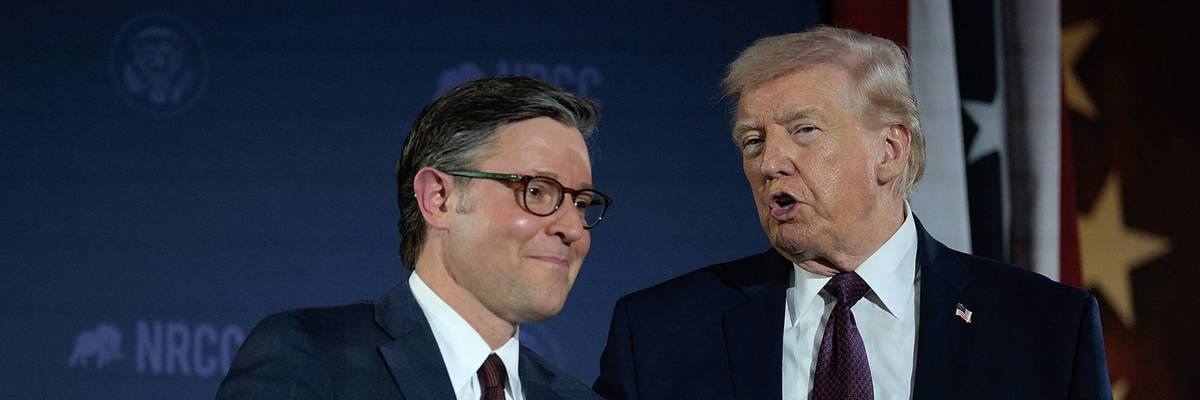
US President Donald Trump and Speaker of the House of Representatives Mike Johnson (R-La.) attend the National Republican Congressional Committee's annual fundraising dinner at Union Station on March 25, 2026 in Washington, DC.
Trump Uses Correspondents' Dinner Shooting to Justify Expanding Spying Powers as Deadline Nears
Section 702 of the Foreign Intelligence Surveillance Act is set to expire Thursday, and the president is claiming Saturday's shooting proved "the safety of our nation" depends on the program.
An exchange of gunfire between an armed suspect and law enforcement outside the White House Correspondents' Dinner on Saturday came days ahead of a deadline for extending far-reaching government surveillance powers, and President Donald Trump wasted no time in claiming that the attempted attack on the event proved that the FBI must be permitted to spy on Americans without obtaining warrants.
In an interview with Fox News Sunday, Trump repeated his previous remarks that he is "willing to give up [his] security" in favor of extending Section 702 of the Foreign Intelligence Surveillance Act (FISA), which is set to expire on Thursday—and suggested other Americans should do the same for "the safety of our nation."
Section 702 allows US intelligence agencies to surveil the electronic communications of foreign nationals overseas without a warrant. Since some of the nearly 350,000 foreign nationals whose communications have been collected under the law are in touch with Americans, Section 702 allows for the collection of emails, text messages, and phone calls of US citizens.
Fox anchor Jacqui Heinrich emphasized that "we don't know right now" whether the suspect in Saturday's shooting, Cole Tomas Allen, "was radicalized" by a foreign individual or group, but asked whether the attack drove home "the importance of having these tools to protect our country from these kinds of threats."
The president responded by complaining that former FBI Director James Comey used FISA to obtain warrants to surveil a former Trump aide as part of the agency's investigation into the 2016 Trump presidential campaign's communications with Russia, before saying FISA has been used in the US-Israeli war on Iran and in the US military's invasion of Venezuela earlier this year.
"It's really needed for national security," said Trump. "Iran is decimated, and we got a lot of information by using FISA... I'm willing to give up my security for the military because ultimately that's to me the highest cause is, you know, the safety of our nation."
Pres. Trump, under prodding from Fox News, exploits White House Correspondents' Dinner shooting to push for Congress to approve FISA domestic spying program: "It's really needed for national security…"
He reiterates that he's willing to give up his liberties for safety. pic.twitter.com/tmcepp0Wgn
— Chris Menahan 🇺🇸 (@infolibnews) April 26, 2026
Jordan Liz, an associate professor of philosophy at San José State University, wrote last week in a column at Common Dreams that while Trump, Republican lawmakers, and US intelligence agencies "make sweeping claims about the terror attacks that Section 702 has prevented, there is little publicly available evidence to support this."
"According to the Cato Institute, there is only one well-documented, independently corroborated case of Section 702 preventing a terrorist attack on American soil: the 2009 New York subway bombing plot," wrote Liz. "In that case, Section 702 was used by the [National Security Agency] to track an exchange between an al-Qaeda courier and Najibullah Zazi, who was living in the US. The NSA passed this information to the FBI, which identified Zazi and disrupted the attack before it took place. Importantly, however, the NSA allegedly received the courier’s foreign email address from the government’s British intelligence partners. At best then, this success was a byproduct of productive intelligence sharing between allies. Rather than proving the necessity of Section 702, this incident underscores how Trump’s inane attacks against key US allies undermine our national security."
The suspect in Saturday's shooting is believed to have acted alone, and no evidence has been released that he was in communication with any foreign entities. A document he wrote alluded to his Christian beliefs and to reports of the administration's abuse of immigrants in detention centers, its boat-bombing operations in the Caribbean Sea and eastern Pacific Ocean, and the bombing of an elementary school in Iran.
The president has been pushing in recent weeks for an extension of Section 702. The program was last reauthorized in 2024, and earlier this month two efforts to extend the program—one for 18 months and the other for five years—failed, with opponents objecting to a lack of privacy reforms and to a loophole allowing data brokers to sell private information about Americans to government agencies that have not obtained judicial approval to seize the data.
After those proposals failed, House Speaker Mike Johnson (R-La.) last week unveiled a new bill to extend Section 702 for three years and require the FBI to submit monthly reports on its reviews of Americans' private data to an oversight official, as well as imposing penalties for abuse—provisions that were dismissed by privacy advocates.
The House Rules Committee was set to convene on Monday, a step toward advancing the new bill toward a vote in the House, and according to NPR, Rep. Jamie Raskin (D-Md.) circulated a memo late last week urging his colleagues to reject the Republicans' latest proposal.
The bill, he wrote, "continues the disastrous policy of trusting the FBI to self-police and self-report its abuses of Section 702 and backdoor searches of Americans' data... FBI agents can still collect, search, and review Americans' communications without any review from a judge."
Four Democrats in the House—Reps. Josh Gottheimer (D-NJ), Tom Suozzi (D-NJ), Marie Gluesencamp Perez (D-Wash.), and Jared Golden (D-Maine)—broke with the party and joined the GOP earlier this month in supporting a procedural vote to advance the reauthorization of Section 702, and privacy advocates are ramping up pressure on them to oppose the latest proposal for an extension.
"It all comes down to those four and where they are going to land,” Hajar Hammado, a senior policy adviser at Demand Progress, told The Intercept Monday, “and if they are going to continue to try to hand Trump and [White House homeland security adviser] Stephen Miller warrantless surveillance authorities without any sort of checks or reforms that make sure they’re not violating civil liberties.”
We are at a crossroads
This country and this world are at a monumental crossroads. In a few short weeks, US voters will have an opportunity to beat back the forces of fascism and confront the billionaires who are rigging the economy, our media system, and our democracy, making it increasingly impossible for ordinary people to get by. We’re not just talking about the election. We’re talking about what must be done once these fascist elements are vanquished from power. We need a bolder set of solutions than what either major party has so far been willing to offer and a working-class movement ready to fight like hell for it. Trump didn't emerge from nowhere. The conditions that fueled MAGA authoritarianism were created by decades of radical neoliberal economic policies and a corrupt political system dominated by corporate interests. They slashed taxes on the super-rich, promising that the benefits would trickle down. They said giveaways to the corporate titans would make life more affordable for the rest of us. It was all bullshit. And when a bitter, betrayed populace searches for someone to blame, right-wing demagogues have little trouble finding scapegoats. People know when they're being lied to, but you won't hear any of this from the corporate media. Only independent journalism—powered and funded by people who believe in building a better world—can deliver truly trustworthy daily news. Our Fall Campaign is underway, and we need your help. To power our newsroom through the rest of the year, we need to raise $125,000 by midnight on October 31. So if you share our vision, please contribute whatever you can to sustain our work. |
An exchange of gunfire between an armed suspect and law enforcement outside the White House Correspondents' Dinner on Saturday came days ahead of a deadline for extending far-reaching government surveillance powers, and President Donald Trump wasted no time in claiming that the attempted attack on the event proved that the FBI must be permitted to spy on Americans without obtaining warrants.
In an interview with Fox News Sunday, Trump repeated his previous remarks that he is "willing to give up [his] security" in favor of extending Section 702 of the Foreign Intelligence Surveillance Act (FISA), which is set to expire on Thursday—and suggested other Americans should do the same for "the safety of our nation."
Section 702 allows US intelligence agencies to surveil the electronic communications of foreign nationals overseas without a warrant. Since some of the nearly 350,000 foreign nationals whose communications have been collected under the law are in touch with Americans, Section 702 allows for the collection of emails, text messages, and phone calls of US citizens.
Fox anchor Jacqui Heinrich emphasized that "we don't know right now" whether the suspect in Saturday's shooting, Cole Tomas Allen, "was radicalized" by a foreign individual or group, but asked whether the attack drove home "the importance of having these tools to protect our country from these kinds of threats."
The president responded by complaining that former FBI Director James Comey used FISA to obtain warrants to surveil a former Trump aide as part of the agency's investigation into the 2016 Trump presidential campaign's communications with Russia, before saying FISA has been used in the US-Israeli war on Iran and in the US military's invasion of Venezuela earlier this year.
"It's really needed for national security," said Trump. "Iran is decimated, and we got a lot of information by using FISA... I'm willing to give up my security for the military because ultimately that's to me the highest cause is, you know, the safety of our nation."
Pres. Trump, under prodding from Fox News, exploits White House Correspondents' Dinner shooting to push for Congress to approve FISA domestic spying program: "It's really needed for national security…"
He reiterates that he's willing to give up his liberties for safety. pic.twitter.com/tmcepp0Wgn
— Chris Menahan 🇺🇸 (@infolibnews) April 26, 2026
Jordan Liz, an associate professor of philosophy at San José State University, wrote last week in a column at Common Dreams that while Trump, Republican lawmakers, and US intelligence agencies "make sweeping claims about the terror attacks that Section 702 has prevented, there is little publicly available evidence to support this."
"According to the Cato Institute, there is only one well-documented, independently corroborated case of Section 702 preventing a terrorist attack on American soil: the 2009 New York subway bombing plot," wrote Liz. "In that case, Section 702 was used by the [National Security Agency] to track an exchange between an al-Qaeda courier and Najibullah Zazi, who was living in the US. The NSA passed this information to the FBI, which identified Zazi and disrupted the attack before it took place. Importantly, however, the NSA allegedly received the courier’s foreign email address from the government’s British intelligence partners. At best then, this success was a byproduct of productive intelligence sharing between allies. Rather than proving the necessity of Section 702, this incident underscores how Trump’s inane attacks against key US allies undermine our national security."
The suspect in Saturday's shooting is believed to have acted alone, and no evidence has been released that he was in communication with any foreign entities. A document he wrote alluded to his Christian beliefs and to reports of the administration's abuse of immigrants in detention centers, its boat-bombing operations in the Caribbean Sea and eastern Pacific Ocean, and the bombing of an elementary school in Iran.
The president has been pushing in recent weeks for an extension of Section 702. The program was last reauthorized in 2024, and earlier this month two efforts to extend the program—one for 18 months and the other for five years—failed, with opponents objecting to a lack of privacy reforms and to a loophole allowing data brokers to sell private information about Americans to government agencies that have not obtained judicial approval to seize the data.
After those proposals failed, House Speaker Mike Johnson (R-La.) last week unveiled a new bill to extend Section 702 for three years and require the FBI to submit monthly reports on its reviews of Americans' private data to an oversight official, as well as imposing penalties for abuse—provisions that were dismissed by privacy advocates.
The House Rules Committee was set to convene on Monday, a step toward advancing the new bill toward a vote in the House, and according to NPR, Rep. Jamie Raskin (D-Md.) circulated a memo late last week urging his colleagues to reject the Republicans' latest proposal.
The bill, he wrote, "continues the disastrous policy of trusting the FBI to self-police and self-report its abuses of Section 702 and backdoor searches of Americans' data... FBI agents can still collect, search, and review Americans' communications without any review from a judge."
Four Democrats in the House—Reps. Josh Gottheimer (D-NJ), Tom Suozzi (D-NJ), Marie Gluesencamp Perez (D-Wash.), and Jared Golden (D-Maine)—broke with the party and joined the GOP earlier this month in supporting a procedural vote to advance the reauthorization of Section 702, and privacy advocates are ramping up pressure on them to oppose the latest proposal for an extension.
"It all comes down to those four and where they are going to land,” Hajar Hammado, a senior policy adviser at Demand Progress, told The Intercept Monday, “and if they are going to continue to try to hand Trump and [White House homeland security adviser] Stephen Miller warrantless surveillance authorities without any sort of checks or reforms that make sure they’re not violating civil liberties.”
- Johnson Delays FISA Vote Amid Bipartisan Push for 'Major, Necessary' Privacy Reforms ›
- Rights Groups Cheer Senate Bill to Curb Warrantless Spying on Americans ›
- Key Democrats Under Pressure to Reject House GOP's New 3-Year FISA Extension ›
- 'Dangerous and Shameful': 42 House Democrats Help GOP Send Trump Spying Bill to Senate | Common Dreams ›
An exchange of gunfire between an armed suspect and law enforcement outside the White House Correspondents' Dinner on Saturday came days ahead of a deadline for extending far-reaching government surveillance powers, and President Donald Trump wasted no time in claiming that the attempted attack on the event proved that the FBI must be permitted to spy on Americans without obtaining warrants.
In an interview with Fox News Sunday, Trump repeated his previous remarks that he is "willing to give up [his] security" in favor of extending Section 702 of the Foreign Intelligence Surveillance Act (FISA), which is set to expire on Thursday—and suggested other Americans should do the same for "the safety of our nation."
Section 702 allows US intelligence agencies to surveil the electronic communications of foreign nationals overseas without a warrant. Since some of the nearly 350,000 foreign nationals whose communications have been collected under the law are in touch with Americans, Section 702 allows for the collection of emails, text messages, and phone calls of US citizens.
Fox anchor Jacqui Heinrich emphasized that "we don't know right now" whether the suspect in Saturday's shooting, Cole Tomas Allen, "was radicalized" by a foreign individual or group, but asked whether the attack drove home "the importance of having these tools to protect our country from these kinds of threats."
The president responded by complaining that former FBI Director James Comey used FISA to obtain warrants to surveil a former Trump aide as part of the agency's investigation into the 2016 Trump presidential campaign's communications with Russia, before saying FISA has been used in the US-Israeli war on Iran and in the US military's invasion of Venezuela earlier this year.
"It's really needed for national security," said Trump. "Iran is decimated, and we got a lot of information by using FISA... I'm willing to give up my security for the military because ultimately that's to me the highest cause is, you know, the safety of our nation."
Pres. Trump, under prodding from Fox News, exploits White House Correspondents' Dinner shooting to push for Congress to approve FISA domestic spying program: "It's really needed for national security…"
He reiterates that he's willing to give up his liberties for safety. pic.twitter.com/tmcepp0Wgn
— Chris Menahan 🇺🇸 (@infolibnews) April 26, 2026
Jordan Liz, an associate professor of philosophy at San José State University, wrote last week in a column at Common Dreams that while Trump, Republican lawmakers, and US intelligence agencies "make sweeping claims about the terror attacks that Section 702 has prevented, there is little publicly available evidence to support this."
"According to the Cato Institute, there is only one well-documented, independently corroborated case of Section 702 preventing a terrorist attack on American soil: the 2009 New York subway bombing plot," wrote Liz. "In that case, Section 702 was used by the [National Security Agency] to track an exchange between an al-Qaeda courier and Najibullah Zazi, who was living in the US. The NSA passed this information to the FBI, which identified Zazi and disrupted the attack before it took place. Importantly, however, the NSA allegedly received the courier’s foreign email address from the government’s British intelligence partners. At best then, this success was a byproduct of productive intelligence sharing between allies. Rather than proving the necessity of Section 702, this incident underscores how Trump’s inane attacks against key US allies undermine our national security."
The suspect in Saturday's shooting is believed to have acted alone, and no evidence has been released that he was in communication with any foreign entities. A document he wrote alluded to his Christian beliefs and to reports of the administration's abuse of immigrants in detention centers, its boat-bombing operations in the Caribbean Sea and eastern Pacific Ocean, and the bombing of an elementary school in Iran.
The president has been pushing in recent weeks for an extension of Section 702. The program was last reauthorized in 2024, and earlier this month two efforts to extend the program—one for 18 months and the other for five years—failed, with opponents objecting to a lack of privacy reforms and to a loophole allowing data brokers to sell private information about Americans to government agencies that have not obtained judicial approval to seize the data.
After those proposals failed, House Speaker Mike Johnson (R-La.) last week unveiled a new bill to extend Section 702 for three years and require the FBI to submit monthly reports on its reviews of Americans' private data to an oversight official, as well as imposing penalties for abuse—provisions that were dismissed by privacy advocates.
The House Rules Committee was set to convene on Monday, a step toward advancing the new bill toward a vote in the House, and according to NPR, Rep. Jamie Raskin (D-Md.) circulated a memo late last week urging his colleagues to reject the Republicans' latest proposal.
The bill, he wrote, "continues the disastrous policy of trusting the FBI to self-police and self-report its abuses of Section 702 and backdoor searches of Americans' data... FBI agents can still collect, search, and review Americans' communications without any review from a judge."
Four Democrats in the House—Reps. Josh Gottheimer (D-NJ), Tom Suozzi (D-NJ), Marie Gluesencamp Perez (D-Wash.), and Jared Golden (D-Maine)—broke with the party and joined the GOP earlier this month in supporting a procedural vote to advance the reauthorization of Section 702, and privacy advocates are ramping up pressure on them to oppose the latest proposal for an extension.
"It all comes down to those four and where they are going to land,” Hajar Hammado, a senior policy adviser at Demand Progress, told The Intercept Monday, “and if they are going to continue to try to hand Trump and [White House homeland security adviser] Stephen Miller warrantless surveillance authorities without any sort of checks or reforms that make sure they’re not violating civil liberties.”
- Johnson Delays FISA Vote Amid Bipartisan Push for 'Major, Necessary' Privacy Reforms ›
- Rights Groups Cheer Senate Bill to Curb Warrantless Spying on Americans ›
- Key Democrats Under Pressure to Reject House GOP's New 3-Year FISA Extension ›
- 'Dangerous and Shameful': 42 House Democrats Help GOP Send Trump Spying Bill to Senate | Common Dreams ›