
SUBSCRIBE TO OUR FREE NEWSLETTER
Daily news & progressive opinion—funded by the people, not the corporations—delivered straight to your inbox.
5
#000000
#FFFFFF
To donate by check, phone, or other method, see our More Ways to Give page.


Daily news & progressive opinion—funded by the people, not the corporations—delivered straight to your inbox.
One organizer called the ruling a "victory for small businesses who have paid billions in unlawful tariffs and deserve their money back."
US customs officials are due to report to the Court of International Trade in New York on Friday to detail their plans for issuing billions of dollars in refunds to American businesses that paid tariffs which were struck down by the US Supreme Court last month.
On Wednesday, Judge Richard Eaton at the federal trade court ruled that "all importers of record" are "entitled to benefit" from the Supreme Court ruling that found President Donald Trump had illegally invoked the 1977 International Emergency Economic Powers Act (IEEPA) to impose tariffs on more than 300,000 US businesses that import goods, the vast majority of which were small businesses, as a central policy of his economic agenda.
The Supreme Court found Trump could not use the IEEPA to unilaterally set tariffs.
Eaton ruled in a case brought by Atmus Filtration, a company based in Nashville, Tennessee, which filed one of about 2,000 lawsuits at the trade court seeking refunds for the tariffs.
US Customs and Border Protection is likely to appeal the decision or “seek a stay to buy more time," former US trade official Ryan Majerus told NBC News, but Eaton did not appear convinced Wednesday when a Justice Department lawyer Claudia Burke, said in court that issuing refunds en masse would be time-consuming for the CBP and would necessitate the manual review of millions of entries.
"We live in the age of computers," said Eaton. "It must be possible for Customs Service to program its computers so it doesn't need a manual review.
Burke also told Eaton that the administration hadn't determined its position on refunding the tariffs, to which the judge replied: "Your position is clear. The Supreme Court told you what your position is."
Eaton noted that refunds are processed every day by CBP through a process called "liquidation" when goods are imported through the agency. CBP issues an accounting of what is owed by the importer, and the company has 180 days to formally contest its duties. The judge ordered customs officials to stop collecting tariffs on goods currently in the liquidation process and to recalculate duties for goods that were past the 180-day window, without the illegally imposed tariffs, resulting in a refund.
“Customs knows how to do this,” said Eaton. "They do it every day. They liquidate entries and make refunds."
Atmus Filtration estimated in court filings it had paid $11 million in illegal tariffs. The federal government collected $130 billion in tariffs under the IEEPA last year, and according to the Penn Wharton Budget Model, could ultimately owe $175 billion in refunds to businesses.
Sen. Mark Warner (D-Va.) said the Trump administration "must move quickly to reimburse the thousands of small businesses in Virginia and across the country that bore the brunt of President Trump’s harmful and illegal tariffs."
Dan Anthony, executive director of the We Pay the Tariffs coalition, called the ruling a "victory for small businesses who have paid billions in unlawful tariffs and deserve their money back."
"The court acted swiftly and correctly," said Anthony. "Now the ball is in the government's court and small businesses are concerned they will drag this out further. American small businesses have waited long enough. A full, fast, and automatic refund process is what these businesses are owed and anything less is unacceptable."
"In just one year, ICE’s spending commitments on weapons, ammunition, and accessories surged fourfold."
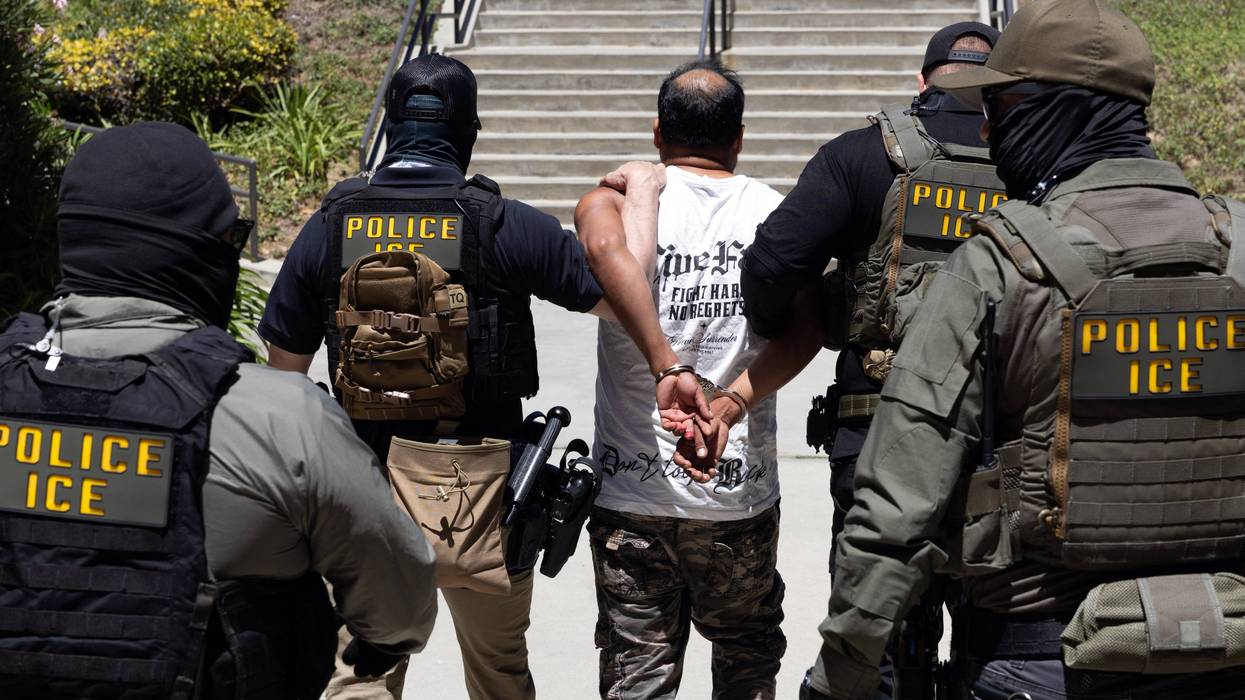
A report produced by the office of Sen. Adam Schiff reveals that federal immigration enforcement agencies amassed a gigantic weapons stockpile during the first year of President Donald Trump's second term.
In total, the report released by Schiff (D-Calif.) finds that US Immigration and Customs Enforcement (ICE) and Customs and Border Protection (CBP) committed to spending over $144 million on weapons and ammunition over the last year, a massive increase over these agencies' spending on weapons in years past.
"In just one year, ICE’s spending commitments on weapons, ammunition, and accessories surged fourfold—an increase of over 360 percent—when compared to ICE’s contracts in 2024," states the report. "In 2025, CBP’s contracts for weapons, ammunition, and accessories doubled when compared to CBP’s 2024 contract totals."
The report documents how both agencies have combined to spend tens of millions of dollars purchasing lethal weapons, including "AR-style rifles, pistols, and large quantities of accessories, such as optical sights for firearms and suppressors"; so-called "less-lethal" weapons including "TASERs, pepper sprays, tear gas canisters, and canister launchers"; and assorted kinds of ammunition.
The report adds that "records show that DHS’s procurement of weapons at immense scale is just beginning, as these contract awards contemplate even greater spending moving forward," which it says should serve "as a stark warning to the American public."
Schiff's report concludes with a warning about the US Department of Homeland Security's (DHS) "growing plans to build a heavily-armed domestic police force," adding that federal immigration agents' killings of Minneapolis residents Renee Good and Alex Pretti could only be the first of many tragedies to come.
In an analysis of the Schiff report published Wednesday, the New Republic's Greg Sargent argued that the Trump administration is trying to launch a domestic "war on terrorism" by bringing the kind of violence the US has deployed overseas back to the homeland.
"In a sense, we’re seeing yet more cancerous growth of the post-September 11 national security bureaucracy, but with a more intensified inward focus," wrote Sargent, who described ICE and CBP under Trump as a "heavily armed secret police force" in a Wednesday social media post.
Georgetown University law professor Rosa Brooks told Sargent that the dangers posed by ICE and CBP could outlast Trump's presidency.
"Trump is building up a well-funded, poorly trained paramilitary force that could easily take on a life of its own,” Brooks explained. “Once you have a massive moneymaking machine ginned up, it’s hard to reverse course and turn off the spigot.”
As President Donald Trump plows ahead with his controversial and legally contested tariffs, he faces mounting pressure to refund Americans for duties struck down last week by the US Supreme Court, including in a letter from 21 Democratic state legislators, first reported Tuesday by Common Dreams.
Lawmakers from Colorado, Illinois, Iowa, Maine, Michigan, New Hampshire, New York, Pennsylvania, Tennessee, Texas, and Vermont called for a swift response to the high court's "definitive ruling" last Friday that the president's imposition of tariffs under the International Emergency Economic Powers Act (IEEPA) "is illegal, unconstitutional, and amounts to an unauthorized tax on the American people."
"Your illegal tariff taxes have created an unprecedented affordability crisis, spiking prices for groceries, cars, clothes, electronics, and countless other household necessities," the lawmakers noted. "Families across our states have been forced to make impossible choices between paying for food, keeping the heat on, and affording clothing for their children."
"Farmers have lost markets, small businesses have been stretched to the breaking point, manufacturing hasn't returned as you promised, job growth flatlined, layoffs rose, and the economy has slowed to a crawl," they continued. "Your illegal tariffs have been an unmitigated disaster."
The legislators demanded that Trump "work with Congress immediately to provide a refund to American families for the illegal tariff taxes you imposed on them through higher prices on everything, from clothes and cars to electronics and groceries, and which cost families at least $1,700 each last year alone."
"These refunds should go to the American people, not just the businesses who paid the tariffs and passed on their cost to Americans in the form of higher prices, lost wages, and layoffs," they stressed. The lawmakers also demanded that Trump "immediately abide by the court's ruling and stop collecting these illegal tariff taxes," and "cease and desist on any plan or scheme to reimpose the tariffs at issue in the Supreme Court's decision without congressional approval."
The letter was organized by Defend America Action as part of a campaign pushing for tariff refunds and also sent to US Senate Majority Leader John Thune (R-SD) and House Speaker Mike Johnson (R-La.). Its signatories include Colorado Sen. Cathy Kipp (D-14) as well as Illinois Sens. Mary Edly-Allen (D-31) and Graciela Guzmán (D-20).
The other signatories are Democratic Reps. Ken Croken (97) of Iowa; Gary Friedmann (14) of Maine; Noah Arbit (20) and Stephen Wooden (81) of Michigan; Susan Almy (Grafton 17), Tony Caplan (Merrimack 8), and Linda Haskins (Rockingham 11) of New Hampshire; Jo Anne Simon (52) of New York; Arvind Venkat (30) of Pennsylvania; Aftyn Behn (51) Tennessee; Rhetta Andrews Bowers (113), Jessica González (104), Vikki Goodwin (47), Josey Garcia (124), Vincent Perez (77), Ron Reynolds (27), and Gene Wu (137) of Texas; and Will Greer (Bennington 2) of Vermont.
Trump is also facing pressure from Democratic governors and members of Congress in the wake of the high court's ruling. On Monday, US Sens. Ed Markey (D-Mass.), Jeanne Shaheen (D-NH), and Ron Wyden (D-Ore.)—along with 19 other members of the chamber's Democratic Caucus, including Senate Minority Leader Chuck Schumer (D-NY)—unveiled the Tariff Refund Act.
The bill would require US Customs and Border Protection to pay refunds for the $175 billion in unlawfully imposed tariffs within 180 days, prioritizing small businesses. It calls on importers, wholesalers, and large corporations to pass on those refunds to their customers.
On Tuesday, US Sens. Cory Booker (D-NJ), Elizabeth Warren (D-Mass.), and Peter Welch (D-Vt.)—who are all notably not original co-sponsors of that bill—wrote to Trump and highlighted that roughly 95% of the cost from Trump's IEEPA tariffs "was passed on to American families and small businesses in the form of increased costs."
"Any refunds from the federal government should be returned to the millions of Americans and small businesses that were illegally cheated out of their hard-earned money," the trio argued. "Your inability or unwillingness to provide tariff refunds to American families would represent an egregious abdication of your responsibility as president—a giveaway to giant corporations that amounts to theft from the middle class."
In the House of Representatives, Congressional Progressive Caucus Chair Greg Casar (D-Texas) also signaled support for refunds, taking aim at Trump on social media Tuesday morning: "We need our money back. He owes us: $1,700 in illegal tariffs per family; $4 billion he's profited off the presidency; $1 trillion he stole in tax breaks for the ultrarich."
Trump has responded to the Supreme Court's decision by not only lashing out at justices but also doubling down on his mission to impose tariffs. Rather than relying on the IEEPA, Trump is now invoking Section 122 of the Trade Act of 1974. A 10% tariff took effect on Tuesday, though the president promised over the weekend that he would aim for 15%.
"Every day, I hear from my neighbors how their cost of living is rising rapidly," Venkat, one of the state lawmakers who signed the letter, told Common Dreams. "Whether it's food, utilities, housing, or healthcare, tariffs are driving inflation and a regressive tax."
Venkat said that Trump doubling down on tariffs is "disastrous for my constituents and all Pennsylvanians."