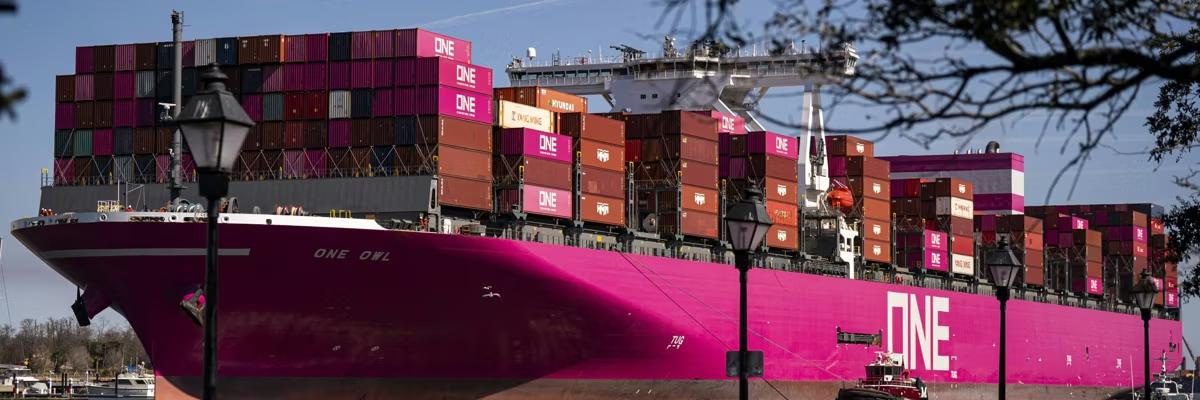
The Ocean Network Express container vessel from Japan arrives with imported goods at the Port of Savannah on February 12, 2026 in Savannah, Georgia.
Federal Judge Orders Trump Admin to Refund Billions of Dollars to Businesses That Paid Illegal Tariffs
One organizer called the ruling a "victory for small businesses who have paid billions in unlawful tariffs and deserve their money back."
US customs officials are due to report to the Court of International Trade in New York on Friday to detail their plans for issuing billions of dollars in refunds to American businesses that paid tariffs which were struck down by the US Supreme Court last month.
On Wednesday, Judge Richard Eaton at the federal trade court ruled that "all importers of record" are "entitled to benefit" from the Supreme Court ruling that found President Donald Trump had illegally invoked the 1977 International Emergency Economic Powers Act (IEEPA) to impose tariffs on more than 300,000 US businesses that import goods, the vast majority of which were small businesses, as a central policy of his economic agenda.
The Supreme Court found Trump could not use the IEEPA to unilaterally set tariffs.
Eaton ruled in a case brought by Atmus Filtration, a company based in Nashville, Tennessee, which filed one of about 2,000 lawsuits at the trade court seeking refunds for the tariffs.
US Customs and Border Protection is likely to appeal the decision or “seek a stay to buy more time," former US trade official Ryan Majerus told NBC News, but Eaton did not appear convinced Wednesday when a Justice Department lawyer Claudia Burke, said in court that issuing refunds en masse would be time-consuming for the CBP and would necessitate the manual review of millions of entries.
"We live in the age of computers," said Eaton. "It must be possible for Customs Service to program its computers so it doesn't need a manual review.
Burke also told Eaton that the administration hadn't determined its position on refunding the tariffs, to which the judge replied: "Your position is clear. The Supreme Court told you what your position is."
Eaton noted that refunds are processed every day by CBP through a process called "liquidation" when goods are imported through the agency. CBP issues an accounting of what is owed by the importer, and the company has 180 days to formally contest its duties. The judge ordered customs officials to stop collecting tariffs on goods currently in the liquidation process and to recalculate duties for goods that were past the 180-day window, without the illegally imposed tariffs, resulting in a refund.
“Customs knows how to do this,” said Eaton. "They do it every day. They liquidate entries and make refunds."
Atmus Filtration estimated in court filings it had paid $11 million in illegal tariffs. The federal government collected $130 billion in tariffs under the IEEPA last year, and according to the Penn Wharton Budget Model, could ultimately owe $175 billion in refunds to businesses.
Sen. Mark Warner (D-Va.) said the Trump administration "must move quickly to reimburse the thousands of small businesses in Virginia and across the country that bore the brunt of President Trump’s harmful and illegal tariffs."
Dan Anthony, executive director of the We Pay the Tariffs coalition, called the ruling a "victory for small businesses who have paid billions in unlawful tariffs and deserve their money back."
"The court acted swiftly and correctly," said Anthony. "Now the ball is in the government's court and small businesses are concerned they will drag this out further. American small businesses have waited long enough. A full, fast, and automatic refund process is what these businesses are owed and anything less is unacceptable."
We are at a crossroads
This country and this world are at a monumental crossroads. In a few short weeks, US voters will have an opportunity to beat back the forces of fascism and confront the billionaires who are rigging the economy, our media system, and our democracy, making it increasingly impossible for ordinary people to get by. We’re not just talking about the election. We’re talking about what must be done once these fascist elements are vanquished from power. We need a bolder set of solutions than what either major party has so far been willing to offer and a working-class movement ready to fight like hell for it. Trump didn't emerge from nowhere. The conditions that fueled MAGA authoritarianism were created by decades of radical neoliberal economic policies and a corrupt political system dominated by corporate interests. They slashed taxes on the super-rich, promising that the benefits would trickle down. They said giveaways to the corporate titans would make life more affordable for the rest of us. It was all bullshit. And when a bitter, betrayed populace searches for someone to blame, right-wing demagogues have little trouble finding scapegoats. People know when they're being lied to, but you won't hear any of this from the corporate media. Only independent journalism—powered and funded by people who believe in building a better world—can deliver truly trustworthy daily news. Our Fall Campaign is underway, and we need your help. To power our newsroom through the rest of the year, we need to raise $125,000 by midnight on October 31. So if you share our vision, please contribute whatever you can to sustain our work. |
US customs officials are due to report to the Court of International Trade in New York on Friday to detail their plans for issuing billions of dollars in refunds to American businesses that paid tariffs which were struck down by the US Supreme Court last month.
On Wednesday, Judge Richard Eaton at the federal trade court ruled that "all importers of record" are "entitled to benefit" from the Supreme Court ruling that found President Donald Trump had illegally invoked the 1977 International Emergency Economic Powers Act (IEEPA) to impose tariffs on more than 300,000 US businesses that import goods, the vast majority of which were small businesses, as a central policy of his economic agenda.
The Supreme Court found Trump could not use the IEEPA to unilaterally set tariffs.
Eaton ruled in a case brought by Atmus Filtration, a company based in Nashville, Tennessee, which filed one of about 2,000 lawsuits at the trade court seeking refunds for the tariffs.
US Customs and Border Protection is likely to appeal the decision or “seek a stay to buy more time," former US trade official Ryan Majerus told NBC News, but Eaton did not appear convinced Wednesday when a Justice Department lawyer Claudia Burke, said in court that issuing refunds en masse would be time-consuming for the CBP and would necessitate the manual review of millions of entries.
"We live in the age of computers," said Eaton. "It must be possible for Customs Service to program its computers so it doesn't need a manual review.
Burke also told Eaton that the administration hadn't determined its position on refunding the tariffs, to which the judge replied: "Your position is clear. The Supreme Court told you what your position is."
Eaton noted that refunds are processed every day by CBP through a process called "liquidation" when goods are imported through the agency. CBP issues an accounting of what is owed by the importer, and the company has 180 days to formally contest its duties. The judge ordered customs officials to stop collecting tariffs on goods currently in the liquidation process and to recalculate duties for goods that were past the 180-day window, without the illegally imposed tariffs, resulting in a refund.
“Customs knows how to do this,” said Eaton. "They do it every day. They liquidate entries and make refunds."
Atmus Filtration estimated in court filings it had paid $11 million in illegal tariffs. The federal government collected $130 billion in tariffs under the IEEPA last year, and according to the Penn Wharton Budget Model, could ultimately owe $175 billion in refunds to businesses.
Sen. Mark Warner (D-Va.) said the Trump administration "must move quickly to reimburse the thousands of small businesses in Virginia and across the country that bore the brunt of President Trump’s harmful and illegal tariffs."
Dan Anthony, executive director of the We Pay the Tariffs coalition, called the ruling a "victory for small businesses who have paid billions in unlawful tariffs and deserve their money back."
"The court acted swiftly and correctly," said Anthony. "Now the ball is in the government's court and small businesses are concerned they will drag this out further. American small businesses have waited long enough. A full, fast, and automatic refund process is what these businesses are owed and anything less is unacceptable."
- Supreme Court Strikes Down Trump Tariffs, But Damage From 'Unhinged Economic Sabotage' Remains ›
- 'More Chaos': Trump Hammered for Plan to Double Down on Tariffs After Supreme Court Ruling ›
- As Trump Imposes New Tariffs, State Lawmakers Demand Direct Refunds for Americans ›
- Opinion | Guess Who Won't See a Refund for Trump's Illegal Tariffs? You | Common Dreams ›
- House Progressive Chair Says 'Every Single Cent' of Trump Tariff Refunds Should Go to Consumers | Common Dreams ›
US customs officials are due to report to the Court of International Trade in New York on Friday to detail their plans for issuing billions of dollars in refunds to American businesses that paid tariffs which were struck down by the US Supreme Court last month.
On Wednesday, Judge Richard Eaton at the federal trade court ruled that "all importers of record" are "entitled to benefit" from the Supreme Court ruling that found President Donald Trump had illegally invoked the 1977 International Emergency Economic Powers Act (IEEPA) to impose tariffs on more than 300,000 US businesses that import goods, the vast majority of which were small businesses, as a central policy of his economic agenda.
The Supreme Court found Trump could not use the IEEPA to unilaterally set tariffs.
Eaton ruled in a case brought by Atmus Filtration, a company based in Nashville, Tennessee, which filed one of about 2,000 lawsuits at the trade court seeking refunds for the tariffs.
US Customs and Border Protection is likely to appeal the decision or “seek a stay to buy more time," former US trade official Ryan Majerus told NBC News, but Eaton did not appear convinced Wednesday when a Justice Department lawyer Claudia Burke, said in court that issuing refunds en masse would be time-consuming for the CBP and would necessitate the manual review of millions of entries.
"We live in the age of computers," said Eaton. "It must be possible for Customs Service to program its computers so it doesn't need a manual review.
Burke also told Eaton that the administration hadn't determined its position on refunding the tariffs, to which the judge replied: "Your position is clear. The Supreme Court told you what your position is."
Eaton noted that refunds are processed every day by CBP through a process called "liquidation" when goods are imported through the agency. CBP issues an accounting of what is owed by the importer, and the company has 180 days to formally contest its duties. The judge ordered customs officials to stop collecting tariffs on goods currently in the liquidation process and to recalculate duties for goods that were past the 180-day window, without the illegally imposed tariffs, resulting in a refund.
“Customs knows how to do this,” said Eaton. "They do it every day. They liquidate entries and make refunds."
Atmus Filtration estimated in court filings it had paid $11 million in illegal tariffs. The federal government collected $130 billion in tariffs under the IEEPA last year, and according to the Penn Wharton Budget Model, could ultimately owe $175 billion in refunds to businesses.
Sen. Mark Warner (D-Va.) said the Trump administration "must move quickly to reimburse the thousands of small businesses in Virginia and across the country that bore the brunt of President Trump’s harmful and illegal tariffs."
Dan Anthony, executive director of the We Pay the Tariffs coalition, called the ruling a "victory for small businesses who have paid billions in unlawful tariffs and deserve their money back."
"The court acted swiftly and correctly," said Anthony. "Now the ball is in the government's court and small businesses are concerned they will drag this out further. American small businesses have waited long enough. A full, fast, and automatic refund process is what these businesses are owed and anything less is unacceptable."
- Supreme Court Strikes Down Trump Tariffs, But Damage From 'Unhinged Economic Sabotage' Remains ›
- 'More Chaos': Trump Hammered for Plan to Double Down on Tariffs After Supreme Court Ruling ›
- As Trump Imposes New Tariffs, State Lawmakers Demand Direct Refunds for Americans ›
- Opinion | Guess Who Won't See a Refund for Trump's Illegal Tariffs? You | Common Dreams ›
- House Progressive Chair Says 'Every Single Cent' of Trump Tariff Refunds Should Go to Consumers | Common Dreams ›