

SUBSCRIBE TO OUR FREE NEWSLETTER
Daily news & progressive opinion—funded by the people, not the corporations—delivered straight to your inbox.
5
#000000
#FFFFFF
To donate by check, phone, or other method, see our More Ways to Give page.
Daily news & progressive opinion—funded by the people, not the corporations—delivered straight to your inbox.
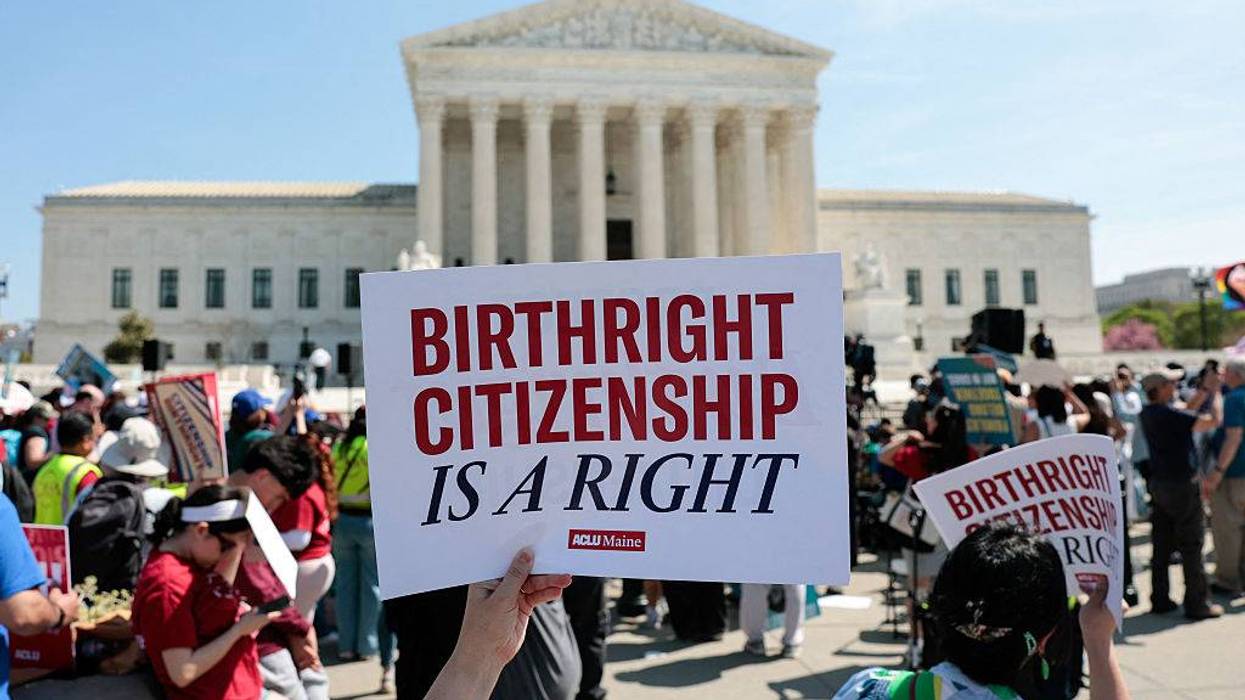
"Birthright citizenship is protected today. But the workers whose children depend on it still face deportation, worksite raids, and an administration that has made clear it will use every tool available to make immigrant workers afraid, isolated, and stripped of their rights," said one campaigner.
The US Supreme Court on Tuesday struck down President Donald Trump's executive order that sought to deny automatic citizenship to children born in the United States to undocumented parents, preserving 150 years of birthright citizenship under the 14th Amendment and dealing a major blow to the administration's xenophobic agenda.
"Children born in the United States to parents unlawfully or temporarily present are 'subject to the jurisdiction' of the United States and are citizens at birth under the 14th Amendment’s citizenship clause," the high court held in Trump v. Barbara.
The 6-3 decision roundly rejected an executive order issued by Trump on the first day of his second term that sought to deny US citizenship for babies born in the United States to parents who are either unlawfully in the United States or legally living in the country on temporary visas.
Every lower court rejected the order. Just three days after its issuance, US District Judge John Coughenour, an appointee of former President Ronald Reagan, blasted it as "blatantly unconstitutional."
A majority of the right-wing Supreme Court agreed.
"Citizenship, then and now, was the right to have rights—to freely participate in our political community. The framers of the 14th Amendment extended that promise to 'every free-born person in this land,'" Chief Justice John Roberts wrote for the court. "We keep that promise today."
Roberts was joined in the majority by Justices Sonia Sotomayor, Elena Kagan, Amy Coney Barrett, and Ketanji Brown Jackson, with Justice Brett Kavanaugh writing a separate concurring opinion agreeing that Trump's executive order was unlawful but basing his reasoning on federal immigration law rather than the 14th Amendment.
"As revealed by the court’s opinion with its detailed account of history and precedent, and by the weighty and thoughtful dissents, the constitutional issue is far more complicated than the statutory issue," Kavanaugh wrote.
Justices Samuel Alito, Clarence Thomas, and Neil Gorsuch dissented.
"This is one of the most important decisions in the history of the court, and in my judgment, the court has made a serious mistake," Alito wrote in his dissent. "As interpreted by the court today, the 14th Amendment confers citizenship on virtually everyone who happens to be born in this country, including the children of 'birth tourists,' women who come here solely for the purpose of giving birth to a child and then promptly return home."
Alito further argued that the 14th Amendment "confers citizenship on only those children who, at birth, owe allegiance solely to this country."
In a 91-page dissent more than three times longer than Roberts' opinion, Thomas wrote that "the court adds to the sad history of the 14th Amendment, which was designed and understood to secure equal rights for the freed Blacks but has instead been repurposed for political projects that the Reconstruction Congress did not support.”
Trump took to his Truth Social network to lament, "The Supreme Court upheld Birthright Citizenship, which is too bad for our Country, but we can easily make it up in Congress through Legislation, with the support of the President, that has now been determined during this process."
"No long and unwieldy Constitutional Amendment is necessary!" he added. "Congress should start TODAY to work on ending expensive and unfair to our Country, Birthright Citizenship. They will have my Complete and Total Support!"
Stephen Miller, Trump's xenophobic deputy chief of staff, seethed on X that Trump v. Barbara is "one of the most destructive and outrageous decisions in the long history of the Supreme Court."
"American citizenship is not the birthright of the world," the white nationalist added. "It belongs only and solely to Americans. No provision of the Constitution can be read to require our national self-obliteration."
Defenders of birthright citizenship and the Constitution welcomed the ruling.
"The Supreme Court affirmed what we know in our hearts and in our communities: The 14th Amendment extends the promise of citizenship to everyone born in the US Immigrants belong," Congresswoman Delia C. Ramirez (D-Ill.), a birthright citizen, said on Bluesky. "No one can deny that immigrants today are also the inheritors of the promise of America—just like so many of my colleagues' ancestors were."
I am the proud, defiant daughter of Maria Elvira Ramirez Guerra, a Guatemalan immigrant who crossed the border pregnant with me. Regardless of what some of my colleagues might call me, I am a citizen by birthright and an AMERICAN!
[image or embed]
— Congresswoman Delia C. Ramirez (@ramirez.house.gov) June 30, 2026 at 8:58 AM
Congresswoman Ilhan Omar (D-Minn.), a former refugee from Somalia, said on social media: "The Supreme Court just upheld birthright citizenship, blocking Trump's attempt to dismantle the 14th Amendment and strip away a constitutional guarantee. If you were born here, you are an American citizen. The Constitution is clear. No one can change that."
American Immigration Council senior fellow Aaron Reichlin-Melnick called the decision "the easiest of layups possible."
Thomas Wolf, director of democracy initiatives at the Brennan Center for Justice at New York University School of Law, said that "the court could not have defensibly ruled any differently."
"The 14th Amendment guaranteed citizenship to everyone born here over 150 years ago," he added. "The Supreme Court affirmed that 20 years later in Wong Kim Ark."
ACLU national legal director Cecilia Wang, a birthright citizen who argued the case before the Supreme Court, said the decision "reaffirms a fundamental American promise—if you are born here, you are a citizen. A president cannot change the Constitution by executive fiat.”
Neidi Dominguez, executive director of the multiracial advocacy group Organized Power in Numbers, said that "today the Supreme Court reaffirmed a constitutional right that should never have been in question."
"Birthright citizenship was guaranteed through the passage of the 14th Amendment after the Civil War, when formerly enslaved Africans and their allies fought to access equal rights and affirm that children born in the United States have citizenship regardless of where their parents come from," she noted. "That right survives today."
"But let us be clear about what happened here," Dominguez continued. "The Trump administration tried to narrow the definition of citizenship and the access to the rights that come with it, and even this Supreme Court disagreed. This is a real relief, and it is welcome. It is also the bare minimum."
"The same court that today defended birthright citizenship last week stripped legal protections from more than 350,000 Haitian and Syrian workers with [temporary protected status] and opened the door to doing the same to up to 1.3 million people," she said. "Earlier this term, it cleared the way for mass layoffs of tens of thousands of federal workers. Working people are not safe because one constitutional right survived. They are fighting on every front."
"Birthright citizenship is protected today. But the workers whose children depend on it still face deportation, worksite raids, and an administration that has made clear it will use every tool available to make immigrant workers afraid, isolated, and stripped of their rights," Dominguez added. "Employers cannot stay silent while the workers they depend on are stripped of their rights one ruling at a time. We are not done fighting."
Virginia Kase Solomón, president and CEO of the pro-democracy group Common Cause, issued a statement saying, “While we welcome the court finally upholding a constitutional amendment ratified nearly two centuries ago, upholding the law is no cause for celebration, it is a requirement."
“Let today be a stark reminder that this court continues to systematically dismantle voting protections for Black and brown communities, tilting the scales of justice toward a dark era where a wealthy, privileged few dictate the rules for the rest of us," she added. "Today may be a brief victory for the rule of law, but our fight to protect our multiracial democracy continues.”
Wolf at the Brennan Center said that “today’s ruling is the right one amid an avalanche of Supreme Court opinions undermining our democracy."
“In just the past few weeks alone, the court further undermined the Voting Rights Act, encouraged more aggressive partisan gerrymandering, dangerously expanded presidential power over federal agencies, and further depleted protections for immigrants," he noted. "This ruling does not make up for all the damage the court has done this term.”
On Tuesday, the court also ruled that states may ban transgender girls from participating in sports at schools receiving public funding.