

SUBSCRIBE TO OUR FREE NEWSLETTER
Daily news & progressive opinion—funded by the people, not the corporations—delivered straight to your inbox.
5
#000000
#FFFFFF
To donate by check, phone, or other method, see our More Ways to Give page.
Daily news & progressive opinion—funded by the people, not the corporations—delivered straight to your inbox.

Can we open the national soul and become aware that those who died were loving people who deserved to live?
When is the last time the US government, or a fragment thereof, has truly been held accountable—not merely legally or politically, but morally accountable—for an act of violence, for its addiction to violence? Ever?
And what might that even mean?
These are not questions I’ve ever even asked until I began learning about a lawsuit that has been filed against Homeland Security Secretary Markwayne Mullin and acting Immigration and Customs Enforcement (ICE) director David Venturella. Technically, it’s a freedom of speech lawsuit, but it’s also so much more than that. At least that’s how it seemed to me, the more I learned about it.
The suit pulls back horrible January and the invasion of Minneapolis, aka, Operation Metro Surge, when armed and masked members of ICE and Customs and Border Protection began occupying the Twin Cities for the purpose of snatching and deporting (“allegedly”) undocumented immigrants, creating immense fear and chaos everywhere, and leading to huge protests.
This is militarism. The enemy dead are hidden behind patriotic propaganda and soon vanish from collective awareness. They’re subhuman; they’re evil.
As everyone knows, two of the protesters were murdered: Renee Good on January 7 and Alex Pretti on January 24. This was too much. The nation was outraged. The murders, combined with the fact that most of the arrestees were found to be in the US legally, quieted down the invasion—though hardly ending the arrests and deportations.
Five months later, David Streever, of Rochester, New York, was contacted—much to his stunned surprise—by agents from the Department of Homeland Security, who gave him a “Warning Notice: You May Be in Violation of Federal Law.”
Turns out, many months earlier, in the wake of the two protest murders, he had sent an email, titled, “What’ Next,” to Todd Lyons, who was the acting ICE director at the time. As quoted in The New York Times, this is part of what Streever wrote:
The director “will never know peace (and) will go down in history as America’s Reinhard Heydrich, the butcher”—referencing the Nazi SS security chief, who is considered to be a principal architect of the Holocaust.
“Even Trump will turn on you before the end, and you will be a sad, despised man who eats himself alive with shame at your own pathetic weakness,” the email read.
“You will seek to lose yourself, to escape the burden of knowing the truth about yourself. But wherever you go, you will find yourself. You will torment yourself until your last day on Earth.”
Sit with these words for a while. Yeah, I found them shocking. I even momentarily wondered if they had gone too far. But notice: There’s no actual threat in the words. Instead, the email is both a moral condemnation and a psycho-spiritual warning. Murder always comes back to haunt the perpetrator. As Adam Steinbaugh, a lawyer at the Foundation for Individual Rights and Expression, which is filing the freedom-of-speech suit, put it: This is not a threat in any way, but a plea to the ICE director to recognize what he has done. And, I would add, take responsibility for it, rather than try to make it vanish by turning the deaths—plus the shattered lives of thousands of deportees—into abstractions.
Indeed, Streever’s email challenges the basic, media-perpetuated belief that nationally committed deaths—mostly via war—are indeed an abstraction, and the more there are, the more abstract they become. I’m glad the email has gone public. This is a far bigger issue than freedom of speech, but the lawsuit is making this forgotten exchange public.
But wherever you go, you will find yourself. You will torment yourself until your last day on Earth.
This applies collectively. In the last three years, about 60 detainees have died in detention cells, according to ICE’s own statistics, described on their website as “detained alien deaths.” But these deaths are not abstractions. Nor are the thousands of alleged “aliens” arrested—pulled from their families—every day. Can we open the national soul, just as Streever pleaded with the ICE director to open his soul? This means being aware that the consequences come home... and beyond that, those who died were loving people who deserved to live.
Consider these words of Bita Iuliano, writing recently about the military jets flying over the nation’s capital, where she lives, that were part of the country’s 250th birthday celebration. Seven hours of flyovers were scheduled for July 4. “These flyovers,” she writes, are “an exercise of an illusion of force, domination, and strength. All to further prop up hyper nationalism and militarism. But we were lucky it was just for a ‘show.’”
She went on:
As an Iranian immigrant, as I watched my children tremble and cover their ears at the roar of bombers and fighter jets over our home, so loud the walls vibrated, I was struck by a haunting duality. My heart broke because I knew what that sound means to children just like them back in Iran.
The Iranian children, she pointed out, knew, as they covered their ears and cuddled, that this could be the last day of their lives. For too many of them, that’s exactly what it was.
This is militarism. The enemy dead are hidden behind patriotic propaganda and soon vanish from collective awareness. They’re subhuman; they’re evil. They’re radical leftists. We have no choice but to kill them, over and over and over. At least 7,300 Iranians (so far). More than 70,000 Palestinians.
People have a right to protest this, to voice their opinions. They also have the right to make moral values public—no matter how much fear this creates for those who are “above” such values.
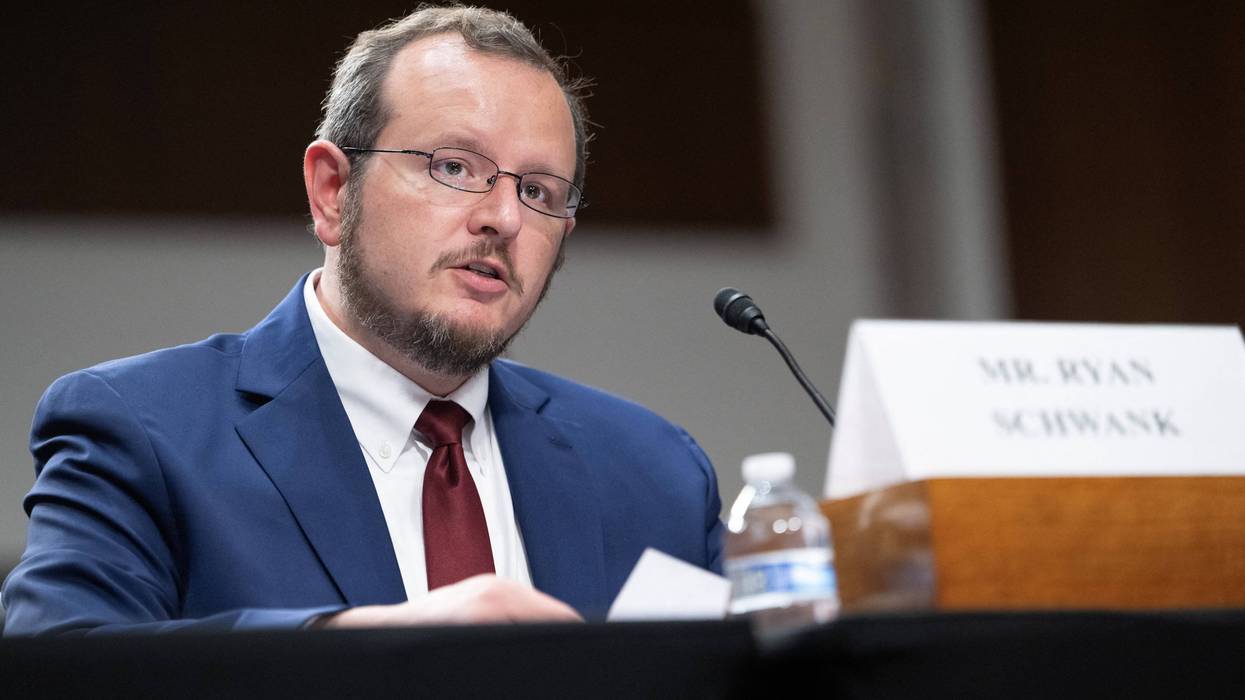
"Never in my career had I ever received such a blatantly unlawful order," said Ryan Schwank, who blew the whistle last month on a "secretive" ICE memo directing agents to enter homes without judicial warrants.
US Immigration and Customs Enforcement is "lying to Congress and the American people" and directing new recruits to "violate the Constitution," according to a whistleblower who testified on Capitol Hill Monday.
Ryan Schwank, a former ICE lawyer who worked at the federal government’s law enforcement training academy, stepped down from his post last week after submitting a whistleblower complaint about an agency policy directing agents to enter homes and arrest people without a judge's warrant.
"I swore an oath to uphold the Constitution," Schwank said at a joint forum on ICE's constitutional violations hosted by Senate and House Democrats. "I followed that oath for four-and-a-half years, working side by side with ICE officers. And I followed it when I resigned on February 13, 2026, a little over a week ago, so I could speak to you today."
He had joined ICE in 2021 as a senior lawyer for the agency, tasked with advising agents on immigration laws and the Constitution. In September 2025, amid President Donald Trump's "surge" in recruitment to carry out his "mass deportation" crusade, Schwank became an instructor for new recruits at the ICE Academy at the Federal Law Enforcement Training Center in Georgia.
"On my first day," Schwank said, "I received secretive orders to teach new cadets to violate the Constitution by entering homes without a judicial warrant."
Schwank said he was “instructed to read and return a memo" that claimed ICE agents had this power in the presence of his supervisor. “Before I was shown this memo, my supervisor warned me that two previous ICE instructors had been dismissed because they questioned senior ICE management over the legality of the memo.”
That memo, which was sent to US Department of Homeland Security (DHS) officials in May, was revealed to the Senate last month through a whistleblower disclosure by Schwank and another official whose identity has not yet been made public.
“The acting ICE director authorized the very conduct that DHS—in 2025 legal training materials—has called ‘the chief evil against which the wording of the Fourth Amendment is directed’—that is, ‘physical entry of the home’ without consent or a proper warrant,” Schwank said.
His testimony confirms previous reporting from the Associated Press, which found that these orders were distributed in a highly unusual way: DHS officials like Schwank were shown the memo before being required to return it to their supervisors and relay the information verbally to new recruits without showing them the directive.
Under this new directive, the whistleblower report said “newly hired ICE agents—many of whom do not have a law enforcement background—are now being directed to rely solely on” an administrative warrant drafted and signed by an ICE official to enter homes and make arrests.
“No court has ever found that any law enforcement has this type of authority to enter homes without a judicial warrant under such circumstances,” said David Kligerman, the senior vice president and special counsel for Whistleblower Aid, the group that sent the disclosure to Congress.
“Never in my career had I ever received such a blatantly unlawful order—nor one conveyed in such a troubling manner,” Schwank said on Monday. “I was being shown this memo in secret by a supervisor who made sure that I understood that disobedience could cost me my job. ICE is teaching cadets to violate the Constitution, and they were attempting to cloak it in secrecy.”
Schwank also said that top ICE and DHS officials were deceiving Congress and the public when they claimed that the new officers and agents brought on as part of the agency's hiring spree were receiving the same basic training as in the past, even as agency syllabi showed that their training hours had been slashed by about 40%.
Testifying before Congress earlier this month, ICE's acting director, Todd Lyons, said that while hours have been cut, “The meat of the training was never removed."
"This is a lie,” Schwank said. “ICE made the program shorter, and they removed so many essential parts that what remains is a dangerous husk. No reasonable person would believe a training program suddenly cut nearly in half could meet the minimum legal requirements.”
The Trump administration has said the reduction of ICE training by more than 240 hours was mostly the result of eliminating Spanish-language classes.
However, according to dozens of pages of internal documents released by Senate Democrats, which were reviewed by the New York Times, the agency's February syllabus had also eliminated classes about the proper use of force, handling the property of detainees, filling out paperwork alleging someone is in the United States without authorization, taking a "victim-centered approach," and "integrity awareness training."
The number of exams agents must take has also been drastically reduced, from 25 in 2021 down to just nine. Some of the exams no longer required are ones on "Judgment Pistol Shooting” and “Determine Removability,” which the Times said was "a reference to how agents decide if people they encounter have legal status in the United States."
Schwank’s testimony comes after immigration agents shot and killed three United States citizens in recent weeks, causing heightened scrutiny of ICE and other DHS agencies. Since Trump's second inauguration on January 20, at least 32 people have been shot by agents, resulting in nine deaths.
In areas where ICE has been surged, such as Minnesota—which was swarmed by around 3,000 agents late last year—numerous instances have been documented of what appear to be uses of unnecessary force, racial profiling, and violations of constitutional rights.
“I am here because I am duty-bound to report the legally required training program at the ICE academy is deficient, defective, and broken,” Schwank said. “Deficient training can and will get people killed... It can and will lead to unlawful arrests, violations of constitutional rights, and fundamental loss of public trust in law enforcement.”
Schwank's testimony came as a partial shutdown of DHS entered its second week, after Democrats refused to fund the agency without significant reforms to ICE, including requirements that they obtain judicial warrants and carry out their duties without masks.
Sen. Richard Blumenthal (D-Conn.), who chaired Monday's panel, said he hopes Schwank's testimony will encourage other whistleblowers to come forward.
“We know about the Trump administration’s decimation of training for immigration officers and its secret policy to shred your Constitutional rights because of the brave Americans who are speaking out today,” Blumenthal said. “They are coming to Congress because we have the responsibility to not only bear witness to these crimes, but to do something to make sure they don’t happen again.”
“To anyone else who is repulsed by what you’re seeing or what authorities are asking you to do, please know that you can make a real difference by coming forward," he added. "You’ll meet a moral imperative. Our door is open, we are here for you when you are ready, and we will do everything within our power to protect your rights.”