
SUBSCRIBE TO OUR FREE NEWSLETTER
Daily news & progressive opinion—funded by the people, not the corporations—delivered straight to your inbox.
5
#000000
#FFFFFF
To donate by check, phone, or other method, see our More Ways to Give page.


Daily news & progressive opinion—funded by the people, not the corporations—delivered straight to your inbox.
"A future administration will cancel the program before the first ship hits the water," said one critic.
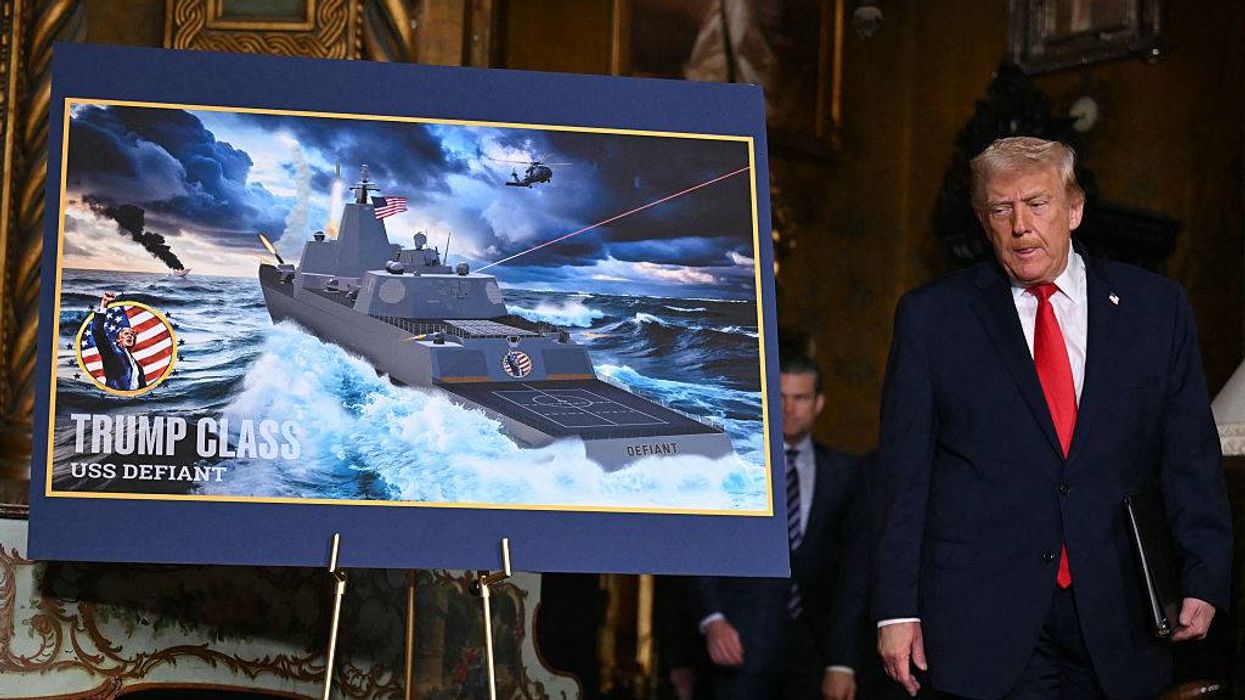
President Donald Trump on Monday announced that the US Navy is building a new class of warship that will be named after him—but naval warfare experts are warning the project looks like a wasteful boondoggle.
Mark Cancian, a senior adviser at the Center for Strategic and International Studies, wrote an analysis of the Trump-branded ships the day after their announcement in which he bluntly predicted that they "will never sail."
Among other things, Cancian argued that the ship being commissioned by the president "will take years to design, cost $9 billion each to build, and contravene the Navy’s new concept of operations, which envisions distributed firepower."
As if that weren't enough, Cancian projected that "a future administration will cancel the program before the first ship hits the water."
Dan Grazier, a senior fellow and program director at the Stimson Center, also predicted doom for Trump's prized ships, which he said would be too overloaded with the latest cutting-edge technology to be effective at naval combat.
"Every gadget you add to one of these systems is one more thing that can break," Grazier wrote in an analysis published by the Quincy Institute for Responsible Statecraft. "When designers lack discipline, as they obviously did while sketching out this latest future boondoggle, a simple mathematical truth asserts itself."
In fact, Grazier felt so confident in his gloomy prognostication for Trump's warships that he told readers they could "take it to the bank."
"The Navy will spend tens of billions of dollars over the course of the next decade on the Trump-class program," he wrote. "At best, the Navy will receive three troublesome ships that will cost more than $10 billion each before then entire scheme is abandoned."
William Hartung, a senior research fellow at the Quincy Institute for Responsible Statecraft, flagged a particularly troubling detail of Trump's warship plan in a lengthy analysis published by Forbes on Thursday.
"The most troubling aspect of the proposed Trump-class ships is that they are supposed to carry sea-launched nuclear armed cruise missiles," Hartung explained. "The last thing the US military needs is yet another way to deliver nuclear weapons. And because nuclear-armed cruise missiles are difficult to tell from cruise missiles armed with nonnuclear bombs, there is a danger that and adversary could mistake an attack with a nonnuclear armed missile with a nuclear attack, with devastating consequences."
Hartung also pointed out that the ships, which are projected to cost billions each, are not the only pricey weapons system that Trump is planning to build, as earlier this year he vowed to build a "Golden Dome" missile defense system that is projected to cost anywhere from $292 billion and $3.6 trillion.
"It’s time for Congress to do its oversight job and slow down these 'golden' programs until the administration can make a plausible case that they can be both affordable and effective," Hartung concluded. "The odds are against them."
Bernard Loo, senior fellow at Singapore’s S. Rajaratnam School of International Studies, said in an interview with CNBC that Trump's proposed ships appear to be "a prestige project more than anything else."
Loo argued that the proposed ships' massive size, with each projected to displace more than 35,000 tons while measuring more than 840 feet, would make each vessel a "bomb magnet" for adversaries.
"The size and the prestige value of it all make it an even more tempting target," Loo added.
"This is a reckless directive from Trump that will only make the country and the world less safe and lead to a terrible new nuclear arms race," Markey said.
President Donald Trump's surprise order to resume nuclear weapons testing has set off concerns about a potential global arms race, but one Democratic senator is working to stop it from happening.
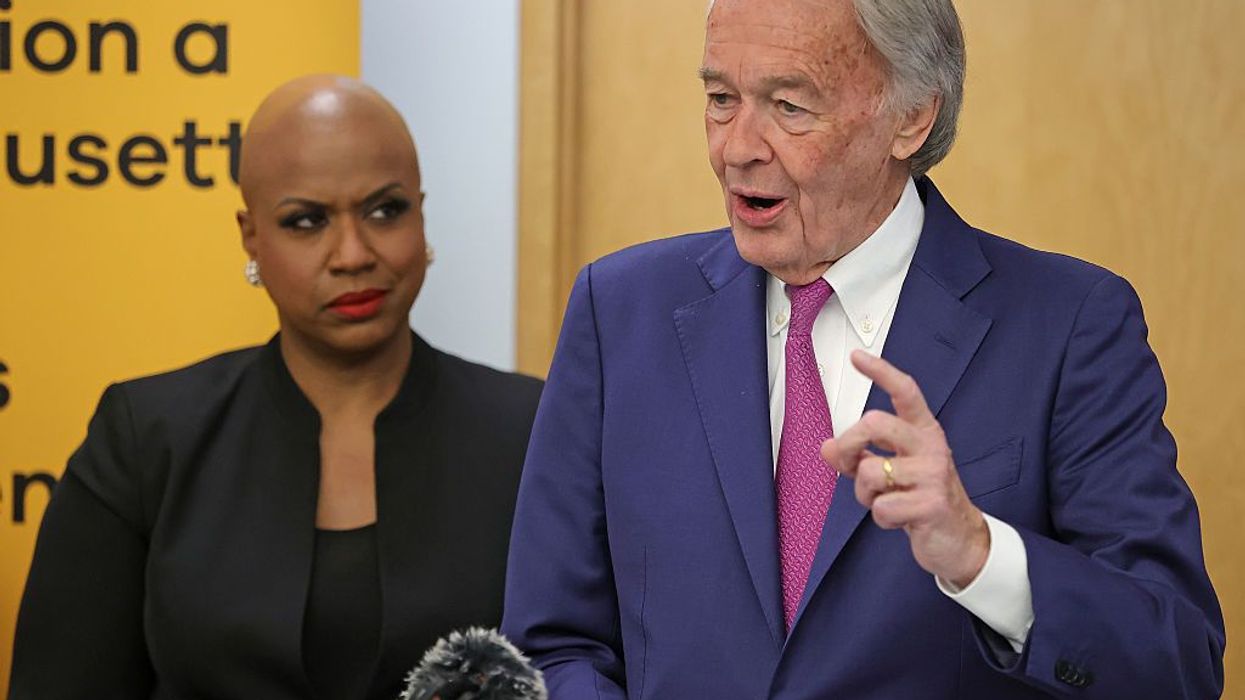
Sen. Ed Markey (D-Mass.) on Thursday introduced emergency legislation to prevent the president from resuming nuclear weapons tests, which experts have warned could undermine global geopolitical stability as more nations could respond by ramping up weapons tests of their own.
The text of Markey's bill is just two pages and it states that "none of the funds authorized to be appropriated or otherwise made available for fiscal year 2026, or authorized to be appropriated or otherwise made available for any fiscal year before fiscal year 2026, and available for obligation as of the date of the enactment of this act, may be obligated or expended to conduct or make preparations for any explosive nuclear weapons test that produces any yield."
In a statement promoting the bill, Markey warned that restarting nuclear weapons tests would be "a mistake of radioactive proportions," which Congress should intervene to block.
"The United States has not conducted a nuclear test since 1992, and there is absolutely no need to resume," Markey said. "A Trumpatomics plan would provoke Russia and China to resume nuclear testing, and China in particular has much more to gain from this than does the United States. This is a reckless directive from Trump that will only make the country and the world less safe and lead to a terrible new nuclear arms race."
Markey, who co-chairs the Nuclear Weapons and Arms Control Working Group, also urged the US Senate to finally ratify the Comprehensive Test Ban Treaty, which was first adopted by the United Nations General Assembly in 1996 and which has been ratified by 178 other nations.
The UK-based Campaign for Nuclear Disarmament (CND) on Thursday put out a statement condemning Trump's weapons testing announcement, which it described as "a wake-up call that the threat of nuclear war is real and accelerating."
The organization also pointed out that resuming nuclear tests was not the only way that the US under the leadership of both Trump and former President Joe Biden is increasing the risks of nuclear war. Among other things, CND pointed to risks posed by the "Golden Dome" missile shield being pushed by Trump, as well as the AUKUS Agreement signed during Biden's tenure that gives Australia access to nuclear-powered submarines.
CND general secretary Sophie Bol warned of the dire consequences of a global nuclear arms race and said "it is absolutely critical that we rachet up the political pressure to make these world leaders—including the British government—step back from this nuclear escalation."
In an editorial published by Common Dreams on Thursday, Pavel Devyatkin, nonresident fellow at the Quincy Institute for Responsible Statecraft, argued that the resumption of nuclear weapons tests "marks a dangerous turning point in international security."
In particular, Devyatkin argued that resuming such tests would imperil chances of extending the nuclear arms treaty between the US and Russia that has been in effect since 2011.
"The New Strategic Arms Reduction Treaty (New START), the last agreement limiting US and Russian nuclear weapons, expires in February 2026," he explained. "For over a decade, New START has kept a cap on deployed warheads and compelled both sides to transparency through data exchanges and inspections. If this agreement expires, there would be no binding limits on the two countries’ nuclear arsenals."
One critic noted Trump's plan for Gaza "contains numerous opportunities for Netanyahu to renege on his commitments, as he has repeatedly done in the past."
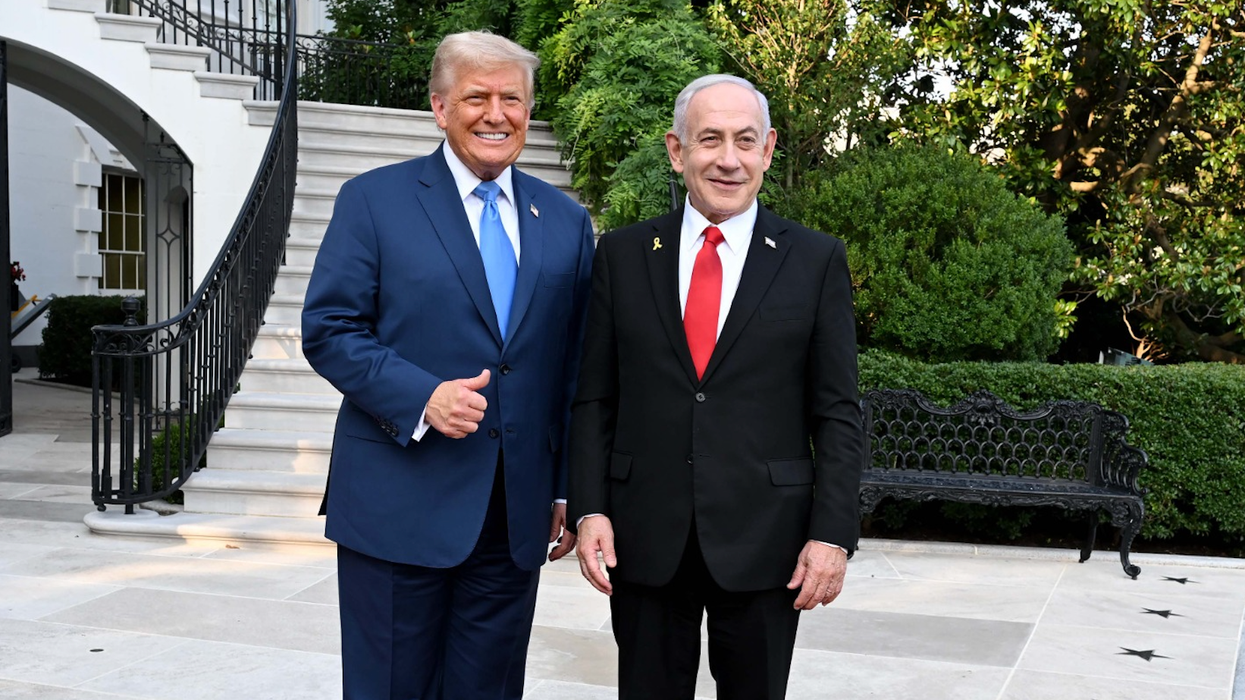
US President Donald Trump announced on Monday that Israeli Prime Minister Benjamin Netanyahu had agreed to a peace plan to end the war in Gaza—but many critics were skeptical that anything good would come from it.
The plan, which the White House released on Monday, requires Hamas to return all remaining Israeli hostages it took in the October 7, 2023 attacks in exchange for the release of nearly 2,000 Palestinian prisoners currently held in Israeli custody.
The plan also mandates that Hamas have no role in governing Gaza after the war, as responsibility for running the exclave would be handed over on a temporary basis to "a technocratic, apolitical Palestinian committee, responsible for delivering the day-to-day running of public services and municipalities for the people in Gaza."
Notably, the Trump proposal dropped previous demands he'd made about expelling Palestinians from their land, and it stated that "no one will be forced to leave Gaza, and those who wish to leave will be free to do so and free to return." The plan also says that "Israel will not occupy or annex Gaza," even though Netanyahu and his government for months have said they intend to take full control of Gaza.
The plan drew some immediate criticism from skeptics, however.
Matt Duss, executive vice president at the Center for International Policy and former foreign policy adviser to Sen. Bernie Sanders (I-Vt.), attacked the Trump plan for not being a serious proposal to achieve peace between Israelis and Palestinians.
"Trump and Netanyahu’s remarks today were a litany of lies about the last 30 years, not a promising foundation for peace," Duss said. "Despite his claim of being close to a deal, Trump's statement that Israel will have 'full US backing' to 'finish the job' in Gaza if his plan is not agreed to stood out most clearly. This would be more of what we have seen not only the last nine months, but the last two years, as the United States has unconditionally armed and subsidized a genocide in Gaza."
Duss welcomed Trump seemingly taking the forced expulsion of Palestinians from Gaza off the table as part of his plan, but added that it also "contains numerous opportunities for Netanyahu to renege on his commitments, as he has repeatedly done in the past."
Drop Site News' Ryan Grim appeared equally skeptical that the Trump plan would hold up, and he wrote in a post on X he's waiting to see "what Netanyahu does to scuttle the deal once he leaves the White House."
Trita Parsi, the executive vice president of the Quincy Institute for Responsible Statecraft, observed in a social media post that Trump had successfully pressured Netanyahu to apologize to the government of Qatar for launching an attack against Hamas leaders on its soil earlier this month.
"That Netanyahu was forced to apologize to the emir of Qatar by phone from the White House with Trump in the room shows the leverage that the US has over Israel when it chooses to," he wrote. "Too often it chooses otherwise. It could've chosen not to support the genocide in the first place."
Drop Site News reported shortly after the deal was announced that the governments of Qatar and Egypt have given it to Hamas, which said it would study the proposal.