SUBSCRIBE TO OUR FREE NEWSLETTER
Daily news & progressive opinion—funded by the people, not the corporations—delivered straight to your inbox.
5
#000000
#FFFFFF
To donate by check, phone, or other method, see our More Ways to Give page.
Daily news & progressive opinion—funded by the people, not the corporations—delivered straight to your inbox.
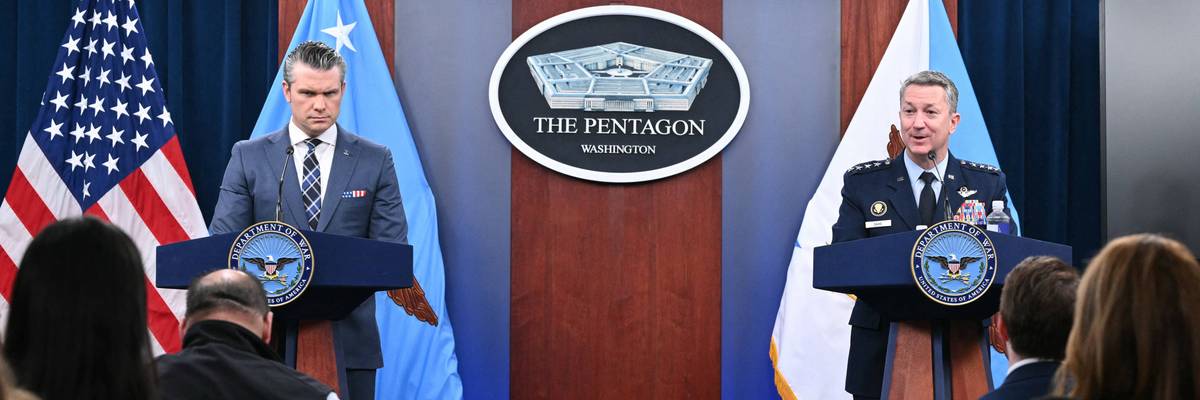
Pentagon Pete Hegseth and Joint Chiefs of Staff Chairman Dan Caine speak during a news conference on March 19, 2026.
"First Trump ordered 2,500 more American ground troops to the Middle East. Then it was doubled to 5,000," wrote one analyst. "Now Trump may literally double down again."
The Trump administration is reportedly considering sending 10,000 additional US troops to the Middle East amid mounting fears of an invasion of Iran, which is mobilizing its forces ahead of a possible ground assault.
The Wall Street Journal reported that the new US troop deployment "would likely include infantry and armored vehicles" and "would be added to the roughly 5,000 Marines and the thousands of paratroopers from the 82nd Airborne Division who have already been ordered to the region." The US Central Command has said roughly 50,000 American troops are currently stationed in the Middle East.
Lawmakers in the US have not authorized any attack on Iran, but legislative efforts to withdraw American forces from the war have thus far failed to pass either chamber of Congress. House Democratic leaders opted to punt a vote on a new Iran war powers resolution until mid-April despite apparently having enough support for passage, and the Senate isn't planning to hold its first public hearing on the war until after lawmakers return from spring recess.
"Sure am glad the US Congress thoroughly debated the merits of this war and the American public had a chance to weigh in regarding this expenditure of blood and treasure before the legislative branch ultimately decided it was worthwhile and voted to authorize it," Brian Finucane, senior adviser to the US Program at the International Crisis Group, wrote sardonically in response to reports of the new troop deployment plans.
Dylan Williams, vice president for government affairs at the Center for International Policy, warned that the rapidly expanding troop deployments are "like a mathematically simplified escalation trap hypothetical come to life."
"First Trump ordered 2,500 more American ground troops to the Middle East. Then it was doubled to 5,000," wrote Williams. "Now Trump may literally double down again by deploying an additional 10,000 ground troops."
The Times of Israel reported Thursday that an unnamed official "from one of the countries mediating between the US and Iran" believes President Donald Trump "appears to be leaning toward ordering a US ground operation against Iran." Israeli Prime Minister Benjamin Netanyahu has said publicly that a "ground component" is necessary in Iran, and Saudi Crown Prince Mohammed bin Salman has reportedly pushed Trump behind the scenes to launch a ground assault.
According to The Times of Israel, "the official intimately familiar with the mediation efforts says the US privately recognizes that Iran is not likely to agree to the concessions presented in Washington’s 15-point plan and has dispatched thousands of troops to the region in order to capture Tehran’s Kharg Island on Trump’s orders."
Kharg Island is Iran’s primary oil export hub. Among those urging Trump to seize the island is former Israeli Defense Minister Yoav Gallant, who wrote Thursday that "on the strategic chessboard of this war, Kharg Island is the next piece."
"Yes, there are risks," wrote Gallant, who is wanted by the International Criminal Court for war crimes and crimes against humanity in Gaza. "Any operation to seize Kharg would require thousands of troops, sustained air and naval support, and detailed intelligence, and it would carry a real and expected cost in human life."
"President Trump has set up the US for this option. By signaling willingness to explore a diplomatic agreement with Iran, he has shown both the American people and the international community that he is prepared to compromise if Iran meets core demands," Gallant added. "In giving Iran days, not months, to meet these conditions, he buys time for US forces and their allies to prepare and finalize operational plans."
Dear Common Dreams reader, It’s been nearly 30 years since I co-founded Common Dreams with my late wife, Lina Newhouser. We had the radical notion that journalism should serve the public good, not corporate profits. It was clear to us from the outset what it would take to build such a project. No paid advertisements. No corporate sponsors. No millionaire publisher telling us what to think or do. Many people said we wouldn't last a year, but we proved those doubters wrong. Together with a tremendous team of journalists and dedicated staff, we built an independent media outlet free from the constraints of profits and corporate control. Our mission has always been simple: To inform. To inspire. To ignite change for the common good. Building Common Dreams was not easy. Our survival was never guaranteed. When you take on the most powerful forces—Wall Street greed, fossil fuel industry destruction, Big Tech lobbyists, and uber-rich oligarchs who have spent billions upon billions rigging the economy and democracy in their favor—the only bulwark you have is supporters who believe in your work. But here’s the urgent message from me today. It's never been this bad out there. And it's never been this hard to keep us going. At the very moment Common Dreams is most needed, the threats we face are intensifying. We need your support now more than ever. We don't accept corporate advertising and never will. We don't have a paywall because we don't think people should be blocked from critical news based on their ability to pay. Everything we do is funded by the donations of readers like you. When everyone does the little they can afford, we are strong. But if that support retreats or dries up, so do we. Will you donate now to make sure Common Dreams not only survives but thrives? —Craig Brown, Co-founder |
The Trump administration is reportedly considering sending 10,000 additional US troops to the Middle East amid mounting fears of an invasion of Iran, which is mobilizing its forces ahead of a possible ground assault.
The Wall Street Journal reported that the new US troop deployment "would likely include infantry and armored vehicles" and "would be added to the roughly 5,000 Marines and the thousands of paratroopers from the 82nd Airborne Division who have already been ordered to the region." The US Central Command has said roughly 50,000 American troops are currently stationed in the Middle East.
Lawmakers in the US have not authorized any attack on Iran, but legislative efforts to withdraw American forces from the war have thus far failed to pass either chamber of Congress. House Democratic leaders opted to punt a vote on a new Iran war powers resolution until mid-April despite apparently having enough support for passage, and the Senate isn't planning to hold its first public hearing on the war until after lawmakers return from spring recess.
"Sure am glad the US Congress thoroughly debated the merits of this war and the American public had a chance to weigh in regarding this expenditure of blood and treasure before the legislative branch ultimately decided it was worthwhile and voted to authorize it," Brian Finucane, senior adviser to the US Program at the International Crisis Group, wrote sardonically in response to reports of the new troop deployment plans.
Dylan Williams, vice president for government affairs at the Center for International Policy, warned that the rapidly expanding troop deployments are "like a mathematically simplified escalation trap hypothetical come to life."
"First Trump ordered 2,500 more American ground troops to the Middle East. Then it was doubled to 5,000," wrote Williams. "Now Trump may literally double down again by deploying an additional 10,000 ground troops."
The Times of Israel reported Thursday that an unnamed official "from one of the countries mediating between the US and Iran" believes President Donald Trump "appears to be leaning toward ordering a US ground operation against Iran." Israeli Prime Minister Benjamin Netanyahu has said publicly that a "ground component" is necessary in Iran, and Saudi Crown Prince Mohammed bin Salman has reportedly pushed Trump behind the scenes to launch a ground assault.
According to The Times of Israel, "the official intimately familiar with the mediation efforts says the US privately recognizes that Iran is not likely to agree to the concessions presented in Washington’s 15-point plan and has dispatched thousands of troops to the region in order to capture Tehran’s Kharg Island on Trump’s orders."
Kharg Island is Iran’s primary oil export hub. Among those urging Trump to seize the island is former Israeli Defense Minister Yoav Gallant, who wrote Thursday that "on the strategic chessboard of this war, Kharg Island is the next piece."
"Yes, there are risks," wrote Gallant, who is wanted by the International Criminal Court for war crimes and crimes against humanity in Gaza. "Any operation to seize Kharg would require thousands of troops, sustained air and naval support, and detailed intelligence, and it would carry a real and expected cost in human life."
"President Trump has set up the US for this option. By signaling willingness to explore a diplomatic agreement with Iran, he has shown both the American people and the international community that he is prepared to compromise if Iran meets core demands," Gallant added. "In giving Iran days, not months, to meet these conditions, he buys time for US forces and their allies to prepare and finalize operational plans."
The Trump administration is reportedly considering sending 10,000 additional US troops to the Middle East amid mounting fears of an invasion of Iran, which is mobilizing its forces ahead of a possible ground assault.
The Wall Street Journal reported that the new US troop deployment "would likely include infantry and armored vehicles" and "would be added to the roughly 5,000 Marines and the thousands of paratroopers from the 82nd Airborne Division who have already been ordered to the region." The US Central Command has said roughly 50,000 American troops are currently stationed in the Middle East.
Lawmakers in the US have not authorized any attack on Iran, but legislative efforts to withdraw American forces from the war have thus far failed to pass either chamber of Congress. House Democratic leaders opted to punt a vote on a new Iran war powers resolution until mid-April despite apparently having enough support for passage, and the Senate isn't planning to hold its first public hearing on the war until after lawmakers return from spring recess.
"Sure am glad the US Congress thoroughly debated the merits of this war and the American public had a chance to weigh in regarding this expenditure of blood and treasure before the legislative branch ultimately decided it was worthwhile and voted to authorize it," Brian Finucane, senior adviser to the US Program at the International Crisis Group, wrote sardonically in response to reports of the new troop deployment plans.
Dylan Williams, vice president for government affairs at the Center for International Policy, warned that the rapidly expanding troop deployments are "like a mathematically simplified escalation trap hypothetical come to life."
"First Trump ordered 2,500 more American ground troops to the Middle East. Then it was doubled to 5,000," wrote Williams. "Now Trump may literally double down again by deploying an additional 10,000 ground troops."
The Times of Israel reported Thursday that an unnamed official "from one of the countries mediating between the US and Iran" believes President Donald Trump "appears to be leaning toward ordering a US ground operation against Iran." Israeli Prime Minister Benjamin Netanyahu has said publicly that a "ground component" is necessary in Iran, and Saudi Crown Prince Mohammed bin Salman has reportedly pushed Trump behind the scenes to launch a ground assault.
According to The Times of Israel, "the official intimately familiar with the mediation efforts says the US privately recognizes that Iran is not likely to agree to the concessions presented in Washington’s 15-point plan and has dispatched thousands of troops to the region in order to capture Tehran’s Kharg Island on Trump’s orders."
Kharg Island is Iran’s primary oil export hub. Among those urging Trump to seize the island is former Israeli Defense Minister Yoav Gallant, who wrote Thursday that "on the strategic chessboard of this war, Kharg Island is the next piece."
"Yes, there are risks," wrote Gallant, who is wanted by the International Criminal Court for war crimes and crimes against humanity in Gaza. "Any operation to seize Kharg would require thousands of troops, sustained air and naval support, and detailed intelligence, and it would carry a real and expected cost in human life."
"President Trump has set up the US for this option. By signaling willingness to explore a diplomatic agreement with Iran, he has shown both the American people and the international community that he is prepared to compromise if Iran meets core demands," Gallant added. "In giving Iran days, not months, to meet these conditions, he buys time for US forces and their allies to prepare and finalize operational plans."