SUBSCRIBE TO OUR FREE NEWSLETTER
Daily news & progressive opinion—funded by the people, not the corporations—delivered straight to your inbox.
5
#000000
#FFFFFF
To donate by check, phone, or other method, see our More Ways to Give page.
Daily news & progressive opinion—funded by the people, not the corporations—delivered straight to your inbox.
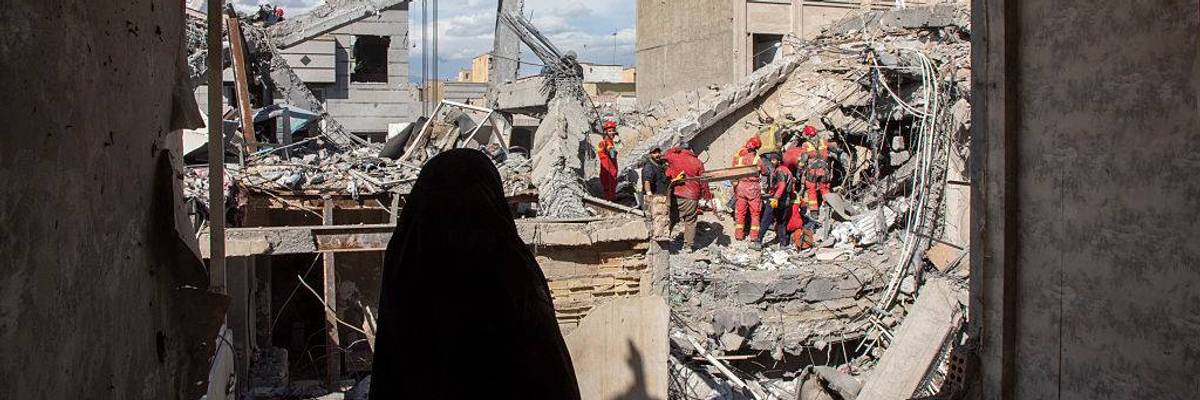
A woman looks on as residents and emergency workers sift through rubble of a residential building that was hit in an airstrike in the early hours of March 27, 2026 in Tehran, Iran.
"The United States and Iran are trapped in a conflict in which each new escalation only deepens a shared, losing predicament... Sooner rather than later, both will confront the urgency of finding an off-ramp."
Multiple reports published in the last two days have indicated that President Donald Trump is seeking to wrap up his illegal war in Iran, which has significantly hurt his domestic political standing—partially by raising gas prices at a time when polls show US voters are primarily concerned about the cost of living.
While ending the Iran war will not be simple, some foreign policy experts believe that it can be done if both the US and Iran truly understand that deescalation is in both nations' best interests.
George Beebe, director of grand strategy at the Quincy Institute for Responsible Statecraft and former director of the CIA’s Russia analysis, and Trita Parsi, executive vice president of the Quincy Institute, have written an essay published on Thursday by Foreign Policy outlining what an achievable Iran "exit plan" would look like.
The authors acknowledged the immense challenges in getting both sides to meet one another halfway, but said this option is preferable to a drawn-out war that will leave both nations poorer and bloodied.
On Iran's side, argued Beebe and Parsi, a deal would involve renewing "its stated commitment to never pursue nuclear weapons," re-opening the Strait of Hormuz to all shipping vessels, and making a commitment "to denominating at least half of its oil sales in US dollars rather than the Chinese yuan."
The US, meanwhile, would "grant sanctions exemptions to countries prepared to finance Iran’s reconstruction" and "would also permit a specified group of states—such as China, India, South Korea, Japan, Turkey, Iraq, and others in the Gulf—to resume trade with Tehran and the purchase of Iranian oil, thereby easing global energy prices."
Beebe and Parsi emphasized that this deal would only be a first step, and they said the next step would be restarting negotiations to establish a nuclear weapons agreement similar to the one previously negotiated by the Obama administration that Trump tore up during his first term.
"The United States and Iran are trapped in a conflict in which each new escalation only deepens a shared, losing predicament," they wrote. "Neither can compel the other’s surrender. Sooner rather than later, both will confront the urgency of finding an off-ramp—one that does not hinge on the other’s humiliation."
Even if Trump takes this course of action, however, there is no guarantee it will succeed, in part because of how much he has already damaged US alliances across the world.
In an analysis published Thursday, Sarah Yerkes, senior fellow at the Carnegie International Endowment for Peace's Middle East Program, argued that even nations in the Middle East that stand to benefit from a weakened Iran are now thinking twice about their dependence on the US for their security needs, given that Trump's war has resulted in Iran launching retaliatory strikes throughout the region.
Yerkes also highlighted how Trump's handling of European allies is making it less likely that they will play a significant part in helping him end the conflict.
"Europe, which is not eager to enter what it sees as a war of choice, has refrained from proactively joining US and Israeli strikes," Yerkes explained. "One of the clearest examples of the transatlantic rift was over the initial reaction to closures in the Strait of Hormuz, the shipping channel for approximately 20% of the world’s seaborne oil and LNG traffic. Multiple European countries refused to cow to Trump’s demand that they send warships to help keep the strait open, inviting public ire from Trump."
The bottom line, warned Yerkes, is that "each day the war continues, without explicit goals or a clear exit strategy, opposition to the United States—from friends and foes, inside and outside—is also likely to grow, making America less safe and less secure."
Dear Common Dreams reader, It’s been nearly 30 years since I co-founded Common Dreams with my late wife, Lina Newhouser. We had the radical notion that journalism should serve the public good, not corporate profits. It was clear to us from the outset what it would take to build such a project. No paid advertisements. No corporate sponsors. No millionaire publisher telling us what to think or do. Many people said we wouldn't last a year, but we proved those doubters wrong. Together with a tremendous team of journalists and dedicated staff, we built an independent media outlet free from the constraints of profits and corporate control. Our mission has always been simple: To inform. To inspire. To ignite change for the common good. Building Common Dreams was not easy. Our survival was never guaranteed. When you take on the most powerful forces—Wall Street greed, fossil fuel industry destruction, Big Tech lobbyists, and uber-rich oligarchs who have spent billions upon billions rigging the economy and democracy in their favor—the only bulwark you have is supporters who believe in your work. But here’s the urgent message from me today. It's never been this bad out there. And it's never been this hard to keep us going. At the very moment Common Dreams is most needed, the threats we face are intensifying. We need your support now more than ever. We don't accept corporate advertising and never will. We don't have a paywall because we don't think people should be blocked from critical news based on their ability to pay. Everything we do is funded by the donations of readers like you. When everyone does the little they can afford, we are strong. But if that support retreats or dries up, so do we. Will you donate now to make sure Common Dreams not only survives but thrives? —Craig Brown, Co-founder |
Multiple reports published in the last two days have indicated that President Donald Trump is seeking to wrap up his illegal war in Iran, which has significantly hurt his domestic political standing—partially by raising gas prices at a time when polls show US voters are primarily concerned about the cost of living.
While ending the Iran war will not be simple, some foreign policy experts believe that it can be done if both the US and Iran truly understand that deescalation is in both nations' best interests.
George Beebe, director of grand strategy at the Quincy Institute for Responsible Statecraft and former director of the CIA’s Russia analysis, and Trita Parsi, executive vice president of the Quincy Institute, have written an essay published on Thursday by Foreign Policy outlining what an achievable Iran "exit plan" would look like.
The authors acknowledged the immense challenges in getting both sides to meet one another halfway, but said this option is preferable to a drawn-out war that will leave both nations poorer and bloodied.
On Iran's side, argued Beebe and Parsi, a deal would involve renewing "its stated commitment to never pursue nuclear weapons," re-opening the Strait of Hormuz to all shipping vessels, and making a commitment "to denominating at least half of its oil sales in US dollars rather than the Chinese yuan."
The US, meanwhile, would "grant sanctions exemptions to countries prepared to finance Iran’s reconstruction" and "would also permit a specified group of states—such as China, India, South Korea, Japan, Turkey, Iraq, and others in the Gulf—to resume trade with Tehran and the purchase of Iranian oil, thereby easing global energy prices."
Beebe and Parsi emphasized that this deal would only be a first step, and they said the next step would be restarting negotiations to establish a nuclear weapons agreement similar to the one previously negotiated by the Obama administration that Trump tore up during his first term.
"The United States and Iran are trapped in a conflict in which each new escalation only deepens a shared, losing predicament," they wrote. "Neither can compel the other’s surrender. Sooner rather than later, both will confront the urgency of finding an off-ramp—one that does not hinge on the other’s humiliation."
Even if Trump takes this course of action, however, there is no guarantee it will succeed, in part because of how much he has already damaged US alliances across the world.
In an analysis published Thursday, Sarah Yerkes, senior fellow at the Carnegie International Endowment for Peace's Middle East Program, argued that even nations in the Middle East that stand to benefit from a weakened Iran are now thinking twice about their dependence on the US for their security needs, given that Trump's war has resulted in Iran launching retaliatory strikes throughout the region.
Yerkes also highlighted how Trump's handling of European allies is making it less likely that they will play a significant part in helping him end the conflict.
"Europe, which is not eager to enter what it sees as a war of choice, has refrained from proactively joining US and Israeli strikes," Yerkes explained. "One of the clearest examples of the transatlantic rift was over the initial reaction to closures in the Strait of Hormuz, the shipping channel for approximately 20% of the world’s seaborne oil and LNG traffic. Multiple European countries refused to cow to Trump’s demand that they send warships to help keep the strait open, inviting public ire from Trump."
The bottom line, warned Yerkes, is that "each day the war continues, without explicit goals or a clear exit strategy, opposition to the United States—from friends and foes, inside and outside—is also likely to grow, making America less safe and less secure."
Multiple reports published in the last two days have indicated that President Donald Trump is seeking to wrap up his illegal war in Iran, which has significantly hurt his domestic political standing—partially by raising gas prices at a time when polls show US voters are primarily concerned about the cost of living.
While ending the Iran war will not be simple, some foreign policy experts believe that it can be done if both the US and Iran truly understand that deescalation is in both nations' best interests.
George Beebe, director of grand strategy at the Quincy Institute for Responsible Statecraft and former director of the CIA’s Russia analysis, and Trita Parsi, executive vice president of the Quincy Institute, have written an essay published on Thursday by Foreign Policy outlining what an achievable Iran "exit plan" would look like.
The authors acknowledged the immense challenges in getting both sides to meet one another halfway, but said this option is preferable to a drawn-out war that will leave both nations poorer and bloodied.
On Iran's side, argued Beebe and Parsi, a deal would involve renewing "its stated commitment to never pursue nuclear weapons," re-opening the Strait of Hormuz to all shipping vessels, and making a commitment "to denominating at least half of its oil sales in US dollars rather than the Chinese yuan."
The US, meanwhile, would "grant sanctions exemptions to countries prepared to finance Iran’s reconstruction" and "would also permit a specified group of states—such as China, India, South Korea, Japan, Turkey, Iraq, and others in the Gulf—to resume trade with Tehran and the purchase of Iranian oil, thereby easing global energy prices."
Beebe and Parsi emphasized that this deal would only be a first step, and they said the next step would be restarting negotiations to establish a nuclear weapons agreement similar to the one previously negotiated by the Obama administration that Trump tore up during his first term.
"The United States and Iran are trapped in a conflict in which each new escalation only deepens a shared, losing predicament," they wrote. "Neither can compel the other’s surrender. Sooner rather than later, both will confront the urgency of finding an off-ramp—one that does not hinge on the other’s humiliation."
Even if Trump takes this course of action, however, there is no guarantee it will succeed, in part because of how much he has already damaged US alliances across the world.
In an analysis published Thursday, Sarah Yerkes, senior fellow at the Carnegie International Endowment for Peace's Middle East Program, argued that even nations in the Middle East that stand to benefit from a weakened Iran are now thinking twice about their dependence on the US for their security needs, given that Trump's war has resulted in Iran launching retaliatory strikes throughout the region.
Yerkes also highlighted how Trump's handling of European allies is making it less likely that they will play a significant part in helping him end the conflict.
"Europe, which is not eager to enter what it sees as a war of choice, has refrained from proactively joining US and Israeli strikes," Yerkes explained. "One of the clearest examples of the transatlantic rift was over the initial reaction to closures in the Strait of Hormuz, the shipping channel for approximately 20% of the world’s seaborne oil and LNG traffic. Multiple European countries refused to cow to Trump’s demand that they send warships to help keep the strait open, inviting public ire from Trump."
The bottom line, warned Yerkes, is that "each day the war continues, without explicit goals or a clear exit strategy, opposition to the United States—from friends and foes, inside and outside—is also likely to grow, making America less safe and less secure."