

SUBSCRIBE TO OUR FREE NEWSLETTER
Daily news & progressive opinion—funded by the people, not the corporations—delivered straight to your inbox.
5
#000000
#FFFFFF
To donate by check, phone, or other method, see our More Ways to Give page.
Daily news & progressive opinion—funded by the people, not the corporations—delivered straight to your inbox.
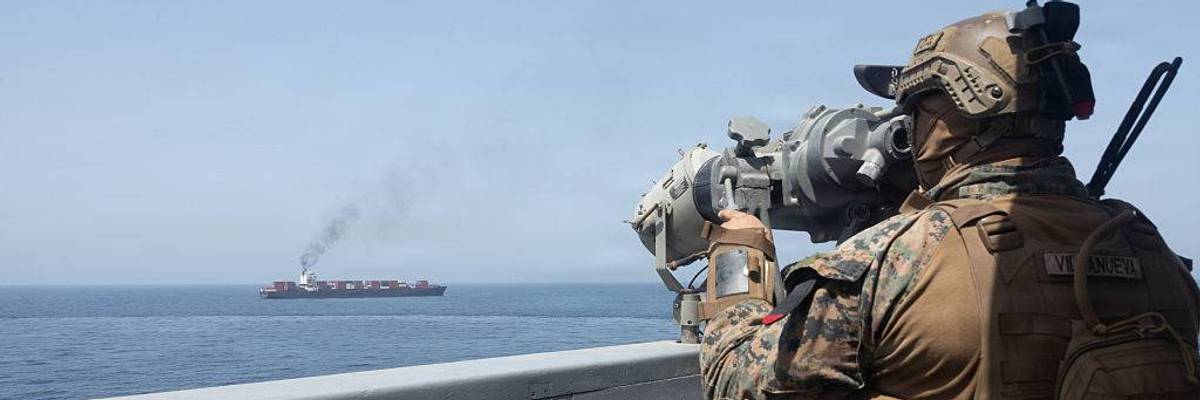
US forces patrol the Arabian Sea near MV Touska on April 20, 2026.
"The closure of the Strait of Hormuz is a problem CAUSED by US military power, not one US military power can fix," said one critic.
Iran on Monday launched missiles and drones at US military forces and merchant ships after President Donald Trump announced plans to help vessels navigate the Strait of Hormuz.
According to The Washington Post, the Iranian strikes "were carried out just after Central Command announced that two U.S.-flagged commercial vessels passed through the strait, the first known to have done so since the ceasefire, closely following the passage of two US destroyers."
Maj. Gen. Ali Abdollahi, a senior Iranian commander, warned in a statement given to the Iranian Mehr News Agency that his country's military "will attack any foreign force, particularly the US military, if it attempts to approach or enter the Strait of Hormuz."
Trump responded to the Iranian attacks by once again threatening to carry out war crimes, telling Fox News' Trey Yingst that Iran will "be blown off the face of the Earth" if it attacks US military ships.
Trump's latest threat comes just over a month after the president delivered an openly genocidal threat against Iran, warning that "a whole civilization will die tonight, never to be brought back again," if Iran's leaders didn't give into his demands.
Amid the resumption of hostilities, the National Iranian American Council (NIAC) warned that the US and Iran could be stumbling into a dangerous new phase of the war, which Trump launched in late February without any authorization from the US Congress.
"In seemingly daring Iran to fire on US vessels by testing their restriction of naval traffic through the Strait of Hormuz," NIAC wrote in a social media post, "the US risks instigating a Gulf of Tonkin-like incident that would serve as a spark for deeper military hostilities. The consistent rejection of diplomatic off-ramps and use of brinksmanship to seek to enhance leverage at the negotiating table is a losing game that risks tilting the US and Iran back into full-blown war."
Trita Parsi, executive vice president of the Quincy Institute for Responsible Statecraft, relayed comments from an unidentified Iranian analyst who said Iran's decision to fire "warning shots" at US military vessels represented a move to a more aggressive strategic posture.
"If Trump plans to restart the war, Iran will not wait for Trump to do so before it retaliates," Parsi wrote. "It will strike preemptively in a measured way to deter Trump."
Sina Toossi, senior fellow at the Center for International Policy, called attention to Trump's claims that his escort mission to get two commercial vessels out of the Strait of Hormuz was a "success," even as it led to reported Iranian strikes on ports in the allied United Arab Emirates.
"Reads like another desperate attempt to steady markets as events suggest otherwise," Toossi remarked.
Jennifer Kavanagh, senior fellow and director of military analysis at Defense Priorities, said the latest round of hostilities showed the Trump administration was still in denial about what needs to happen to reopen the strait.
"The closure of the Strait of Hormuz is a problem CAUSED by US military power, not one US military power can fix," Kavanagh explained. "The sooner Washington accepts this, the sooner we can start working toward a diplomatic resolution."
Dear Common Dreams reader, It’s been nearly 30 years since I co-founded Common Dreams with my late wife, Lina Newhouser. We had the radical notion that journalism should serve the public good, not corporate profits. It was clear to us from the outset what it would take to build such a project. No paid advertisements. No corporate sponsors. No millionaire publisher telling us what to think or do. Many people said we wouldn't last a year, but we proved those doubters wrong. Together with a tremendous team of journalists and dedicated staff, we built an independent media outlet free from the constraints of profits and corporate control. Our mission has always been simple: To inform. To inspire. To ignite change for the common good. Building Common Dreams was not easy. Our survival was never guaranteed. When you take on the most powerful forces—Wall Street greed, fossil fuel industry destruction, Big Tech lobbyists, and uber-rich oligarchs who have spent billions upon billions rigging the economy and democracy in their favor—the only bulwark you have is supporters who believe in your work. But here’s the urgent message from me today. It's never been this bad out there. And it's never been this hard to keep us going. At the very moment Common Dreams is most needed, the threats we face are intensifying. We need your support now more than ever. We don't accept corporate advertising and never will. We don't have a paywall because we don't think people should be blocked from critical news based on their ability to pay. Everything we do is funded by the donations of readers like you. When everyone does the little they can afford, we are strong. But if that support retreats or dries up, so do we. Will you donate now to make sure Common Dreams not only survives but thrives? —Craig Brown, Co-founder |
Iran on Monday launched missiles and drones at US military forces and merchant ships after President Donald Trump announced plans to help vessels navigate the Strait of Hormuz.
According to The Washington Post, the Iranian strikes "were carried out just after Central Command announced that two U.S.-flagged commercial vessels passed through the strait, the first known to have done so since the ceasefire, closely following the passage of two US destroyers."
Maj. Gen. Ali Abdollahi, a senior Iranian commander, warned in a statement given to the Iranian Mehr News Agency that his country's military "will attack any foreign force, particularly the US military, if it attempts to approach or enter the Strait of Hormuz."
Trump responded to the Iranian attacks by once again threatening to carry out war crimes, telling Fox News' Trey Yingst that Iran will "be blown off the face of the Earth" if it attacks US military ships.
Trump's latest threat comes just over a month after the president delivered an openly genocidal threat against Iran, warning that "a whole civilization will die tonight, never to be brought back again," if Iran's leaders didn't give into his demands.
Amid the resumption of hostilities, the National Iranian American Council (NIAC) warned that the US and Iran could be stumbling into a dangerous new phase of the war, which Trump launched in late February without any authorization from the US Congress.
"In seemingly daring Iran to fire on US vessels by testing their restriction of naval traffic through the Strait of Hormuz," NIAC wrote in a social media post, "the US risks instigating a Gulf of Tonkin-like incident that would serve as a spark for deeper military hostilities. The consistent rejection of diplomatic off-ramps and use of brinksmanship to seek to enhance leverage at the negotiating table is a losing game that risks tilting the US and Iran back into full-blown war."
Trita Parsi, executive vice president of the Quincy Institute for Responsible Statecraft, relayed comments from an unidentified Iranian analyst who said Iran's decision to fire "warning shots" at US military vessels represented a move to a more aggressive strategic posture.
"If Trump plans to restart the war, Iran will not wait for Trump to do so before it retaliates," Parsi wrote. "It will strike preemptively in a measured way to deter Trump."
Sina Toossi, senior fellow at the Center for International Policy, called attention to Trump's claims that his escort mission to get two commercial vessels out of the Strait of Hormuz was a "success," even as it led to reported Iranian strikes on ports in the allied United Arab Emirates.
"Reads like another desperate attempt to steady markets as events suggest otherwise," Toossi remarked.
Jennifer Kavanagh, senior fellow and director of military analysis at Defense Priorities, said the latest round of hostilities showed the Trump administration was still in denial about what needs to happen to reopen the strait.
"The closure of the Strait of Hormuz is a problem CAUSED by US military power, not one US military power can fix," Kavanagh explained. "The sooner Washington accepts this, the sooner we can start working toward a diplomatic resolution."
Iran on Monday launched missiles and drones at US military forces and merchant ships after President Donald Trump announced plans to help vessels navigate the Strait of Hormuz.
According to The Washington Post, the Iranian strikes "were carried out just after Central Command announced that two U.S.-flagged commercial vessels passed through the strait, the first known to have done so since the ceasefire, closely following the passage of two US destroyers."
Maj. Gen. Ali Abdollahi, a senior Iranian commander, warned in a statement given to the Iranian Mehr News Agency that his country's military "will attack any foreign force, particularly the US military, if it attempts to approach or enter the Strait of Hormuz."
Trump responded to the Iranian attacks by once again threatening to carry out war crimes, telling Fox News' Trey Yingst that Iran will "be blown off the face of the Earth" if it attacks US military ships.
Trump's latest threat comes just over a month after the president delivered an openly genocidal threat against Iran, warning that "a whole civilization will die tonight, never to be brought back again," if Iran's leaders didn't give into his demands.
Amid the resumption of hostilities, the National Iranian American Council (NIAC) warned that the US and Iran could be stumbling into a dangerous new phase of the war, which Trump launched in late February without any authorization from the US Congress.
"In seemingly daring Iran to fire on US vessels by testing their restriction of naval traffic through the Strait of Hormuz," NIAC wrote in a social media post, "the US risks instigating a Gulf of Tonkin-like incident that would serve as a spark for deeper military hostilities. The consistent rejection of diplomatic off-ramps and use of brinksmanship to seek to enhance leverage at the negotiating table is a losing game that risks tilting the US and Iran back into full-blown war."
Trita Parsi, executive vice president of the Quincy Institute for Responsible Statecraft, relayed comments from an unidentified Iranian analyst who said Iran's decision to fire "warning shots" at US military vessels represented a move to a more aggressive strategic posture.
"If Trump plans to restart the war, Iran will not wait for Trump to do so before it retaliates," Parsi wrote. "It will strike preemptively in a measured way to deter Trump."
Sina Toossi, senior fellow at the Center for International Policy, called attention to Trump's claims that his escort mission to get two commercial vessels out of the Strait of Hormuz was a "success," even as it led to reported Iranian strikes on ports in the allied United Arab Emirates.
"Reads like another desperate attempt to steady markets as events suggest otherwise," Toossi remarked.
Jennifer Kavanagh, senior fellow and director of military analysis at Defense Priorities, said the latest round of hostilities showed the Trump administration was still in denial about what needs to happen to reopen the strait.
"The closure of the Strait of Hormuz is a problem CAUSED by US military power, not one US military power can fix," Kavanagh explained. "The sooner Washington accepts this, the sooner we can start working toward a diplomatic resolution."

