SUBSCRIBE TO OUR FREE NEWSLETTER
Daily news & progressive opinion—funded by the people, not the corporations—delivered straight to your inbox.
5
#000000
#FFFFFF
To donate by check, phone, or other method, see our More Ways to Give page.
Daily news & progressive opinion—funded by the people, not the corporations—delivered straight to your inbox.
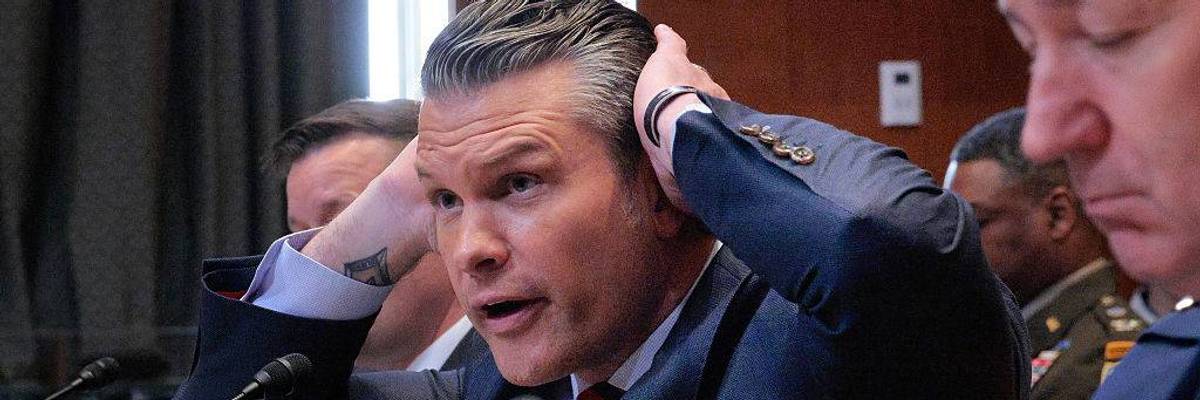
US Defense Secretary Pete Hegseth testifies before the Senate Committee on Appropriations, Subcommittee on Defense on May 12, 2026 in Washington, DC.
"What we're seeing is the public experience how more spending does not actually keep them safe," said a researcher at Brown University's Costs of War Project.
US Defense Secretary Pete Hegseth on Thursday released yet another ad pitching President Donald Trump's proposed $1.5 trillion Pentagon budget, as new polling showed major skepticism over the idea.
In his latest pitch for the record-breaking defense budget, the former Fox News host insists that "America is not in decline," even though the US has been unable to compel Iran to reopen the Strait of Hormuz despite having spent nearly $1 trillion on defense in 2025.
"We remain the strongest military power on Earth," Hegseth continued. "But that power requires renewal. And with global threats that are constantly evolving, it's time to make a $1.5 trillion investment."
The $1.5 trillion investment is a GENERATIONAL DOWN PAYMENT on America’s national defense.
This investment guarantees the United States maintains overwhelming strength and unmatched deterrence against any adversary for generations to come. pic.twitter.com/2zOSlZkzNr
— Secretary of War Pete Hegseth (@SecWar) May 14, 2026
A $1.5 trillion military budget would be over 50% more than the 2025 US defense budget and more than four times the money spent on defense by China, the world’s second-biggest defense spender.
Among other things, Hegseth said that the budget would invest $18 billion into Trump's proposed "Golden Dome" missile defense shield, which the Congressional Budget Office on Tuesday estimated would cost $1.2 trillion to create, deploy, and operate over the first 20 years of its existence.
Hegseth also said that the Pentagon would be increasing its investment in artificial intelligence by "800%," although it's not at the moment clear how well AI helps militaries effectively fight wars.
The defense secretary concluded his video by insisting that "we are expanding our strength, we are restoring our deterrence, and we are putting America first."
USA Today reported on Thursday that a new poll conducted by ReThink Media and the Costs of War Project at Brown University finds that nearly 60% of Americans think the proposed Trump Pentagon budget is too large, including 40% who say $1.5 trillion is "much too high" to spend on defense.
Breaking the figures down by party, 87% of Democrats said the defense budget was too high, along with 54% of independents, and even 30% of Republicans.
Jennifer Greenburg, a researcher with Brown's Costs of War Project, told USA Today that Americans were broadly skeptical that plunging more taxpayer money into the Pentagon is really necessary given that the US already doles out more for defense than the next four biggest spenders—China, Russia, Germany, and India—combined.
"In real time, I think what we're seeing," said Greenberg, "is the public experience how more spending does not actually keep them safe."
In a column published by The New York Times on Wednesday, longtime national security reporter Noah Shachtman argued that Hegseth's $1.5 trillion proposal was "less like a budget and more like a trip to an endless casino buffet" in which the Pentagon spends money in "gut-busting proportions."
Shachtman also noted that the proposed $1.5 trillion defense budget comes at a time when the Trump administration has wrecked traditional oversight mechanisms, thus making waste and fraud far more likely at a Pentagon that's never passed an audit.
"One of their early actions was to fire and replace the Pentagon’s inspector general, whose office looks into claims of fraud and abuse in military contracting," Shachtman explained. "The independent office that tests whether our weapons actually work has been gutted."
Ben Freeman, director of the Democratizing Foreign Policy program at the Quincy Institute for Responsible Statecraft, argued in an analysis published on Tuesday that Hegseth's budget pitch at congressional hearings this week was particularly baffling because there is really no imperative behind it on par with the Cold War or the post-9/11 defense buildup.
"Despite presenting no strategic necessity for the largest year-over-year Pentagon spending increase since World War II," Freeman wrote, "Hegseth repeatedly claimed the $1.5 trillion Pentagon budget was a sound financial decision, arguing in the Senate hearing that 'at every level we have made it a fiscally responsible budget.' Yet, the fact is that the entirety of this proposed increase in Pentagon spending would be deficit financed, effectively going on Uncle Sam’s credit card."
Dear Common Dreams reader, It’s been nearly 30 years since I co-founded Common Dreams with my late wife, Lina Newhouser. We had the radical notion that journalism should serve the public good, not corporate profits. It was clear to us from the outset what it would take to build such a project. No paid advertisements. No corporate sponsors. No millionaire publisher telling us what to think or do. Many people said we wouldn't last a year, but we proved those doubters wrong. Together with a tremendous team of journalists and dedicated staff, we built an independent media outlet free from the constraints of profits and corporate control. Our mission has always been simple: To inform. To inspire. To ignite change for the common good. Building Common Dreams was not easy. Our survival was never guaranteed. When you take on the most powerful forces—Wall Street greed, fossil fuel industry destruction, Big Tech lobbyists, and uber-rich oligarchs who have spent billions upon billions rigging the economy and democracy in their favor—the only bulwark you have is supporters who believe in your work. But here’s the urgent message from me today. It's never been this bad out there. And it's never been this hard to keep us going. At the very moment Common Dreams is most needed, the threats we face are intensifying. We need your support now more than ever. We don't accept corporate advertising and never will. We don't have a paywall because we don't think people should be blocked from critical news based on their ability to pay. Everything we do is funded by the donations of readers like you. When everyone does the little they can afford, we are strong. But if that support retreats or dries up, so do we. Will you donate now to make sure Common Dreams not only survives but thrives? —Craig Brown, Co-founder |
US Defense Secretary Pete Hegseth on Thursday released yet another ad pitching President Donald Trump's proposed $1.5 trillion Pentagon budget, as new polling showed major skepticism over the idea.
In his latest pitch for the record-breaking defense budget, the former Fox News host insists that "America is not in decline," even though the US has been unable to compel Iran to reopen the Strait of Hormuz despite having spent nearly $1 trillion on defense in 2025.
"We remain the strongest military power on Earth," Hegseth continued. "But that power requires renewal. And with global threats that are constantly evolving, it's time to make a $1.5 trillion investment."
The $1.5 trillion investment is a GENERATIONAL DOWN PAYMENT on America’s national defense.
This investment guarantees the United States maintains overwhelming strength and unmatched deterrence against any adversary for generations to come. pic.twitter.com/2zOSlZkzNr
— Secretary of War Pete Hegseth (@SecWar) May 14, 2026
A $1.5 trillion military budget would be over 50% more than the 2025 US defense budget and more than four times the money spent on defense by China, the world’s second-biggest defense spender.
Among other things, Hegseth said that the budget would invest $18 billion into Trump's proposed "Golden Dome" missile defense shield, which the Congressional Budget Office on Tuesday estimated would cost $1.2 trillion to create, deploy, and operate over the first 20 years of its existence.
Hegseth also said that the Pentagon would be increasing its investment in artificial intelligence by "800%," although it's not at the moment clear how well AI helps militaries effectively fight wars.
The defense secretary concluded his video by insisting that "we are expanding our strength, we are restoring our deterrence, and we are putting America first."
USA Today reported on Thursday that a new poll conducted by ReThink Media and the Costs of War Project at Brown University finds that nearly 60% of Americans think the proposed Trump Pentagon budget is too large, including 40% who say $1.5 trillion is "much too high" to spend on defense.
Breaking the figures down by party, 87% of Democrats said the defense budget was too high, along with 54% of independents, and even 30% of Republicans.
Jennifer Greenburg, a researcher with Brown's Costs of War Project, told USA Today that Americans were broadly skeptical that plunging more taxpayer money into the Pentagon is really necessary given that the US already doles out more for defense than the next four biggest spenders—China, Russia, Germany, and India—combined.
"In real time, I think what we're seeing," said Greenberg, "is the public experience how more spending does not actually keep them safe."
In a column published by The New York Times on Wednesday, longtime national security reporter Noah Shachtman argued that Hegseth's $1.5 trillion proposal was "less like a budget and more like a trip to an endless casino buffet" in which the Pentagon spends money in "gut-busting proportions."
Shachtman also noted that the proposed $1.5 trillion defense budget comes at a time when the Trump administration has wrecked traditional oversight mechanisms, thus making waste and fraud far more likely at a Pentagon that's never passed an audit.
"One of their early actions was to fire and replace the Pentagon’s inspector general, whose office looks into claims of fraud and abuse in military contracting," Shachtman explained. "The independent office that tests whether our weapons actually work has been gutted."
Ben Freeman, director of the Democratizing Foreign Policy program at the Quincy Institute for Responsible Statecraft, argued in an analysis published on Tuesday that Hegseth's budget pitch at congressional hearings this week was particularly baffling because there is really no imperative behind it on par with the Cold War or the post-9/11 defense buildup.
"Despite presenting no strategic necessity for the largest year-over-year Pentagon spending increase since World War II," Freeman wrote, "Hegseth repeatedly claimed the $1.5 trillion Pentagon budget was a sound financial decision, arguing in the Senate hearing that 'at every level we have made it a fiscally responsible budget.' Yet, the fact is that the entirety of this proposed increase in Pentagon spending would be deficit financed, effectively going on Uncle Sam’s credit card."
US Defense Secretary Pete Hegseth on Thursday released yet another ad pitching President Donald Trump's proposed $1.5 trillion Pentagon budget, as new polling showed major skepticism over the idea.
In his latest pitch for the record-breaking defense budget, the former Fox News host insists that "America is not in decline," even though the US has been unable to compel Iran to reopen the Strait of Hormuz despite having spent nearly $1 trillion on defense in 2025.
"We remain the strongest military power on Earth," Hegseth continued. "But that power requires renewal. And with global threats that are constantly evolving, it's time to make a $1.5 trillion investment."
The $1.5 trillion investment is a GENERATIONAL DOWN PAYMENT on America’s national defense.
This investment guarantees the United States maintains overwhelming strength and unmatched deterrence against any adversary for generations to come. pic.twitter.com/2zOSlZkzNr
— Secretary of War Pete Hegseth (@SecWar) May 14, 2026
A $1.5 trillion military budget would be over 50% more than the 2025 US defense budget and more than four times the money spent on defense by China, the world’s second-biggest defense spender.
Among other things, Hegseth said that the budget would invest $18 billion into Trump's proposed "Golden Dome" missile defense shield, which the Congressional Budget Office on Tuesday estimated would cost $1.2 trillion to create, deploy, and operate over the first 20 years of its existence.
Hegseth also said that the Pentagon would be increasing its investment in artificial intelligence by "800%," although it's not at the moment clear how well AI helps militaries effectively fight wars.
The defense secretary concluded his video by insisting that "we are expanding our strength, we are restoring our deterrence, and we are putting America first."
USA Today reported on Thursday that a new poll conducted by ReThink Media and the Costs of War Project at Brown University finds that nearly 60% of Americans think the proposed Trump Pentagon budget is too large, including 40% who say $1.5 trillion is "much too high" to spend on defense.
Breaking the figures down by party, 87% of Democrats said the defense budget was too high, along with 54% of independents, and even 30% of Republicans.
Jennifer Greenburg, a researcher with Brown's Costs of War Project, told USA Today that Americans were broadly skeptical that plunging more taxpayer money into the Pentagon is really necessary given that the US already doles out more for defense than the next four biggest spenders—China, Russia, Germany, and India—combined.
"In real time, I think what we're seeing," said Greenberg, "is the public experience how more spending does not actually keep them safe."
In a column published by The New York Times on Wednesday, longtime national security reporter Noah Shachtman argued that Hegseth's $1.5 trillion proposal was "less like a budget and more like a trip to an endless casino buffet" in which the Pentagon spends money in "gut-busting proportions."
Shachtman also noted that the proposed $1.5 trillion defense budget comes at a time when the Trump administration has wrecked traditional oversight mechanisms, thus making waste and fraud far more likely at a Pentagon that's never passed an audit.
"One of their early actions was to fire and replace the Pentagon’s inspector general, whose office looks into claims of fraud and abuse in military contracting," Shachtman explained. "The independent office that tests whether our weapons actually work has been gutted."
Ben Freeman, director of the Democratizing Foreign Policy program at the Quincy Institute for Responsible Statecraft, argued in an analysis published on Tuesday that Hegseth's budget pitch at congressional hearings this week was particularly baffling because there is really no imperative behind it on par with the Cold War or the post-9/11 defense buildup.
"Despite presenting no strategic necessity for the largest year-over-year Pentagon spending increase since World War II," Freeman wrote, "Hegseth repeatedly claimed the $1.5 trillion Pentagon budget was a sound financial decision, arguing in the Senate hearing that 'at every level we have made it a fiscally responsible budget.' Yet, the fact is that the entirety of this proposed increase in Pentagon spending would be deficit financed, effectively going on Uncle Sam’s credit card."