

5
#000000
#FFFFFF
To donate by check, phone, or other method, see our More Ways to Give page.
Daily news & progressive opinion—funded by the people, not the corporations—delivered straight to your inbox.

In the midst of the torrent of lies and repressive practices emanating from Washington, the use of research to guide strategy and support organizing is more important than ever.
I have spent the bulk of my career—on and off since the late Carter administration—following the money that drives war and repression. What I have finally learned after so many decades of doing research on the war machine is that while research is critical, it must be in the service of a smart strategy backed by a lot of hard work by organizers from all walks of life.
My interest in using research to promote social change was sparked by my years at Columbia University in the 1970s, when I was a researcher and advocate in the divestment movement targeting the apartheid regime of South Africa and a participant in other social justice movements like the boycott in support of the United Farmworkers Union and the opposition to the Pinochet dictatorship in Chile.
Henry Kissinger’s justification for the US-backed coup in Chile that put Augusto Pinochet in power still sticks in my mind: “I don’t see why we need to stand by and watch a country go Communist due to the irresponsibility of its own people.”
So much for the land of the free and the beacon of global democracy.
The US role in the coup was eventually recounted by many media outlets, but for me the first and most important was the North American Congress on Latin America (NACLA), which devoted several issues of its magazine, then called The Latin America and Empire Report, to the origins of the coup, including the role of US corporations. I was so impressed with their research and commitment that I applied to work at NACLA after graduating from Columbia in January 1978. They wisely demurred, since my background on Latin America was largely limited to what I had read in their own reports. Still, their skill in deploying detailed research to debunk the official lies that surrounded the coup stuck with me.
My real schooling in research, however, came in the anti-apartheid movement, starting with the divestment campaign at Columbia and expanding into my work with national anti-apartheid organizations like the American Committee on Africa (ACOA). Again, research was front and center. In order to make effective demands for divestment, we needed to know which companies were supporting the apartheid regime, and which of those companies our universities held stock in. ACOA was of great help in this, including through Richard Knight, who worked in a back room of their offices at 198 Broadway and had what may well have been the messiest desk in the history of progressive politics. But if my memory serves me correctly, he seemed to be able to remember exactly where he put a given document in one of the many piles of paper that obscured his desktop. The work he did, along with colleagues at ACOA, helped fuel the student divestment movement, along with research by students on campuses around the country.
Another key group at that time was Corporate Data Exchange (CDE). Tina Simcich, who worked at CDE and was also part of the New York Committee to Oppose Bank Loans to South Africa (COBLSA), did the definitive research on which banks were lending to the apartheid regime.
At Columbia, we made an interesting discovery that put the lie to the university’s position on divestment. In response to demands to divest from firms involved with the apartheid regime, university leaders argued that, if there were objections to the actions of companies they were invested in, they felt it would be more productive to support shareholder resolutions seeking to change their conduct than to divest from those companies’ stocks.
if there were not people organizing for change, my research would be little more than a peculiar hobby.
But after digging around in past Columbia University documents, we found a memo from a prior year in which the university had responded to a request to support a shareholder resolution on behalf of trade unionists in Chile, some of whom had been murdered by the Pinochet regime. The university’s position then proved to be precisely the opposite of what it said just a few years later when asked to divest from companies involved in South Africa: They didn’t think it was productive to engage in shareholder resolutions. If there was an ethical issue with one of their holdings, their preference was to divest from the stock of that company.
Although it was a small instance of hypocrisy, it was nonetheless revealing. At that point, the university had been determined to do absolutely nothing to hold companies that were complicit in repression accountable. Our divestment campaign of the mid-1970s did not succeed, but in 1985, another cohort of student activists did finally persuade Columbia to divest. The next year, in 1986, Congress passed comprehensive sanctions on South Africa, overriding a veto attempt by President Ronald Reagan.
Obviously, research was only partly responsible for our success. It was research in the service of organizing and sound strategy that won the day. The fact that the liberation movements in South Africa, including the African National Congress and the Black Consciousness Movement, were calling for divestment greatly strengthened our case. And inspiring organizers and speakers like the incomparable Prexy Nesbitt and the late Dumisani Kumalo, a South African exile who went on to be liberated South Africa’s first representative to the United Nations, played a huge role, as did thousands of campus activists, religious leaders, trade unionists, state and local officials, and heads of pension funds.
Eight years later, in 1994, Nelson Mandela was sworn in as the first president of a free South Africa. The vast bulk of the credit for that historic change goes to the people of South Africa, but the divestment campaign and the larger global boycott of the apartheid regime played an important supporting role, a role much appreciated by activists in South Africa.
As for me, my work in the anti-apartheid movement shaped my career. I worked for a while as part of the collective that put out Southern Africa magazine, an independent journal that supported the anti-apartheid movement and the liberation movements in Southern Africa. The original editor was Jennifer Davis, the brilliant exiled South African economist who went on to direct ACOA. I wrote articles about the divestment campaign, violations of the arms embargo on South Africa, and the role of US firms in propping up the apartheid regime. The skills and values I learned there were far more important to my career than my philosophy degree from Columbia, an institution whose leaders have now covered themselves in shame by cracking down on students speaking out against US-financed Israeli genocide in Gaza.
Our work against apartheid was inspired in part by the generation of 1968, whose research exposed the role of companies fueling the war in Vietnam, including Dow Chemical, which produced napalm that was used to kill and maim untold numbers of people. We were also influenced by publications like “Who Rules Columbia,” as well as a handy publication on how to research the corporate ties of one’s university, published by the ever-relevant and crucial NACLA. And groups like National Action Research on the Military-Industrial Complex (NARMIC) were invaluable for peace activists from the anti-Vietnam War period onward.
Other influences on me from that generation of researchers and analysts included Michael Klare, whose reports and books like Supplying Repression, War Without End: American Planning for the Next Vietnams, and Rogue States and Nuclear Outlaws: America’s Search for a New Foreign Policy were foundational in forming my understanding of US military spending and strategy. And my perspective on the domestic factors driving Pentagon spending began with The Iron Triangle, written by my friend and mentor Gordon Adams (now Abby Ross).
Activists pushing universities to divest from companies profiting from Israel’s war in Gaza have made connections with the earlier generation of researchers described above, from webinars with members of NARMIC to essays that link to documents like “Who Rules Columbia?”
A key organization in the middle of current efforts is Little Sis—a powerful research organization whose name is based on the idea that they are the opposite of Big Brother. They facilitate research and make connections on a wide range of issues, but at this moment one of their most important products is a webinar they did with Dissenters, a youth anti-militarism group based in Chicago, on how to research the corporate ties of universities. It’s a tutorial on researching university ties to war profiteers, going well beyond the issue of stock holdings in arms makers to look at the connections of trustees, financial institutions, and other relevant ties to weapons makers.
As the Trump administration stops collecting some kinds of data and destroys other kinds altogether, the job of research will be ever more difficult.
Groups of dedicated students within the ceasefire and anti-genocide movements on US campuses have done excellent work in researching the corporate ties of their own universities. I appeared on Santita Jackson’s radio show in February 2025 and connected with Bryce Greene, a student at the University of Indiana involved in the ceasefire-Gaza movement there. He and his fellow students were researching the military ties of the university, and they wanted me to review their research to see if they were missing anything. As it happened, they had dug up far more information than I would have, in part because of local connections. Their biggest find was related to the university’s ties to the Naval Surface Warfare Center (NSWC), Crane Division, which provides technical support for everything from missile defense systems to Special Operations Forces. University professors had gone back and forth between Crane and campus, and Crane had a direct presence at the school. Students then started a “keep Crane off campus” campaign.
Researchers focused specifically on Israel and Gaza include the American Friends Service Committee, which has a web page on “Companies Profiting from the Gaza Genocide,” and No Tech for Apartheid, which, among other things, reaches out to workers at Google and Amazon to encourage them to take a stand against technology from tech firms going to support the Israeli war effort. One of the most valuable current resources is the United Nations report, From the Economy of Occupation to the Economy of Genocide, produced under the supervision of Special Rapporteur Francesca Albanese, which describes its purpose this way:
This report investigates the corporate machinery sustaining Israel’s settler-colonial project of displacement and replacement of the Palestinians in the occupied territory. While political leaders and governments shirk their obligations, far too many corporate entities have profited from Israel’s economy of illegal occupation, apartheid and now, genocide. The complicity exposed by this report is just the tip of the iceberg; ending it will not happen without holding the private sector accountable, including its executives.
The most effective current model for using data to shape the debate on security issues is the Costs of War Project at Brown University. Their work on the costs of America’s post-9/11 wars ($8 trillion and counting), the number of overseas US counterterror missions, the cost of US military aid and military operations in support of Israel (over $22 billion in the first year of the war in Gaza) is routinely cited in the press and by political leaders, and provides fuel for activists in their writing and public education efforts.
The best current example of merging research, organizing, and strategy is the new Poor People’s Campaign, cochaired by Reverend William Barber of Repairers of the Breach and Reverend Liz Theoharis of the Kairos Center. Their campaign was inspired by the effort of the same name announced by Martin Luther King Jr. in November 1967. King was assassinated before his campaign came to fruition, but the National Welfare Rights Organization (NWRO) and other groups picked up the work of making its signature event, The Poor People’s March on Washington, happen.
One of the bedrock principles of the current Poor People’s Campaign is that the people most impacted by poverty should lead the movement. But cultivating such leadership, especially among those who have been excluded from the halls of power and influence for so long, requires an ongoing process of research, education, and training. Theoharis, director of the Kairos Center and cochair of the Poor People’s Campaign, underscores this point in her new book on the history of poor people’s organizing, coauthored with Noam Sandweiss-Back:
Without a continual process of learning, reflecting, and growing intellectually, our organizing is reduced to mobilizing, an exercise in moving bodies without supporting existing leaders and developing new ones... mobilizing people is important, but when it becomes our sole focus, we sacrifice long-term power for short-term action.
As Theoharis notes, King made a similar point in Where Do We Go From Here?:
Education without social action is a one-sided value because it has no true power potential. Social action without education is a weak expression of pure energy… Our policies should have the strength of deep analysis beneath them to be able to challenge the clever sophistries of our opponents.
In the midst of the torrent of lies and repressive practices emanating from Washington, the use of research to guide strategy and support organizing is more important than ever. But as the Trump administration stops collecting some kinds of data and destroys other kinds altogether, the job of research will be ever more difficult. That can be partially compensated for by drawing on the collective knowledge of researchers, organizers, and community members alike, taking our lead from people who are on the front lines of dealing with repressive policies.
Occasionally, when I am giving a talk on how to reduce the influence of the war machine, I point out that, if there were not people organizing for change, my research would be little more than a peculiar hobby. That is only a slight exaggeration. We need to bring together researchers, organizers, and strategists, taking our lead from members of impacted communities, to work in partnership against the challenges we now face on a daily, at times hourly, basis.
This means the content of our work may take different forms. Rather than reports and briefings, we may need to rely on music, storytelling, art, and ritual to share insights on the political terrain and tales of resistance and revival in these times of escalating crisis. This may become even more to the point as traditional forms of protest continue to be criminalized.
We have a rich history to guide and inspire us, but the task is ours.
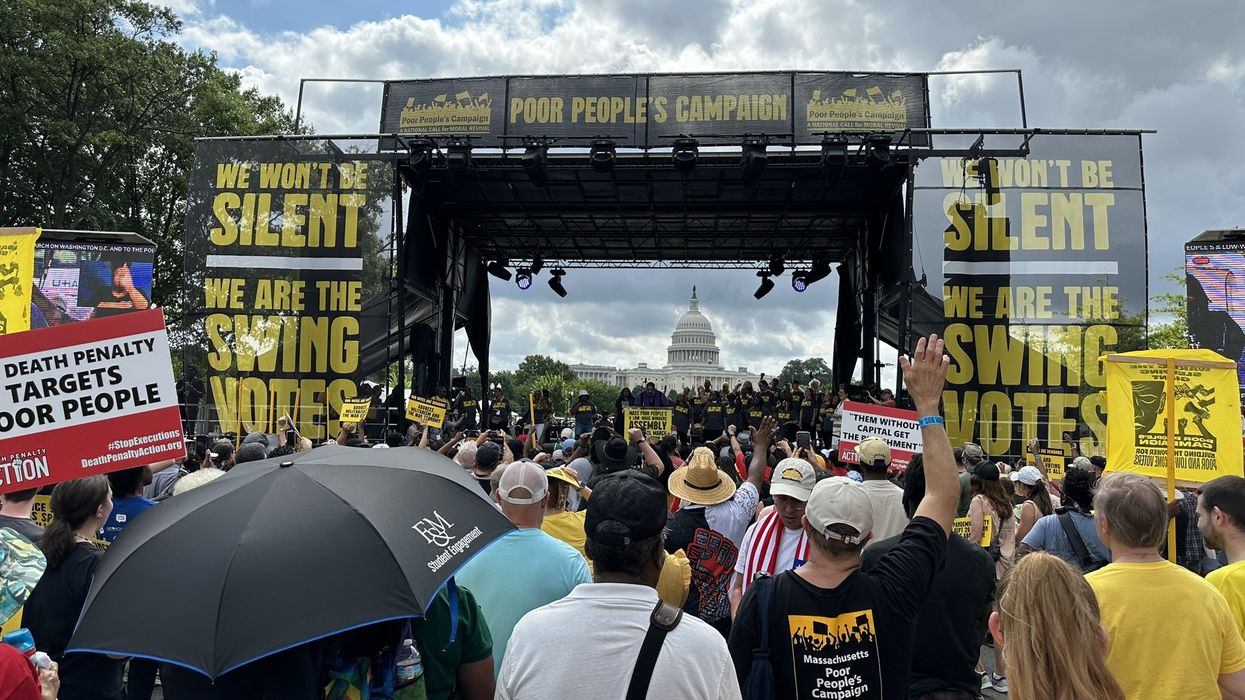
Blessed are those of the people, for the people, and by the people.
Whatever postures our country has projected to the world—shining city on a hill, leader of the free world, model of democracy, the indispensable nation, a rules-based order—all have crumbled like a house of cards. Our country’s failures, however, are deeper and older than the recent election.
The United Nations lowered the U.S. ranking to No. 41 among nations in 2022 due to the extreme gap between the rich and the rest and women’s loss of reproductive freedom. Elsewhere the U.S. ranks as a “flawed democracy” because of its severely fractured society. These ongoing societal failures feed a continuous decline in health, such that we now ranks 48th among 200 countries in life expectancy, while having the largest number by far of billionaires and millionaires compared with other wealthy countries. Corporate lobbies for the weapons industry, fossil fuels, pharmaceuticals, processed foods, etc. dictate our federal government’s priorities while 78% of U.S. people live paycheck to paycheck.
Blessed Is the Poor People’s Campaign: This national campaign in more than 45 states is organized around the needs and demands of the 140 million poor and low-income Americans. Its vision to restructure our society from the bottom up, recognizes “we must… deal with the interlocking injustices of systemic racism, poverty, ecological devastation, and the denial of healthcare, militarism, and the distorted moral narrative of religious nationalism that blames the poor instead of the systems that cause poverty.” Add sexism to that list of injustices.
Blessed is Fair Share Massachusetts, a coalition of labor unions and dozens of community and faith-based organizations that won passage of the Fair Share Amendment in 2022. The constitutional amendment has instituted a 4% surcharge on annual income over $1 million. In 2024 the $1.8 billion accrued from the tax on millionaires provides free school meals; free community college; and funds to invest in roads, bridges, and public transit.
In 1948, the United States signed the Universal Declaration of Human Rights (UDHR), which recognizes adequate housing as one cornerstone of the right to an adequate standard of living. All 27 European Union member states as well as Australia and South Africa institutionalized housing as a human right for their citizens while the United States has not. In every state except Oregon and Wyoming, it can be illegal to be homeless, essentially casting blame on 650,000 adults and over 2 million children for their poverty-stricken homelessness
Blessed is Rosie’s Place, a model to our country of woman-centered humanism. Much more than a shelter, it is a mecca and “a second chance for 12,000 poor and homeless women each year” in Boston. Rosie’s Place was founded on Easter Sunday 1974 in an abandoned supermarket, as the first shelter for women in the country. From providing meals and sanctuary from the streets, it grew into a multi-service community center that offers women emergency shelter and meals plus support and tools to rebuild their lives. Rosie’s offers a food pantry, ESOL classes, legal assistance, wellness care, one-on-one support, housing and job search services, and community outreach. Ninety percent of homeless women have suffered severe physical or sexual abuse at some time in their lives.
Blessed are the nearly 3,000 domestic violence shelters and groups organized throughout the U.S. to provide temporary shelter and help women rebuild their lives, offering legal assistance, counseling, educational opportunities, and multi-services for their children.
A recent Gallup Survey found that the U.S. ranks last among comparable nations in trust of their government and major institutions, including business leaders, journalists and reporters, the medical system, banks, public education, and organized religion—a plunge from top of the list nearly 20 years ago.
Blessed is Hands Across the Hills, a blue-state red-state seven-year effort formed after Donald Trump’s 2016 election to bring together progressive residents in western Massachusetts and more conservative residents of rural eastern Kentucky, for conversations and sometimes intense dialogues about their political and cultural differences. They disputed the idea “that we are hopelessly divided, as a myth sold to us by politicians and mass media, to hide our nation’s all-too-real inequalities.”
Blessed are the peacemakers across dozens of federal agencies, including the military and in communities throughout the country, who challenge, resist, resign, and refuse orders in our flawed hyper-militaristic government. Since the U.S.-enabled genocide in Gaza, more than 250 veterans and active-duty soldiers have become members, respectively, of About Face: Veterans Against the War, Feds for Peace, Service in Dissent, and A New Policy PAC. All have arisen from current and former federal employees aligned with the majority of Americans who want the Israeli-U.S. war on Gaza (now expanded to Lebanon and the West Bank) to end through diplomacy.
Blessed are those of the people, for the people, and by the people—beacons in a country sundered by militarism, rich privilege, origins in slavery and genocide of Native Americans, and persistent inequality for women.
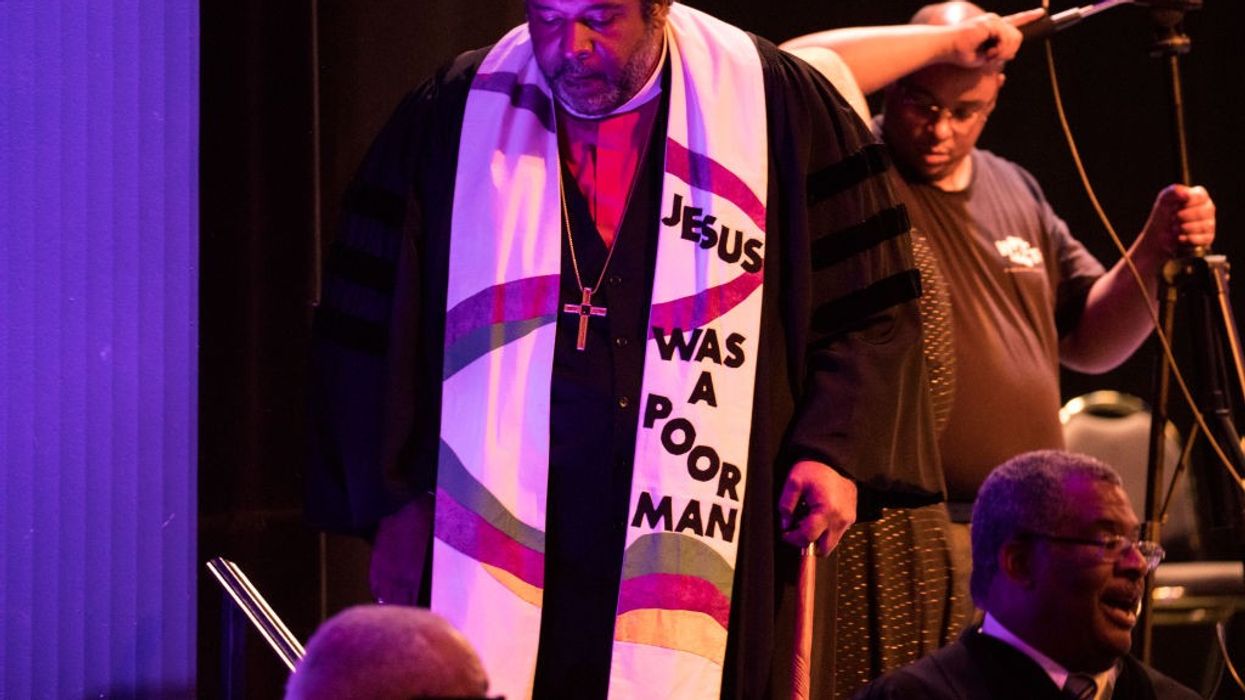
"We should really be talking about how to abolish the majority of poverty, because we know what would happen if we did have serious living minimum wage and healthcare," Barber said.
William Barber, a bishop and co-chair of the Poor People's Campaign, said in an interview published Thursday that U.S. presidential debates, and the race more broadly, was "failing" the poor, whose needs and concerns he said aren't being addressed.
About 38 million people in the U.S. live in poverty, roughly 11.5% of the population, as determined by the federal government. PPC says that one-third of the electorate, or 85 million people, are poor or low-income.
"We're talking about poverty that is not an anomaly among one group of people. But in fact, is across the country, in every community, in every city," Barber told USA Today. "We should really be talking about how to abolish the majority of poverty, because we know what would happen if we did have serious living minimum wage and healthcare."
Both @KamalaHarris & @realDonaldTrump say they want to represent working people. Why not accept @RevDrBarber’s challenge to debate the causes of America’s exceptional poverty & the policies that could end it. https://t.co/TIjUvOof0O
— Jonathan Wilson-Hartgrove (@wilsonhartgrove) October 3, 2024
PPC was inspired by a 1968 movement of the same name organized by Martin Luther King Jr. and led by allies after his assassination. They set up a 3,000-person protest camp on Washington Mall in the spring of that year, staying for six weeks.
Barber, a Black pastor and political organizer from North Carolina, was among those who led the relaunch in 2018—Poor People's Campaign: A National Call for a Moral Revival—which started with demonstrations in Washington, D.C., and at statehouses across the country.
Barber, who recently wrote a book about white poverty, has said that there's a "deafening silence" on the part of the media with regard to economic justice in the U.S.
Barber told USA Today that the debate moderators, as well as the presidential and vice presidential candidates, have failed to address it. He said Tuesday's vice presidential debate should have featured a question on a living minimum wage.
"To not have that as a major question and drill it down and make these candidates answer the question is a failing, we believe of the debate system," Barber said.
The current federal minimum wage is $7.25, set in 2009. Barber has frequently expressed outrage that Congress hasn't acted to raise it in the last 15 years.
In 2021, Sen. Bernie Sanders (I-Vt.) moved to raise the minimum wage to $15, via an amendment to the Covid-19 stimulus package, but all 50 Republican senators and eight members of the Democratic caucus voted it down.
Barber noted that Minnesota Gov. Tim Walz, the Democratic vice presidential nominee, raised the need to expand the child tax credit and for affordable housing in the debate, but said the moderators should have explicitly asked about the needs of poor people.
"I think there's a great failure of the press, of those who planned the debate, and even the politicians themselves, for not putting millions of people at the center of the political debate," Barber said.
Barber in fact recommended a reform to the debate format in which nonpartisan experts lay out facts on an issue before candidates speak—and people who are affected by an issue, rather than professional moderators, ask the questions.
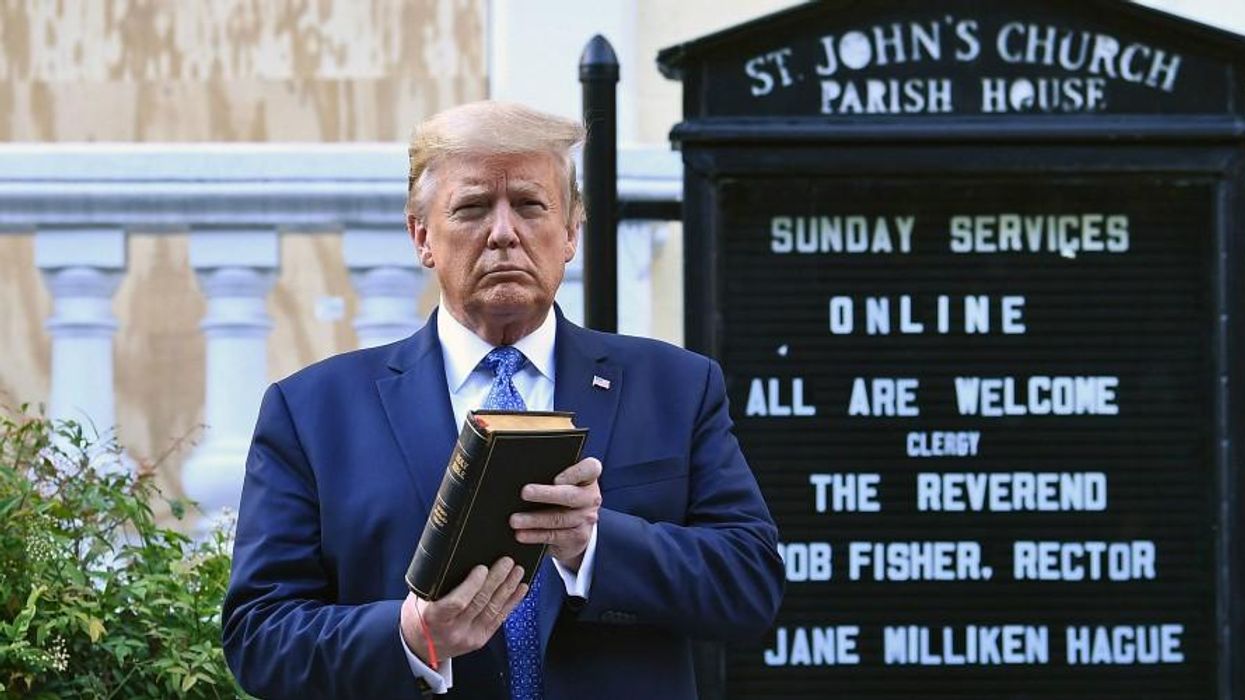
"All those legal fees are apparently really making Donald Trump's pockets hurt because his latest commercial venture, after selling sneakers and cologne, is as a Bible salesman," said one critic.
Critics of former U.S. President Donald Trump on Thursday derided the presumptive 2024 Republican nominee for hawking $60 patriotic-themed Bibles, with one prominent progressive cleric warning that the so-called Good Book "exposes grifters who try to exploit it."
The
God Bless the USA Bible—which is actually a rebranded 9/11 commemorative Bible first offered for sale in 2021 by country musician Lee Greenwood of "God Bless the USA" fame—has been slammed by devout Christians for having an American flag emblazoned on its cover and for containing nationalist documents including the U.S. Constitution, Declaration of Independence, and Pledge of Allegiance.
"You all should get a copy of God Bless the USA Bible," Trump said in a 3-minute video promoting the book—which is not connected with his campaign. "You have to have it for your heart, for your soul."
"Replacing the real Bible with Trump Bibles is a too-perfect symbol of what has happened to evangelical Christianity."
Critics from across the political spectrum slammed what Slate senior writer Amanda Marcotte called Trump's "newest grift to squeeze money out of his cult followers."
"The not-at-all subtle message of the video is that Trump doesn't believe any of this faith-in-God crap, but he definitely believes in using Christian identity as a weapon to make money and dominate his foe," Marcotte wrote.
Bishop William Barber, the founding director of the Center for Public Theology & Public Policy at Yale Divinity School and a co-chair of the Poor People's Campaign,
said on social media that "the prophet Ezekiel named it in his day: Greedy politicians make an unholy alliance with false religion that says God is on their side when God has said no such thing!"
Conservative political commentator Charlie Sykes on Wednesday
blasted Trump for "commodifying the Bible during Holy Week," while former Republican Congresswoman Liz Cheney of Wyoming said that "instead of selling Bibles, you should probably buy one. And read it, including Exodus 20:14."
The volume's release comes during Christian Holy Week, and as Trump struggles to pay a $175 million bond after a New York judge found that he and his company committed massive fraud.
"Religion and Christianity are the biggest things missing from this country," Trump said in the promotional video. "It's one of the biggest problems we have, and it's why our country is going haywire. We've lost religion in our country."
"All Americans need a Bible in their home, and I have many. It's my favorite book," he added. "We must make America pray again."
Some observers noted how Trump used Christianity and the Bible as a prop during his White House tenure, including the time in 2020 when he ordered the violent dispersal of racial justice protesters in the wake of George Floyd's murder by Minneapolis police so he could pose for a photo-op outside a Washington, D.C. church.
Despite facing 91 federal and state criminal charges, Trump is all but certain to secure the 2024 Republican presidential nomination. Christian nationalists have been busily preparing for a second Trump term, in part by drafting Project 2025, which one watchdog described as a "far-right playbook for American authoritarianism."
While his words and deeds may be antithetical to Christian doctrine, Trump is wildly popular among Evangelical Christians.
"Replacing the real Bible with Trump Bibles is a too-perfect symbol of what has happened to evangelical Christianity," Marcotte wrote. "The mistake is in believing Trump's followers are confused or ashamed about their devotion to a godless creep who laughs at true believers. In Trump's hands, the Bible is not a text for prayer and reflection, it's just a weapon. It's much easier to beat people down with a book if it's closed."
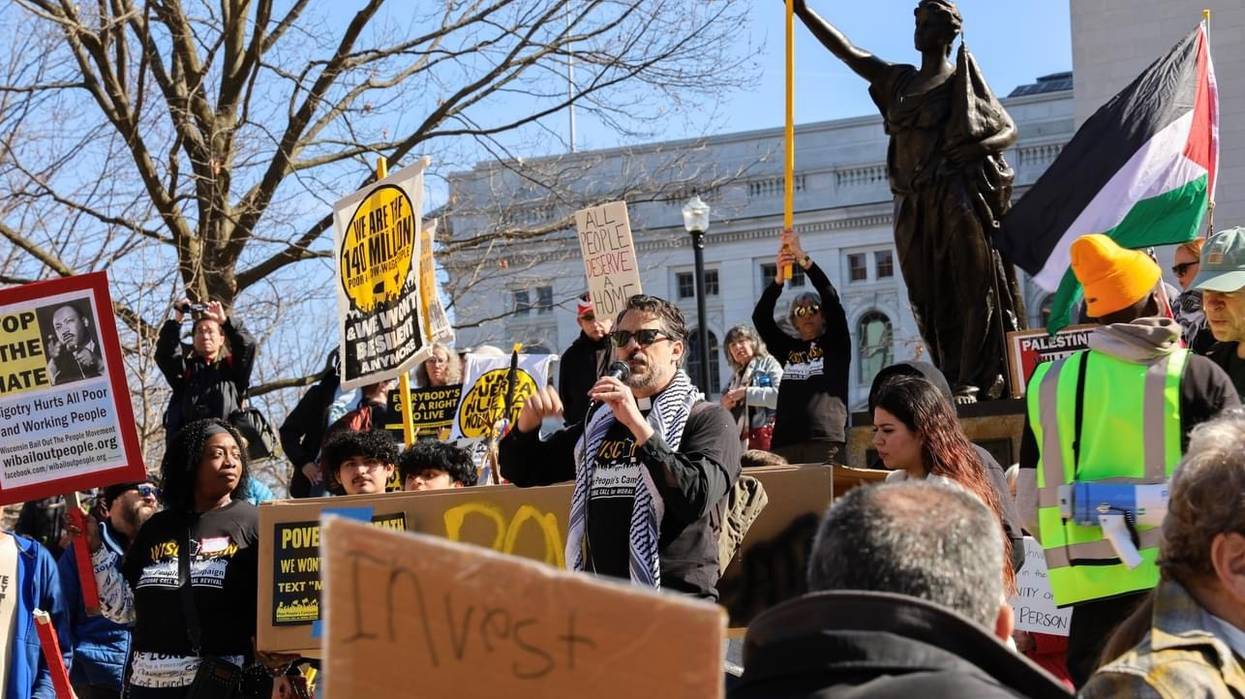
"We are putting politicians in every state on notice," said Rev. Dr. William Barber.
Leaders of the Poor People's Campaign delivered its policy agenda to lawmakers at statehouses across the United States on Monday and warned that if elected representatives don't act, they won't get the votes of low-wage workers who were integral to the defeat of former President Donald Trump four years ago.
Monday's actions, which included visits with state lawmakers from both major parties, were part of a broader 42-week mobilization of poor voters that the Poor People's Campaign announced last month.
"Do not listen to those who say poor and low-wage voters are apathetic about politics or marginal to election outcomes," Rev. Dr. William J. Barber, national co-chair of the Poor People's Campaign, said during a rally in North Carolina over the weekend.
"Poor and low-wage voters have the power to change electoral outcomes up and down the ballot in November," said Barber, pointing to the slim 2020 margins in key battleground states such as Michigan and Arizona. "We are putting politicians in every state on notice: If you want our votes, you must legislate to end the crisis of death by poverty in America."
The agenda that organizers presented to state lawmakers on Monday calls for immediate action to abolish "poverty as the fourth-leading cause of death in the U.S.," end "voter suppression in all its forms," raise minimum wages to a living wage, guarantee healthcare and affordable housing for all, bolster worker protections, and more.
"We are seeing from state houses all over the nation that we will not be silenced or ignored anymore," Von Allen Goodman, tri-chair of the Massachusetts Poor People's Campaign, said during a rally in Boston on Saturday.
"When our politics makes it easier to get a gun than to get food, quality education, living wages, or healthcare, then there's a problem with the soul of our nation."
The Poor People's Campaign estimates that there are around 85 million poor and low-wage eligible voters across the U.S.—roughly 30% of the country's electorate. In 2020, according to a study released by the campaign and its allies, 168 million Americans who voted had an annual household income of less than $50,000.
Research published last year in the Journal of the American Medical Association estimated that a decade or more of uninterrupted poverty is linked to 295,000 deaths per year in the U.S.—roughly 800 deaths per day. That made long-term poverty the country's fourth-leading cause of death in 2019, behind heart disease, cancer, and smoking.
"In our campaign across the country, poor and low-wage allies have decided that we are not accepting the silence from the media and political establishment that ignores 800 daily deaths of poor and low-wealth people," said Barber. "Poverty by America is an abolishable and unnecessary reality that can be eradicated by enacting policies that address the interlocking injustices of systemic racism, systemic poverty, ecological devastation and the denial of healthcare, militarism, and the false moral narrative of religious nationalism."
"When our politics makes it easier to get a gun than to get food, quality education, living wages, or healthcare," he added, "then there's a problem with the soul of our nation."
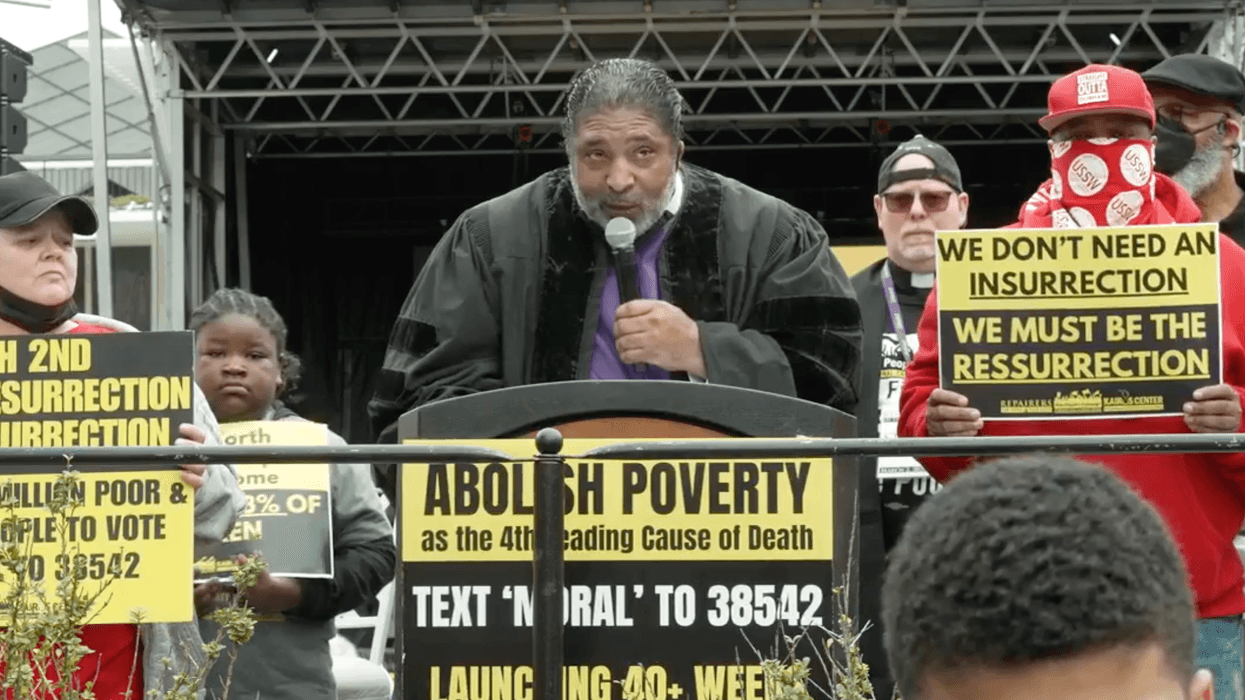
"Our government's refusal to fully address poverty and low wages even after the worst days of Covid is not only killing our brothers and sisters," said Rev. Dr. William Barber. "It's killing our public conscience."
Low-wage workers, faith leaders, and allies rallied in state capitals across the United States on Saturday as part of a mass mobilization of poor voters ahead of the pivotal 2024 election.
The nationwide demonstrations were organized by the Poor People's Campaign, a multiracial movement calling on state legislators and members of the U.S. Congress to act immediately to end the "crisis of death by poverty" in the richest country in the world. Research published last year found that poverty is the fourth-leading cause of death in the United States.
Thousands gathered and marched Saturday in 32 states—from Maine to Indiana to North Carolina—and Washington, D.C., carrying signs that read "abolish poverty" and "our votes are demands." In South Carolina and other states, activists placed mock coffins on the steps of state Capitol buildings as they demanded living wages, stronger workplace protections, and universal healthcare.
William J. Barber, national co-chair of the Poor People's Campaign, said during a demonstration in Raleigh that "the low-wage voices you hear today are living testimony... telling their stories, crying out against the forces of death."
"Our government's refusal to fully address poverty and low wages even after the worst days of Covid is not only killing our brothers and sisters," added Barber. "It's killing our public conscience."
Eric Winston, a member of the Union of Southern Service Workers and a catering cook for a minor league baseball team, told the crowd in Raleigh that he's "tired of working low-wage jobs over and over thinking just working hard would get me what I need."
"I'm tired of working 70 to 80 hours a week and still not having money for the necessity of bills," said Winston. "I'm tired of getting sick and not being able to go see the doctor."
"I organize today because I'm sick and tired of fighting by myself. There's more people in my situation who may not look like me but go through the same struggles as I do," Winston continued. "As working people, we should only vote for politicians who support the rights of workers. Period."
In Columbus, Rev. Dr. Jack Sullivan noted during remarks from the steps of Ohio's Capitol building that long-term poverty kills more than 800 people per day in the United States.
"I have to believe that if 800 politicians were to die every day, if 800 CEOs were to die every day, there would be congressional hearings, Senate subcommittee gatherings, documentation to prevent the tragic deaths of those leaders," said Sullivan. "How 'bout some documentation to prevent the tragic deaths of the poor!"
The nationwide rallies came after the Poor People's Campaign launched a 42-week mobilization of low-income voters who were critical in defeating former President Donald Trump in 2020.
"There are approximately 85 million poor and low-wage eligible voters in this country who represent at least 30% of the electorate. In so-called battleground states, it's close to and over 40%," the campaign said ahead of Saturday's demonstrations. "High percentages of poor and low-wage voters don't vote because politicians fail to enact policies or address the issues that affect their lives."
On March 4, advocates with the Poor People's Campaign are planning to gather at legislative offices in state capitals across the U.S. to deliver a "package to legislators on both sides of the political aisle documenting the conditions poor people are facing in their state and the bold actions that can be taken to address these crises."
"It is not a mistake that we are meeting here before the State of the Union address in Congress, because we intend to drive this issue right into the heart of our politics," Barber said Saturday. "Two hundred and ninety-five thousand people will die this year and have died every year for the last few years from poverty. That's on our own front door."
"Nobody ever calls their name," said Barber. "Nobody challenges this political violence."

The opportunity costs of throwing endless trillions of dollars at the military means far less is invested in other crucial American needs, ranging from housing and education to public health and environmental protection.
Joe Biden wants you to believe that spending money on weapons is good for the economy. That tired old myth—regularly repeated by the political leaders of both parties—could help create an even more militarized economy that could threaten our peace and prosperity for decades to come. Any short-term gains from pumping in more arms spending will be more than offset by the long-term damage caused by crowding out new industries and innovations, while vacuuming up funds needed to address other urgent national priorities.
The Biden administration’s sales pitch for the purported benefits of military outlays began in earnest last October, when the president gave a rare Oval Office address to promote a $106-billion emergency allocation that included tens of billions of dollars of weaponry for Ukraine, Israel, and Taiwan. MAGA Republicans in Congress had been blocking the funding from going forward and the White House was searching for a new argument to win them over. The president and his advisers settled on an answer that could just as easily have come out of the mouth of Donald Trump: jobs, jobs, jobs. As Joe Biden put it:
We send Ukraine equipment sitting in our stockpiles. And when we use the money allocated by Congress, we use it to replenish our own stores… equipment that defends America and is made in America: Patriot missiles for air defense batteries made in Arizona; artillery shells manufactured in 12 states across the country—in Pennsylvania, Ohio, Texas; and so much more.
It should be noted that two of the four states he singled out (Arizona and Pennsylvania) are swing states crucial to his reelection bid, while the other two are red states with Republican senators he’s been trying to win over to vote for another round of military aid to Ukraine.
Lest you think that Biden’s economic pitch for such aid was a one-off event, Politico reported that, in the wake of his Oval Office speech, administration officials were distributing talking points to members of Congress touting the economic benefits of such aid. Politico dubbed this approach “Bombenomics.” Lobbyists for the administration even handed out a map purporting to show how much money such assistance to Ukraine would distribute to each of the 50 states. And that, by the way, is a tactic companies like Lockheed Martin routinely use to promote the continued funding of costly, flawed weapons systems like the F-35 fighter jet. Still, it should be troubling to see the White House stooping to the same tactics.
Yes, it’s important to provide Ukraine with the necessary equipment and munitions to defend itself from Russia’s grim invasion, but the case should be made on the merits, not through exaggerated accounts about the economic impact of doing so. Otherwise, the military-industrial complex will have yet another never-ending claim on our scarce national resources.
The official story about military spending and the economy starts like this: The massive buildup for World War II got America out of the Great Depression, sparked the development of key civilian technologies (from computers to the internet), and created a steady flow of well-paying manufacturing jobs that were part of the backbone of America’s industrial economy.
There is indeed a grain of truth in each of those assertions, but they all ignore one key fact: The opportunity costs of throwing endless trillions of dollars at the military means far less is invested in other crucial American needs, ranging from housing and education to public health and environmental protection. Yes, military spending did indeed help America recover from the Great Depression but not because it was military spending. It helped because it was spending, period. Any kind of spending at the levels devoted to fighting World War II would have revived the economy. While in that era, such military spending was certainly a necessity, today similar spending is more a question of (corporate) politics and priorities than of economics.
It’s long past time for a reckoning about what kinds of investments truly make Americans safe and economically secure—a bloated military budget or those aimed at meeting people’s basic needs.
In these years Pentagon spending has soared and the defense budget continues to head toward an annual trillion-dollar mark, while the prospects of tens of millions of Americans have plummeted. More than 140 million of us now fall into poor or low-income categories, including one out of every six children. More than 44 million of us suffer from hunger in any given year. An estimated 183,000 Americans died of poverty-related causes in 2019, more than from homicide, gun violence, diabetes, or obesity. Meanwhile, ever more Americans are living on the streets or in shelters as homeless people hit a record 650,000 in 2022.
Perhaps most shockingly, the United States now has the lowest life expectancy of any industrialized country, even as the International Institute for Strategic Studies reports that it now accounts for 40% of the world’s—yes, the whole world’s!—military spending. That’s four times more than its closest rival, China. In fact, it’s more than the next 15 countries combined, many of which are U.S. allies. It’s long past time for a reckoning about what kinds of investments truly make Americans safe and economically secure—a bloated military budget or those aimed at meeting people’s basic needs.
What will it take to get Washington to invest in addressing non-military needs at the levels routinely lavished on the Pentagon? For that, we would need presidential leadership and a new, more forward-looking Congress. That’s a tough, long-term goal to reach, but well worth pursuing. If a shift in budget priorities were to be implemented in Washington, the resulting spending could, for instance, create anywhere from 9% more jobs for wind and solar energy production to three times as many jobs in education.
As for the much-touted spinoffs from military research, investing directly in civilian activities rather than relying on a spillover from Pentagon spending would produce significantly more useful technologies far more quickly. In fact, for the past few decades, the civilian sector of the economy has been far nimbler and more innovative than Pentagon-funded initiatives, so—don’t be surprised—military spinoffs have greatly diminished. Instead, the Pentagon is desperately seeking to lure high-tech companies and talent back into its orbit, a gambit which, if successful, is likely to undermine the nation’s ability to create useful products that could push the civilian sector forward. Companies and workers who might otherwise be involved in developing vaccines, producing environmentally friendly technologies, or finding new sources of green energy will instead be put to work building a new generation of deadly weapons.
In recent years, the Pentagon budget has approached its highest level since World War II: $886 billion and counting. That’s hundreds of billions more than was spent in the peak year of the Vietnam War or at the height of the Cold War. Nonetheless, the actual number of jobs in weapons manufacturing has plummeted dramatically from 3 million in the mid-1980s to 1.1 million now. Of course, a million jobs is nothing to sneeze at, but the downward trend in arms-related employment is likely to continue as automation and outsourcing grow. The process of reducing arms industry jobs will be accelerated by a greater reliance on software over hardware in the development of new weapons systems that incorporate artificial intelligence. Given the focus on emerging technologies, assembly line jobs will be reduced, while the number of scientists and engineers involved in weapons-related work will only grow.
In addition, as the journalist Taylor Barnes has pointed out, the arms industry jobs that do remain are likely to pay significantly less than in the past, as unionization rates at the major contractors continue to fall precipitously, while two-tier union contracts deny incoming workers the kind of pay and benefits their predecessors enjoyed. To cite two examples: In 1971, 69% of Lockheed Martin workers were unionized, while in 2022 that number was 19%; at Northrop Grumman today, a mere 4% of its employees are unionized. The very idea that weapons production provides high-paying manufacturing jobs with good benefits is rapidly becoming a thing of the past.
More and better-paying jobs could be created by directing more spending to domestic needs, but that would require a dramatic change in the politics and composition of Congress.
Members of Congress and the Washington elite continue to argue that the U.S. military is this country’s most effective anti-poverty program. While the pay, benefits, training, and educational funding available to members of that military have certainly helped some of them improve their lot, that’s hardly the full picture. The potential downside of military service puts the value of any financial benefits in grim perspective.
Many veterans of America’s disastrous post-9/11 wars, after all, risked their physical and mental health, not to speak of their lives, during their time in the military. After all, 40% of veterans of the Iraq and Afghan wars have reported service-related disabilities. Physical and mental health problems suffered by veterans range from lost limbs to traumatic brain injuries to post-traumatic stress syndrome (PTSD). They have also been at greater risk of homelessness than the population as a whole. Most tragically, four times as many veterans have committed suicide as the number of military personnel killed by enemy forces in any of the U.S. wars of this century.
The toll of such disastrous conflicts on veterans is one of many reasons that war should be the exception, not the rule, in U.S. foreign policy.
And in that context, there can be little doubt that the best way to fight poverty is by doing so directly, not as a side-effect of building an increasingly militarized society. If, to get a leg up in life, people need education and training, it should be provided to civilians and veterans alike.
Federal efforts to address the problems outlined above have been hamstrung by a combination of overspending on the Pentagon and the unwillingness of Congress to more seriously tax wealthy Americans to address poverty and inequality. (After all, the wealthiest 1% of us are now cumulatively worth more than the 291 million of us in the “bottom” 90%, which represents a massive redistribution of wealth in the last half-century.)
The tradeoffs are stark. The Pentagon’s annual budget is significantly more than 20 times the $37 billion the government now invests annually in reducing greenhouse gas emissions as part of the Inflation Reduction Act. Meanwhile, spending on weapons production and research alone is more than eight times as high. The Pentagon puts out more each year for one combat aircraft—the overpriced, underperforming F-35—than the entire budget of the Centers for Disease Control and Prevention. Meanwhile, one $13 billion aircraft carrier costs more to produce than the annual budget of the Environmental Protection Agency. Similarly, in 2020, Lockheed Martin alone received $75 billion in federal contracts and that’s more than the budgets of the State Department and the Agency for International Development combined. In other words, the sum total of that company’s annual contracts adds up to the equivalent of the entire U.S. budget for diplomacy.
If current trends continue, the military economy will only keep on growing at the expense of so much else we need as a society, exacerbating inequality, stifling innovation, and perpetuating a policy of endless war.
Simply shifting funds from the Pentagon to domestic programs wouldn’t, of course, be a magical solution to all of America’s economic problems. Just to achieve such a shift in the first place would, of course, be a major political undertaking and the funds being shifted would have to be spent effectively. Furthermore, even cutting the Pentagon budget in half wouldn’t be enough to take into account all of this country’s unmet needs. That would require a comprehensive package, including not just a change in budget priorities but an increase in federal revenues and a crackdown on waste, fraud, and abuse in the outlay of government loans and grants. It would also require the kind of attention and focus now reserved for planning to fund the military.
One comprehensive plan for remaking the economy to better serve all Americans is the moral budget of the Poor People’s Campaign, a national movement of low-income people inspired by the 1968 initiative of the same name spearheaded by the Reverend Martin Luther King, Jr., before his assassination that April 4. Its central issues are promoting racial justice, ending poverty, opposing militarism, and supporting environmental restoration. Its moral budget proposes investing more than $1.2 trillion in domestic needs, drawn from both cuts to Pentagon spending and increases in tax revenues from wealthy individuals and corporations. Achieving such a shift in American priorities is, at best, undoubtedly a long-term undertaking, but it does offer a better path forward than continuing to neglect basic needs to feed the war machine.
If current trends continue, the military economy will only keep on growing at the expense of so much else we need as a society, exacerbating inequality, stifling innovation, and perpetuating a policy of endless war. We can’t allow the illusion—and it is an illusion!—of military-fueled prosperity to allow us to neglect the needs of tens of millions of people or to hinder our ability to envision the kind of world we want to build for future generations. The next time you hear a politician, a Pentagon bureaucrat, or a corporate functionary tell you about the economic wonders of massive military budgets, don’t buy the hype.
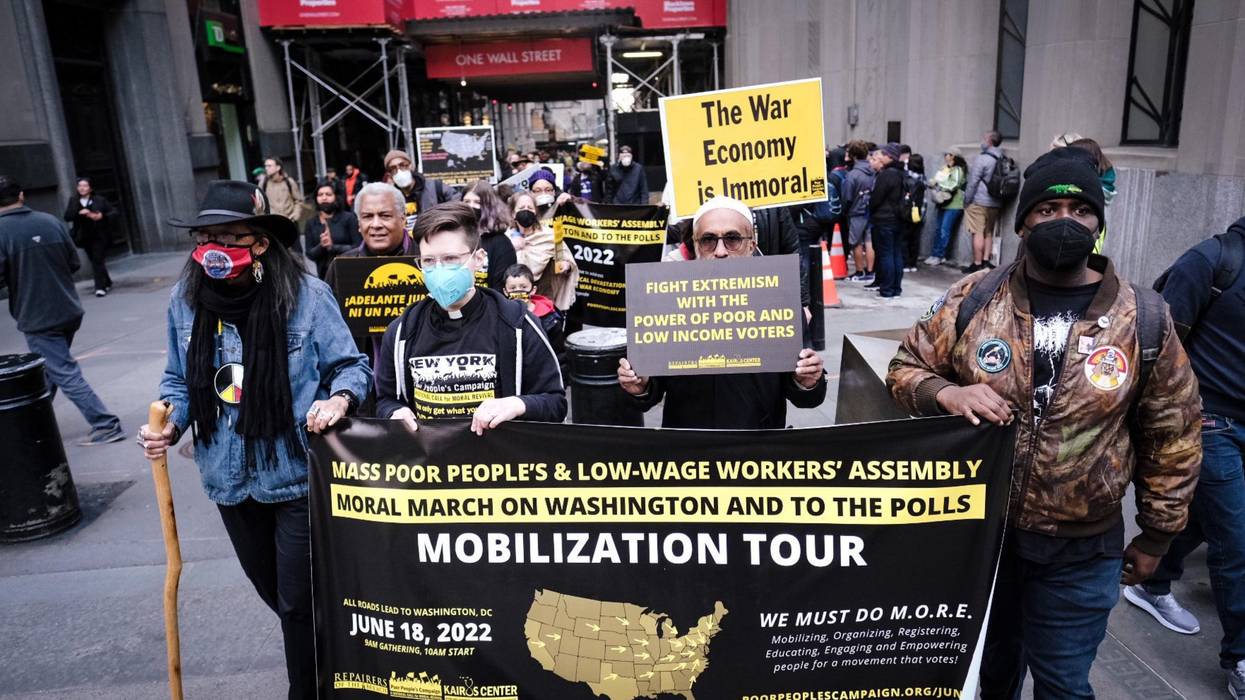
Growing up corporate conditioned by the omnipresent values of aggressive commercialism over civic and democratic values is the lot of people indentured to choiceless lives shaped by merciless corporatism.
A teacher once said to me: “A society pays for what it values.” If so, our society values commercial entertainment, including spectator sports, orders of magnitude more than it values civics defined as the rights and duties exercised by citizens in a democracy.
What if we lived in a society that valued both equally?
1. Possibly the most visible event would be an annual Academy of Civic Heroes Awards viewed by tens of millions of people. The glitter would shine not on the winner’s wardrobes, but on their victories of justice and on their groundbreaking documentaries, books, and features. The acceptance remarks would not be gushing flurries of thank yous, but concise evocations of their hard-earned struggles for, and portrayals of, a just society.
2. The school curriculum in our elementary, secondary, and higher education institutions would provide academic parity for civics and civic skills with courses on business and science, technology, engineering, and mathematics (STEM).
Regular civic engagement makes a democracy function productively and presciently for its citizenry and its posterity. Markets would be our servants, not our masters.
3. The media would provide significant space and time for citizen activities as they do for sports and the arts and movies. Presently The New York Times has a daily special Arts Section but not a special civic activity section. You know how much space is devoted to sports in the Times. Even NPR and PBS networks are heavy on entertainment and hardly feature any civic leaders or doers, whether to interview (they prefer to interview themselves or academics) or to report local or national civic actions.
4. Celebrities attract audiences and supporters. The media creates entertainment and sports celebrities. Except for a few years in the 1960s and 1970s, the media rarely highlights emerging civic leaders or their proven achievements. Therefore, these priceless advocates have difficulty attracting audiences or supporters.
5. We would celebrate anniversaries, in a broader fashion, beyond those remembering wars or other major acts of violence, natural disasters, or revered presidents. Apart from the holiday in honor of citizen Martin Luther King, Jr., little is formally remembered of the citizen leaders who built the edifices of justice for our country—for instance in the abolition of slavery, voting rights for women, and livelihoods and dignity rights for workers and farmers. Sure, they are sometimes mentioned in textbooks without much context or drama—but how many national civic leaders do you know in America today? They’re not covered on the degraded television or radio evening news.
6. The number of civic lobbyists would far outnumber those pressing for corporate privileges. Instead, companies from the drug, oil and gas, and Silicon Valley businesses swarm over Capitol Hill with their promises of campaign money.
7. Parity would mean that big radio stations like WTOP in Washington, D.C. (news, weather, and sports) could devote time to local civic activities as it does by giving free advertisements to opening businesses or movies. Business and entertainment have their slots by the hour or day while civic conferences and marches (as with “Poor People’s Campaign”) are regularly ignored.
As is routine with these stations, WTOP declined to mention or report the most expansive convention in American history of civic leaders, doers, and thinkers over six days at the Constitution Hall in 2016. None of the 161 stalwart presenters, except Patti Smith, were athletes or entertainers.
8. Just as there is regular data on the number of engineers, scientists, accountants, and others, there would be data on how many full-time citizens there are and how many are graduating with a major in “civil practice” (which does not exist, with very few exceptions).
9. Just as famous athletes’ and other entertainers’ clothing, equipment, and autographs are selling for big money in the collectibles market, societal parity would have similar markets for citizen advocacy memorabilia which could help raise needed funds.
10. Parity of fundraising or investment would mean hundreds of billions of dollars raised to fund tens of thousands of full-time civic groups—local, state and, national—having a seat at the table where important decisions are now being made unilaterally, often in secret, by the few for the many. Civic society monies would pay for democracy’s own media—TV, radio, newspapers, magazines, and social media, owned and used by the people, not beholden to commercial advertisers.
There would be legions of knowledgeable, full-time civic communicators and advocates taking knowledge to action that addresses the many serious perils—some rising to omnicidal levels (see my January 12, 2024, column: “Five Omnicides Facing Our Unprepared World”)—that are now worsening and being ignored by a plutocratic and oligarchic corporate state.
As they do now for Wall Street and Silicon Valley riches, the young would rush to strengthen and lift up the structures of justice—“Justice is the great interest of man on earth,” as Daniel Webster asserted. Regular civic engagement makes a democracy function productively and presciently for its citizenry and its posterity. Markets would be our servants, not our masters.
Alas, growing up corporate conditioned by the omnipresent values of aggressive commercialism over civic and democratic values is the lot of people indentured to choiceless lives shaped by merciless corporatism.
As corporations are increasingly raising our screen-addicted children by harmful direct marketing undermining parental authority and knowledge day after day, more and more people, regardless of their political labels, are realizing that this can no longer be tolerated. The people of good will and the tools of democratic transformation are available or attainable but mostly latent in our existing civic institutions.
My small example-rich paperback—Breaking Through Power: Its Easier Than We Think (City Lights, 2016) will encourage you to champion civic values.
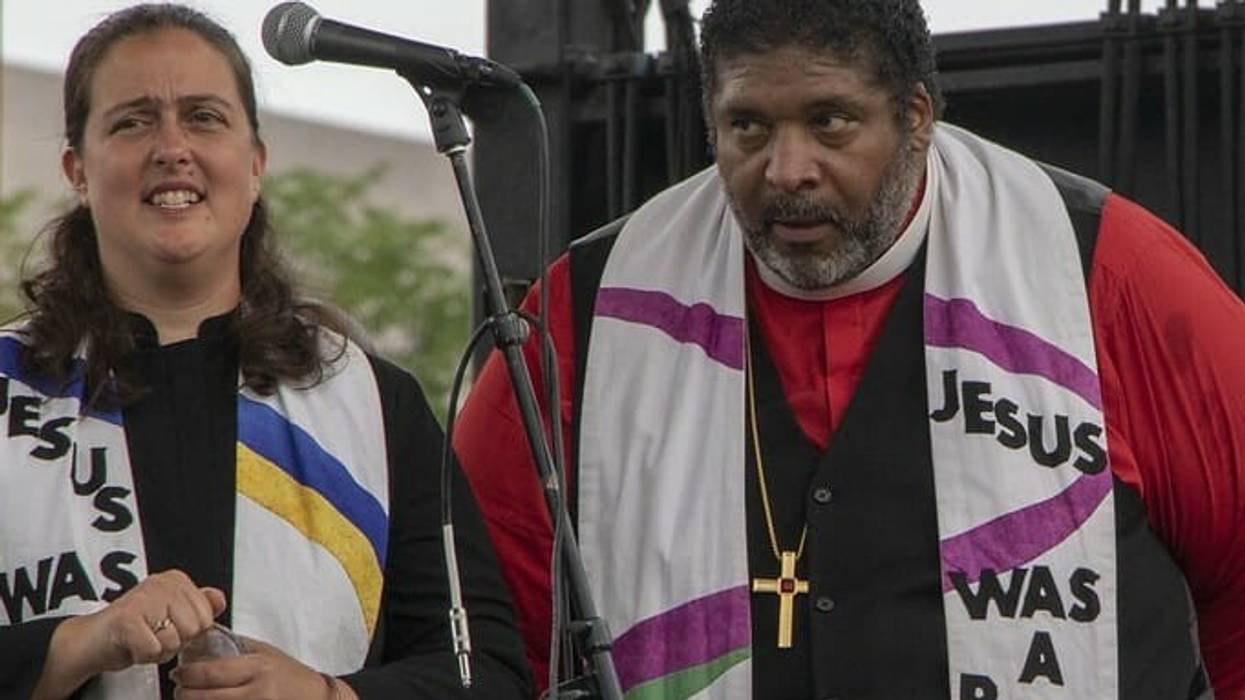
The anti-poverty organizer and civil rights leader has brought this chair with him everywhere, from Yale to jail, from Broadway to the Vatican to the White House, without any issues. But at a movie theatre in Greenville, North Carolina there was a problem.
Bishop William Barber is taking a stand, after being denied a place to sit down. It happened on the day after Christmas.
Barber is a renowned civil rights activist, co-chair of the Poor People’s Campaign, a theologian and preacher. He’s a Yale Professor and Founding Director of the Center for Public Theology and Public Policy at Yale Divinity School, and, for almost 30 years, was Pastor of Greenleaf Christian Church in Goldsboro, NC.
Barber’s 90-year-old mother wanted to spend Christmas with him. They planned to go see the just-released remake of The Color Purple, the 1985 film based on the Pulitzer Prize-winning novel by Alice Walker. They drove to the AMC Theater in Greenville. That’s when his problem began.
In a news conference days later, Barber, whose typically thunderous oratory has been likened to that of Martin Luther King, Jr., choked up as he described what happened:
“We had to come to Greenville because you all know in eastern North Carolina there ain’t a whole lot of theaters, in our small rural towns like Roper, and Piney Woods, and Jamesville and Bertie, and Chocowinity, Plymouth. We went to enjoy the music and the story of that movie of triumph over adversity…the movie was a gift to my mother who came to North Carolina as a federal government administrative professional in the 1960s to help integrate public schools with my father who was asked to come here by EV Wilkins, the former principal of what was then the all black Union School in Roper, North Carolina. Going to this movie this week was supposed to be a gift to me, and a gift to her.”
Barber’s younger brother died of pancreatic cancer several years ago, making him an only son again, so time with his mother was that much more important. Barber described his struggle with his own disability:
“For more than 30 years now, I’ve suffered from a form of arthritis. This is rare, but one of the most dangerous. debilitating forms called ankylosing spondylitis…I’m walking now with two canes, I have to carry a high chair with me everywhere I go… I cannot begin to sit in a low chair nor rise from a low position.”
Managers at the AMC theater in Greenville, North Carolina told Barber that he could not use his special chair in the theater. They called armed security and the police and had Bishop Barber removed.
Barber saw purple – just not The Color Purple.
“I think about all the other people in the world, people who don’t get up and try to enjoy public accommodation, because of their fear. The law says you have to reasonably accommodate. There was no attempt to accommodate, there was an attempt to say no, period, end of story. You’re not coming in,” said Barber on the Democracy Now! news hour. Barber has brought this chair with him everywhere, from Yale to jail, from Broadway to the Vatican to the White House, without any issues.
The 1990 Americans with Disabilities Act, the ADA, bans discrimination against differently-abled people in employment; bans discrimination by state and local government (a similar ban in federal facilities and federally-funded programs preceded the ADA); in public places like movie theaters and restaurants; and requires websites to be accessible.
Yet, more than 33 years after the ADA was passed and signed into law by Republican President George H.W. Bush, differently-abled people still face discrimination and exclusion on a daily basis.
“Of all the things we have to be fighting at this time of war, anti-semitism, Islamophobia, homophobia, of fight for voting rights, the fight for living wages, the fight for health care, that these two would choose to fight me, to fight somebody who has a visible disability, and saying no to me going in and watching a movie that’s about triumph and family, which is why my mother really wanted to see it on that day.”
It’s ironic that Bishop Barber would suffer discrimination attempting to take his mother, herself a civil rights activist, to see The Color Purple, a story that plumbs the experiences of Black people in the Jim Crow South in the early decades of the 20th century – experiences that shaped Barber and his family.
But Barber is an organizer. Following the incident, Adam Aron, the CEO of AMC Theaters, the world’s largest movie theater chain, flew to Greenville to meet with him. Barber says the conversation has just begun.
“This is about what systemic changes and policy changes to training need to be done to ensure this happens to no one,” the bishop said at his news conference. “AMC should mean this when somebody says ‘AMC’: I know they will Accommodate Me Caringly.”
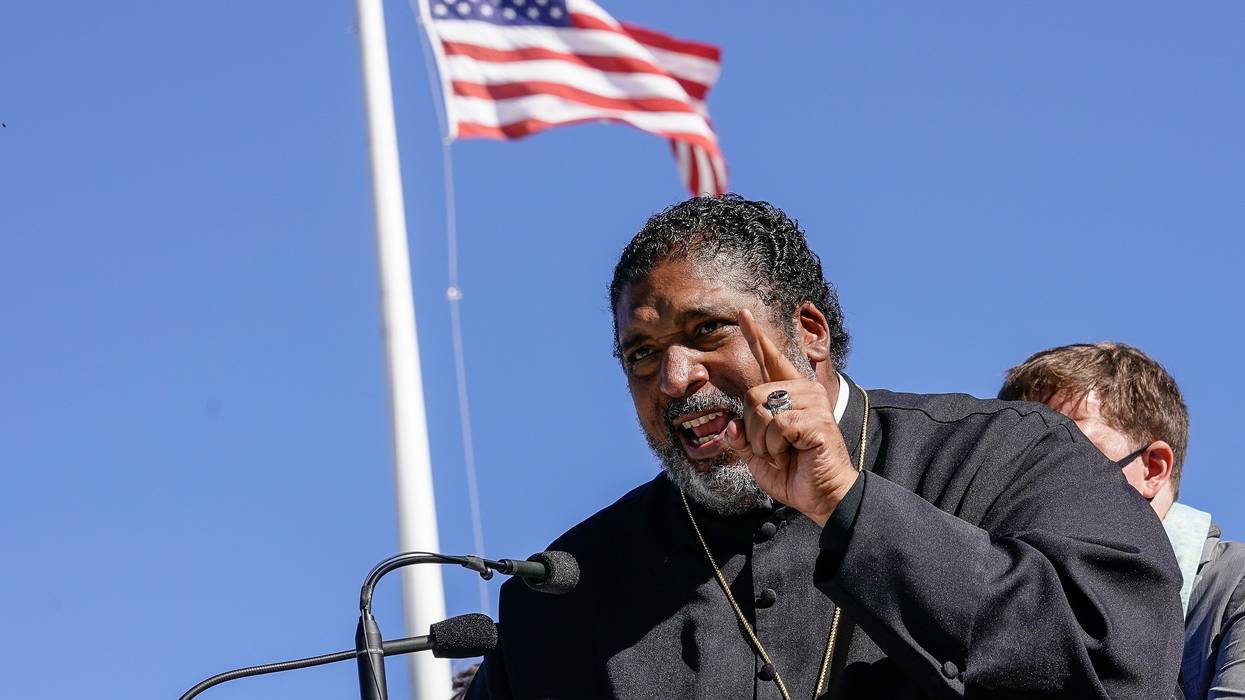
"We will not allow the clock to be turned back on our democracy, for our hard-fought gains to vanish, or for our children to have less democracy, less rights, less environmental justice than we do today."
Bishop William J. Barber II, Repairers of the Breach, and the North Carolina Poor People's Campaign joined advocates, impacted people, and interfaith clergy members this week for a letter demanding state lawmakers "cease and desist" from attacks on the poor.
"In honor of all those who have given their lives to secure and protect the sacred right to vote, we are delivering a moral indictment of your cynical priorities and immoral policies," the coalition wrote to the Republican-controlled North Carolina General Assembly just after the 58th anniversary of the passage of the federal Voting Rights Act of 1965.
"Instead of addressing the crises of poverty and low wages, lack of healthcare, underfunded public education, voter suppression, and environmental collapse," says the coalition's open letter to North Carolina legislators, "you have chosen to use 'culture wars' that engender hate to camouflage and distract from your true agenda."
"Your deceptive and deadly attacks aimed against Black and civil rights history, women, the LGBTQ+ community, immigrants, students, teachers, and everyday North Carolinians, while ensuring more access to guns promotes a devastating agenda that hurts all of us," the coalition continued. "And you are doing this at a time when poverty is the fourth leading cause of death in this nation, more than gun violence, obesity, homicide, and diabetes, in the richest nation in the world."
"The lack of willingness from state officials to create a democracy where its constituents have an equal and fair opportunity to vote, access to universal healthcare, educational opportunities, justice and public safety, is morally and constitutionally offensive and a sign of your fear of the people."
Democratic North Carolina Gov. Roy Cooper has worked to block some policies of far-right lawmakers, but Republicans have had veto-proof majorities in the state House and Senate since April, when Rep. Tricia Cotham—elected by the voters of District 112 as a Democrat—joined the GOP, enabling further attacks on election rules, LGBTQ+ rights, reproductive freedom, public education, and more.
Meanwhile, as the new letter notes, in North Carolina, over 4 million residents are poor or low-income, nearly 2 million earn under $15 an hour, more than 1 million lack health insurance, and average household debt rose 6% last year to an average of $56,590.
Five weeks after the start of the new fiscal year, the letter calls out North Carolina lawmakers for not providing pay raises for teachers and public employees and declining to fund expanded healthcare coverage while plotting to dump millions of dollars into private school vouchers and engaging in "failed and flawed trickle-down economics in the state, giving millions in dollars to the wealthy and corporations."
The letter cites portions of the state constitution and features specific demands for policies on voting rights, living wages, the right to form and join a union, gun control, healthcare, criminal justice, public schools, environmental justice, and LGBTQ+ and immigrant communities.
"At a time when ending poverty is within our grasp, we cannot and will not continue to allow the elected leaders of this state to blatantly ignore the rights of the people who put them in office," the coalition declared. "We will not allow the clock to be turned back on our democracy, for our hard-fought gains to vanish, or for our children to have less democracy, less rights, less environmental justice than we do today."
"The lack of willingness from state officials to create a democracy where its constituents have an equal and fair opportunity to vote, access to universal healthcare, educational opportunities, justice and public safety, is morally and constitutionally offensive and a sign of your fear of the people," the letter adds. "Our call today will be a part of ushering in a new era in North Carolina of revived leadership and moral vision guided by our greatest ethical and constitutional teachings. We believe, together, that this generation can finally realize the promise of a Third Reconstruction and equal protection under the law for all North Carolinians."
A statement announcing the letter points out that it "comes just months after Bishop Barber, faith communities, low-wage workers, and advocacy groups were blocked by metal barricades from entering the North Carolina Statehouse to mark the 10th anniversary and recommitment of the Moral Monday movement and to deliver a warning to North Carolina's newly minted supermajority that it must use its newfound power to uplift the people of the state."
Reflecting on a decade of the Moral Monday movement around that anniversary in April, Barber told Durham-based Indy Week that "even when the extremists led the General Assembly, we proved that you don't have to just sit down and take it, that you can continue to stand and to struggle and cry and fight together."
"On the 10th anniversary, we are not just having an anniversary; we are having a recommitment," he added. "Because even with all that has been done, North Carolina still has over 4 million people who are poor and low-wealth. North Carolina still is not paying people a living wage of at least $15 an hour. So we still have work to do."